Asia
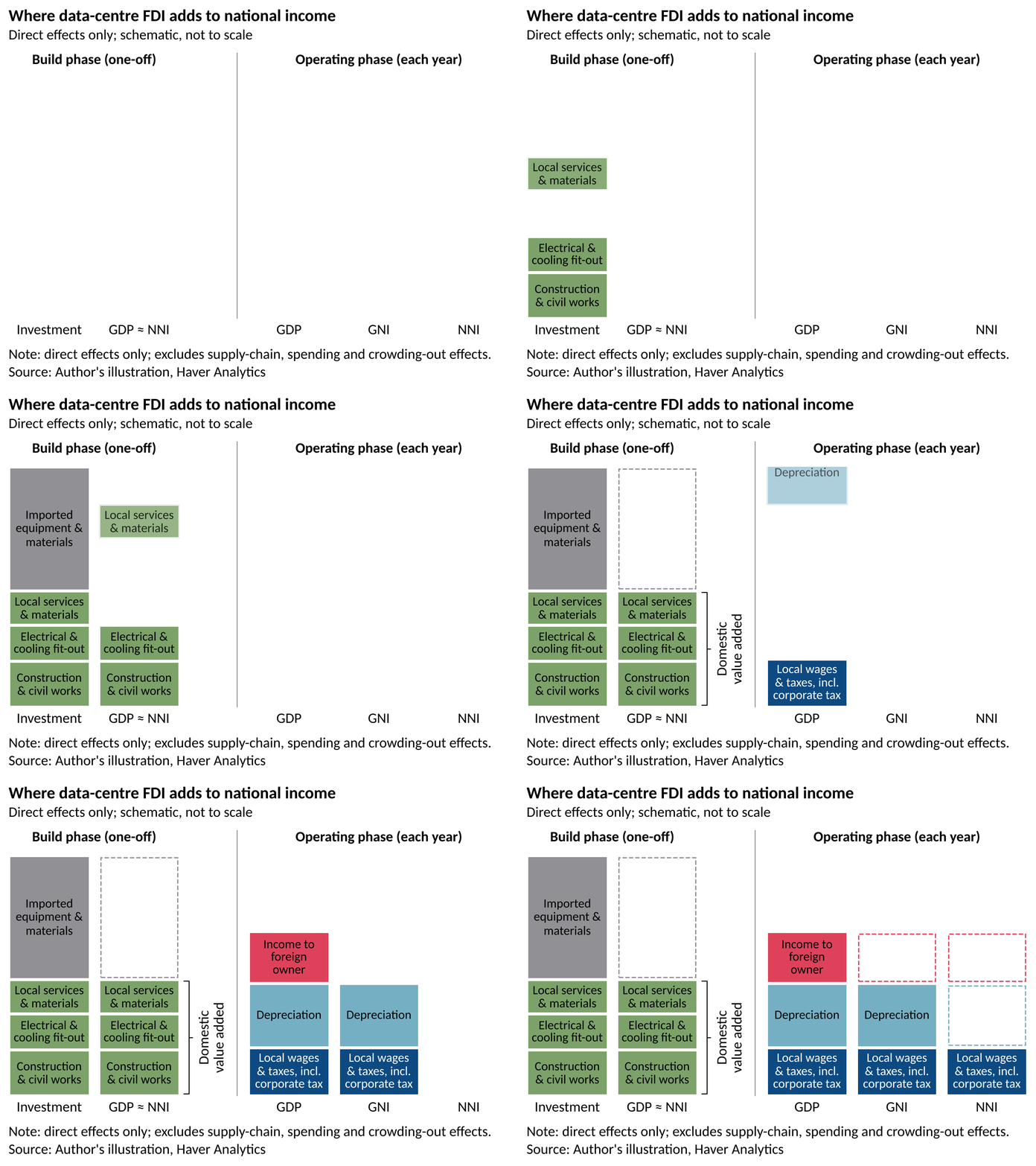
In this week’s Letter, we look at Southeast Asia’s race to host the data centres behind the AI boom, and at how much of the gain stays at home. Asia already anchors the AI hardware supply chain, from Taiwan’s chip fabrication to South Korea’s memory, while Southeast Asia has centred on packaging, testing and assembly (chart 1). The region is now moving to the final stage: hosting the computing capacity itself. Malaysia offers the clearest example. National growth held above 5% in 2024 and 2025, but Johor grew 8.0% last year as its services sector expanded 9.9% (chart 2). Foreign direct investment underpins the boom, with Malaysia’s FDI position in information and communication tripling between 2022 and 2025 (chart 3). Strains on power and water have followed, prompting new tariffs and tighter approvals. Thailand is on a similar path. Digital industries, including data centres, took almost half of approved FDI in 2025, while approvals elsewhere fell (chart 4). Concentration in the water-stressed Eastern Economic Corridor and gaps in oversight have led the Board of Investment to pause new data centre applications. Singapore offers a cautionary tale. Operating surplus in its data processing and hosting industry rose roughly sevenfold between 2018 and 2024 (chart 5). Yet resource constraints prompted a moratorium on new data centres from 2019 to 2022, which partly redirected investment to Johor. Finally, we ask where the gains go (chart 6). Imported equipment absorbs much of the build phase, while foreign ownership, depreciation and thin staffing shrink what residents keep once facilities are running. The wedge between GDP and national income is largest where facilities are foreign-owned and capital-heavy, as under the region’s FDI-led model.
The AI supply chain and Asia Asia already sits at the heart of the AI hardware supply chain (chart 1). Taiwan leads in logic fabrication, packaging, testing and server assembly, while South Korea leads in high-bandwidth memory. China holds leading positions in packaging, testing and data centres. Southeast Asia’s role has so far sat further along the chain. Malaysia plays a significant part in packaging and testing, Vietnam in testing and Thailand in server and rack assembly. The region’s ambitions are now moving to the final stage. Malaysia and Singapore already play a significant role in hosting data centres, while Thailand, Indonesia, Vietnam and the Philippines are emerging players. For economies that earned their place by assembling and testing chips, hosting the computing capacity those chips power is a natural next step. It is also a resource-hungry one, as the rest of this Letter shows.