Haver Analytics
Haver Analytics

Economy in Brief: 2026

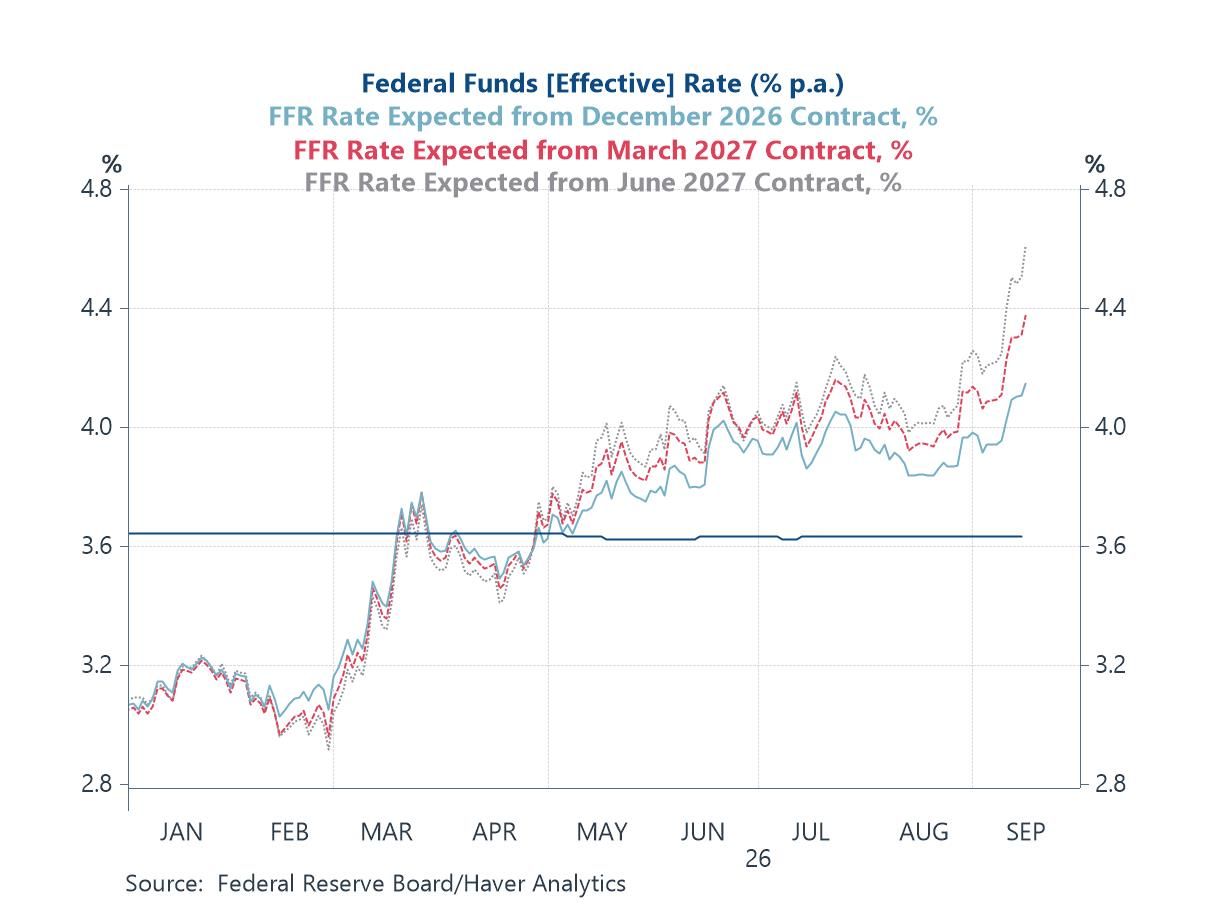
  • The past few weeks have seen a sharp escalation in tensions in the Middle East, triggering a rapid repricing across energy markets and a rise in geopolitical risk (chart 1). This comes at a time when the global economy is still heavily dependent on fossil fuels, leaving it structurally exposed to such shocks (chart 2), while longer-run increases in energy use per capita—driven in large part by industrialisation in China and elsewhere—have contributed to a rise in real energy prices over time (chart 3). Financial markets have been responding, with short-dated bond yields edging higher as expectations of monetary easing are reassessed (chart 4), and forward-looking sentiment indicators are showing early signs of softening (chart 5). At the same time, and of note, there are some tentative signs of stabilisation in parts of the global economy, notably in China where investment has picked up at the margin, supported by policy-led infrastructure spending (chart 6). Even so, it remains early days, and the balance of risks continues to tilt toward a more fragile outlook should the instability in the Middle East persist.

    • January sales -17.6% m/m (-11.3% y/y) to 587,000, third m/m fall in four months.
    • Sales m/m down in all four regions; sales y/y down in the West (-28.7% y/y) and South (-8.8% y/y).
    • Median sales price down to $400,500; avg. price down to $499,500—both at six-month lows.
    • Months' supply rises to 9.7 mths., highest since Oct. ’22.
    • New claims declined by 8,000 to 205,000.
    • Continuing claims rose by 10,000 to 1.857 million
    • The insured unemployment rate remained at 1.2%.
    • The annual revision to the claims seasonal factors reflects minor changes in the claims series over the past year, with one notable upward revision to the November 29 week, when claims were revised from 192,000 to 216,000.
    • The volatile food and energy components jumped...
    • ...But other items also showed upward pressure.
    • January factory orders +0.1% m/m (+4.4% y/y); second m/m gain in three months and 7.7% above the Jan. ’24 low.
    • Durable goods flat; nondurable goods orders +0.3% m/m; shipments +0.5% m/m.
    • Transportation orders -0.8% m/m, led by a 23.8% plunge in defense aircraft orders.
    • Unfilled orders +0.8%, the sixth straight m/m rise.
    • Inventories +0.1%, the third consecutive m/m increase.
    • Applications for loans to purchase edged up, while applications for loan refinancing plummeted.
    • Effective interest rate on 30-year fixed loans rose 12bps to 6.48%.
    • Average loan size declined.
  • Germany
    | Mar 17 2026

    Germany’s ZEW Survey Sours

    The ZEW survey, which is a survey of German financial experts, showed a weakening in March as the economic situation deteriorated sharply in the wake of the start of the war in Iran. For the euro area, the reading dropped to -29.9 in March from -13.6 in February; for Germany, the reading surprisingly improved a slight bit to -62.9 from -65.9; for the United States, a positive reading of 4.5 was still posted; however, it was down significantly from +19.6 in February. China’s reading fell to -33.7 from -31.5. The rank standings for these readings on data back to late-1992 for most reporters, but only back to April 2021 for China, shows the euro area at a reading near its median over this span. While Germany and the U.S. are substantially below their medians, with percentile standings near 30% for Germany and near the 40th percentile for the U.S. China logs a stronger queue standing above its median at 68.3%.

    Macro expectations fell more clearly and sharply for all the reporters in March. For Germany, the drop was to -0.5 in March from +58.3 in February, while the U.S. drop was to -28.7 from -5.1 in February. China’s drop was to -15.8 from +13.1 in February. The standings for these March readings place China at a 1.7 percentile standing, the U.S. at a 16.1 percentile standing, and Germany at a 25.1 percentile standing. All of them are quite weak in the lower quartile of their respective queues of data.

    With oil prices jumping sharply, inflation expectations have simply skyrocketed on the month. For the euro area, the reading that was near 0 in February jumped to 79 in March. For Germany, a reading of -2.3 in February surged to 79.2 in March. For the U.S., an inflation expectation of 43.1 in February nearly doubled to 80.4 in March. For China, a February reading of 10.5 ran up to 56.0 for March. The queue percentile standings for the March readings rose to the 98th percentile for the euro area, Germany, and the U.S., while China's standing also moved up strongly to its 93rd percentile, when ranked over a shorter period extending back to April 2021.

    With inflation going up, short-term interest rate expectations rose as well. Those expectations rose in the euro area, the U.S., and China. For each of these reporters, there was a significant increase in the short-term rate expectations. The euro area expectation survey value has a standing in its 70.9 percentile, China’s standing is at its 55th percentile, while the U.S. standing is still below its median at its 22.4 percentile.

    Long-term rate expectations moved up in all areas as well, with Germany's new reading having a 66.8 percentile standing, China at a 75th percentile standing, and the U.S. at a 59th percentile standing. Each one of these is above its historic median. Long-term expectations are elevated.

    Stock markets in all areas weakened in March compared to February, with most showing declines of about 50% or so in this survey. The queue standings for the new readings are all in the lower 25th percentile of their respective data queues. Some of them are significantly lower, such as Germany, which stands only in its 9th percentile. On balance, the attack in Iran has been a game-changer for economic perceptions and expectations. Markets are wary. And everyone knows the centerpiece is the Strait of Hormuz. But that does not make it much easier to handicap the future.

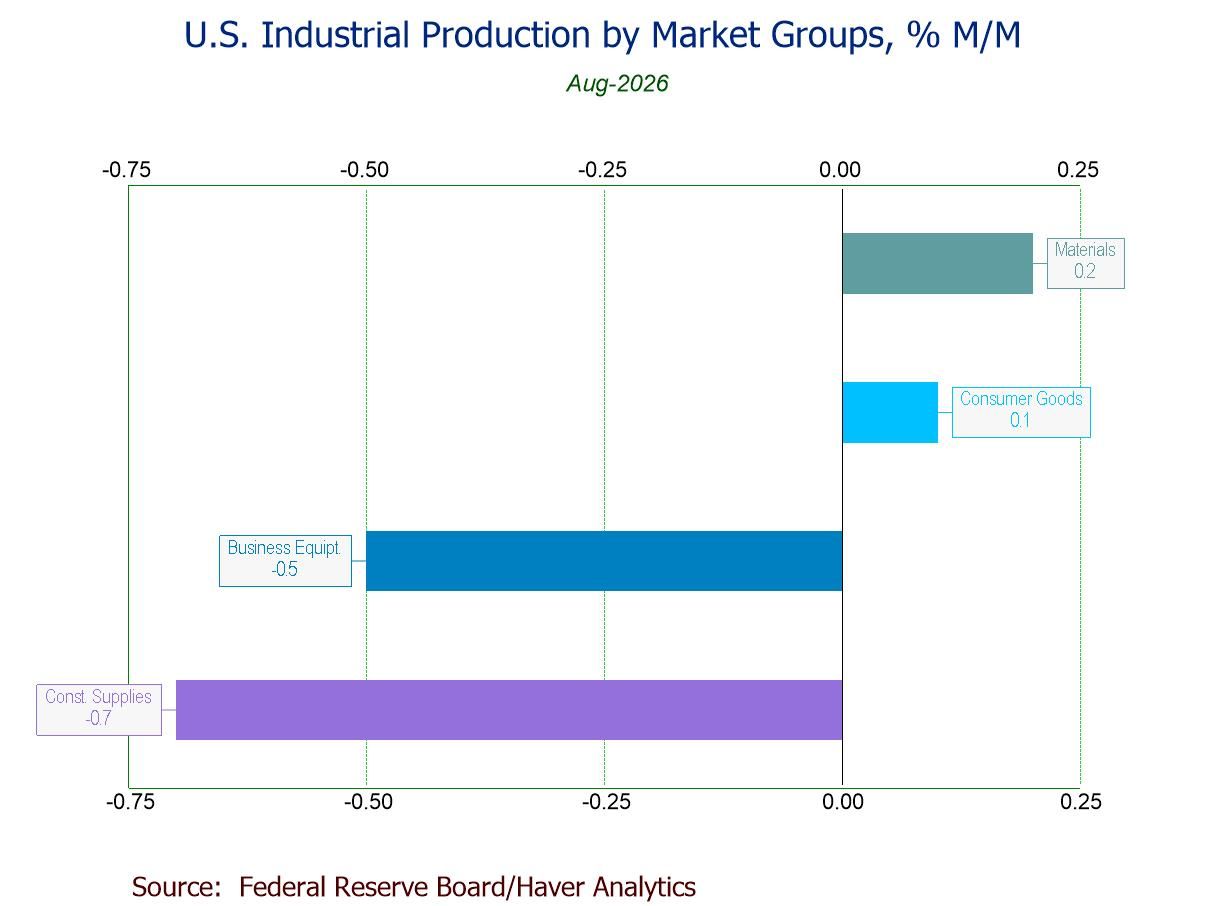
    • Total industrial output increased 0.2% m/m in February, slightly larger than expected.
    • There was no revision to January, but there were small upward revisions to November and December.
    • Manufacturing output increased 0.2% m/m, mining rose 0.8%, while utilities production slid 0.6% m/m.
    • The headline rate of capacity utilization was unchanged in February and remained well below its long-term average.