German Orders Make Strong Jump, but from a Too-Deep Hole
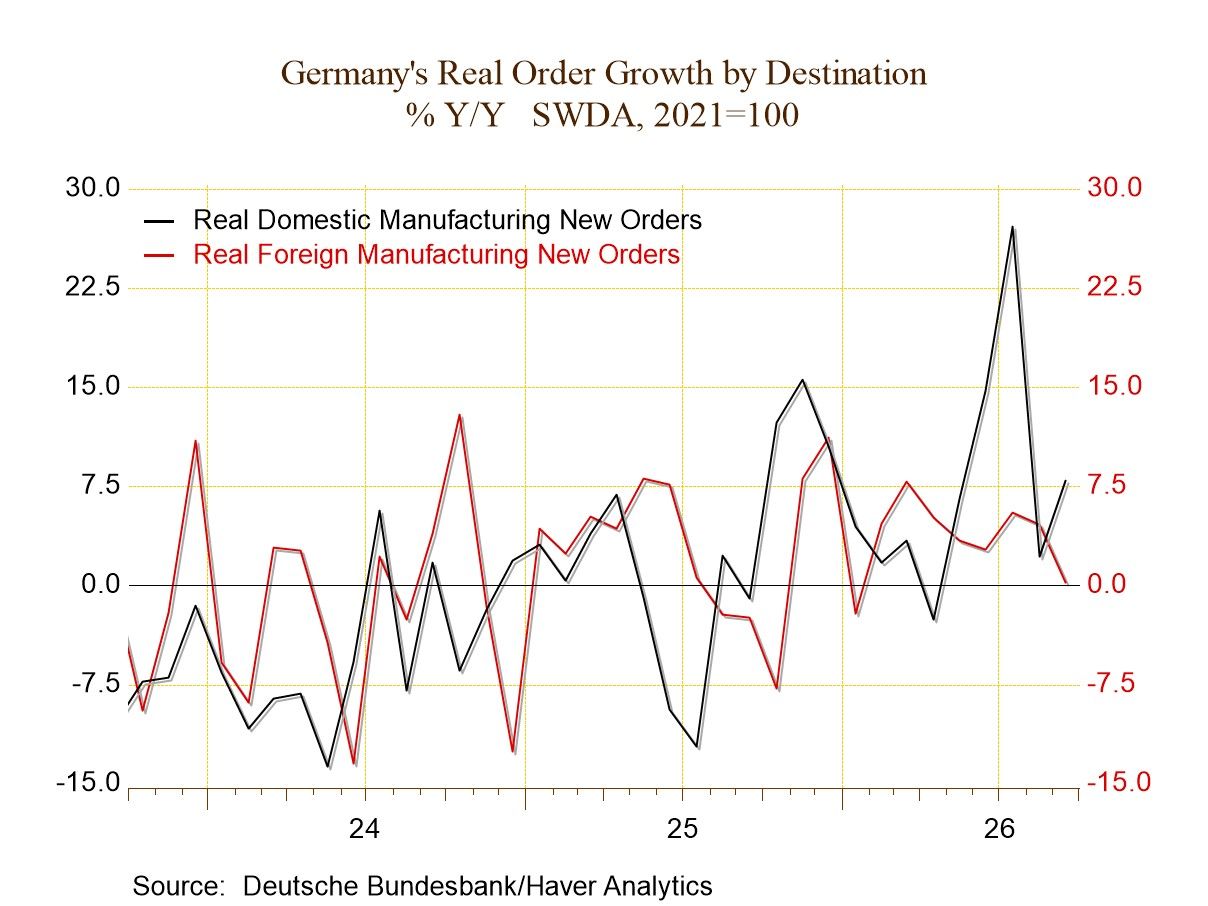
On the German long-term chart of year-over-year growth rates, we can see that German orders, both domestic- and foreign-sourced, while quite volatile, are making a consistent trend move to stronger ground.
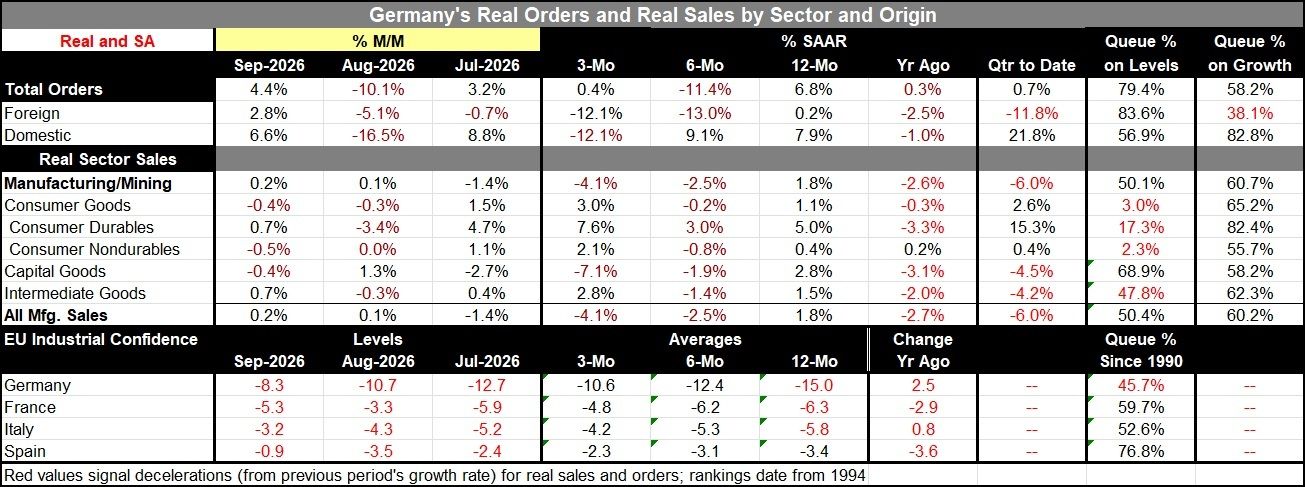
The table, in contrast, focuses on growth rates over the last two years and principally over the last year and shorter horizons. On that shorter time horizon, orders are generally weakening.
Orders overview Total orders show improved growth over 12 months compared to the growth rate a year ago. On a shorter view, however, comparing the six-month growth rate to the 12-month growth rate finds a step down to -4.7% over six months from 3.3% over 12 months, then comparing the three-month growth rate to the six-month growth rate, another step down to an -11.9% annual rate from a -4.7% annual rate occurs. Despite improvement in the year-over-year growth performance, the pattern of orders from the one-year horizon on shows a general weakening.
Foreign vs. domestic patterns: inconsistent meets convoluted Foreign orders improve over 12 months compared to their year-ago growth rate, with the year-ago growth rate at -2.5% compared to +0.2% over the last 12 months. Over six months, that pace degrades to a -13% annual rate, then, over three months, it makes the most modest improvement to -12.1% from -13%. In contrast, domestic orders make a sharp improvement over 12 months compared to a year ago as the 12-month growth rate jumps to 7.9% compared to -1% a year ago. Over six months, that growth rate steps up from 7.9% to 9.1% at an annual rate, but then over three months, it falls back hard to a -12.1% growth rate.
Monthly patterns Monthly growth rates tell somewhat similar stories about the twists and turns being convoluted and echoing the sequential pattern since the month-to-month data show an extremely weak August with a strong bounce-back in September, but that September bounce-back is paltry in comparative terms, compared to the setback experienced in August. Rolling all of this up into a pattern for the quarter-to-date results for the now-completed third quarter shows total foreign order growth falling at an 11.8% annual rate, as domestic orders surge ahead at a 21.8% annual rate, pushing total orders up at a paltry 0.7% annual rate. Evaluating performance by looking at the standing of the 12-month growth rates, those growth rates year-over-year for total orders have a 58.2 percentile standing driven substantially by domestic orders that have an 82.8 percentile standing against what are weak foreign growth rates for orders at a 38.1 percentile standing.
Real sales overall and by sector Moving on to look at real sales and what's going on with sector sales expressed in real terms, we see a smaller increase in real sales that rose by 0.2% in September after rising by 0.1% in August compared to a 1.4% drop in July. Sequential real sales follow the pattern for orders, with the year-over-year growth rate at 1.8% stronger than a -2.6% year-ago pace, then, over six months that growth rate falls from 1.8% to -2.5%, and then over three months it falls again to -4.1%. Real sales across sectors generally follow this same pattern. The growth rates for manufacturing sales are nearly identical to the headline number for mining and manufacturing.
EU Commission industrial confidence in EMU’s Big-Four economies The panel at the bottom looks at a sampling of the large monetary union economies, Germany, France, Italy, and Spain, comparing the results in terms of the EU industrial confidence metrics. These measures generally find improvement for the economies in September compared to August with France as the exception. In France, the September value of -5.3 was a decline from -3.3 in August, whereas the other countries experienced slightly less deeply negative assessments in September compared to August. The average data presented in the sequential pattern find Germany slightly improving on the EU industrial confidence index from a -15 reading over 12 months to -12.4 over six months, to -10.6 over three months, a clear progression toward improvement. Even France has a progression toward improvement although with a much slighter tendency for improvement. Italy and Spain also show small movements toward improvement from 12 months to six months, to three months. However, the 12-month change shows some mixed performance. Compared to a year ago, Germany and Italy show improvement, from their year-ago values, while France and Spain show deterioration. Evaluating the September industrial confidence level readings by comparing them to those back to 1990, we find all of them reside at a level at or above their 50th percentile except for Germany; the German reading has a 45.7 percentile standing, fewer than 5-percentile points below its median. Italy has a standing at its 52.6 percentile, France at its 59.7 percentile. In Spain, the ongoing success story of the Monetary Union, there is a 76.8 percentile standing.
Summing up On balance, we have disappointing data for Germany over the near term although still evidence that viewed more broadly there is improvement in train for the German economy. The EU industrial confidence data are mixed on the Big-Four EMU economies, although the sequential ratings suggest that there was improvement in train there. These economies continue to face an uncertain future with the war in Ukraine and still unsettled conditions in Iran that are hard to characterize and continue to be associated with an unusual elevation in oil prices and the interruption of other supply lines. Meanwhile, central banks are raising rates, with the Bank of England joining the club, offering a rate hike today and warning that there could be more ahead. Investors are also trying to puzzle out the implications for global policy of the substantial and unexpected loss of power by Republicans in the midterm elections in the United States, raising the question of how different the next two years might look. So far, the market reaction seems to be positive, but that's going to be something to continue to watch. Markets often like it when there's political impasse, and the U.S. may be exactly in that situation for the next two years.

Robert Brusca
AuthorMore in Author Profile »Robert A. Brusca is Chief Economist of Fact and Opinion Economics, a consulting firm he founded in Manhattan. He has been an economist on Wall Street for over 25 years. He has visited central banking and large institutional clients in over 30 countries in his career as an economist. Mr. Brusca was a Divisional Research Chief at the Federal Reserve Bank of NY (Chief of the International Financial markets Division), a Fed Watcher at Irving Trust and Chief Economist at Nikko Securities International. He is widely quoted and appears in various media. Mr. Brusca holds an MA and Ph.D. in economics from Michigan State University and a BA in Economics from the University of Michigan. His research pursues his strong interests in non aligned policy economics as well as international economics. FAO Economics’ research targets investors to assist them in making better investment decisions in stocks, bonds and in a variety of international assets. The company does not manage money and has no conflicts in giving economic advice.
More Economy in Brief
 Global