German IP: Solid Gains in September; Strong Survey Results
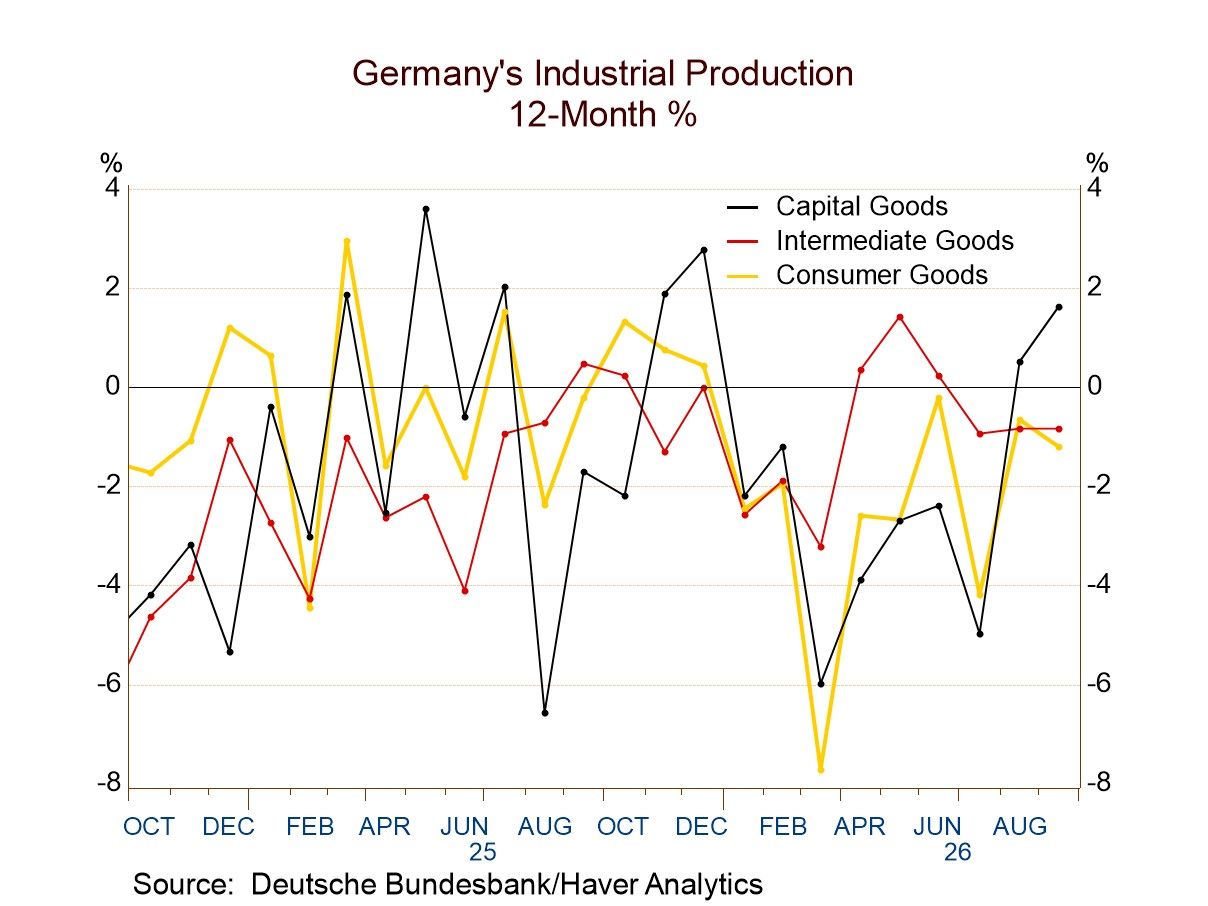
German industrial production rose by 0.7% in September after rising 1% in August. Consumer goods and capital goods sectors also had strong gains in each of the last two months. Intermediate goods showed milder and more erratic output results and trends.
Sequentially, IP headline gains are 0.5% over 12 months; that rises to a 1.5% annualized pace over six months but edges slightly lower to a 1.3% pace over three months. Still, there are output gains on all horizons, and the three-month and six-month gains are each stronger than the year-on-year.
Consumer goods output sequentially is less buoyant even over three months, largely because of a huge drop in July that gains in August and September could not erase. So, the sequential output trend for consumer goods is erratic despite two solid months of back-to-back gains. Capital goods output shows acceleration and building momentum, with its annualized pace at 8% over three months. Intermediate goods output shows contractions over each of the sequential horizons and a tendency toward deceleration.
September data conclude the data for Q3. On a full quarter-over-quarter basis, output is falling in two of three sectors. The exception is capital goods, where output posts a quarterly gain of just 0.4% at an annual rate.
To put growth in a greater perspective, annual growth rates of output ranked on data back to 2006 place total German IP growth at a 50.8 percentile standing. Capital goods have a 52.4 percentile standing for growth, while consumer goods growth is a laggard at a 36.7 percentile standing and intermediate goods at a 42.7 percentile standing. Only total IP growth and capital goods have standings above their respective 50% mark, placing them above their median gain on this horizon.
German manufacturing output, real orders, and real sales show erratic-to-weaker trends. Manufacturing output shows gains on all sequential horizons, while real orders and real sales are both showing significant declines as well as a pattern of deceleration. Manufacturing output and real sales are falling in Q3. But in terms of ranked year-over-year growth rates, real orders and real sales have standings above their historic median rates.
The survey indicators for the German economy show a progression toward strength over the last three months, and so do the sequential readings, for the most part. All the indicators are higher month-to-month. But their percentile standings, conducted on levels of these survey data, all register below median standings on data back to 2006. Recent performance is good, but it is weak in a historic context.
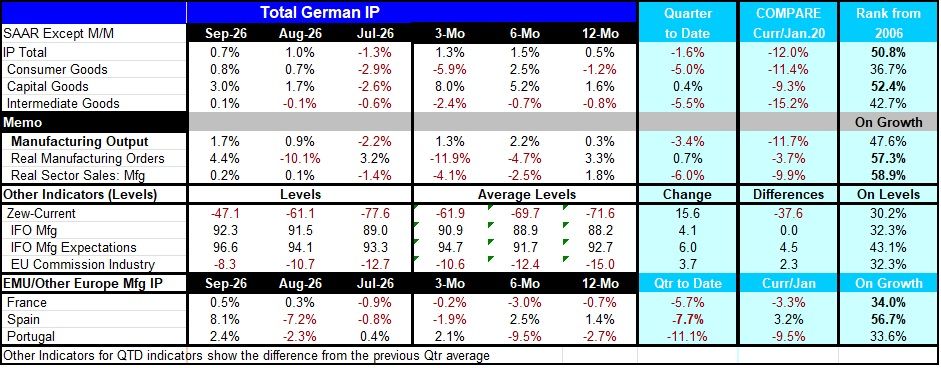
Data for three early reporting EMU members, France, Spain, and Portugal, show output increases in September. However, their respective sequential footprints are not as upbeat. France shows output declines over each sequential horizon; Spain and Portugal are erratic. However, Spain’s IP growth rate over 12 months is above its median result, while France and Portugal have IP growth rates ranking near the lower third of their respective historic queues of growth rates for output.
On balance, the German data reported are fairly solid, with the surveys being quite upbeat. Real orders and real sales trends are cautionary and must be monitored. The three European reporters underline the fact that Europe is faring less well than Germany. Just another reason to be wary of good news. But what we do have here is a nice slug of good news. Maybe it can last?

Robert Brusca
AuthorMore in Author Profile »Robert A. Brusca is Chief Economist of Fact and Opinion Economics, a consulting firm he founded in Manhattan. He has been an economist on Wall Street for over 25 years. He has visited central banking and large institutional clients in over 30 countries in his career as an economist. Mr. Brusca was a Divisional Research Chief at the Federal Reserve Bank of NY (Chief of the International Financial markets Division), a Fed Watcher at Irving Trust and Chief Economist at Nikko Securities International. He is widely quoted and appears in various media. Mr. Brusca holds an MA and Ph.D. in economics from Michigan State University and a BA in Economics from the University of Michigan. His research pursues his strong interests in non aligned policy economics as well as international economics. FAO Economics’ research targets investors to assist them in making better investment decisions in stocks, bonds and in a variety of international assets. The company does not manage money and has no conflicts in giving economic advice.
More Economy in Brief
 Global