

Japan’s LEI Weakens in September
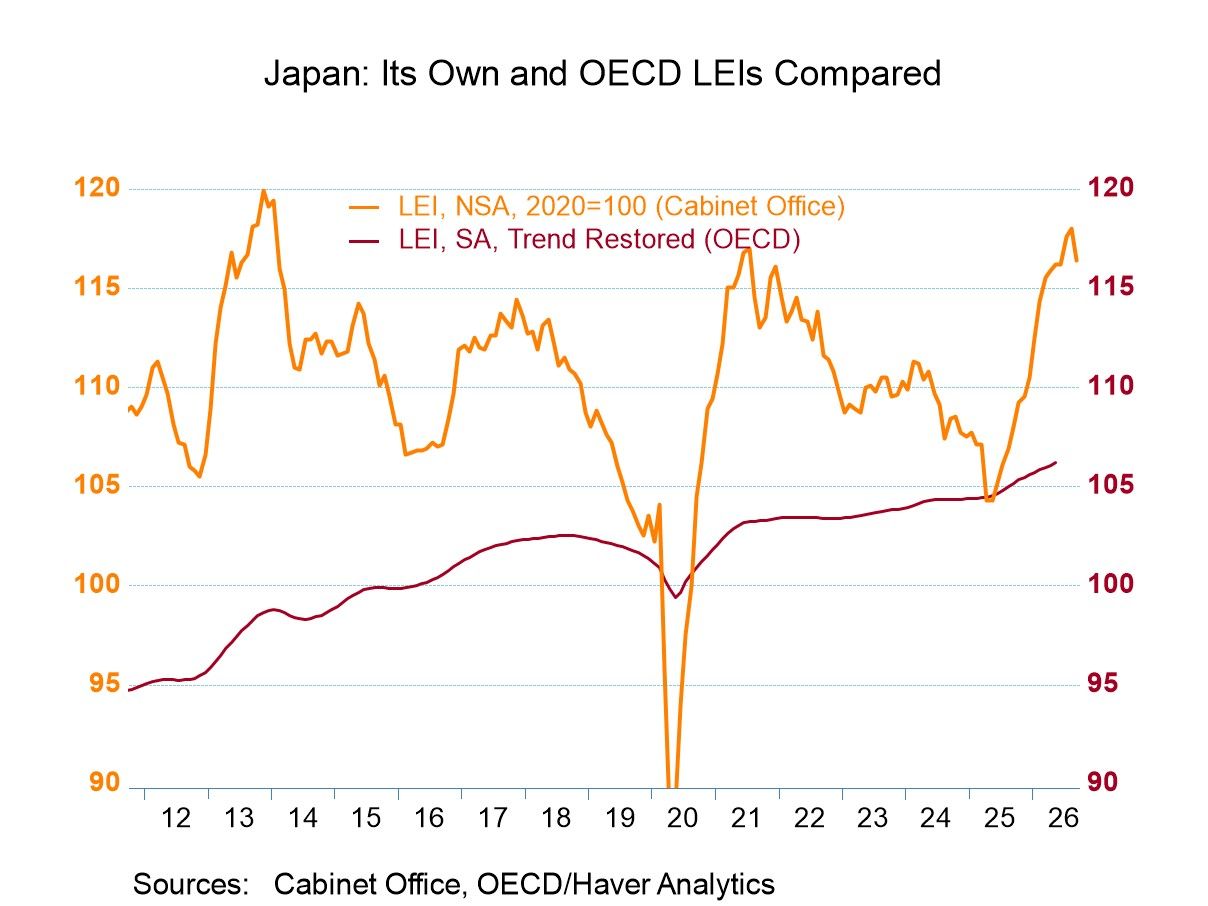
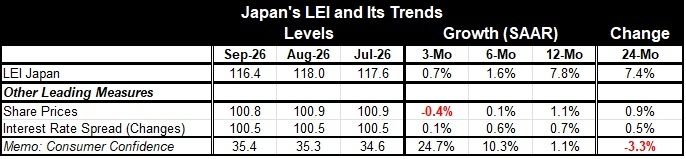
Japan's leading economic index, released by the Cabinet Office, has moved up from much lower readings in mid-2025. In July and August, it made two sizable moves higher, reaching a peak in August at an index level of 118. However, in September, the index fell sharply to a level of 116.4, a sharper fall than had been expected (but this reading is still preliminary). After the fall, the September reading is only marginally higher than its readings in May and June of this year.
The leading index has been boosted by rising share prices until recently, and the interest rate spread has also signaled advance as the Bank of Japan has been raising rates.
As a reference, I include the consumer confidence indicator where we see that confidence has been mildly rising since April of this year; yet, the gradient has been extremely mild and it comes after a more lengthy period of weakness for that indicator, so that the year-over-year increase in confidence shows a 1.1% rise. However, the change over 24 months for consumer confidence is negative. But over the same 24 months, the May index is up by 7.4%, and share prices and the interest rate spread also show increases over that two-year span.
Through September, the Economy Watchers index is showing modest contraction in its headline and modest expected contraction in its future index, with a percentile standing for the Economy Watchers current index in its 47th percentile, whereas the outlook index is only in its 41st percentile; neither one of those is registering much strength. Both of those readings are below their historic medians; the median on ranking data occurs at a percentile standing of 50%.
The detail from the Economy Watchers index tells us that households are expressing some degree of normalcy in current conditions that is showing contraction but that nonetheless has a historic percentile standing above its median, ranking in its 53.4 percentile. The eating and drinking places category is a reading that tends to be volatile and depends on the overall state of the economy. It is showing less shrinkage in September than in August, but it has a queue standing that is elevated, in its 60th percentile, relatively firm. Manufacturers also have a queue percentile standing above neutral. But the overall picture remains modest.
Summing up The leading index reflects these modest conditions for growth. However, even with these cooling LEI readings, the Bank of Japan is still set for a rate hike, perhaps as soon as its next meeting. While the Cabinet Office leading index has declined, the current conditions index continues to improve in September. Thus, growth in Japan is balanced and strong enough that action against too-high inflation remains likely. The economy also will be benefiting from some fiscal stimulus. But financial conditions and particularly foreign exchange rate behavior could shift and set a new background and create a new policy dilemma at the drop of a hat.

Robert Brusca
AuthorMore in Author Profile »Robert A. Brusca is Chief Economist of Fact and Opinion Economics, a consulting firm he founded in Manhattan. He has been an economist on Wall Street for over 25 years. He has visited central banking and large institutional clients in over 30 countries in his career as an economist. Mr. Brusca was a Divisional Research Chief at the Federal Reserve Bank of NY (Chief of the International Financial markets Division), a Fed Watcher at Irving Trust and Chief Economist at Nikko Securities International. He is widely quoted and appears in various media. Mr. Brusca holds an MA and Ph.D. in economics from Michigan State University and a BA in Economics from the University of Michigan. His research pursues his strong interests in non aligned policy economics as well as international economics. FAO Economics’ research targets investors to assist them in making better investment decisions in stocks, bonds and in a variety of international assets. The company does not manage money and has no conflicts in giving economic advice.
More Economy in Brief
 Global