Global| Nov 04 2026
Composite Global PMIs Lose Breadth but Not Much Strength
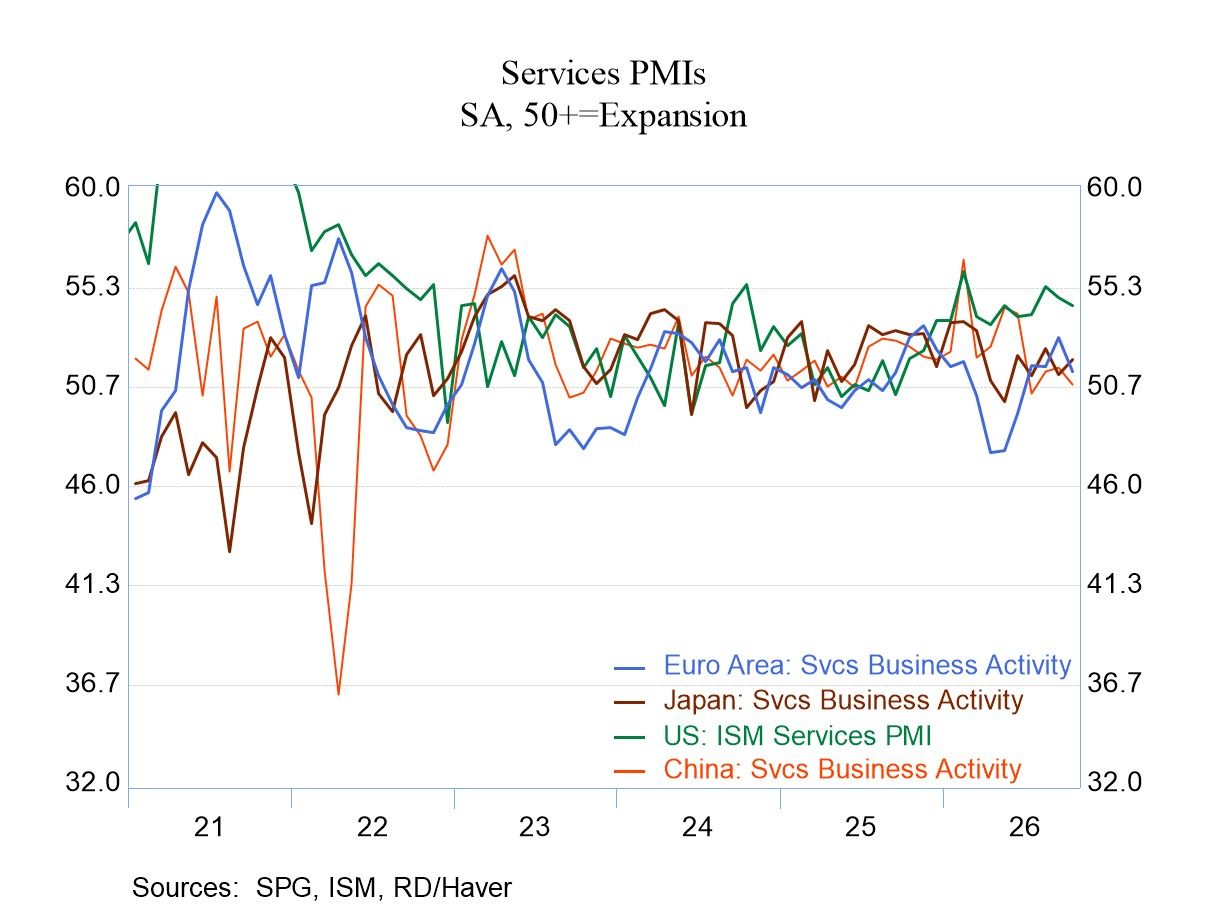
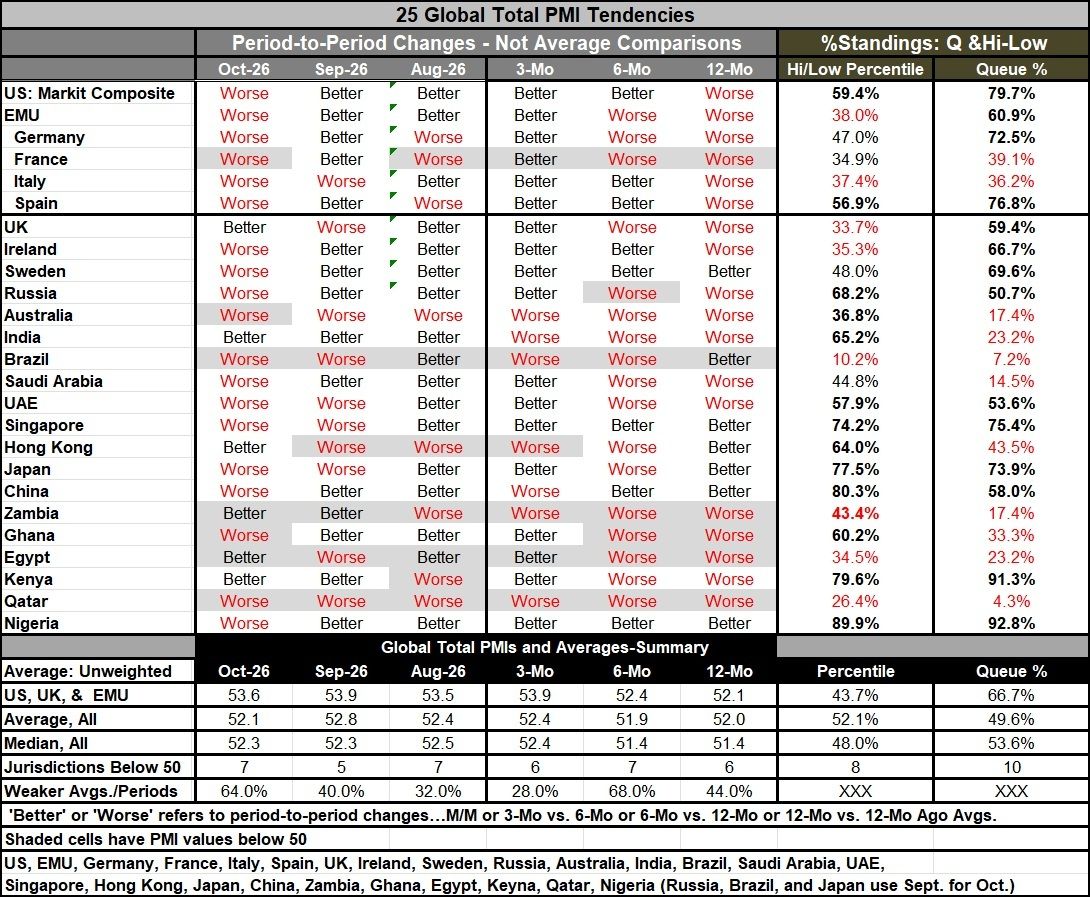
The S&P Global PMI data for October show a very broad worsening, with only 6 of 25 reporting countries logging month-to-month improvement. However, the average PMI reading for the total PMIs on an unweighted basis in October yields a value of 52.1 compared to 52.8 in September, a modest drop for such broad weakening. The group median, however, was unchanged at 52.3 in October compared to 52.3 in September. The number of jurisdictions contracting in October rose to 7 from 5 in September, back to where it was in August and back to its six-month average for the number of reporters contracting.
There is no single number that can adequately pin down exactly how this diverse group of countries is performing; no single metric can characterize the global economy adequately. However, we can see from the various metrics that there's a good deal of irregularity, and the deterioration itself may not have been large. There's a fairly broad-based deterioration that occurred from September to October. Even so, the average reading in October is slightly below the three-month average of 52.4, which is stronger than its six-month and 12-month readings for the pooled group average. The group median, at 52.3, is nearly the same as the 52.4 reading for the last three months, which is a reading above its six-month and 12-month values. In short, there appears to be some mixing around and oscillation of the performance metrics by some of the reporting countries, but not so clear erosion.
The average reading for the group consisting of the United States, the United Kingdom, and the European Monetary Union shows 52.1 for the 12-month average, 52.4 for the six-month average, and then a rise to 53.9 for the three-month average. The October reading for this group at 53.6 is below the three-month average. But the October reading is still above the six-month and 12-month averages.
The shaded areas in the table identify periods when the readings are below 50, indicating a decline in activity in PMI terms. There are five reporting areas that have this characteristic over three months, six months, and 12 months. They are France, Brazil, Zambia, Egypt, and Qatar.
Despite various degrees of improving or deteriorating, there are 17 reporters that record total PMI values above 50 over three months, six months, and 12 months. And there are 16 that show expansion over each of the last three months. Growth rules.
At least growth has been the rule. It's not clear that there's been a lot of strength. To assess strength, we look at the queue percentile standings that rank the current October readings against all previous values back to January 2021. Queue percentile standings have an average value of 52.1% and a median of 48%. The average is about two percentile points above the neutral diffusion reading of 50, while the median across these reporters is about two percentile points below the neutral reading, indicating no change in output. There are 11 reporters with queue standings below their 50th percentile, putting them below their medians for the period. Among the weakest reporters are Qatar at a 4.3% standing and Brazil at a 7.2% standing; Australia and Zambia have standings at their respective 17th percentiles. That leaves 14 countries above their 50% mark and, therefore, above their historic medians. Only two countries log standings in their 90th percentiles, Kenya and Nigeria. Other than these two, the highest standings are in the 70th percentile, such as the U.S. (at a 79.7 percentile), Spain, Germany, Singapore, and Japan. The more advanced countries have standings at higher percentile markers; however, France and Italy are exceptions with readings that are in their respective 30th percentiles.
The global economy is in a period of significant transition with countries fighting off inflation stemming from war in the Middle East owing to substantially higher oil prices, but also from the interruption of other supply lines, and the ongoing conflict between Ukraine and Russia. All of this, of course, is occurring in the aftermath of COVID; the main COVID disruption ended slightly less than five years ago. It has been a difficult period. And it is leading now to some significant political displacements, with Europe seeing significant domestic discord particularly over fiscal positions. And the U.S. just recently witnessed a significant loss of support for the Republican Party in power, paving the way for some new and unknown policy tilts in the period ahead as Democrats will rule in the Senate and the House for the next two years.

Robert Brusca
AuthorMore in Author Profile »Robert A. Brusca is Chief Economist of Fact and Opinion Economics, a consulting firm he founded in Manhattan. He has been an economist on Wall Street for over 25 years. He has visited central banking and large institutional clients in over 30 countries in his career as an economist. Mr. Brusca was a Divisional Research Chief at the Federal Reserve Bank of NY (Chief of the International Financial markets Division), a Fed Watcher at Irving Trust and Chief Economist at Nikko Securities International. He is widely quoted and appears in various media. Mr. Brusca holds an MA and Ph.D. in economics from Michigan State University and a BA in Economics from the University of Michigan. His research pursues his strong interests in non aligned policy economics as well as international economics. FAO Economics’ research targets investors to assist them in making better investment decisions in stocks, bonds and in a variety of international assets. The company does not manage money and has no conflicts in giving economic advice.
More Economy in Brief