

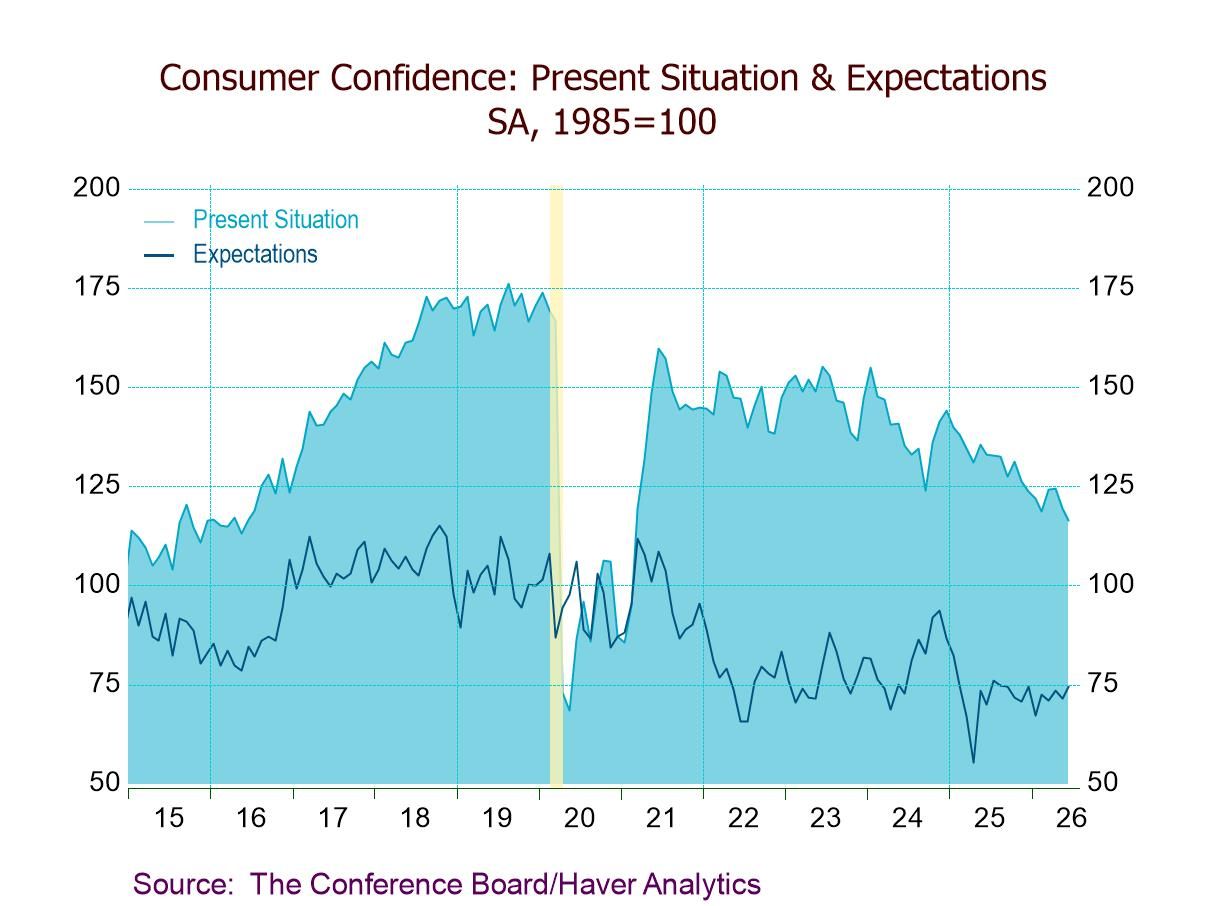
- Headline up 0.6 pts. to 91.2 in June, below expectations; fourth m/m increase in five mths.
- Present Situation Index down 3.0 pts. to 116.4, lowest since Feb. ’21.
- Expectations Index up 3.0 pts. to 74.4, a six-month high.
- Consumers less optimistic about current business & labor market conditions; more upbeat about future business & financial conditions.
- Inflation expectations down to 6.0%, lowest since Feb., as lower oil prices in recent weeks eased consumer inflation fears.
 USA| Jun 30 2026
U.S. Consumer Confidence Rebounds in June from a Four-Month Low
 USA| Jun 30 2026
U.S. JOLTS: Openings and Hiring Little Changed in May
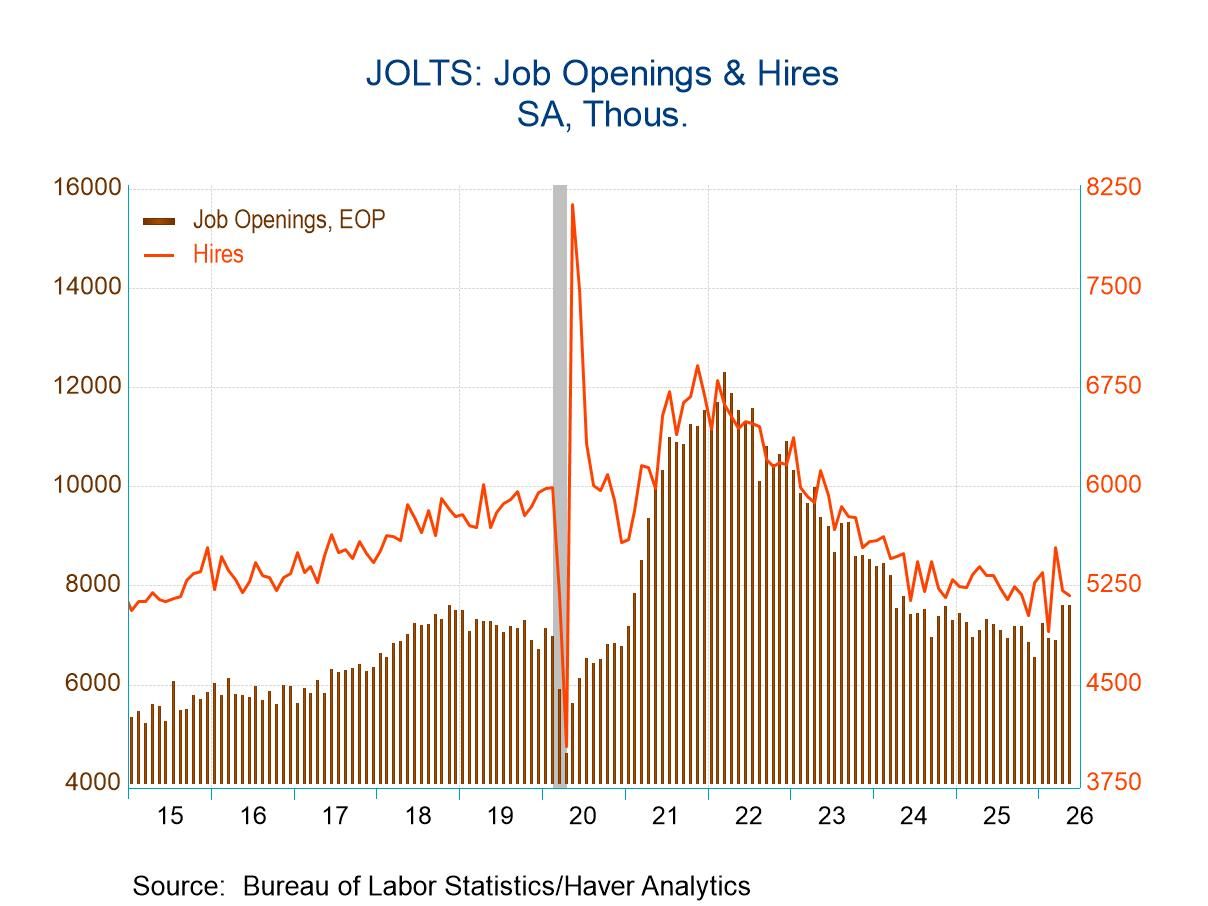
- Openings edged up 9,000 but to the highest level since May 2024.
- However, hiring fell 45,000 for the third monthly decline in the past four months.
- Separations rose 63,000 with increases in both quits and layoffs.
by:Sandy Batten
|in:Economy in Brief
 Europe| Jun 30 2026
Large EU Economies Show Some Inflation Cooling
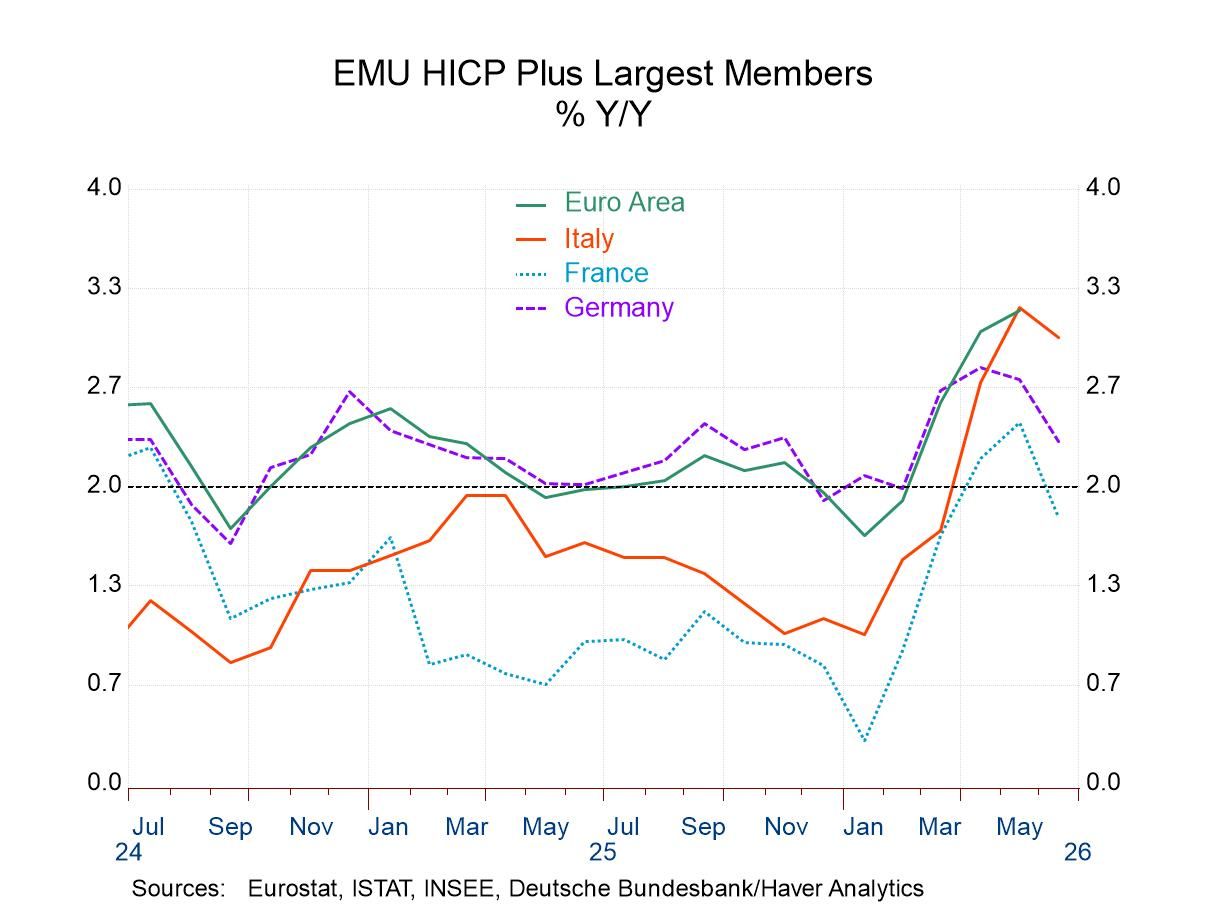
Some inflation progress, but not enough: The headline HICP in June for the largest monetary union economies have largely broken lower, with the exception of Spain. The German headline HICP fell by 0.1% in June after being flat in May. In France, the price index fell by 0.5% in June after growing by 0.3% in May. In Italy, the June index rose by 0.1% after rising by 0.3% in May. In Spain, June brought a 0.3% increase after a 0.2% increase in May.
Core or ex-energy (Germany): The core inflation readings are available for Germany, Italy, and Spain. In the case of Germany, it's an index excluding energy only. June brought a 0.1% increase for the German index, a 0.1% decline for Italy's core index, and a 0.2% increase for Spain’s core measure. On balance, these are a good collection of results from the standpoint of the ECB that has an inflation target of 2% for the European Monetary Union as a whole, but no guidance for individual countries.
Sequentially: Sequentially, the headline inflation rate shows progress in Germany and France, while excesses are stubborn in Italy and Spain. Over 12 months, all the inflation rates are excessive, but France is only technically excessive and probably acceptable at 2.1% year-over-year. Germany's increase over 12 months is 2.4%, Italy's is 3.1%, and Spain’s is 3.6%. The progression of inflation from 12-months to 6-months to 3-months shows accelerations over six months compared to 12 months for France and Italy, while Germany and Spain show decelerations. However, Spain's six-month inflation rate is still 3.3%. Germany has dropped to 2.2%, France is at 3.3%, and Italy has jumped up to 5.5%. Over three months, the German headline inflation rate is zero and France has fallen to 2%, but in Italy’s headline pace has accelerated to 6.9% and Spain remains at 3.3%. These are all compounded rates of change over three months.
Three-month trends are mixed: None of this is really surprising since oil prices have been surging over the period and are now starting to decline. Over 12 months, the oil price is down by 22.6%; over six months, it’s down by 37% at an annual rate; and over three months, the oil price is flat. Much of this price action is still quite recent. These figures are for Brent crude measured in euros. Over three months, German inflation is flat for the headline HICP, while France’s inflation rate is down to 2%. In Italy, the three-month pace is 6.9%; in Spain it’s at 3.3%. Headline inflation still has a somewhat erratic performance over three months, although it's quite acceptable in Germany and France and quite not acceptable in Italy and Spain.
Core inflation is lower but still too high: Core inflation shows much more moderation because the behavior of energy prices leaves core inflation largely unaffected. If the core is affected, it occurs only after a more substantial knock-on effects from other industries. German ex-energy inflation is at 2.3% over 12 months and then settles down to a 2% annualized pace over six months and three months. Italian core inflation is golden on all three periods, at 1.5% over 12 months, down to 1.4% over six months, and down to 1.2% over three months. Spain's core inflation is excessive, although it is making progress toward a more agreeable rate from a European standpoint. Spain’s core inflation is 2.9% over 12 months, remains at 2.9% over six months, then decelerates to a 2.4% annualized rate over three months.
 Europe| Jun 29 2026
EU Indexes Show European Improvement in June
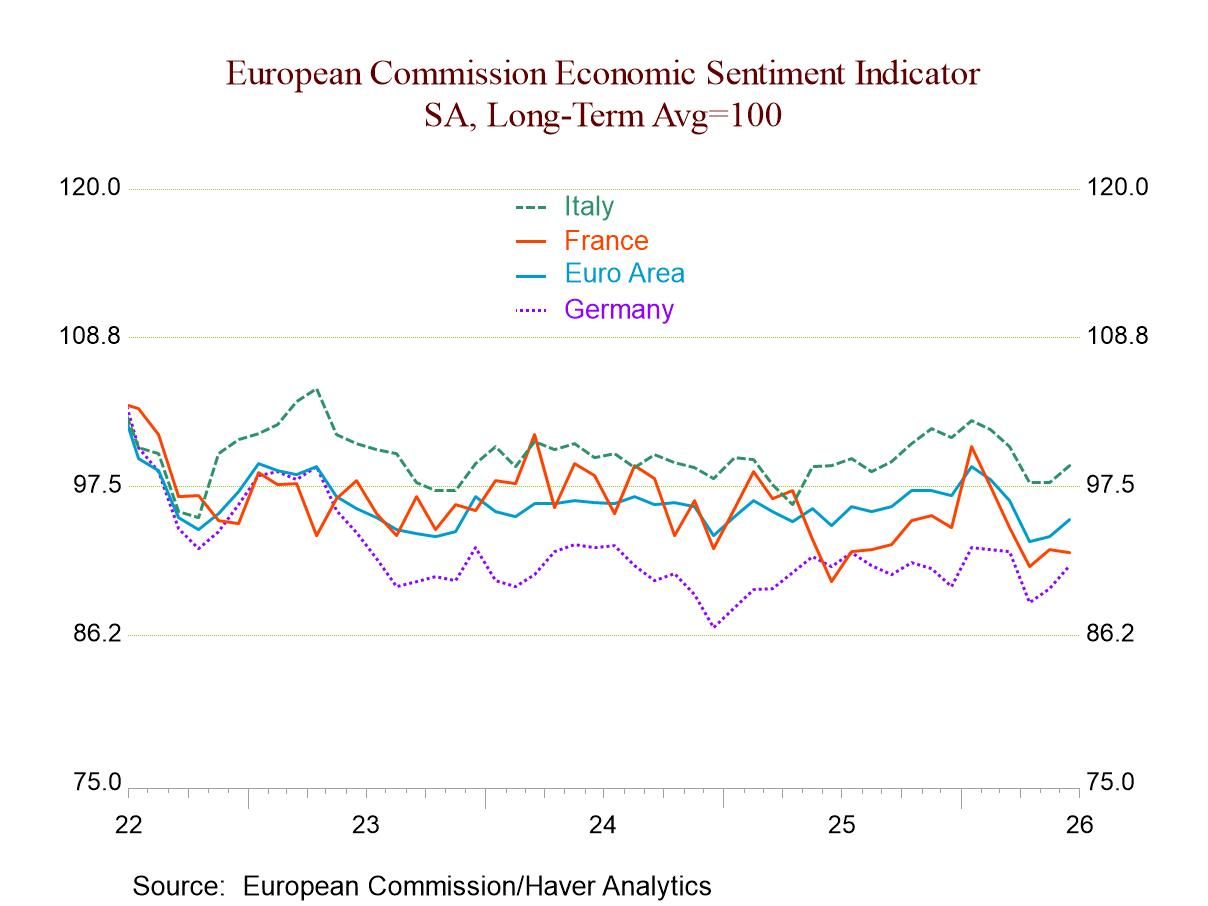
Headline indexes for the European Monetary Union improved in June to a reading of 95.0 from 93.7 in May. The index had been stronger at 96.4 in March; however, it fell to 93.3 in April, recovered slightly to 93.7 in May, and has now reached 95.0. While still below its March high, the index has made progress in the wake of the outbreak of war-like conditions and the closure of the Strait of Hormuz.
Sector performance The industrial reading for the sector, at -8, has a 36.3 percentile standing, which better than the headline index for the Monetary Union with a 25.4 percentile standing. The EMU-wide sector index, consumer confidence, improved to a net diffusion reading of -17.7 in June from -19 in May, but that still leaves it with a very weak 8.1 percentile standing, the lowest among sector readings. Retailing improved to a net diffusion reading of -10 in June from -11 in May and posted a 38.1 percentile standing. The construction sector deteriorated, falling back to -5 from -4 in May; it has been undergoing steady degradation since at least March, but it still has a 68.4 percentile standing. It is the only sector with a percentile standing above 50, placing it above its historic median. The services sector had a net diffusion reading of +3, identical to its May reading and has a 24-percentile standing.
Sector index ranking The sector readings clearly show that the monetary union is exhibiting a number of sectors with subpar growth; beyond ‘subpar,’ many are quite weak. The exception is—and has been for some time—the construction sector, which continues to perform above average and post an above-median metric. It is, perhaps surprising that we often think of consumer confidence as being relatively forward-looking, but in this schematic, consumer confidence is the weakest of the sectors; in fact, like statistics from the U.S., we find the same prevailing situation with consumer readings exceptionally weak. These weak consumer readings coexist with much stronger retailing readings and stronger industrial readings, although both of those are below their historic medians in Europe. This report is a sort of gut check for what consumer confidence means; it may not be as important as we used to think it was. Although the business cycle at this juncture seems to be concentrated more on the supply side and on recovery in the business community, that effect compounded by the influence of AI is much stronger in the U.S. than in Europe.
Country detail – Large economies The country detail shows 16 of 20 early reporting countries with only one of the top four countries showing a decline month-to-month, and that's France. France recorded a 0.2% decline in June, while Germany posted a 1.9% increase, Italy gained 1.3%, and Spain rose 0.7%. Spain had the lone small decrease in May, while in April all of the large countries showed significant monthly declines in their overall indexes in the wake of the onset of the war with Iran.
Smaller economies in EMU Apart from the Big Four economies, 12 other EMU members report in June; of those, 5 showed month-to-month declines in their country level indexes. This was up from three showing declines in May, although it was a vast improvement from April, when all of the country indexes turned negative and generated substantial month-to-month declines, except for Slovakia and Lithuania.
Big Four economy rankings Among the Big Four economies, the strongest ranking reading in June is Spain at a 52.3 percentile standing, followed by Italy at a 41.6 percentile standing, France at a 22.7 percentile standing, and Germany at an 18.7 percentile standing.
Other economy rankings Among the other 12 countries, the percentile standing readings range from a high of 76.1% for Greece to a low of 9.3% for Austria. Five of 12 of the smaller EMU members have percentile standings of 50% or greater, putting them above their historic medians, while the other 7 have rankings that range from a high of 44.6% in Portugal to a low of 9.3% in Austria.
Summing up Conditions in the monetary union have improved over the last two months after a substantial stumble in the wake of the war in the Middle East with Iran and the closure of the Strait of Hormuz. However, the rebound in the European recovery is in gear; it is slow and measured. Conditions are still weak on balance.
 Asia| Jun 29 2026
Economic Letter from Asia: Oil Down, Emerging Risks
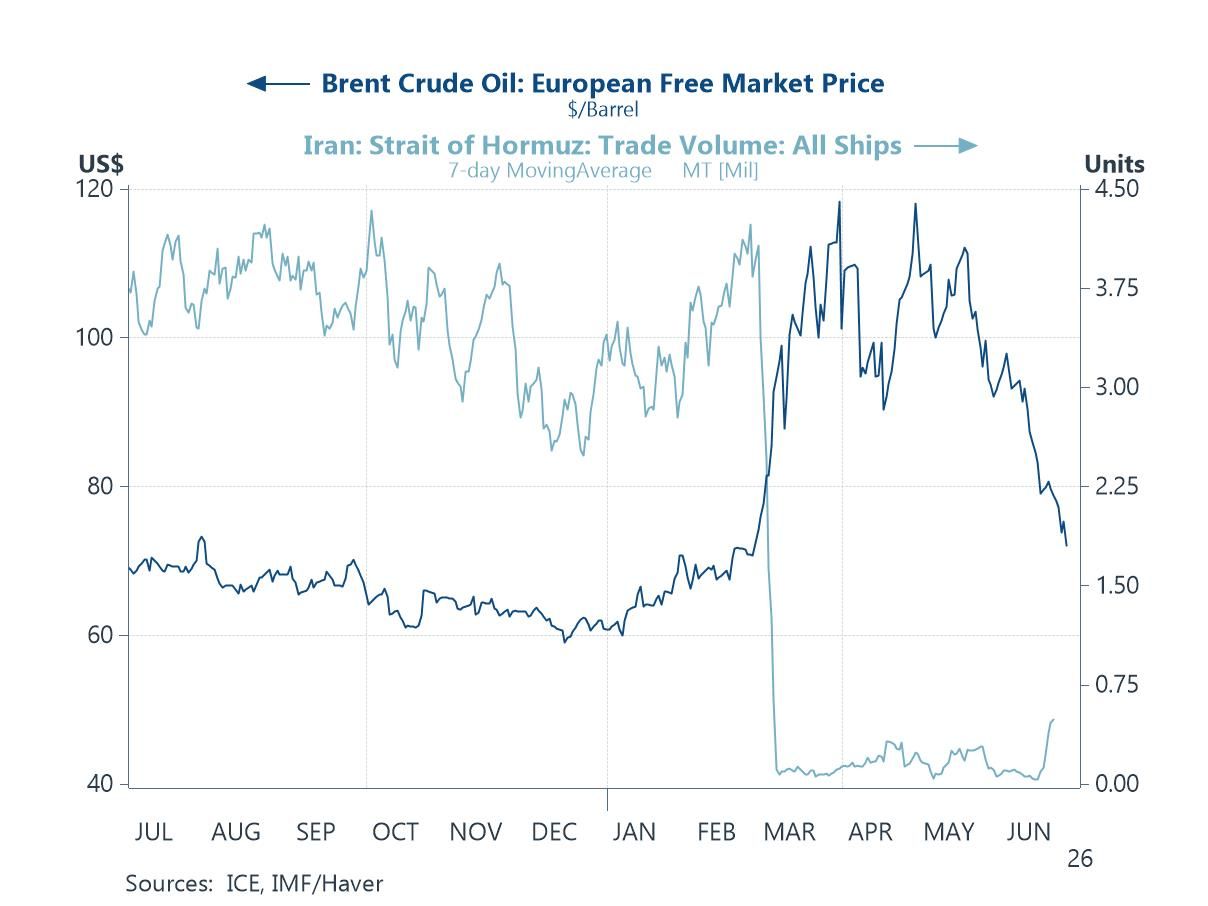
In this week's Letter, we explore the significant pullback in oil prices that followed the US-Iran memorandum of understanding and consider its broader economic implications. The agreement saw a fragile ceasefire ensue and a gradual resumption of shipping flows through the Strait of Hormuz (chart 1). We acknowledge that this major pullback will certainly be welcome to policymakers across the region and beyond. Previously elevated energy prices had added to the fiscal burdens of governments and sharpened the dilemma facing central banks (chart 2). That dilemma pits the need to rein in inflation against the risk of choking off economic growth. That said, while one source of inflationary pressure seems to be ebbing, another looks to be emerging on the horizon. It stems from a potential "Super El Niño" event, which meteorologists have been warning about for some time now. Asia sits at the centre of such risks, as past strong El Niño events have directly and adversely affected crop production (chart 3). The impact is not limited to potential surges in headline inflation via food supply shocks, especially in Asia. It extends directly to growth as well (chart 4), given the nontrivial share of GDP that agriculture still commands in many Asian economies (chart 5). Should price pressures simply rotate from energy to food, government subsidies may follow suit (chart 6). Central bankers, for their part, may find themselves unable to ease off the tightening pedal just yet. Some Asian economies, however, would still manage to offset such a growth shock through other engines. Electronics and semiconductors, buoyed by the current AI upcycle, offer one such cushion for the more fortunate. For others, lacking such offsets, the agricultural hit may simply have to be borne in full.
The US-Iran conflict and oil prices The recent memorandum of understanding between the US and Iran, aimed at working towards a final deal, has already brought visible relief to crude oil markets (chart 1). This relief has held despite the renewed tensions that have followed the agreement, which markets seem to have largely looked past. The easing in prices should go a long way towards unwinding the inflation concerns that elevated oil prices had previously stoked. Much of the pullback reflects anticipation of the substantial supply now expected to return to global markets. Yet some shipping trackers, such as the IMF's, already point to a marked pickup in traffic through the Strait of Hormuz. Even so, those volumes still remain well below the levels seen before the conflict began in the region.
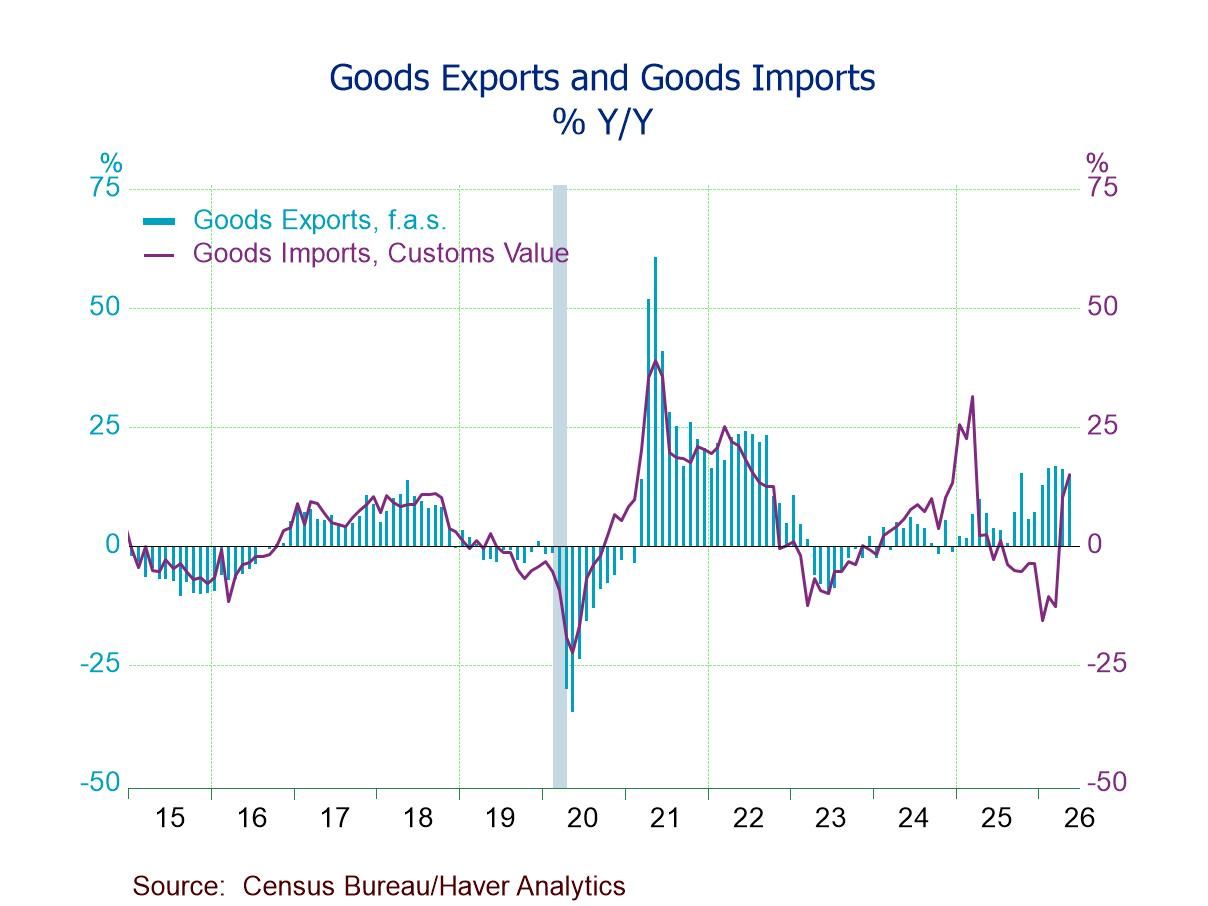
- Deficit: $105.75 bil. in May, up $22.75 bil. (+27.4%) from April’s $83.01 bil.
- Exports -5.4%, first m/m decline since Dec., led by a 9.2% drop in nonauto consumer goods exports.
- Imports +3.6%, fourth straight m/m rise to highest level since Mar. ’25, driven by an 11.5% gain in imports of other goods.
 France| Jun 26 2026
French Industry and Services Confidence Diverge in June
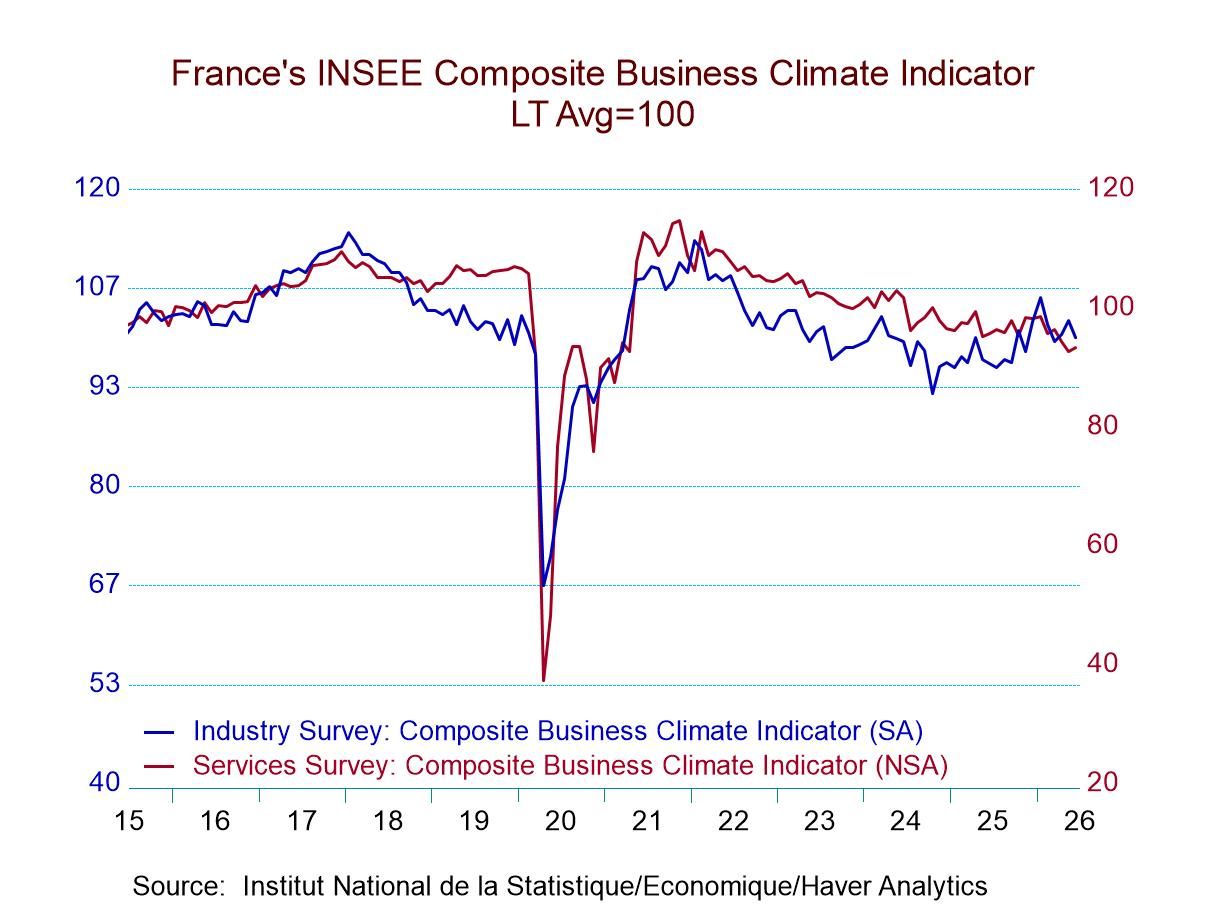
In June, there's a slight divergence in the performance of industry climate and service sector climate, although broadly the two sectors have seen their composite indexes moving in more or less the same direction. Since 2024, the industry survey has moved up slightly after falling faster than the services gauge. The services survey has been locked in a slow trend of deterioration, largely since it reached a peak in 2021 in the wake of COVID.
The industry climate gauge has a 30.8 percentile standing, but the recent production trend, while declining, logs a more substantial 42.8 percentile standing. Contributing survey members find their own industry ‘likely trend’ much weaker, at a 21.2 percentile standing. Demand overall, however, has standings above the 50th percentile, putting overall and foreign orders & demand each above their respective medians for this period of ranking back to 2001. Inventories have a strong 81-percentile ranking. Prices are extremely strong, with 87-percentile and 86-percentile standings for respondents for their personal industry trend for prices as well as for the overarching manufacturing sector estimate of prices. Higher prices seem to be the one thing that everyone can agree on by a large margin.
 Global| Jun 25 2026
Charts of the Week: Calmer Waters, New Currents
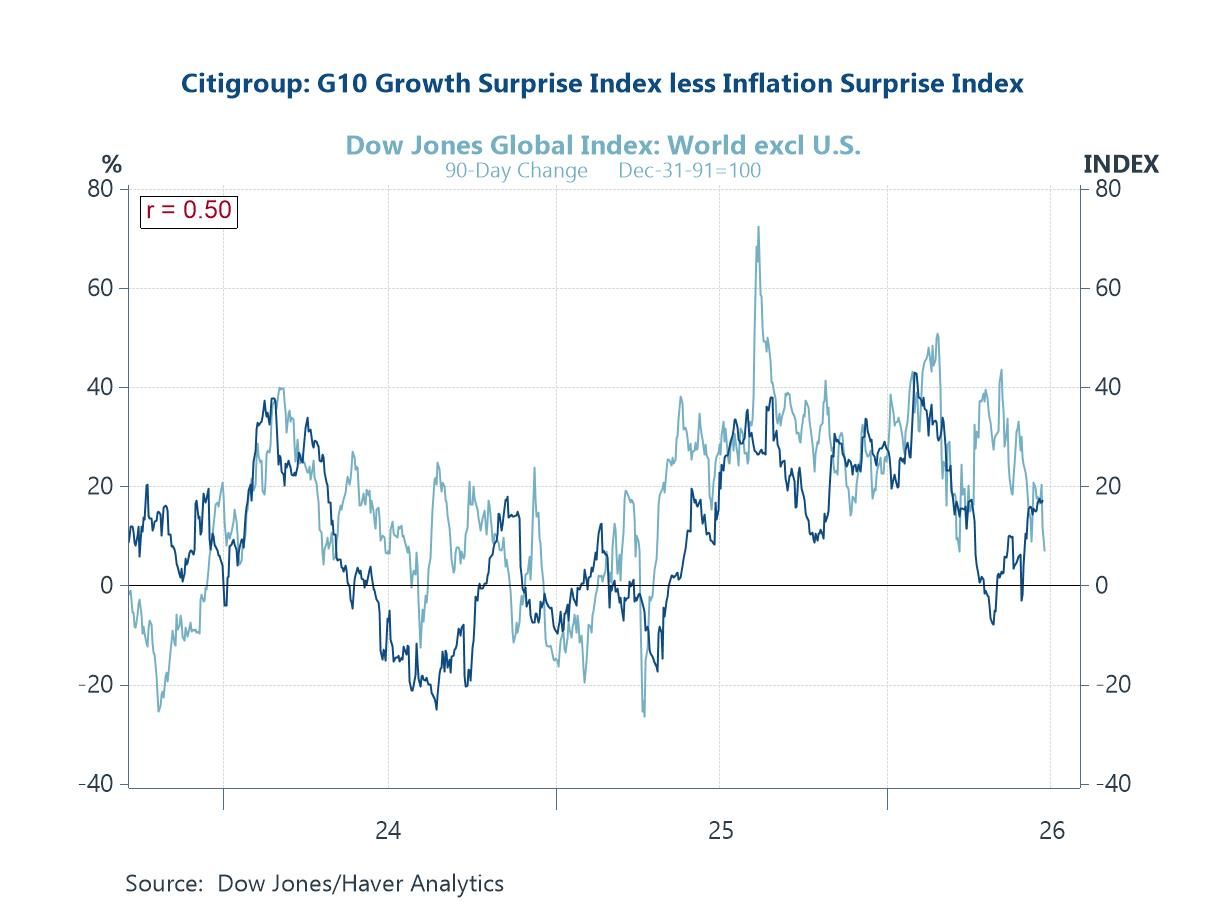
The mood in global financial markets this week is more settled, though “settled” should not be confused with resolved. The US-Iran memorandum of understanding, signed last week, has continued to do its work: oil prices have fallen further, Strait of Hormuz shipping traffic has picked up measurably, and the risk premium that had been embedded in energy markets since the conflict escalated in March is now visibly unwinding. That is a material development for the inflation outlook, and central bankers will be watching carefully. Yet the picture is not without its complications. Technology stocks — the most conspicuous beneficiary of the prevailing low-rate, high-growth narrative — have been subject to renewed jitters this week, as investors grow more attentive to stretched valuations and the implications of a Federal Reserve that, under new chair Kevin Warsh, is no longer signalling the easing cycle previously priced into markets. Against this backdrop, this week’s charts draw on the latest data to assess where the global economic cycle stands. Equity momentum outside the United States has tracked closely with global growth and inflation surprises, a correlation that tells us something important about how activity is being perceived (chart 1). Meanwhile, the breakdown of the previously tight relationship between oil prices and US two-year yields is arguably one of the more telling market signals of recent weeks (chart 2). June’s flash PMI surveys point to easing supply chain stress and softer output price inflation in manufacturing — a finding that chimes naturally with lower crude prices and the resumption of Hormuz flows (chart 3). The Strait of Hormuz itself deserves a closer look: traffic data and the mechanics of the oil price pullback are telling a coherent story that supports the PMI picture (chart 4). South Korea’s trade data, including semiconductors, offer a slightly softer read on global demand momentum at the margin (chart 5). And looming on the horizon, one new risk is drawing the attention of meteorological authorities: a Super El Niño event whose probability has been rising, with potentially significant implications for food commodity prices and Asian agriculture (chart 6).
by:Andrew Cates
|in:Economy in Brief
- of7Go to 1 page