U.S. Consumer Confidence Rebounds in June from a Four-Month Low
Summary
- Headline up 0.6 pts. to 91.2 in June, below expectations; fourth m/m increase in five mths.
- Present Situation Index down 3.0 pts. to 116.4, lowest since Feb. ’21.
- Expectations Index up 3.0 pts. to 74.4, a six-month high.
- Consumers less optimistic about current business & labor market conditions; more upbeat about future business & financial conditions.
- Inflation expectations down to 6.0%, lowest since Feb., as lower oil prices in recent weeks eased consumer inflation fears.
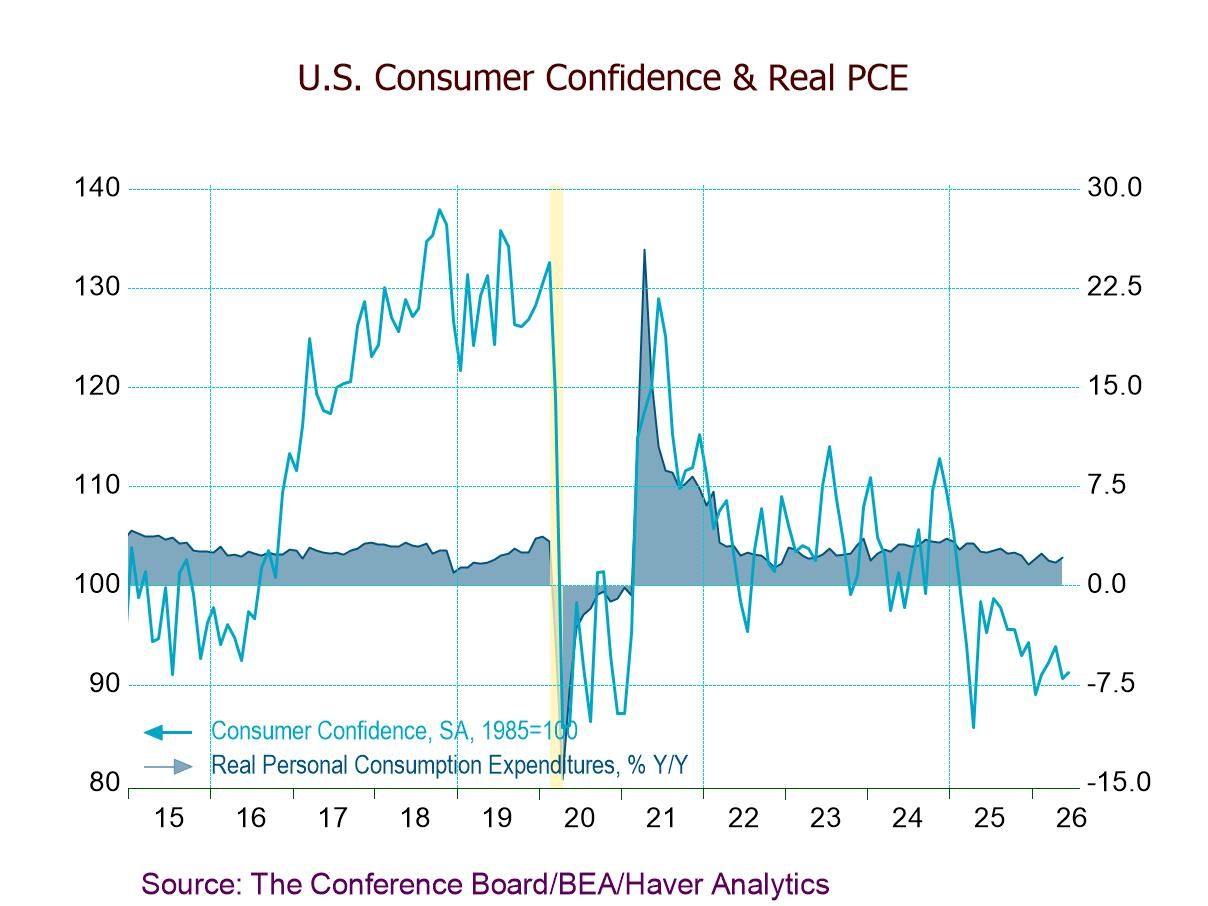
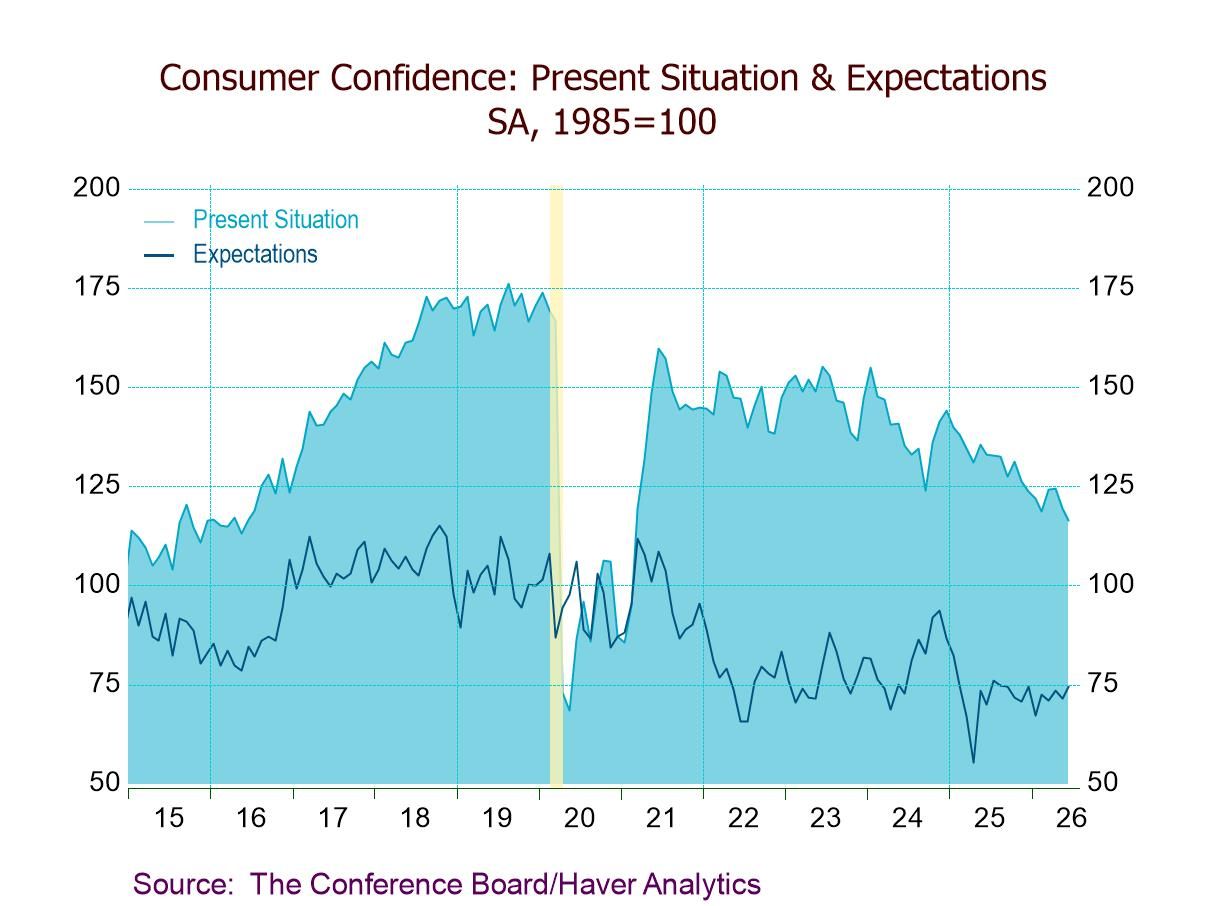
The Conference Board U.S. Consumer Confidence Index rose 0.7% m/m (-4.2% y/y) to a lower-than-expected 91.2 in June, the fourth monthly rise in five months, after a downwardly revised 3.4% decline to a four-month-low 90.6 in May (-0.7%; 93.1 initially). A reading of 94.3 had been expected in the Action Economics Forecast Survey. The June reading was 6.4% above a low of 85.7 in April 2025 but down from 95.2 in June 2025 and 19.1% below a high of 112.8 in November 2024.
Consumers' views of present economic conditions weakened for the second consecutive month in June, while the views of future economic conditions improved m/m. The Present Situation Index—which assesses current business and labor market conditions—fell 2.5% m/m (-12.5% y/y) to 116.4 in June, the lowest level since February 2021, following a 4.0% drop to 119.4 in May and two successive m/m increases. The index was lower than 133.0 in June 2025 and 25.0% below a high of 155.3 in June 2023. The Expectations Index—which measures the short-term outlook for income, business, and labor market conditions—rose 4.2% m/m (6.4% y/y) to 74.4 this month, the highest level since December and the second increase in three months, after a 2.7% decline to 71.4 in May. The index was higher than 69.9 in June 2025, while 20.6% below a high of 93.7 in November 2024.
Labor market readings showed less optimism this month. The jobs gap—representing the difference between respondents indicating that jobs are plentiful and those saying jobs are hard to get—dropped to 2.4% in June, the lowest reading since February 2021, from 5.0% in May. Calculated by Haver Analytics, this series had an 85% correlation with the unemployment rate over the last 20 years. The jobs plentiful measure inched up to 24.9% of respondents in June from 24.8% in May (the lowest since February 2021). Perceptions of the current labor market weakened, with the jobs hard-to-get measure rising to 22.5% this month, the highest level since January 2021, from 19.8% in May.
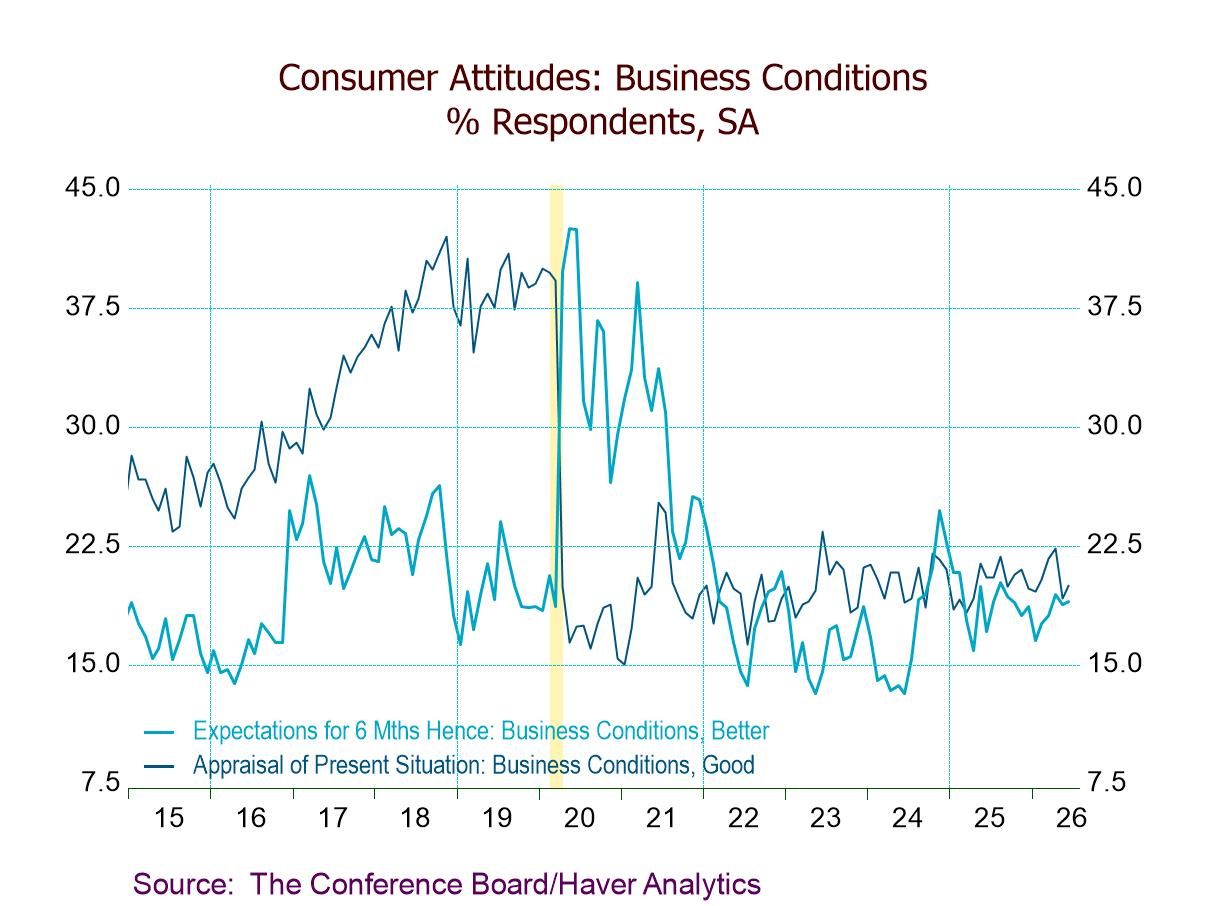
Consumers generally viewed business conditions as slightly more favorable compared to last month. Current business conditions were perceived as good by 20.0% of respondents in June, up from 19.2% in May but below a high of 23.4% in June 2023. Expectations that business conditions would improve in six months were 19.0% of respondents, up from 18.8% in May but below a high of 24.7% in November 2024. More jobs were expected in six months by 15.2% of respondents, slightly down from 16.6% in May and below a high of 22.8% in November 2024. The percentage expecting rising income rose to 20.8% in June from 19.2% in May, the highest since February 2020 and above a low of 14.4% in February 2023.
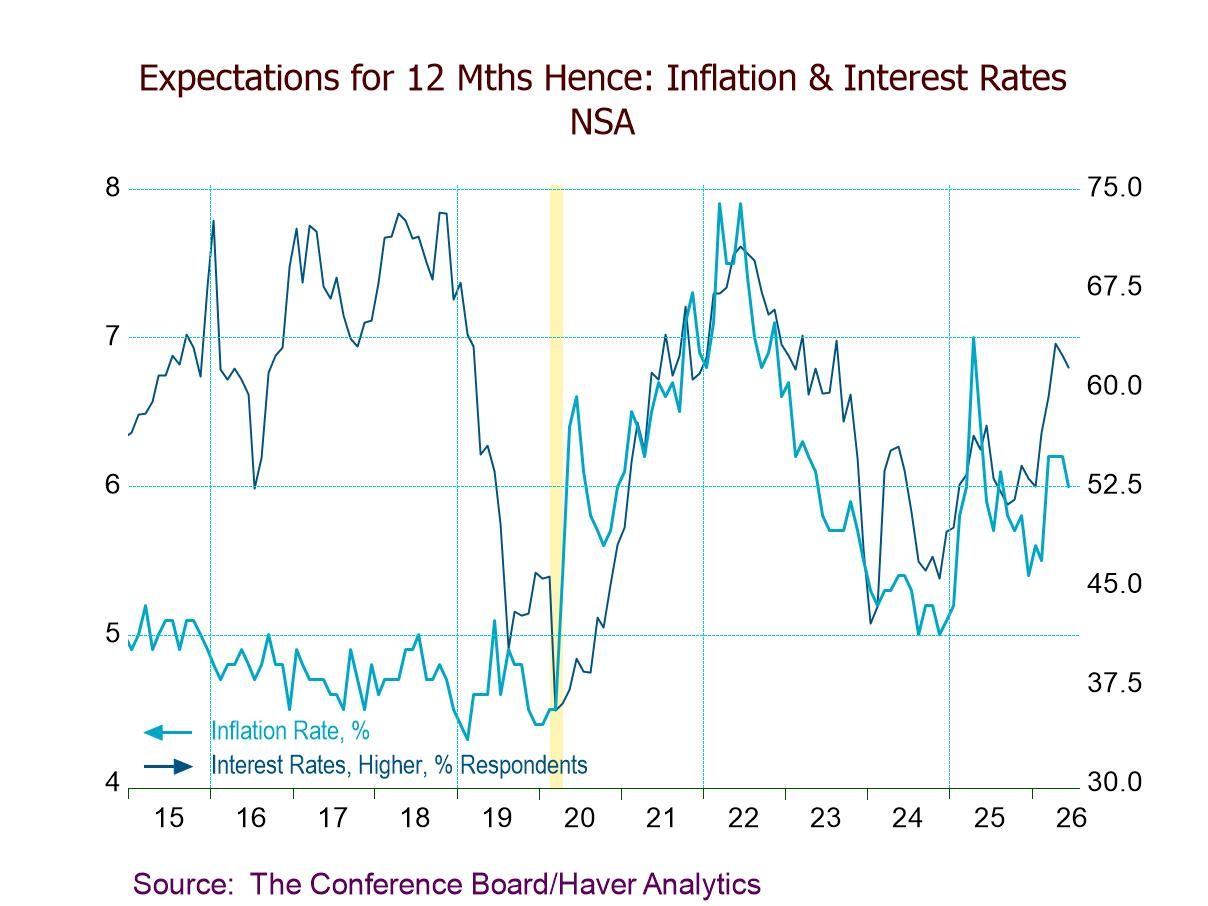
Inflation expectations eased this month but remained elevated. The expected inflation rate in twelve months slipped to 6.0% in June, the lowest since February, after holding at 6.2% for three straight months. The latest reading was below a high of 7.0% in April 2025 but above a low of 5.0% in November 2024. In June, 61.5% of respondents expected that interest rates would rise over the next twelve months, down from 62.4% in May but up from 42.1% in January 2024.
The share of respondents planning to buy a home within six months rebounded to 6.6% in June from 6.5% in May. It was below its most recent high of 7.0% in April but above a low of 4.6% in February 2024. Those planning to buy automobiles rose to 13.3% of respondents this month from 12.6% in May; it was up from a low of 10.6% in April 2025. Meanwhile, the share of respondents planning a vacation within six months declined to 39.1%, the lowest since April 2021, from 41.4% in May.
The Consumer Confidence data are available in Haver’s CBDB database. The total indexes, which are indexed to 1985=100, appear in USECON, and market expectations are in AS1REPNA.

Winnie Tapasanun
AuthorMore in Author Profile »Winnie Tapasanun has been working for Haver Analytics since 2013. She has 20+ years of working in the financial services industry. As Vice President and Economic Analyst at Globicus International, Inc., a New York-based company specializing in macroeconomics and financial markets, Winnie oversaw the company’s business operations, managed financial and economic data, and wrote daily reports on macroeconomics and financial markets. Prior to working at Globicus, she was Investment Promotion Officer at the New York Office of the Thailand Board of Investment (BOI) where she wrote monthly reports on the U.S. economic outlook, wrote reports on the outlook of key U.S. industries, and assisted investors on doing business and investment in Thailand. Prior to joining the BOI, she was Adjunct Professor teaching International Political Economy/International Relations at the City College of New York. Prior to her teaching experience at the CCNY, Winnie successfully completed internships at the United Nations. Winnie holds an MA Degree from Long Island University, New York. She also did graduate studies at Columbia University in the City of New York and doctoral requirements at the Graduate Center of the City University of New York. Her areas of specialization are international political economy, macroeconomics, financial markets, political economy, international relations, and business development/business strategy. Her regional specialization includes, but not limited to, Southeast Asia and East Asia. Winnie is bilingual in English and Thai with competency in French. She loves to travel (~30 countries) to better understand each country’s unique economy, fascinating culture and people as well as the global economy as a whole.
More Economy in Brief
 Global