Large EU Economies Show Some Inflation Cooling
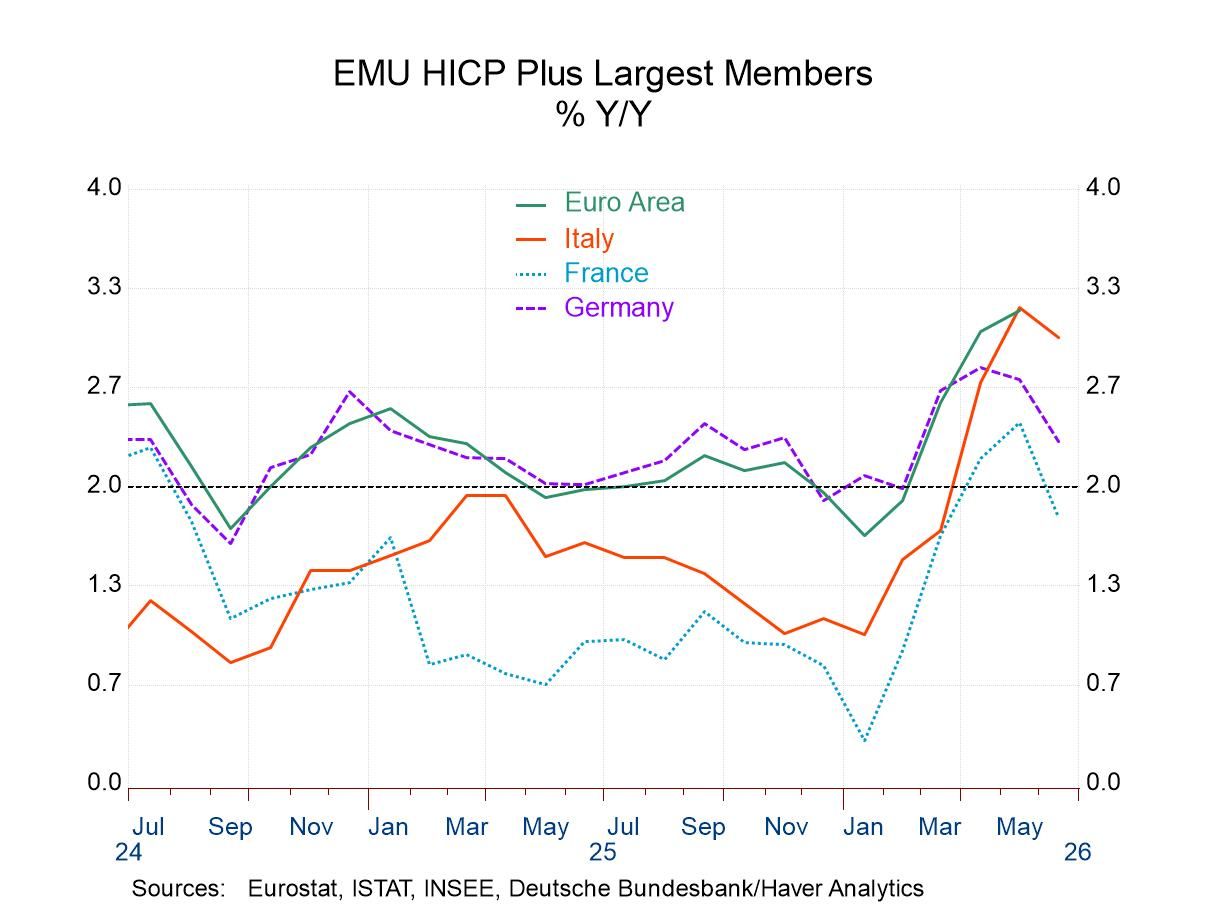
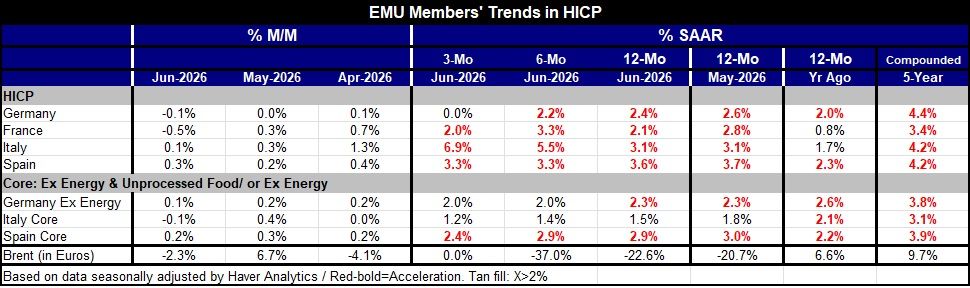
Some inflation progress, but not enough: The headline HICP in June for the largest monetary union economies have largely broken lower, with the exception of Spain. The German headline HICP fell by 0.1% in June after being flat in May. In France, the price index fell by 0.5% in June after growing by 0.3% in May. In Italy, the June index rose by 0.1% after rising by 0.3% in May. In Spain, June brought a 0.3% increase after a 0.2% increase in May.
Core or ex-energy (Germany): The core inflation readings are available for Germany, Italy, and Spain. In the case of Germany, it's an index excluding energy only. June brought a 0.1% increase for the German index, a 0.1% decline for Italy's core index, and a 0.2% increase for Spain’s core measure. On balance, these are a good collection of results from the standpoint of the ECB that has an inflation target of 2% for the European Monetary Union as a whole, but no guidance for individual countries.
Sequentially: Sequentially, the headline inflation rate shows progress in Germany and France, while excesses are stubborn in Italy and Spain. Over 12 months, all the inflation rates are excessive, but France is only technically excessive and probably acceptable at 2.1% year-over-year. Germany's increase over 12 months is 2.4%, Italy's is 3.1%, and Spain’s is 3.6%. The progression of inflation from 12-months to 6-months to 3-months shows accelerations over six months compared to 12 months for France and Italy, while Germany and Spain show decelerations. However, Spain's six-month inflation rate is still 3.3%. Germany has dropped to 2.2%, France is at 3.3%, and Italy has jumped up to 5.5%. Over three months, the German headline inflation rate is zero and France has fallen to 2%, but in Italy’s headline pace has accelerated to 6.9% and Spain remains at 3.3%. These are all compounded rates of change over three months.
Three-month trends are mixed: None of this is really surprising since oil prices have been surging over the period and are now starting to decline. Over 12 months, the oil price is down by 22.6%; over six months, it’s down by 37% at an annual rate; and over three months, the oil price is flat. Much of this price action is still quite recent. These figures are for Brent crude measured in euros. Over three months, German inflation is flat for the headline HICP, while France’s inflation rate is down to 2%. In Italy, the three-month pace is 6.9%; in Spain it’s at 3.3%. Headline inflation still has a somewhat erratic performance over three months, although it's quite acceptable in Germany and France and quite not acceptable in Italy and Spain.
Core inflation is lower but still too high: Core inflation shows much more moderation because the behavior of energy prices leaves core inflation largely unaffected. If the core is affected, it occurs only after a more substantial knock-on effects from other industries. German ex-energy inflation is at 2.3% over 12 months and then settles down to a 2% annualized pace over six months and three months. Italian core inflation is golden on all three periods, at 1.5% over 12 months, down to 1.4% over six months, and down to 1.2% over three months. Spain's core inflation is excessive, although it is making progress toward a more agreeable rate from a European standpoint. Spain’s core inflation is 2.9% over 12 months, remains at 2.9% over six months, then decelerates to a 2.4% annualized rate over three months.
Policy: The ECB has already started to raise rates and warned that there could be more ahead, depending on circumstances. However, we are seeing signs here that inflation is beginning to behave, particularly for the core measures. We could see the headlines improve more dramatically if oil prices continue to drop as they have been. Growth in the European area has been mixed on the continent; in the United Kingdom, growth is showing signs of weakening as the U.K. inflation rate has dropped rather sharply.
Outlook: The outlook is still guarded. There continues to be a war in Ukraine and unsettled conditions in the Middle East, including concerns over the Strait of Hormuz where Iran continues to say that it wants to be in control of traffic through the Strait. That position doesn't seem likely to be palatable to the U.S, although time will tell what kind of deal, if any, emerges from that conflict. Inflation developments are going to depend importantly on what happens with oil and how open the Strait becomes. As we can see, Germany and Italy already present relatively controlled core inflation rates. The rest of the monetary union should follow suit as all prices should continue to behave and follow oil prices lower. It has been a long period with inflation misbehaving. The core and ex-energy inflation statistics show us that over the last five years, Germany has had a compounded ex-energy inflation rate of 3.8%, Italy 3.1%, and Spain 3.9%. These are readings excluding energy and over that five-year period. Oil and energy are not the only price concerns. Energy prices had a compounded annual rate increase of 9.7% over the last five years. Monetary policy has gotten far behind where it's supposed to be and has allowed prices to rise far more than they should have. Central banks need to pay more attention to hitting their inflation targets in the future; they can't keep missing to this extent and convince anybody that they have a viable credible inflation target at 2%.

Robert Brusca
AuthorMore in Author Profile »Robert A. Brusca is Chief Economist of Fact and Opinion Economics, a consulting firm he founded in Manhattan. He has been an economist on Wall Street for over 25 years. He has visited central banking and large institutional clients in over 30 countries in his career as an economist. Mr. Brusca was a Divisional Research Chief at the Federal Reserve Bank of NY (Chief of the International Financial markets Division), a Fed Watcher at Irving Trust and Chief Economist at Nikko Securities International. He is widely quoted and appears in various media. Mr. Brusca holds an MA and Ph.D. in economics from Michigan State University and a BA in Economics from the University of Michigan. His research pursues his strong interests in non aligned policy economics as well as international economics. FAO Economics’ research targets investors to assist them in making better investment decisions in stocks, bonds and in a variety of international assets. The company does not manage money and has no conflicts in giving economic advice.
More Economy in Brief
 Global