

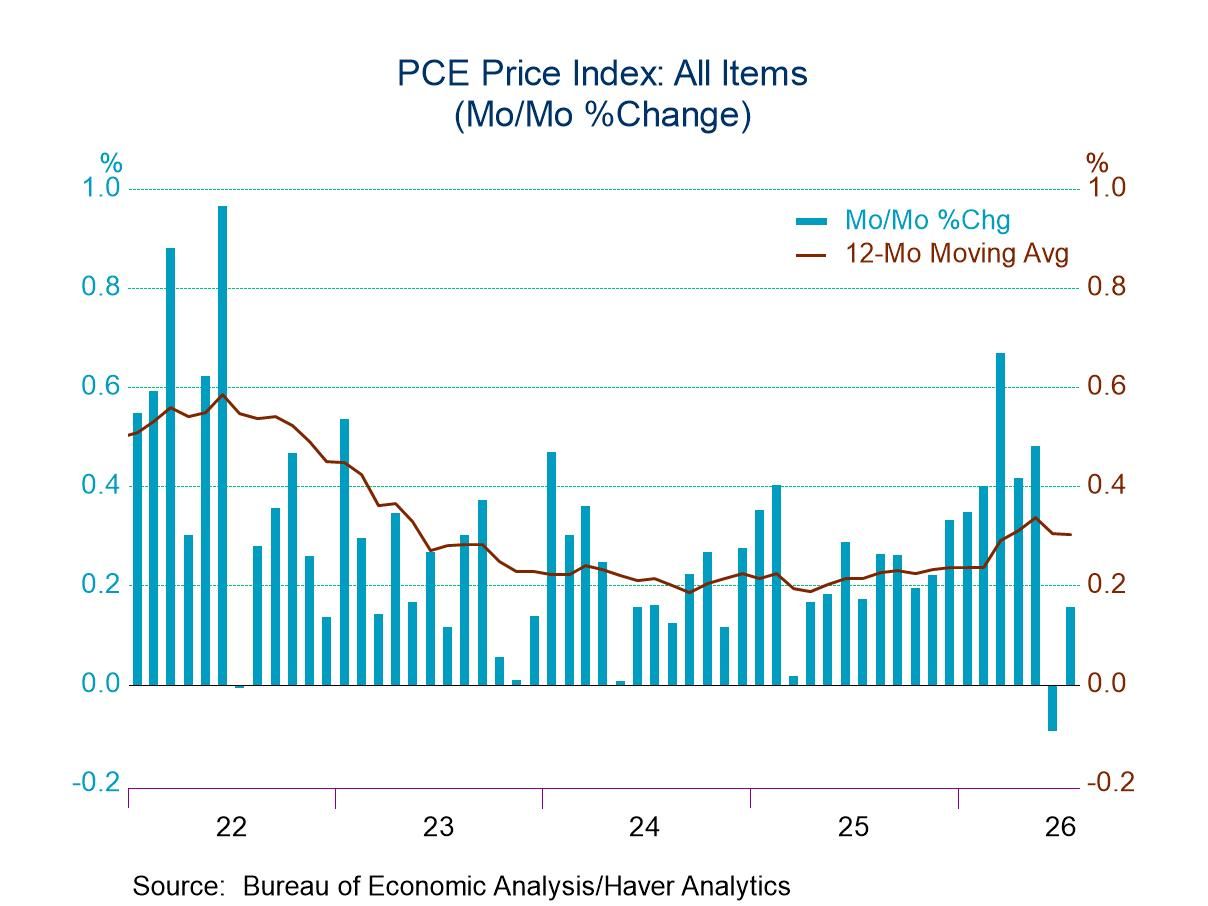
- Headline and Core PCE price measures cooled in the last two months.
- Real spending stalled in July.
- Saving uptick should be viewed as a pause in the downtrend.
 USA| Aug 26 2026
U.S. Income and Spending: Inflation Progress Amid Spending Stall
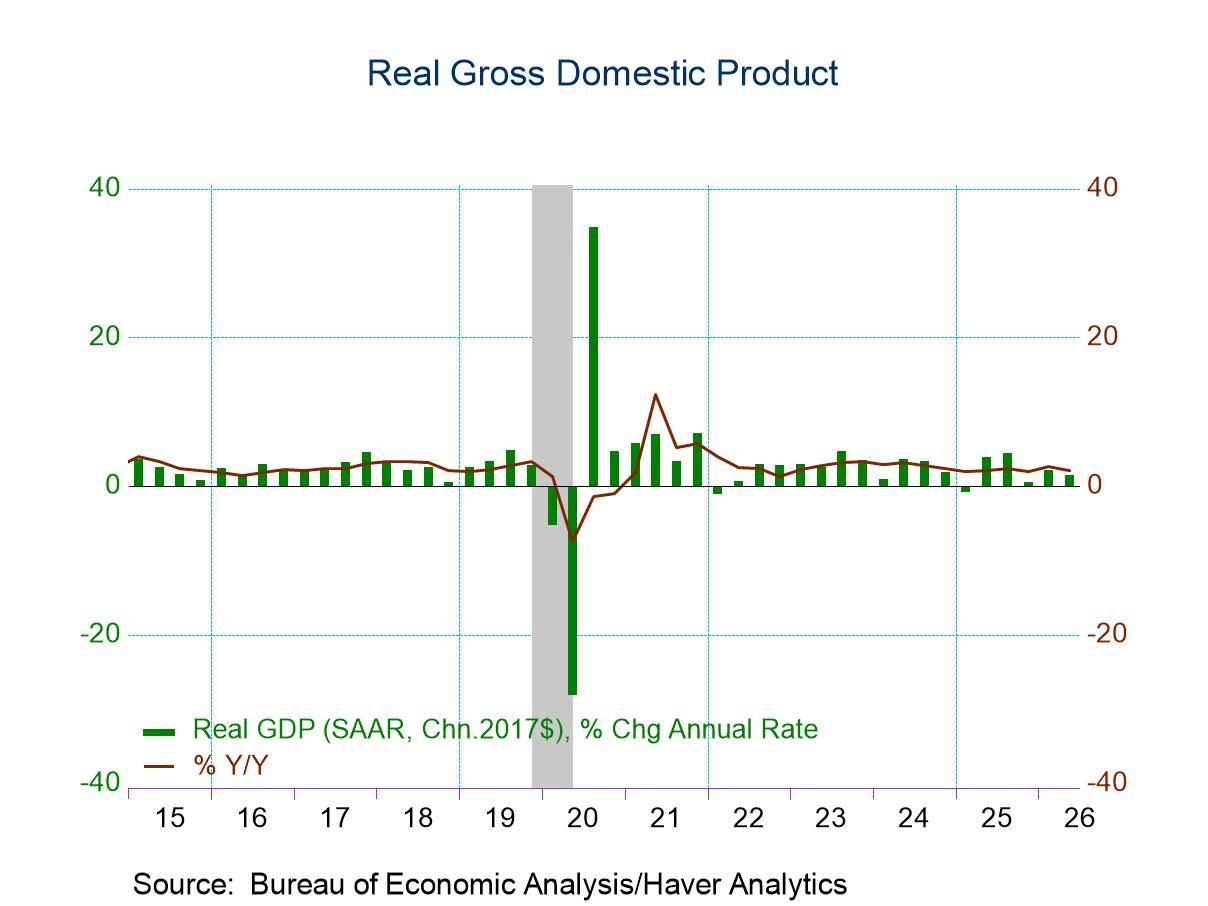
- The 1.5% q/q saar increase in real GDP reported in the advance report was not revised in the second estimate.
- Inventory investment and net exports continued to be meaningful drags on overall growth.
- The strong domestic demand growth reported in the advance report was revised even stronger.
- Corporate profits surged 9.1% q/q not annualized in Q2, the fastest quarterly advance since Q2 2021.
by:Sandy Batten
|in:Economy in Brief
 Global| Aug 26 2026
Charts of the Week: Resilient Growth, Restless Yields
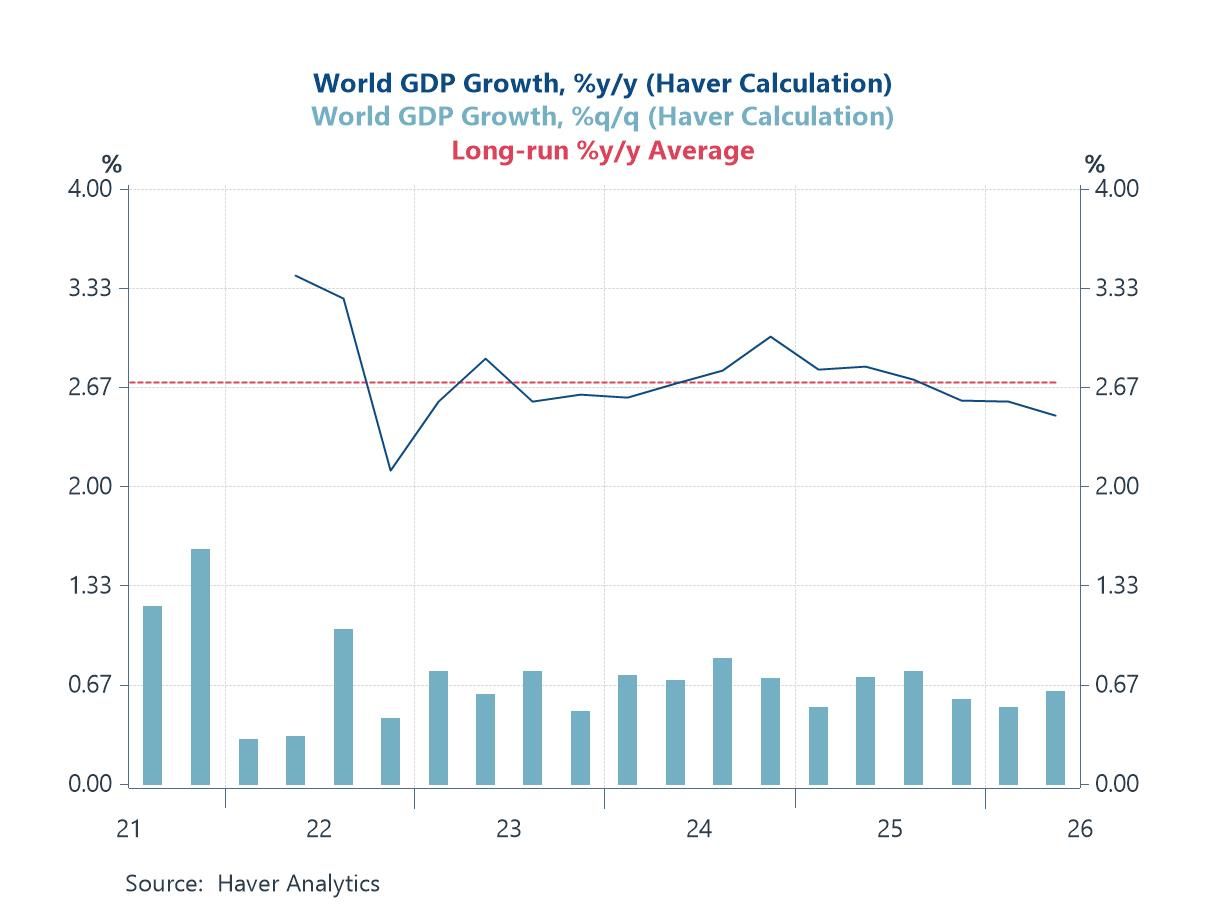
A dominant anxiety in financial markets remains the level of long-term interest rates. It is worth beginning, though, with the real economy, where the news of recent days has been more reassuring. Haver’s proprietary calculation of world GDP growth suggests the global economy held up well in the second quarter, expanding at close to its long-run average pace and defying the sharper slowdown many had feared (chart 1). The August flash purchasing managers’ indices tell a similar story, with most of the major economies both in expansion and still improving — though, as ever, the composite readings conceal a more uneven picture beneath (chart 2). From South Korea, whose trade figures are among the world’s most timely, comes the same message, and a pointed one about the artificial-intelligence boom: semiconductor exports have continued to surge (chart 3). Yet the market’s gaze stays fixed on US yields, and a decomposition explains why they are being watched so closely — the rise has come overwhelmingly from the real component, not from any meaningful revival of inflation expectations (chart 4). That, one might argue, is not a passing technical matter but a structural one, rooted in who is willing to fund the US government. The rest of the world now funds a steadily shrinking share of its debt (chart 5), and the surplus nations that once recycled their savings into Treasuries are turning, instead, to gold (chart 6). It is against this backdrop that Treasury Secretary Scott Bessent's recent remarks that the government may intervene in the market to support its debt have drawn attention.
by:Andrew Cates
|in:Economy in Brief
 USA| Aug 26 2026
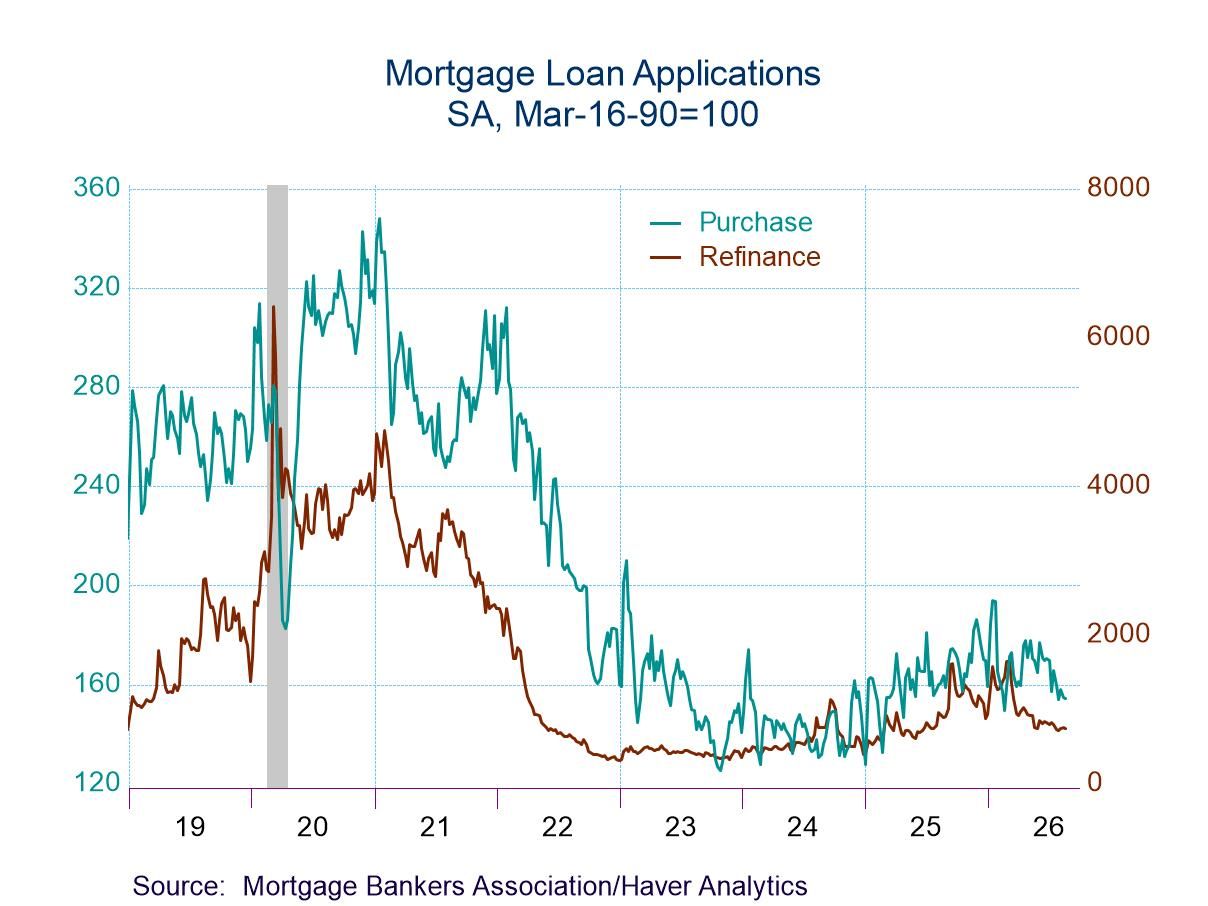
U.S. Mortgage Applications Fell in the August 21 Week
- Both applications for loans to purchase and for loan refinancing declined in the latest week.
- Interest rate on 30-year fixed-rate loans edged up 1bp to 6.97%.
- Average loan size inched up in the August 21 week.
 USA| Aug 25 2026
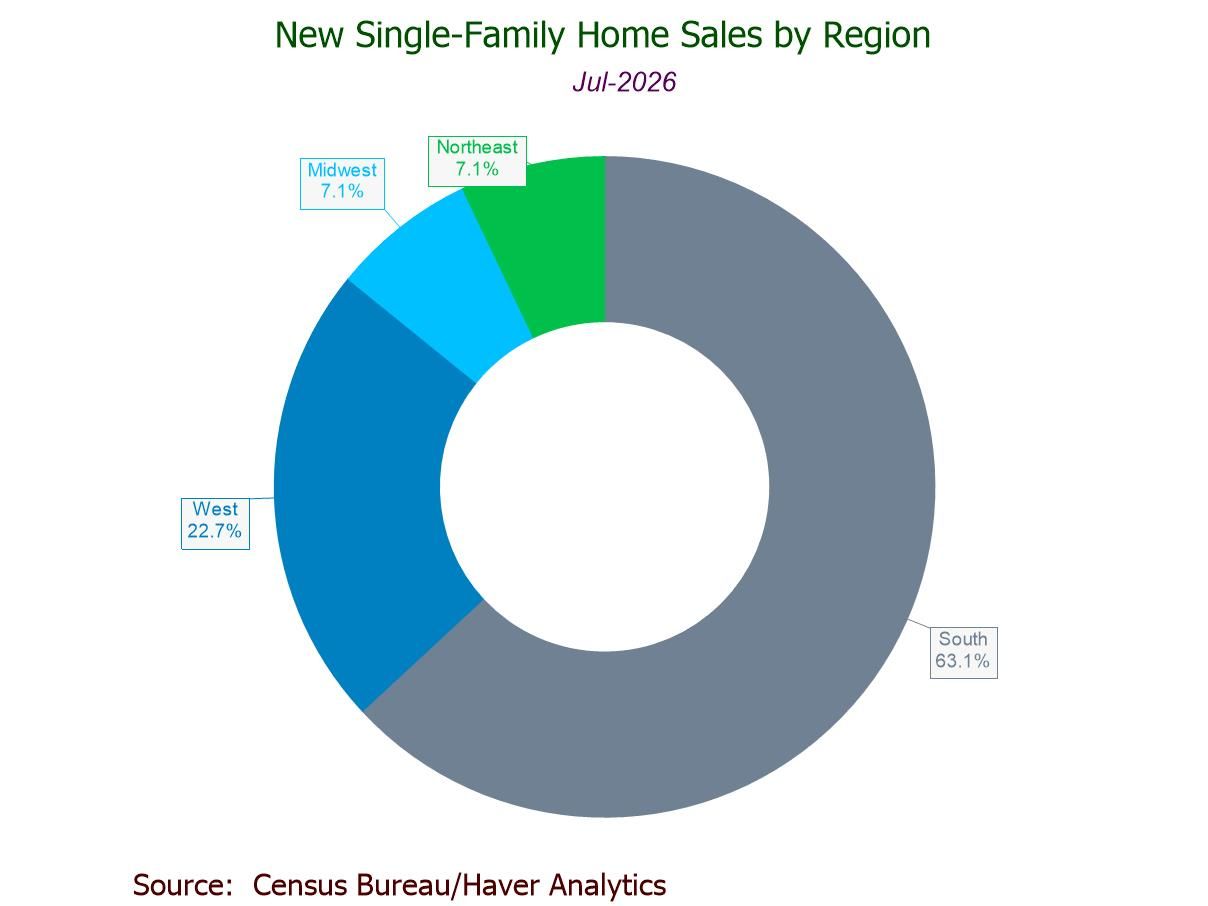
U.S. New Home Sales Hit a Six-Month Low in July
- Sales -10.5% m/m (-6.3% y/y) to 607,000 in July; down 19.8% from a November high.
- Sales m/m down in the Midwest (-42.7%) and South (-13.0%); up in the Northeast (+30.3%) and West (+6.2%).
- Sales y/y plunging in the Midwest (-50.6%); surging in the Northeast (+95.5%).
- Median sales price -2.3% m/m to $393,800, a five-year low; avg. price +4.1% m/m to $508,800.
- Unsold inventory +1.9% m/m (-1.6% y/y) to 488,000, highest since Oct. '25.
- Months' supply up to 9.6 mths., a six-month high.
 USA| Aug 24 2026
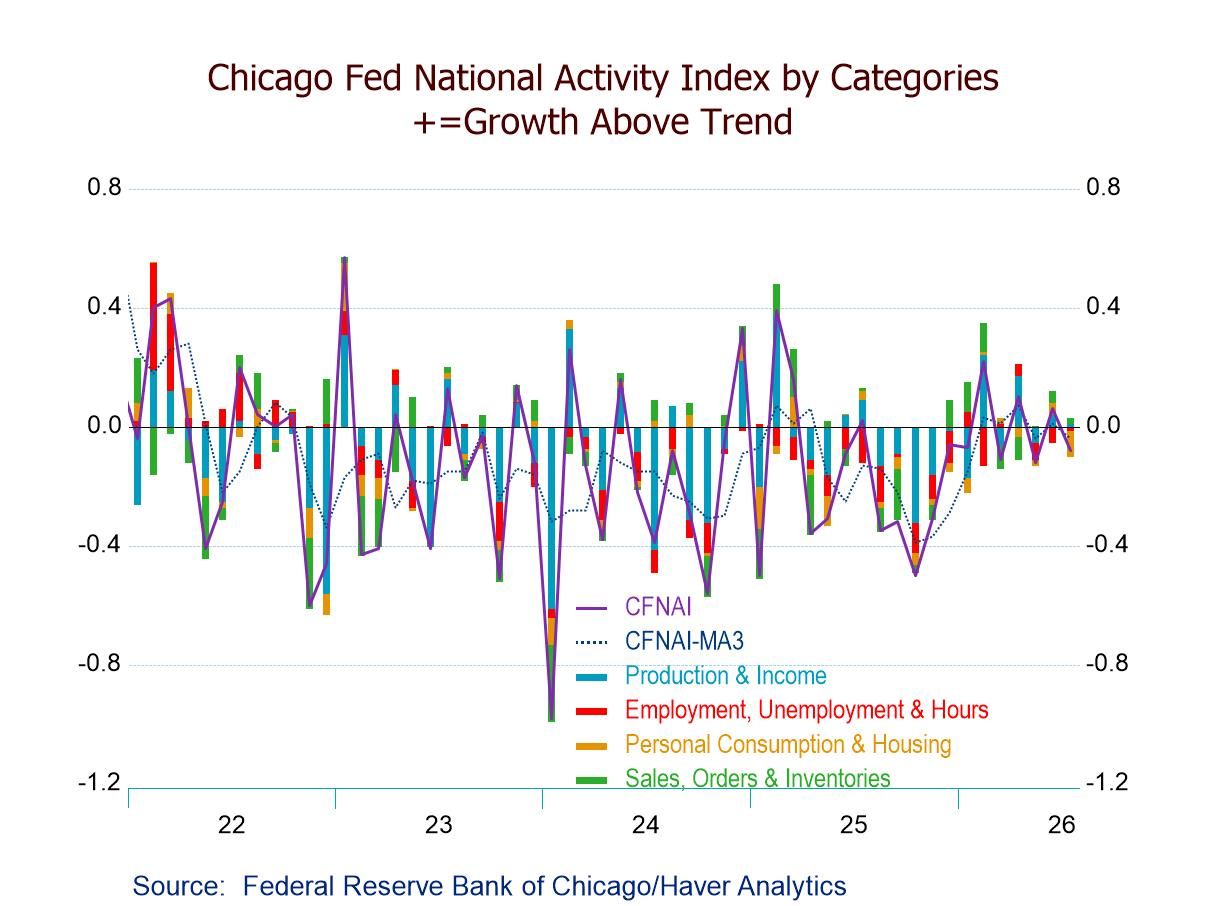
Chicago Fed National Activity Index Negative in July After June’s Upwardly Revised Positive Reading
- CFNAI down to -0.08 in July, negative for the second time in three months.
- Three of four CFNAI components down m/m; two make negative contributions.
- CFNAI-MA3 down to -0.04, second negative reading in three mths.; still above -0.70 (recession signal).
- CFNAI Diffusion Index down to +0.05, remaining positive for the fourth time in five mths.
 Sweden| Aug 24 2026
Sweden’s Housing Market Shows Signs of Life
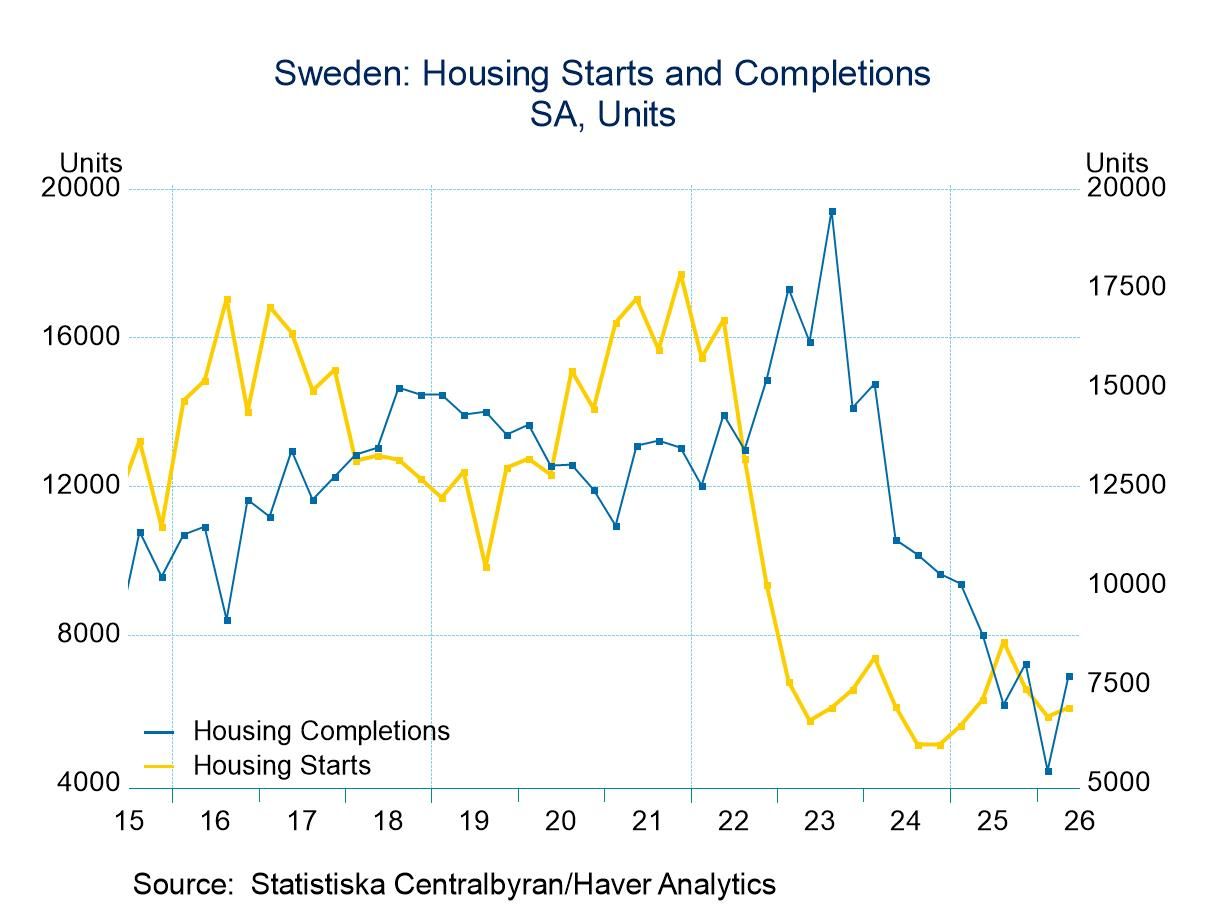
Sweden ended its rate cutting back in the third quarter of 2025. Since then, housing prices have drifted higher. However, housing activity, starts, have had a minor bounce from their lows but no real recovery. Starts are still well below their 2015-2022 levels. But the pace of decline has slowed and given way to oscillation and stability.
Sweden’s inflation rate has fallen back down to its pre-Covid pace. Inflation is no longer a problem there as the headline and core rates for two consecutive quarters are below the 2% mark and look comfortable there. House prices have stabilized. There has not been a year-on-year drop in house prices since 2024-Q1.
Housing completions in this environment have a one-quarter bounce. It’s too early to call this a bottom in completions, but we do have what looks like a spike low in completions. With housing prices creeping back up, having risen for three quarters in a row, the market is beginning to look firmer.
The economy is back in gear, with industrial production rising as of the end of 2024 and logging growth rates of over 4% year-over-year, even after slowing from its rapid recovery from mid-2024 to 2025-Q3.
Sweden shows the signs of having a soft landing in the wake of all the Covid excesses, even with the post-Covid War in Ukraine and the more recent bottlenecks for energy and other supplies in the Strait of Hormuz. Only time will tell if the authorities can continue this run of good policy results.
Monetary policy seems well positioned, with the policy interest rate less than a percentage point above the inflation rate but more than one and one-half percentage points above the core rate of inflation. Interest rates in Sweden were last dropped in late 2025.
Sweden is less affected by the complications in the Middle East and principally uses fossil fuels in its economy to fuel transportation. Apart from that, it has a rich resource of hydro, nuclear, and green energy. This helps give it a buffer against the rollicking prices in the global energy sector and to buffer it from some of that uncertainty.
 Asia| Aug 24 2026
Economic Letter from Asia: Heating Up
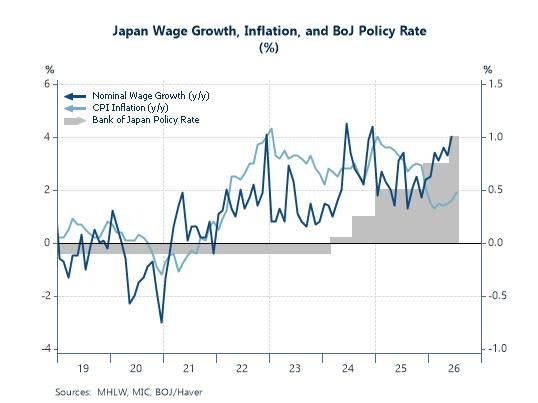
In this week's Letter, we examine how Japan's hard-won reflation is being tested by an energy shock and a fiscal turn. Japan has come a long way in achieving substantive inflation and, more recently, real wage growth, substantiating its tightening cycle (chart 1). Q2 real GDP growth nonetheless underwhelmed, dragged partly by a slump in public inventories that may prove one-off (chart 2). More discouraging was private consumption, whose contribution to growth was flat over the quarter. Delving into the household picture, real spending has continued to shrink despite real wage gains in recent months (chart 3). Elevated energy prices appear to be affecting household behaviour, stalling the translation of higher wages into domestic demand-led growth.
Recent market moves have reflected other drivers, including renewed yen weakness after a short-lived appreciation prompted by intervention. Government bond yields have surged, reflecting both tightening expectations and concerns over Japan's fiscal health, in a climb extending well beyond Japan (chart 4). One potential offset to elevated global oil prices is domestic, and it lies in rice. Last year's constrained supply has evolved into a glut this year, with prices diving (chart 5). Given rice's weight in the consumption basket, the deflationary effects may be significant. Lastly, we turn to fiscal prospects, with talk of the 2027 budget already underway. Investors are watchful of the cabinet's expansionary bias, and how increased spending and food tax cuts may lift bond issuance, with details still scant at this juncture (chart 6).
Japan’s state of play Japan has already managed to get many things going in its favour. After decades of low to negative inflation, consumer inflation rose above 2%, though it has since eased to just above 1% (chart 1). Accompanying the pickup in price pressures is wage growth, which has risen in nominal terms over recent years. Only more recently has it grown in excess of consumer inflation, indicating an interim period of real wage growth that generally benefits households. Sustained inflation alongside wage growth is what the Bank of Japan has long sought. With such conditions among others fulfilled, the central bank had some justification to begin normalising monetary policy, with its latest rate hike in June this year. Complications nonetheless remain. Persisting tensions between the US and Iran are keeping oil prices elevated, threatening to upend Japan's recovery in its domestic sector. They have also prompted government measures to support growth and help households tide through price increases. Those measures have drawn their own concerns, especially over Japan's fiscal health, which we discuss in more detail later.
- of62Go to 7 page