

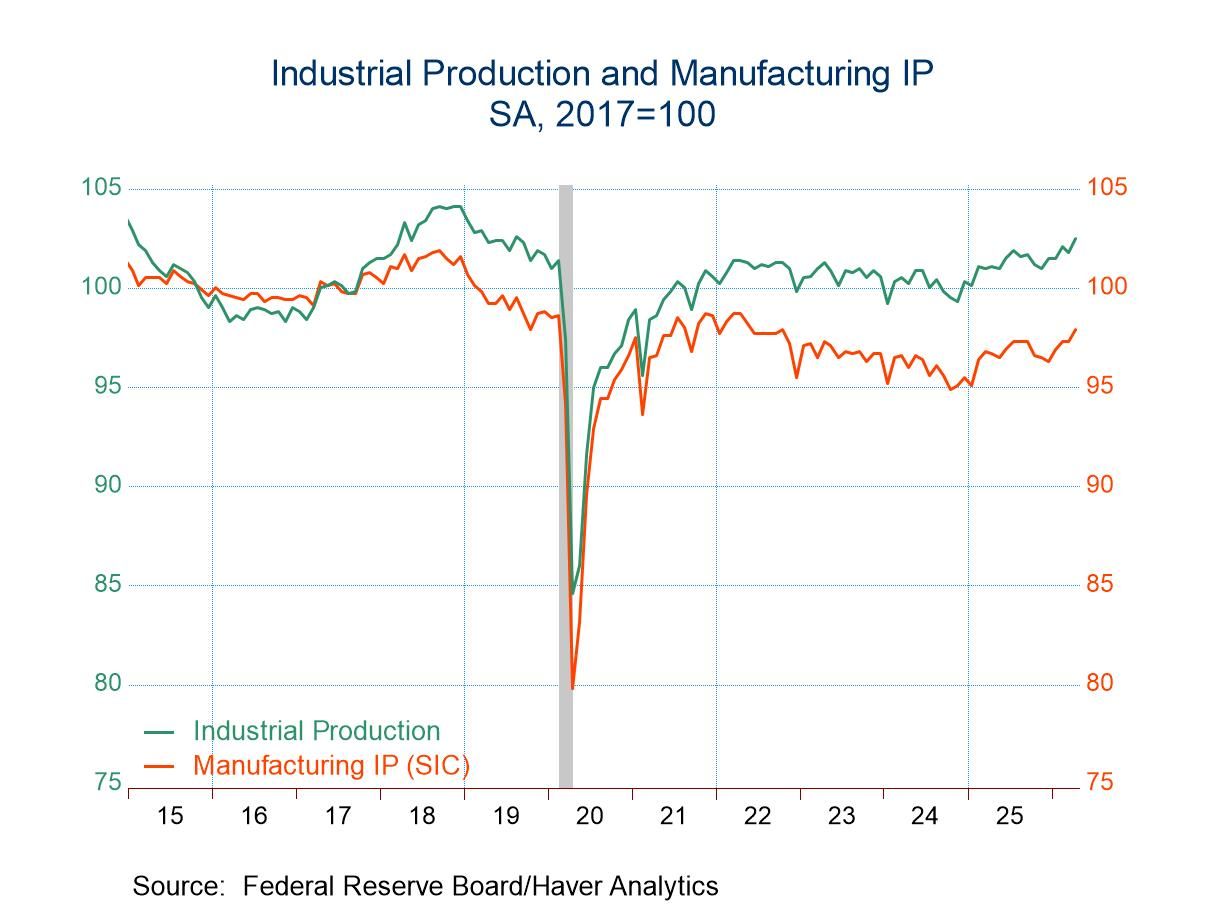
- Total industrial output increased a much larger-than-expected 0.7% m/m in April with a small upward revision to March.
- Manufacturing output increased 0.6% m/m, led by a 5.3% m/m rebound in vehicle production.
- Mining output edged down 0.1% m/m, while utilities production rose 1.9% m/m.
- The headline rate of capacity utilization rose to 76.1% in April, its highest reading since last August but still well below its long-term average.
 USA| May 15 2026
U.S. Industrial Production Jumped in April
by:Sandy Batten
|in:Economy in Brief
 Canada| May 15 2026
Canadian Industry Perks Up
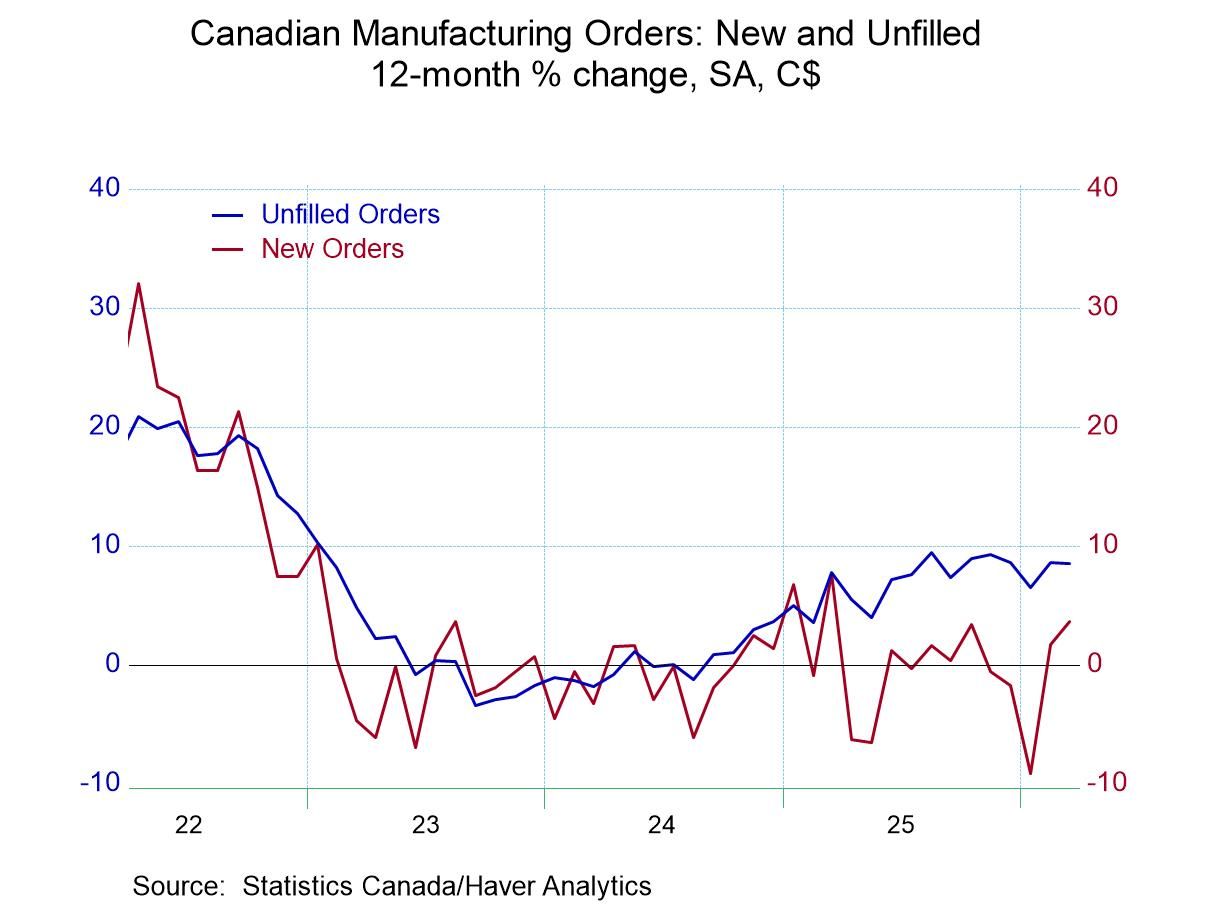
Industrial orders in Canada are back on an expansion path with orders growing 4.7% in March on top of a 6.9% gain in February. These statistics chronicle Canadian orders digging out from a hole they fell into early in 2026. Now the data show emerging sequential growth in Canadian orders, which are advancing 3.6% over 12 months at a 14.9% annual rate over six-months, and a 26.7% annual rate over three-months. Still, on the chart that plots the year-over-year growth rates these recent accelerated rates of growth appear as mere recoveries from what had been earlier weakness. It remains to be seen how much acceleration the Canadian economy will actually undergo.
Unfilled orders expanded in March for the second month in a row, growing 2.4% after growing 1.4% in February once again following the recovery theme.
Manufacturing shipments grew by 3% in March after growing 3.4% in February and after dropping sharply in January - again echoing the recovery theme. Durable goods show two months of increases with the March increase weak after a very strong rise in February. Motor vehicle output recovered very strongly in February, after falling at a 37.1% annual rate in January; motor vehicle output is up by 15% in March, a hefty growth rate but short of what was posted in February. Once again, we see an echo of the theme of recovery. However, shipments of durable goods excluding motor vehicles are less robust, after dropping 1.8% in January output rose by 3.8% in February and has fallen back, dropping by 1.1% in March, a small fly in the ointment of this recovery theme for Canada. And nondurable goods shipments saw a small increase in January of 0.2%, a flat February, and now an extremely strong, 5.6% month-to-month gain in March.
Canada's sequential growth rates are on the verge of showing broad acceleration. Orders clearly do accelerate from 12-months to six-months to three-months. Unfilled orders, however, accelerate over six-months compared to 12-months and then take a small step back over three-months to an annualized growth rate of 13.4% - a very small step back that is still far above the 12-month growth pace. Manufacturing shipments, too, show a small flaw in acceleration as the 6-month pace dips ever so slightly before logging a very strong 3-month pace. Durable goods then are an exception to the acceleration theme; however, nondurable goods get back on board with the strong acceleration move.
Rankings The rank standings for these categories are based on annual growth rates and comparison with data extend back approximately 25 years. Orders have a 58-percentile standing, unfilled orders have a 57-percentile standing, while manufacturing shipments have a 62-percentile standing. Shipments for durable goods durables excluding motor vehicles and from motor vehicles as a stand-alone have rankings in their 30th- to 40th-percentiles, below their historic medians. (medians occur at a ranking of 50). However, nondurables have an extremely strong 80.5 percentile standing. The data are consistent, the recovery and progress with the exception that durable goods shipments that are not fully on board and languish below their historic median results. Ranking the data over six-month growth rates improves the results somewhat and brings motor vehicles on board for a growth rate that is above its historic median.
Signs of improvement Goods-based industry shows signs of picking up even in March as oil prices were rising and industry was facing greater challenges. The US industrial production report for April, similarly, shows acceleration across the board, even as the economy continued to deal with the difficulties of rising oil prices. Of course, the Canadian US economies are closely linked; we would expect the manufacturing sectors to be performing with some degree of synchronization. However, there's no reason to be complacent about the outlook. Oil prices have continued to rise, the challenge to consumers is strong and across all countries. In the US special tax cuts enacted last year, which went into effect earlier this year, have helped to deliver extra money to consumers that have helped them deal with the oil price shock. But these were funds that were supposed to help stimulate the economy to higher growth and were planned by the President to help him with midterm elections coming later in the year. The US economy still has to deal with those realities with sharply divided political reality as well.
Outlook The US acrimony with Canada has taken a back burner for a while. And as that has happened the Canadian economy has come back to life. However, Canada still has some problems with inflation although it also has a broader inflation target to accommodate some flexibility. And the prospect for more inflation because of global oil prices continues to hang in the balance. The results for March are encouraging but certainly not definitive. Canada has mounted a nice recovery after a period of difficulty earlier in the year but it's still hard to say what comes next.
 Global| May 14 2026
Charts of the Week: The Tug of War
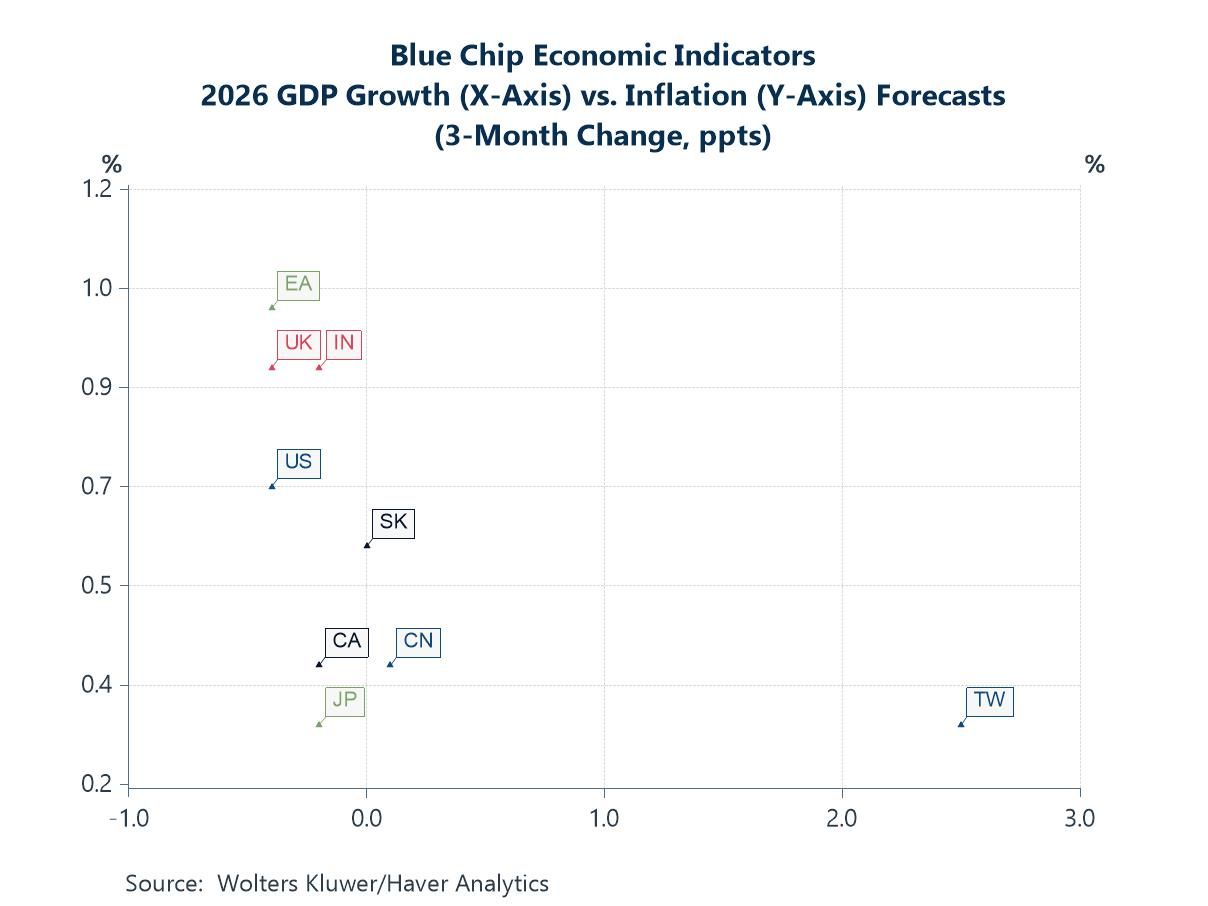
The global economy is still caught between two powerful and competing forces. On one side, the AI investment boom continues to support growth, industrial activity and equity markets, particularly in the US and parts of Asia. On the other, renewed Middle East tensions and higher energy prices are adding to inflation risks and broader policy uncertainty. The latest Blue Chip survey reflects this divide clearly: growth expectations have generally held up best in economies tied to AI-related investment and technology supply chains, while inflation forecasts have risen more sharply in more energy-exposed economies such as the UK and euro area (chart 1). Forecasters still largely expect only limited pass-through from higher energy prices into core inflation, although recent US CPI data suggest underlying price pressures remain somewhat sticky (charts 2 and 3). At the same time, the extraordinary continued surge in global AI investment — now approaching $300 billion annually — highlights the sheer scale of capital being deployed into semiconductors, data centres and digital infrastructure, particularly in the United States (chart 4). The divergence in industrial production trends also reinforces the growing gap between economies benefiting from structural growth drivers — such as Taiwan’s semiconductor sector and Denmark’s pharmaceutical industry — and those struggling with higher energy costs and weaker competitiveness, notably Germany and the UK (chart 5). Meanwhile, improving Chinese activity indicators suggest policy support and stronger technology demand may finally be helping to stabilise growth (chart 6). Overall, the world economy remains resilient, but increasingly uneven, with AI-related investment continuing to offset — though not eliminate — the drag from geopolitical fragmentation and rising energy insecurity.
by:Andrew Cates
|in:Economy in Brief
 USA| May 14 2026
U.S. Retail Sales Slowed in April But Remained Solid
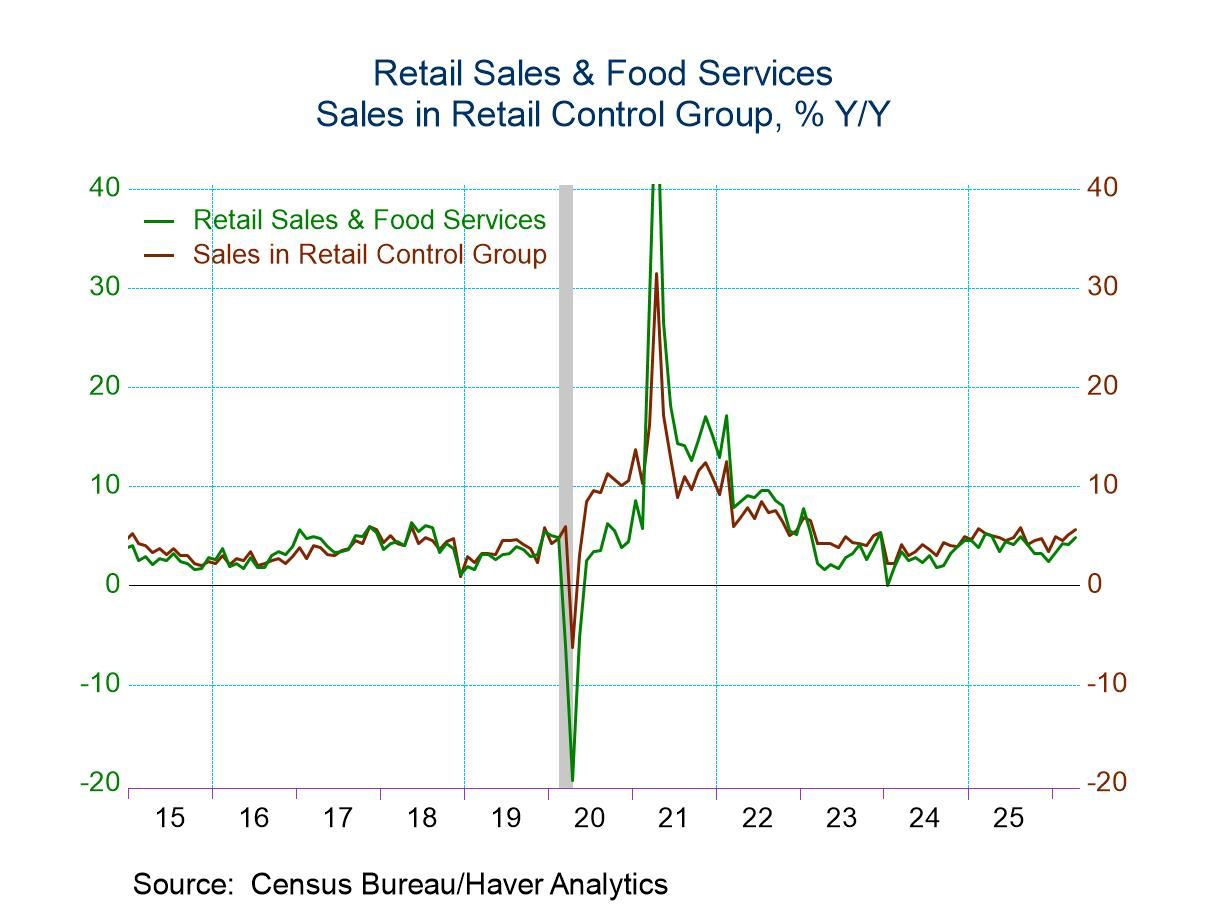
- Total sales increase 0.5% m/m in April after a 1.6% monthly jump in March.
- Gasoline sales rose 2.8% m/m in April on top of a 13.7% surge in March.
- Auto sales fell 0.4% m/m after a 0.6% m/m rise in March.
- Excluding auto and gasoline sales, remaining sales increased by a solid 0.5% m/m in April versus a 0.7% m/m rise in March.
- Sales of the retail control group that is used to construct PCE rose 0.5% m/m in April and are 5.4% annualized above the Q1 average, providing a good start to Q2.
by:Sandy Batten
|in:Economy in Brief
 USA| May 14 2026
U.S. Initial Unemployment Claims rose in the Week of May 9
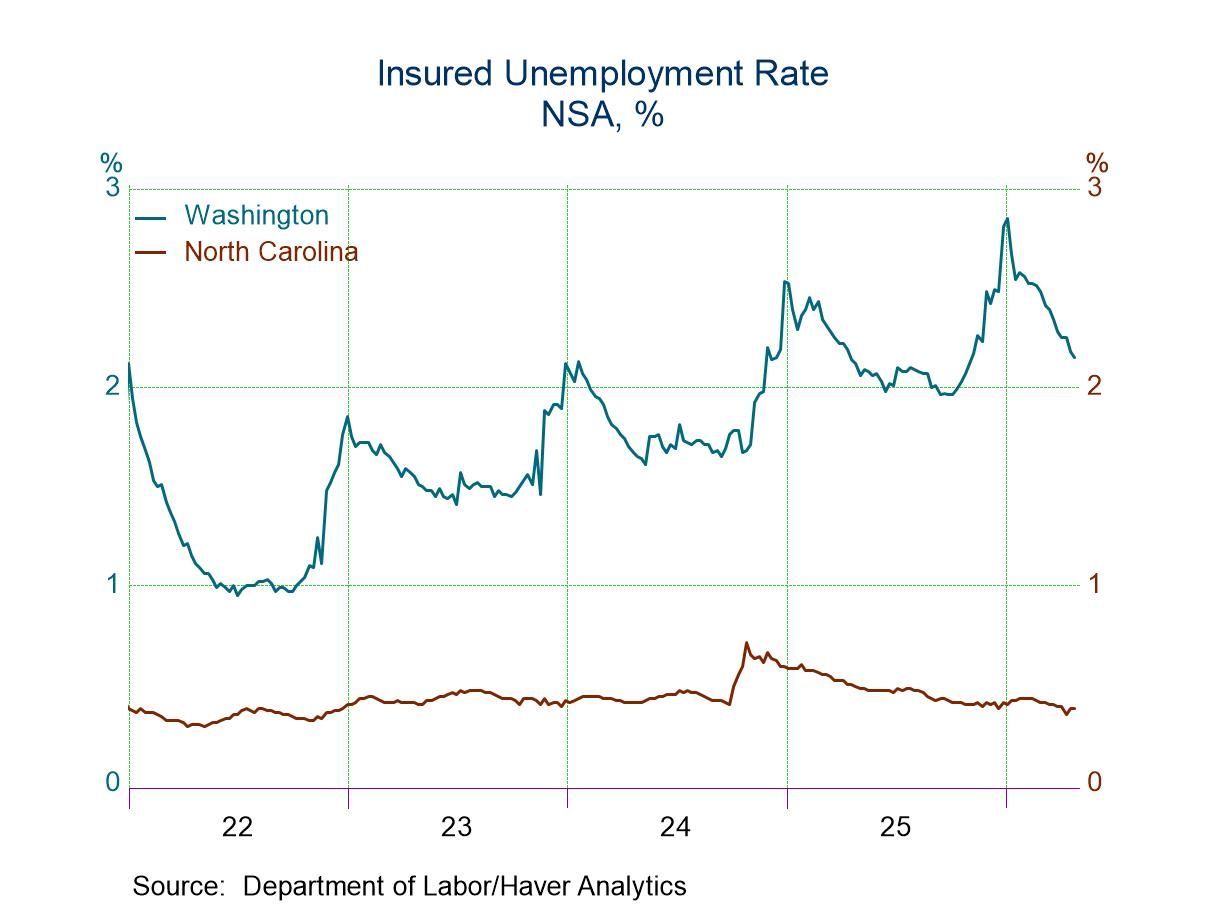
- New claims rose by 12,000 to 211,000.
- Continuing claims rose by 24,000 to 1.782 million.
- The insured unemployment rate was back up to 1.2% in the week of May 2, from the one-week dip to 1.1% the prior week.
 United Kingdom| May 14 2026
UK Q1 GDP Growth Steps Up
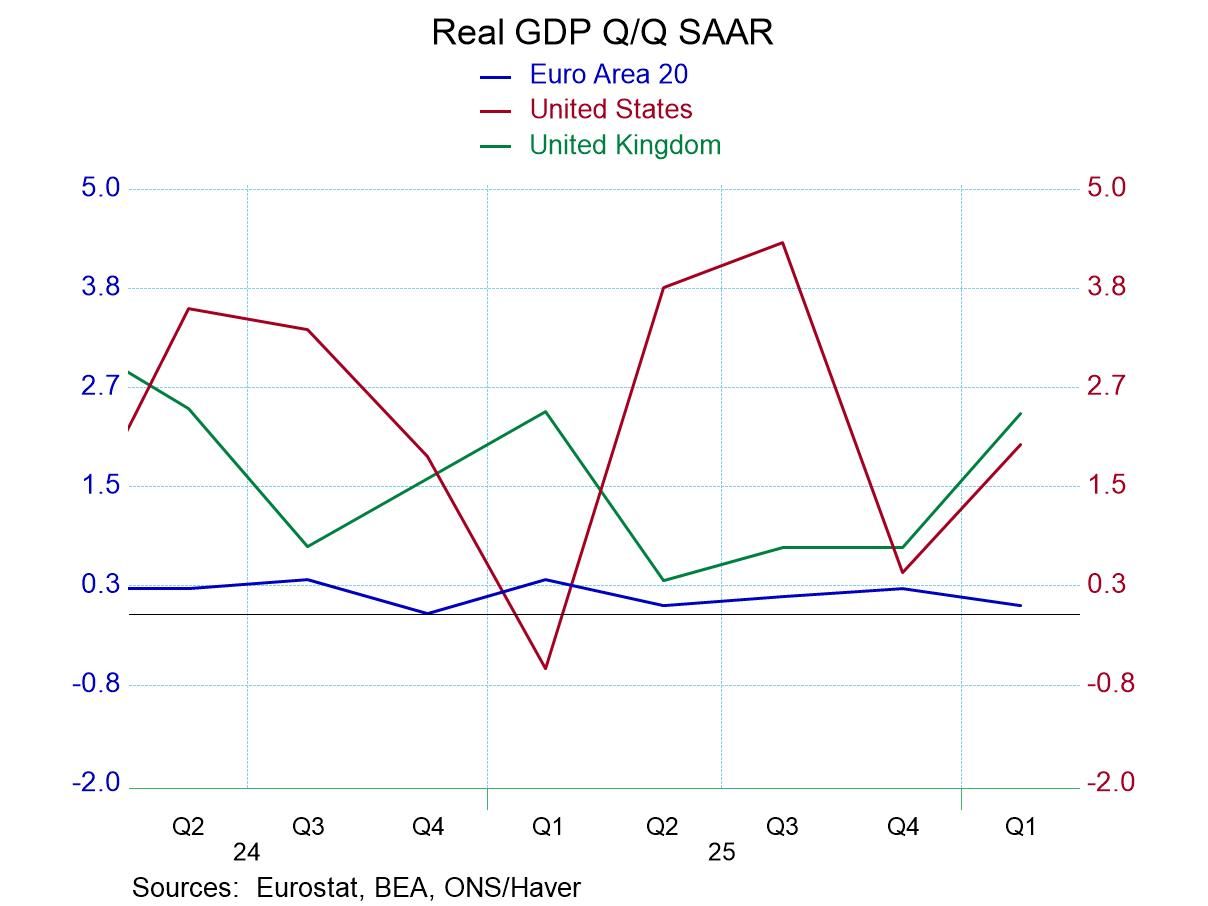
UK GDP grew by 2.5% in 2026-Q1. GDP growth quarterly was last this strong in 2024-Q2 and last stronger in 2024-Q1. This is the strongest quarterly growth in about two years. Private consumption surged in 2026-Q1, rising at a 2.4% annual rate. Capital formation and housing each backed off in the last two quarters. This is the opposite form the US where investment is strongly pushing growth ahead.
On the international side of the ledger, UK exports rose at a 0.4% annualized rate in the quarter while imports rose by a strong 2.6% annual rate, still, viewed on its own, domestic demand rose at a 3.2% annual rate.
Domestic demand growth has picked up to over 1% at 1.5% on a year-over-year basis. That is a good development. However, it is still a weak showing. Over the last 26 years domestic demand’s Year-on-year gain ranks at its 30th-percentiel; it has been weaker than this only about 30% of the time. But over the last nearly four-years the 1.5% gain is just below its median. This gives some indication of how weak growth has been in the post-Covid period. The UK was still in a post Brexit environment, when it had to deal with Covid, the invasion of Ukraine, and now the Middle East. At the same time, it has had a considerable amount of its own political turmoil and still does.
The chart above shows the snake crawl of GDP that continues to depict growth in the EMU area. That is a continuing weak environment- one of the UK’s important export markets. Europe’s fixation on social welfare spending and the need to tax to pay for it has robbed the economy of its dynamism. Still, both the UK and the Euro-Area continue to have lingering inflation issues. And both show current inflation in an upswing.
Central bankers' inflation and growth Central banks are playing a waiting game, the best that they can. Major money center country central banks have been consistently overshooting their inflation targets since Covid. And despite excess inflation banks have been reluctant to hike rates and have instead pursued a strategy of persisting slow rate reduction. It has been a curious period in which central banks have kept their inflation target goals but simply have been content to miss their targets in the short run and promise to thit them in the long run. This is clearly a policy of only temporary usefulness because it is bound to blow up, the longer inflation fails to be controlled at its targeted pace. For now, UK interest rates remain higher than in Europe, closer to the level in the US and with a monetary policy committee that seems determined to stop the overshoot as oil prices flare. We’ll see if the BOE MPC members are really ready to pull the trigger on higher rates as UK GDP growth looks firmer.
 USA| May 13 2026
April PPI: Broad-Based Pressure
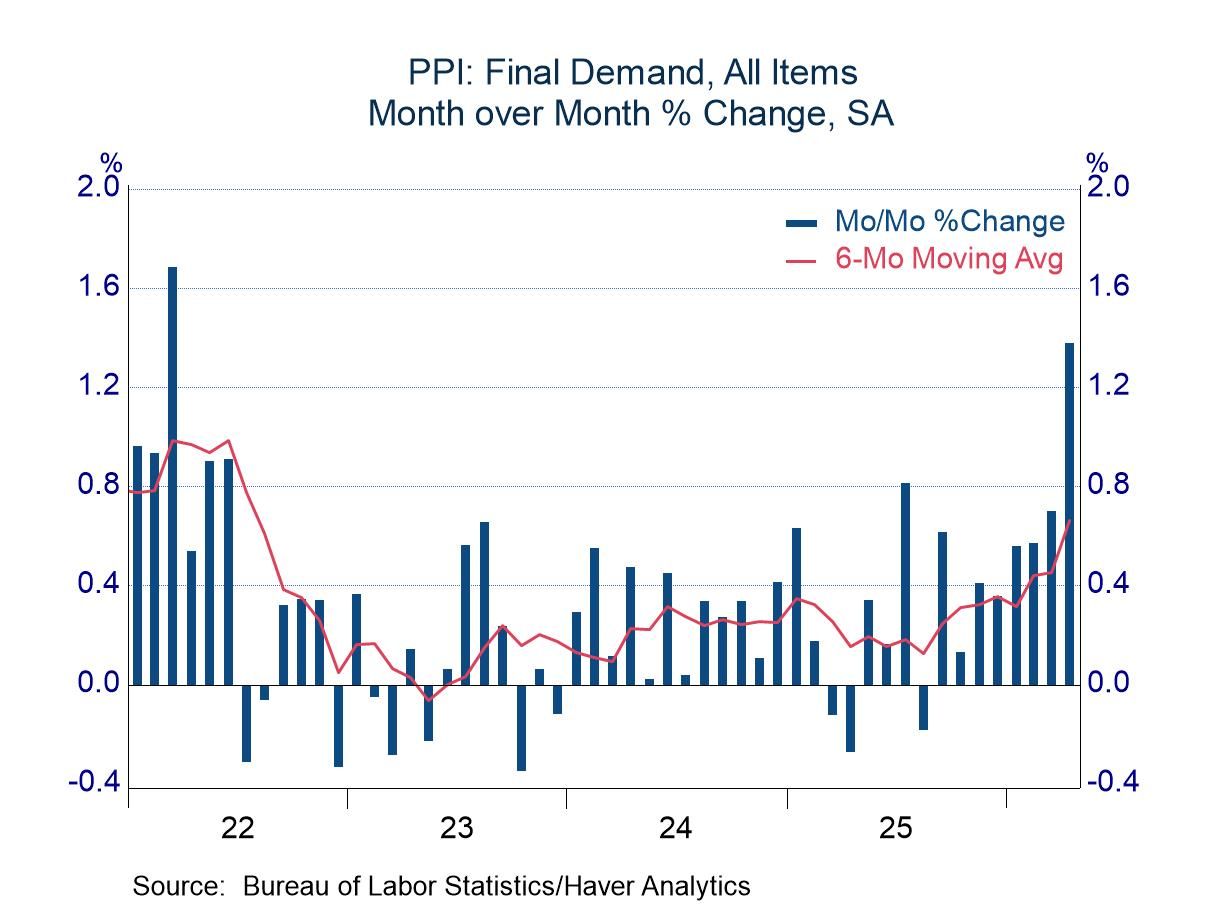
- The energy component led the sharp increase in the PPI, but it had support from many other areas.
- Excluding energy, most service prices rose sharply; prices of non-energy goods also were under pressure.
- The food component went against the grain with an increase of only 0.2%.
 Europe| May 13 2026
Manufacturing IP in EMU Slogs Ahead
Industrial production in the European monetary area in March rose by 0.2%. Manufacturing output rose by 0.4%, marking two-months in a row of output increases. Output is still falling overall and in manufacturing over three months. Over three-months total manufacturing output excluding construction falls 2.7% annualized, over 6-months, it falls at a 0.4% annual rate, and over three-months the pace of decline steps back up again to -1.2% at an annual rate. The declines in manufacturing are more or less along the same lines.
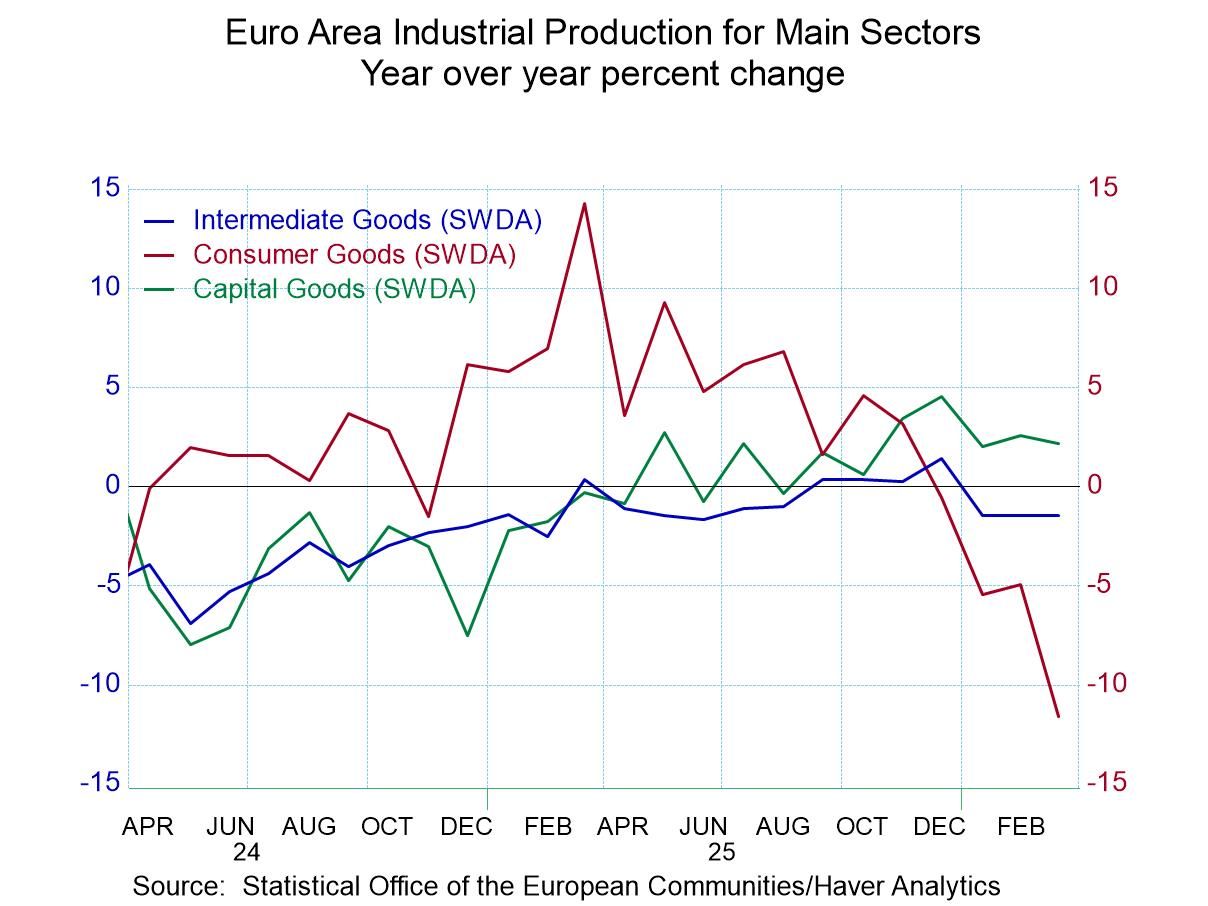
Sectors Output of consumer goods fell in March, driven by a decline in the output of nondurable goods that fell 4.5% month-to-month. Intermediate goods output rose by 0.9% in the month, increasing for the second month in a row. Capital goods output rose 1.1% after rising 0.8% in February.
Sequential growth However sequential growth rates find headline growth negative over 12-months, six-months, and three-months- the same as for manufacturing. Consumer goods output declines at an accelerating pace dropping 11.6% over 12-months, at a 13.6% annual rate over six-months and at a 24.9% annual-rate over three-months. Those declines are led by reduction in consumer nondurables output. Intermediate goods output is mostly weak over the horizon, falling by 1.5% over 12-months and by 0.9% over 3 months annualized. The exception is capital goods sector where output rises by 2.2% over 12 months and accelerates to 4.6% over 6-months but then tails back, trimming growth to a 1.2% annual rate over three-months.
Country Performance On a country basis declines occur in only two early-reporting members; those are Malta and Germany in March. Over three months output declines in the monetary area occurs in Ireland and Luxembourg and in Germany- with increases elsewhere. Output declines over 12-months, six-months, and three-months in the monetary area only for Germany, Luxembourg, and Ireland. There are consistent output increases in the monetary union in Austria, France, Finland, Italy, Greece, and Portugal. For most countries, increasing output is the rule despite the weak headlines, indicating that large economies are faring worse than smaller economies.
Q1 Growth In the completed first quarter, we have manufacturing output falling by 1.8% at an annual rate and overall output falling at a 1.9% annual rate. Output declines in the quarter and in all major sectors. As for country reporters output falls in the quarter for Austria, Germany, Luxembourg, and Ireland.
Growth rate rankings So, the percentile queue standings presented in the right-hand column are rankings of industrial production growth rates over 12-months. Compared to recent history, overall output has a 17-percentile standing which is relatively weak, in the lower one-fifth of its ranked results over the period (back to 2006). Only capital goods output at 52.5% has a standing above the 50% level which places it above its median result for the period. Among reporting countries seven have percentile standings above 50%, above their respective medians. The countries where output does not grow at a pace in excess of its median are Germany, Luxembourg, Malta, and Ireland.
On balance the smaller countries seem to be faring better in the European monetary union. The last two months have been relatively good months for output across the union; however, January had been so weak that the two months have not been able to recover from the weakness experienced in January. And the March data hardly reflect the hardships that are going to be visiting these economies because of the rise in oil prices and concerns about the situation in Iran and the strait of Hormuz. The future is unlikely to get better.
- of7Go to 4 page