

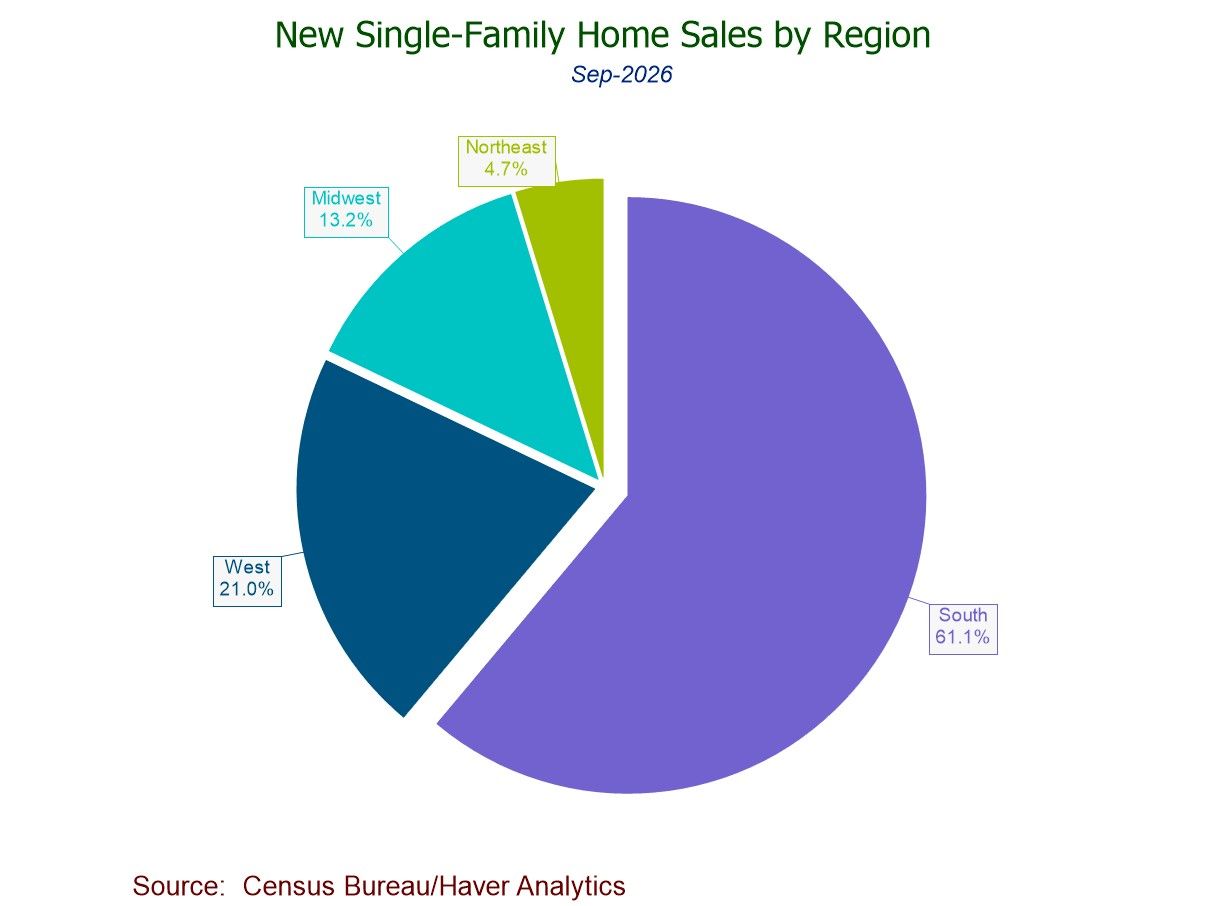
- Sales -0.6% m/m (-5.3% y/y) to 676,000 in Sept.; still 26.4% above a July ’22 low.
- Sales m/m down in the Midwest (-7.3%) and South (-6.6%); up in the Northeast (+28.0%) and West (+21.4%).
- Sales y/y down in all regions except the Northeast (+10.3%).
- Median sales price +3.9% m/m to $400,400, first rise in five mths.; avg. price +0.4% m/m to $472,800.
- Unsold inventory -1.0% m/m (-2.3% y/y) to 476,000, lowest since Sept. ’24; months' supply down to 8.4 mths., a Dec. ’25 low.
USA| Oct 27 2026
U.S. New Home Sales Ease in September Following August Rebound
More Commentaries
 Global| Oct 23 2026
S&P PMIs Show Mixed but Broad Weakening in October
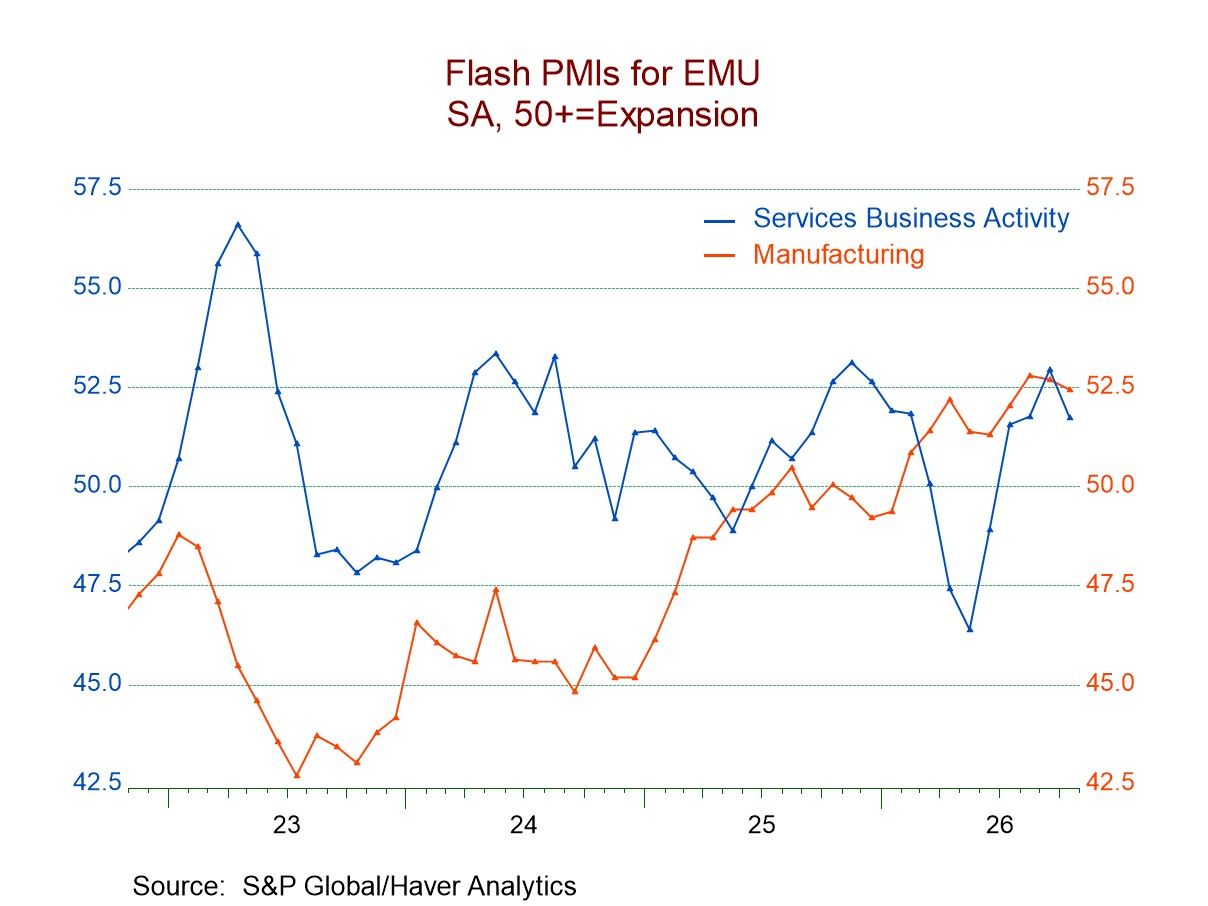
Among the early reporting countries, I present flash readings for the S&P PMIs in October. Only two of these reporters, the United Kingdom and India, show stronger headline PMI readings in October than they had in September. For reporters Germany, the U.K., Australia, and the United States, stronger PMI readings for the manufacturing sector emerge in October compared to September. However, only the U.K. and Japan report stronger services readings in October than they reported in September.
The weakness in services is very broad-based, while the weakness in manufacturing is mixed. The impact on the headline causes readings to be weaker in most cases in October than they were in September. This rounds out the picture of an uneven economy as central banks are on the path to fight what has been an excess of inflation, as energy prices continue at uncomfortably high levels.
However, these results are only for the month of October. If we look at the three-month averages, which are based on historical final data and so do not include the October ‘flash’ readings, we have stronger readings across the board for the headline PMI. We have stronger readings across the board except for India in services. Also, over three months, the performance of the manufacturing sector is mixed, with four stronger and four weaker reporters.
For six months the picture is more uneven, as slightly more readings are weakening compared to the 12-month readings that are strengthening. However, over six months the U.S. shows strengthening on all three sector readings, as does India. Three-sector weakness over six months comes from Australia, while Japan, the U.K., France, Germany, and the European Monetary Union all show the headline weaker over six months, driven by a weaker services sector.
Over 12 months all the readings are stronger for all three sectors for all country comparisons except the U.S. For the U.S., weaker readings are in the services sector and the composite index compared to a year ago.
The queue percentile standings paint an upbeat picture, with the average composite reading at a 52nd percentile standing, above its historic median; manufacturing at a 58th percentile standing is looking quite strong, while services at a 46.8 percentile standing shows that the services sector has performed below its median performance on data back to 2021. Australia and India are the weakest on these timelines in terms of their ranking for their composites as well as because they have below-median results for their manufacturing and services sectors. The U.S. shows the strongest statistics on this comparison, with an 86.8 percentile standing for its composite, a 77.9 percentile standing for manufacturing, and an 85.3 percentile standing for services. Among the remaining countries, only France has a composite reading below its median, meaning it is below a ranking of 50%, while Japan manages a headline ranking of 72.1% despite having a services ranking below its 50% mark, and it does that on the strength of a manufacturing ranking in its 80.9 percentile.
Changes over 12 months show declines in all three PMI sector readings only in India and in Australia. The U.K. and France show improvements in all three sectors over 12 months, while the monetary union and Germany show headline declines over 12 months caused by a weakening services sector in the face of solid increases in manufacturing.
 Global| Oct 22 2026
Charts of the Week: Growth on Borrowed Strength
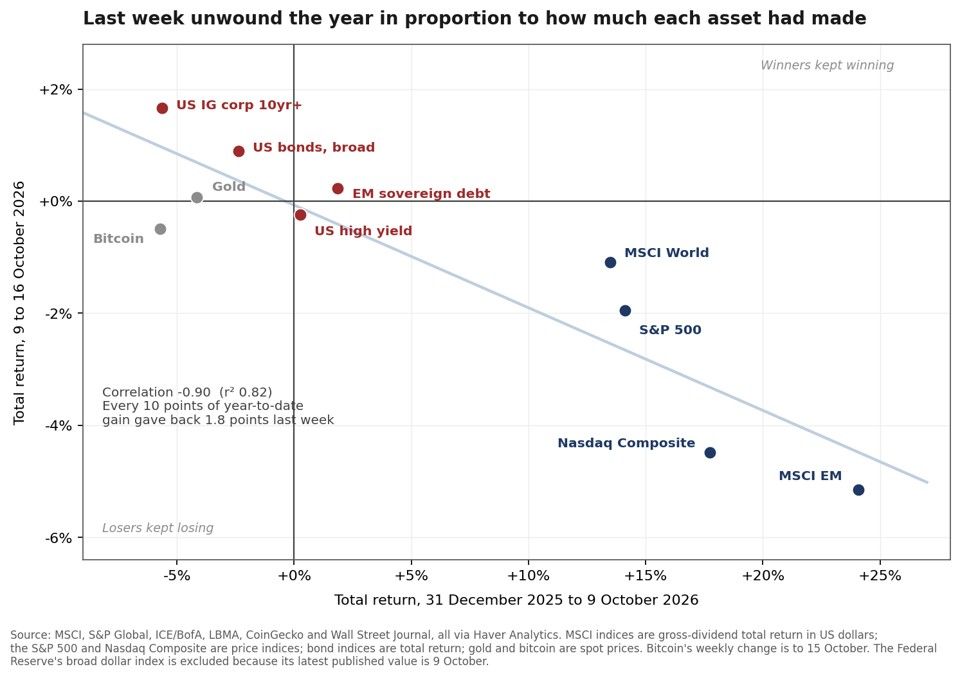
The global economy has proved remarkably resilient in the face of war, political uncertainty and persistently high borrowing costs. Yet resilience is not the same as strength. Growth has become increasingly dependent on a narrow investment boom, particularly in artificial intelligence, while its financial and physical costs are mounting. Last week's market retreat exposed the concentration of investor enthusiasm (chart 1), while Japanese exports revealed the growing importance of semiconductor investment to global industry (chart 2). Elsewhere, the picture is less reassuring. British wage disinflation appears to be stalling (chart 3), housing markets remain subdued (chart 4), and China's investment weakness has spread well beyond property (chart 5). Meanwhile, rising electricity prices point to another constraint on growth (chart 6). The underlying question is whether the investment sustaining the expansion can deliver sufficient productivity gains to justify its rising costs.
by:Andrew Cates
|in:Economy in Brief
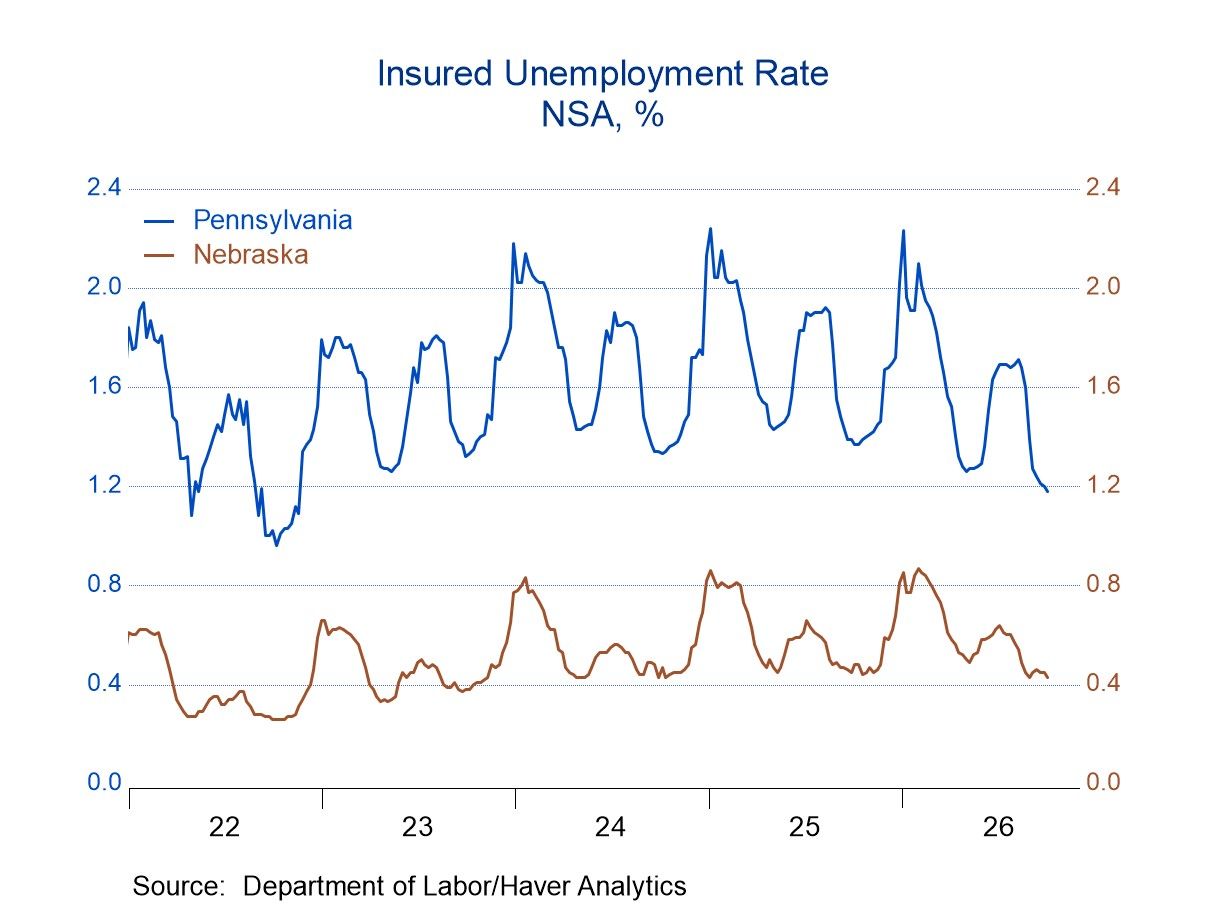
- New claims declined by 6,000 to 194,000 in the week of October 17.
- Continuing claims rose by 25,000 to 1.728 million in the week ending October 10.
- The insured unemployment rate was unchanged at 1.1% in the week of October 10.
 France| Oct 22 2026
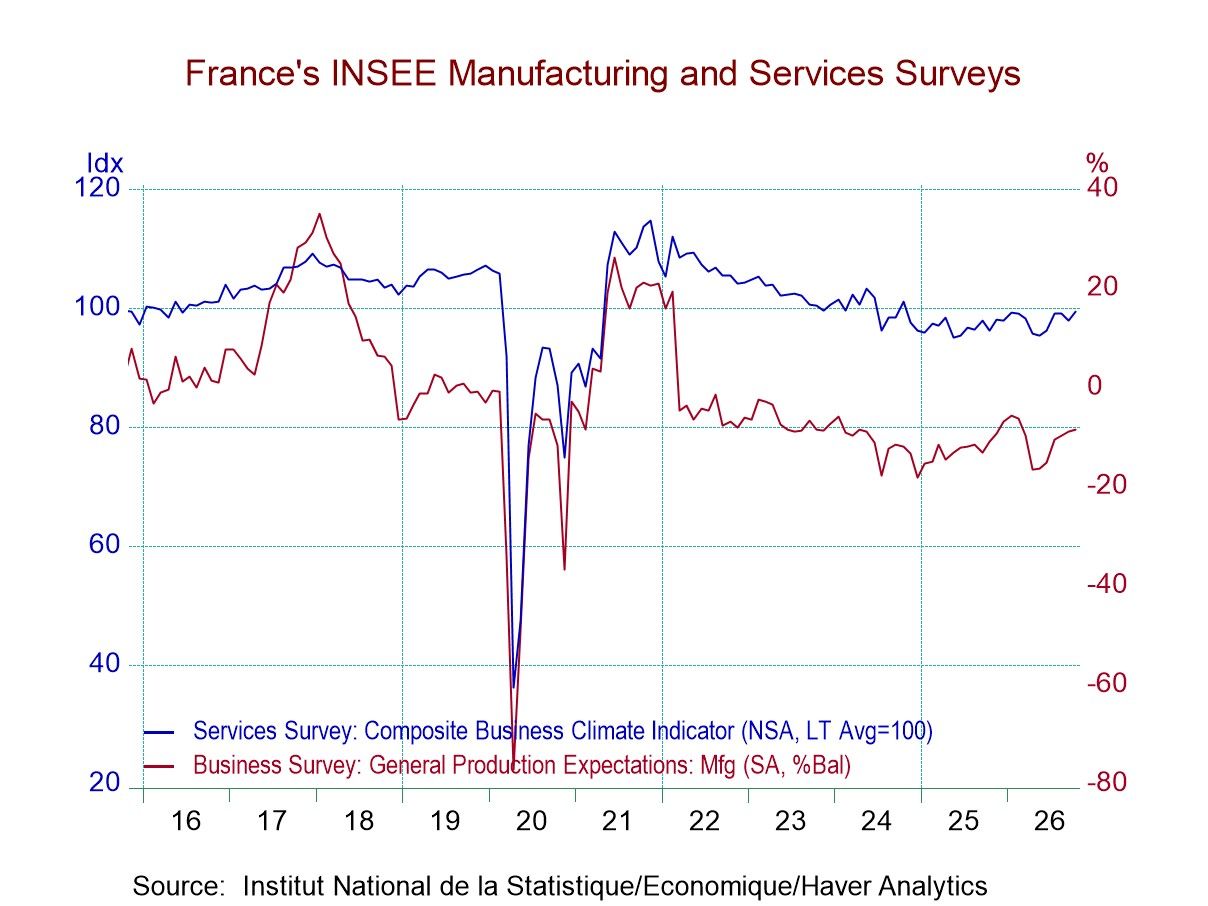
French Industry and Services Both Improve
The INSEE survey for France that evaluates manufacturing and services sector firms shows a strong rebound for manufacturing in October and a solid rebound for services in the same month. However, the two sectors are experiencing significantly different environments, with the industry climate reading for manufacturing at a 76.5 percentile standing, putting it in the top 25 percentile of all performances back to 2001. The services climate reading is at a 42.8 percentile standing, leaving it below its historic median over the same period.
Manufacturing The manufacturing survey shows manufacturing production expectations improved slightly, moving from a -9 reading in September to -8.5 in October; the recent trend for production increased to 2.3 in October from -1.4 in September. While participants in the survey found the prospects for their own industry, the personal likely trend rose to 18.6 from 14.3 in September. The assessment of the industry trend is still a weak one with a 40th percentile standing; however, the personal likely trend is quite strong at a 93.8 percentile standing. This shows that participants have a much more upbeat view of their own industry compared to their expectations for the manufacturing sector as a whole. Since the survey is a broad one across sectors, these results make the survey somewhat inconsistent with itself.
Orders and demand improved sharply in October with the net rating of -10.5, sharply improved from -15.8 in September. The response for foreign orders and demand showed an even stronger positive shift to -1 from -10.1 in September. The rankings for orders and demand show a 74.2 percentile standing for the overall reading, while foreign orders & demand have an 87.3 percentile standing; both of these are quite strong.
The outlook for prices diverges, with firms seeing their own likely price and trend for their industry at 10.6 in October, lower than 14.6 in September. However, for the manufacturing sector price level, they look for an escalation to 31.1 in October from 24.7 in September. The own likely price trend has a 78.1 percentile standing, while the manufacturing price level has an 83.3 percentile standing; both are looking for significant upward pressure on prices.
Services The services survey in October shows an increase in the climate indicator to 99.3 from 97.8 in September; however, it still leaves the sector with a 42.8 percentile standing, below its historic median. The three-month average and the 12-month average of the climate gauge both show improvements; in both cases, they're relatively small, but a lot of that is the result of the smoothing. In terms of the rankings, the rankings for the three-month and 12-month measures are fairly similar to the ranking for the reading for the current month in October.
The outlook improved to -9 in October from -10 in September but still has only a 34.6 percentile standing, nearly a lower 1/3 standing for the outlook.
For sales, the observed performance over the last three months weakened to -5 in October from -1 in September. However, the expectations for three months ahead improved to 3.9 from 0.6 in September. The past observed trend is weak with a 22.5 percentile standing, while the expected result for the three months ahead has an above median, at a 60.8 percentile standing. With such a weak outlook, the turnaround on sales is surprising.
On the price side, there are slightly mixed results, with the observed trend over three months falling to 2.2 in October from 3.4 in September against the expected trend over the next three months, which moved up to 5 from 4.6 in September. The ranking of the past three-month trend is a 77.8 percentile standing; the ranking for the expected trend is a stronger 89.2 percentile standing.
 USA| Oct 21 2026
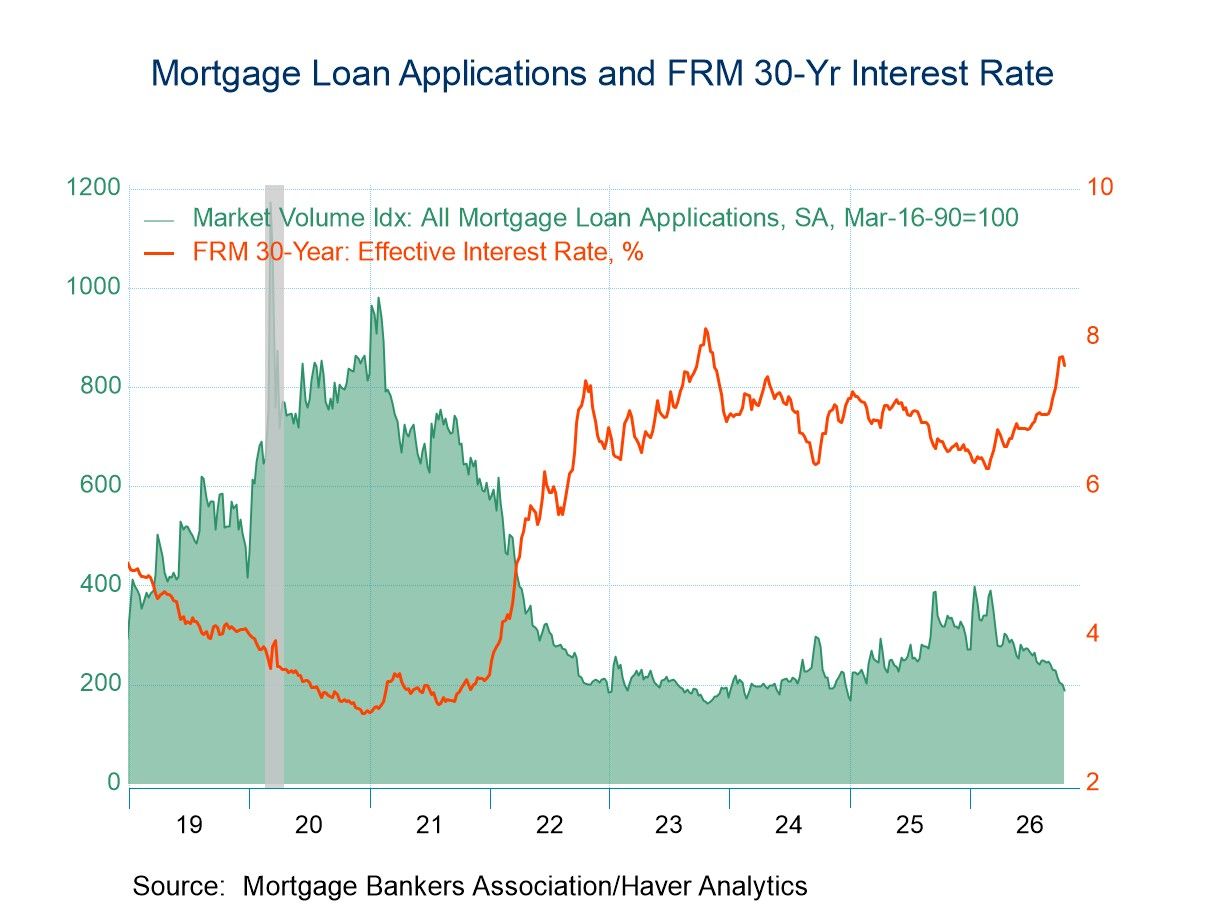
U.S. Mortgage Applications Fell in the October 16 Week
- Applications for loans to purchase and applications for loan refinancing both declined in the latest week.
- Interest rate on 30-year fixed-rate loans fell 12bps to 7.63%, the first decline in 8 weeks.
- Average loan size rose slightly in the October 16 week.
 United Kingdom| Oct 21 2026
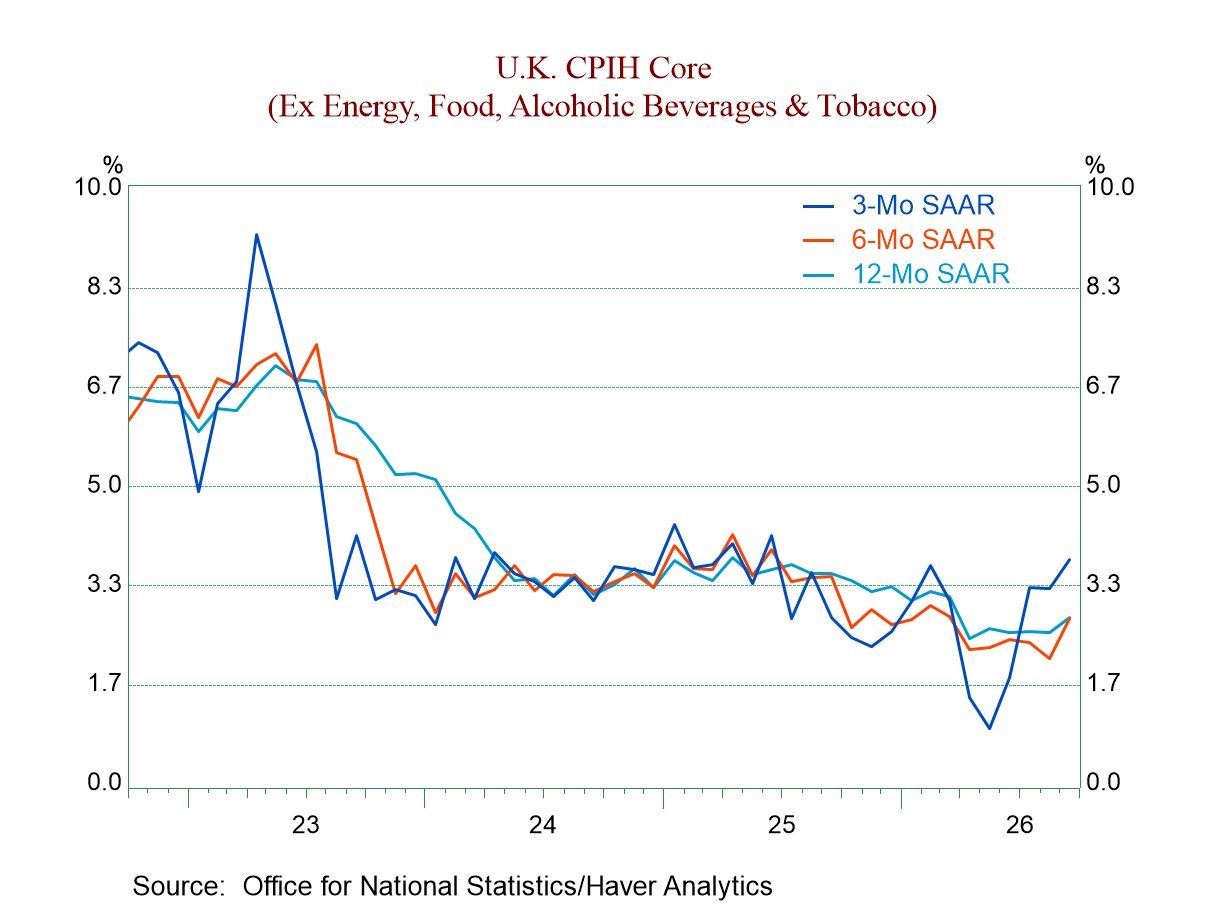
U.K. CPI Goes Off the Rails Ahead of BOE Meeting
Inflation in the United Kingdom is back to misbehaving in September. The HICP rendition of inflation posted a 0.5% increase, its second in a row, following a 0.6% increase in July. The CPIH, however, performed exactly the same, with a 0.5% increase in September and August, after a 0.6% gain in July. This is going to put the Bank of England's back up against the wall when it comes to making its next interest rate decision.
Hot, hot, hot: Inflation runs hot in the United Kingdom. The CPIH version shows a 6.6% annual rate over three months, a 4.2% pace over six months, and 3.6% over 12 months. This is a clear accelerating profile with inflation clearly over the 2% mark over each one of those horizons. A year ago, inflation was rising 4.1% year-over-year. There's very little here to provide any escape from the conclusion that interest rates need to go up and inflation is a problem that needs some strict attention.
Core inflation is rising as well: Core inflation in the U.K. under the CPIH measure rose 0.4% in September after rising 0.2% in August and 0.4% in July. The sequence of core inflation rates from 12 months inward shows a 12-month pace of 3.1%, a six-month pace of 3.2%, and a three-month pace of 4.1%. These increases are faster-paced step by step as horizons shorten. However, like the headline, all three of these metrics are above 2% and once again there is this accelerating trend in place, even for the core, and that has to be an even more difficult pill for the Bank of England to swallow.
Inflation acceleration: If we look at the tendency to accelerate, acceleration occurred in 58.3% of the categories in July; that proportion fell to 41.7% in August, and it was back up to 50% in September. So, as of September, the proportion of these categories showing acceleration is split pretty much 50/50, making it less of a clear acceleration imperative on volatile monthly data. However, over three months compared to six months, 75% of the categories are accelerating; over six months compared to 12 months, again 75% of the categories are accelerating; over 12 months compared to 12 months ago, that proportion drops to 41.7%. But the drop in the breadth of inflation is also related to the fact that the 12-month inflation rate had dropped from a year ago at 3.8% to 3.5%; it dropped more, from 4% to 3.1%, in the case of the core CPIH. In other words, inflation has fallen from a very excessive pace to a still excessive pace, and that drop is ‘endorsed’ by a drop in breadth. Breadth can reinforce direction. And now inflation and breadth both are rising – a bad sign.
Inflation ranking: We also can look at how inflation ranks compared to where it's been and on this basis that we wind up with another troubling finding. The HICP version of inflation has an 82nd percentile standing; the CPIH version also has an 82nd percentile standing and the CPIH core measure has a slightly higher 82.7 percentile standing. So, inflation is high even by historic experience; that compares current year-over-year inflation in September to inflation rates back to the year 2000. On that timeline, in fact, the median for inflation has a 77th percentile standing and the average pace for inflation has a 72nd percentile standing across categories. Now both of these are slightly lower than the actual CPIH version at a ranking of 82%. What that tells us is that inflation has been even more virulent in those categories that have a higher weight in the CPI.
Summing up On balance, this is a poor report; it will probably put the Bank of England's back up against the wall to enforce another rate hike. It's hard to see how the central bank can look at these various measures of inflation and their path and decide to pass on a rate hike at its next meeting, so brace yourself.
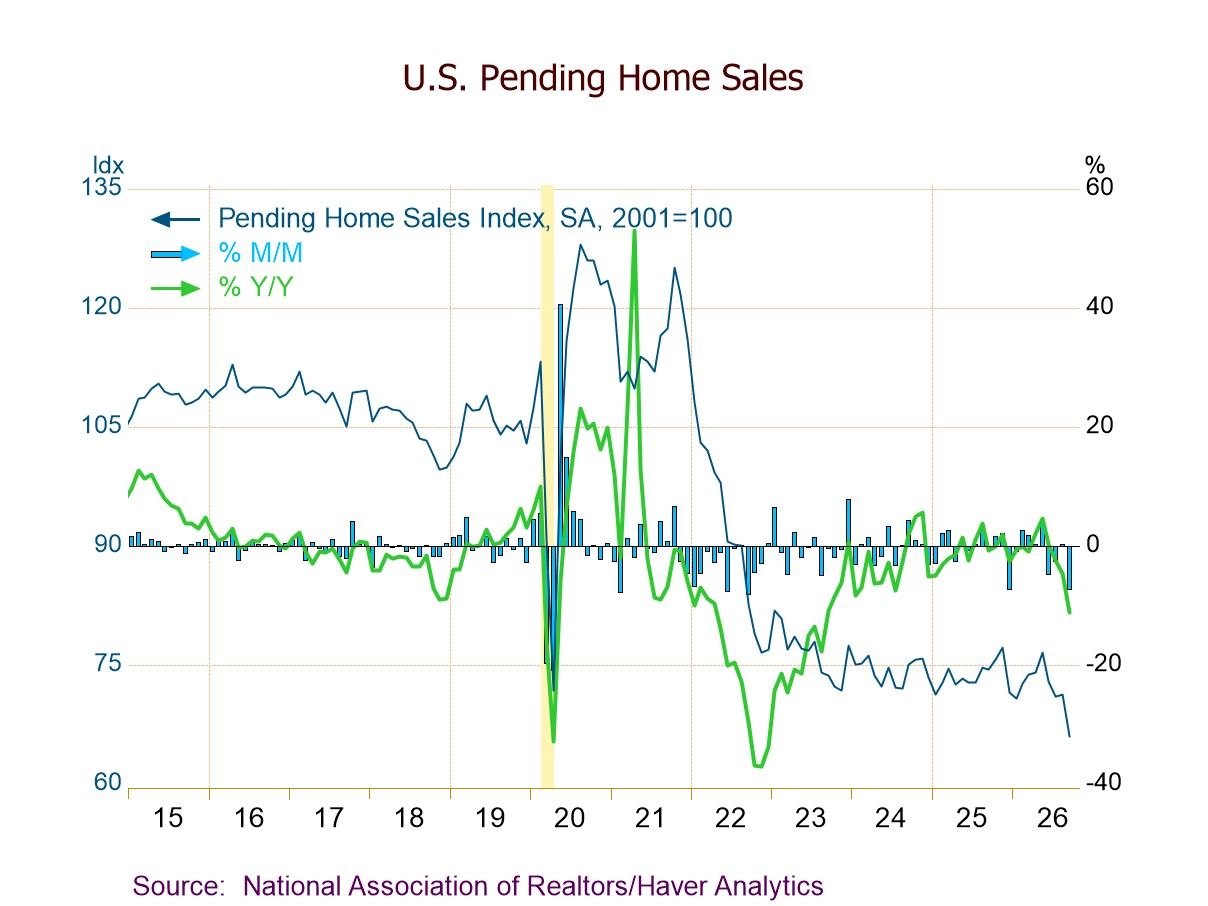
- PHSI -7.3% m/m (-11.3% y/y) to an all-time index low of 66.0 in Sept; third decline in four mths.
- Home sales down m/m and y/y in all four regions, w/ the steepest drop in the West (-9.2% m/m, -15.0% y/y).
- 30-year mortgage rate up to 6.86% in Sept., highest since Jan. ’25, weighing on homebuying demand and affordability.
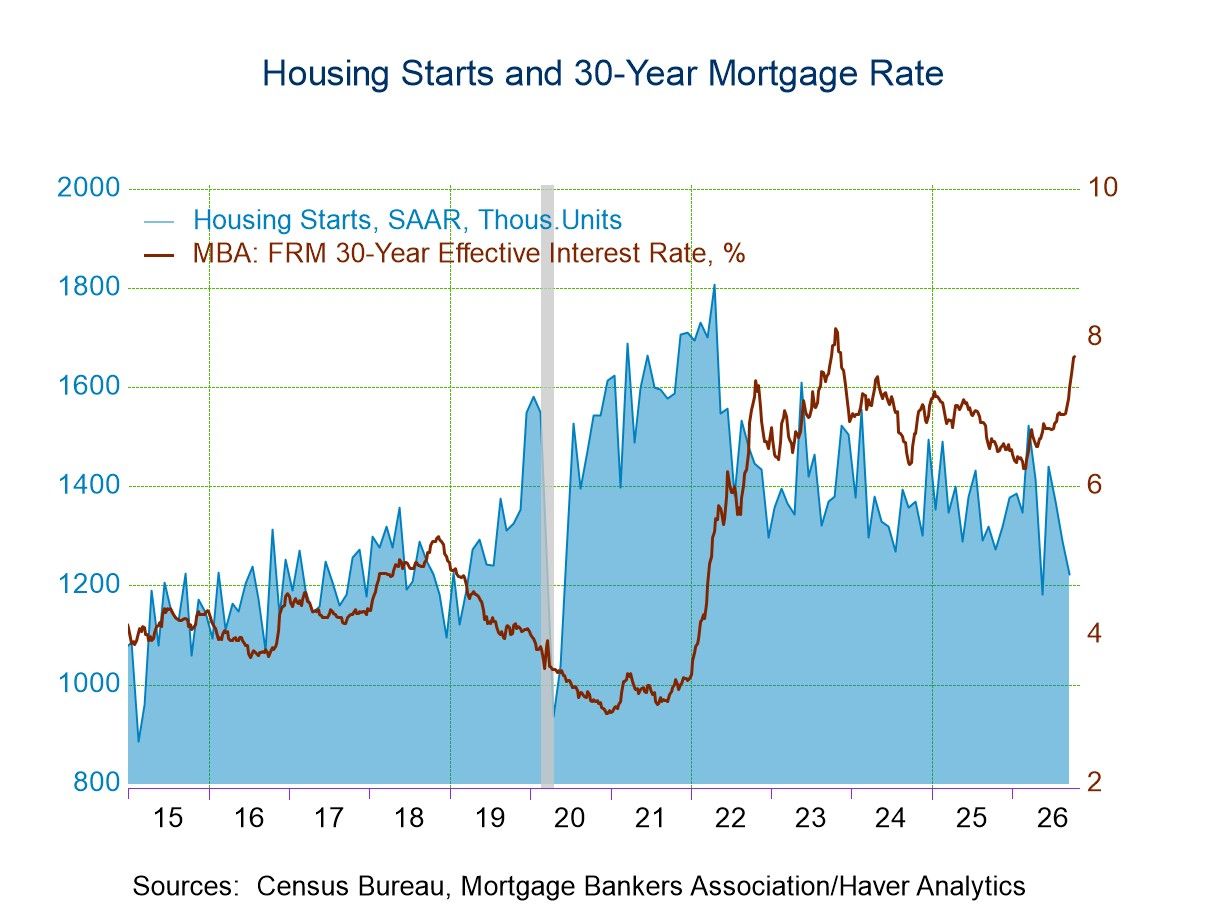 USA| Oct 20 2026
September U.S. Housing Starts Hit by Rising Interest Rates
- Housing starts fell 5.2% m/m in September to their second lowest level since the COVID pandemic shutdown with upward revisions to both July and August.
- Both single-family and multi-family starts declined in September.
- Permits were little changed in September with a sharp rise in muti-family permits nearly offsetting a meaningful decline in single-family permits.
by:Sandy Batten
|in:Economy in Brief
- of170Go to 1 page