U.K. CBI Survey Remains Weak but Sharply Rebounds
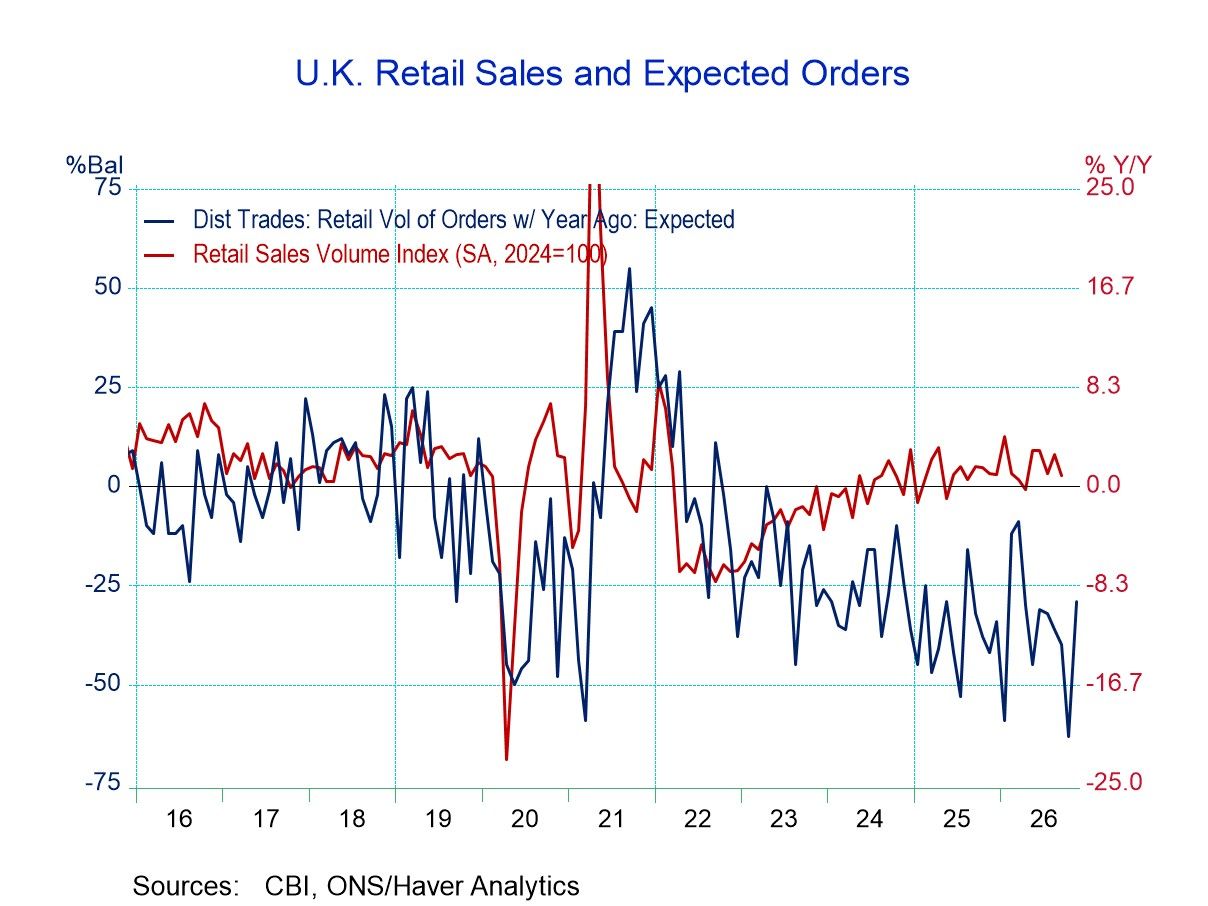
The Confederation of British Industry (CBI) survey responses in October, for October itself or looking to the month ahead, show sharp improvements in the current results and significant improvement in expected retail sales and less broad improvement for expected wholesale orders and sales.
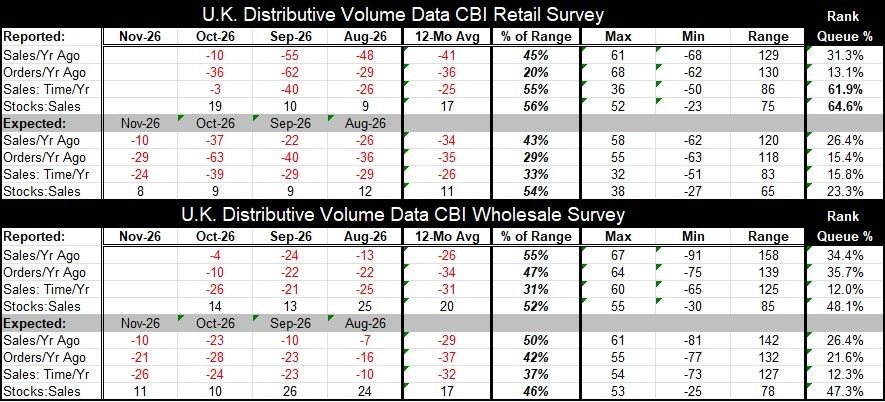
The rank standings of the survey categories all are below their 50% marks, their respective medians, for all the survey items except for the retail survey on sales for the time of year and for inventory ratios.
Overview This means that despite some relatively pronounced recovery between September and October, conditions are still subpar for most of the categories. October levels are generally above levels posted a year ago as well and here, we're comparing the actual readings in October to October of one year ago, and the expectations for November to November of one year ago. For the most part, we're seeing significant improvements on that basis. We're also seeing significant improvements in the October-November values for current and expected activities compared to the 12-month averages. So, the U.K. economy has been through a real sort of baptism of fire over the last 12 months, with extremely weak readings having been posted and then, in October, or looking ahead to November, there is quite a remarkable improvement. But the economy was in such a deep hole that even with this sharp month-to-month jump, conditions continue to score out as weak compared to historic benchmarks.
Retailing in real time The retail survey, for example, is showing sales in October for the concept ‘sales compared to a year ago’ at a -10 diffusion reading, compared to -55 in September and a 12-month average of -41. Orders, compared to a year ago, at -36 in October sharply improve; they also are up from -62 in September, but they're only back to their 12-month average, which is -36. Sales ‘for the time of year’ improve sharply to -3 in October from -40 in September; that compares to a 12-month average of -25. Without referencing the ranking statistics, it's clear that there's a sharp improvement underway, but when we reference the queue rankings, we see that it's still an improvement that has a long way to go just to get back to ‘average.’
Retailing expectations Similarly, the expectations for retailing for ‘sales compared to a year ago’ in November are at -10 compared to -37 in October; that compares to a 12-month average of -34. Orders, compared to a year ago, come in at -29 for November’s expectations, up from -63 in October; that compares to a 12-month average of -35. So that marks a sharp improvement month-to-month, but a modest improvement compared to the 12-month average. Sales ‘for the time of year’ also improve to -24 for what's expected in November, from -39 in October; the -24 reading is only marginally better than the -26 average over the last 12 months.
Current wholesaling evaluations The volume assessments for the current situation in wholesaling show similar improvements in October compared to September and also for the October standings relative to the 12-month averages. Sales compared to a year ago, for example, are at a -4 reading in October compared to -24 in September, which compares to a 12-month average of -26. But here again the queue standing for that October reading is only in its 34th percentile, barely above the lower third of all readings chronicled back to August 2002. Orders compared to a year ago come in at -10 compared to -22 in September, which compares to a -34 average over 12 months. Sales ‘for the time of year,’ a sort of seasonally adjusted view, actually deteriorate in wholesaling to -26 in October from -21 in September, but there is an improvement when compared to the 12-month average of -31.
Wholesaling expectations Wholesaling expectations improve to -10 in November on the metric ‘sales compared to a year ago,’ a significant improvement from October’s -23 reading and an improvement from the 12-month average of -29. Orders ‘compared to a year ago’ improve to a reading of -21 in November from -28 in October; that's a nice improvement from the -37 average over 12 months. Sales ‘for the time of year,’ however, deteriorate slightly in November to -26 from -24 in October, although there is an improvement from the 12-month average of -32. Expected ‘sales for the time of year’ have an extremely low ranking, with a lower 12th percentile standing. But that was also the low ranking in retailing this month, for expected sales for the time of year in November, even though in retailing there was a sharp monthly improvement.
Retail sales have held up better than the CBI survey suggested
The bottom line So, the message from distributive trades in October is mixed. But it’s a mixed message that's still relatively positive. The various aspects of the distributive trades survey largely show improvements and some significant improvements from where they had been, especially one month ago. But one month ago, these readings really had their back against the wall; so even though there are improvements, conditions are still scored out as weak, when compared to history. However, they had been abysmally weak and so this is still a significant improvement for many measures. It's far from signaling that the economy is out of the woods, but it does suggest that the economy faces challenges that are perhaps more normal rather than the extraordinary circumstances it had seemed to face over the past year and especially one month ago.

Robert Brusca
AuthorMore in Author Profile »Robert A. Brusca is Chief Economist of Fact and Opinion Economics, a consulting firm he founded in Manhattan. He has been an economist on Wall Street for over 25 years. He has visited central banking and large institutional clients in over 30 countries in his career as an economist. Mr. Brusca was a Divisional Research Chief at the Federal Reserve Bank of NY (Chief of the International Financial markets Division), a Fed Watcher at Irving Trust and Chief Economist at Nikko Securities International. He is widely quoted and appears in various media. Mr. Brusca holds an MA and Ph.D. in economics from Michigan State University and a BA in Economics from the University of Michigan. His research pursues his strong interests in non aligned policy economics as well as international economics. FAO Economics’ research targets investors to assist them in making better investment decisions in stocks, bonds and in a variety of international assets. The company does not manage money and has no conflicts in giving economic advice.
More Economy in Brief
 Asia