

September U.S. Housing Starts Hit by Rising Interest Rates
by:Sandy Batten
|in:Economy in Brief
Summary
- Housing starts fell 5.2% m/m in September to their second lowest level since the COVID pandemic shutdown with upward revisions to both July and August.
- Both single-family and multi-family starts declined in September.
- Permits were little changed in September with a sharp rise in muti-family permits nearly offsetting a meaningful decline in single-family permits.
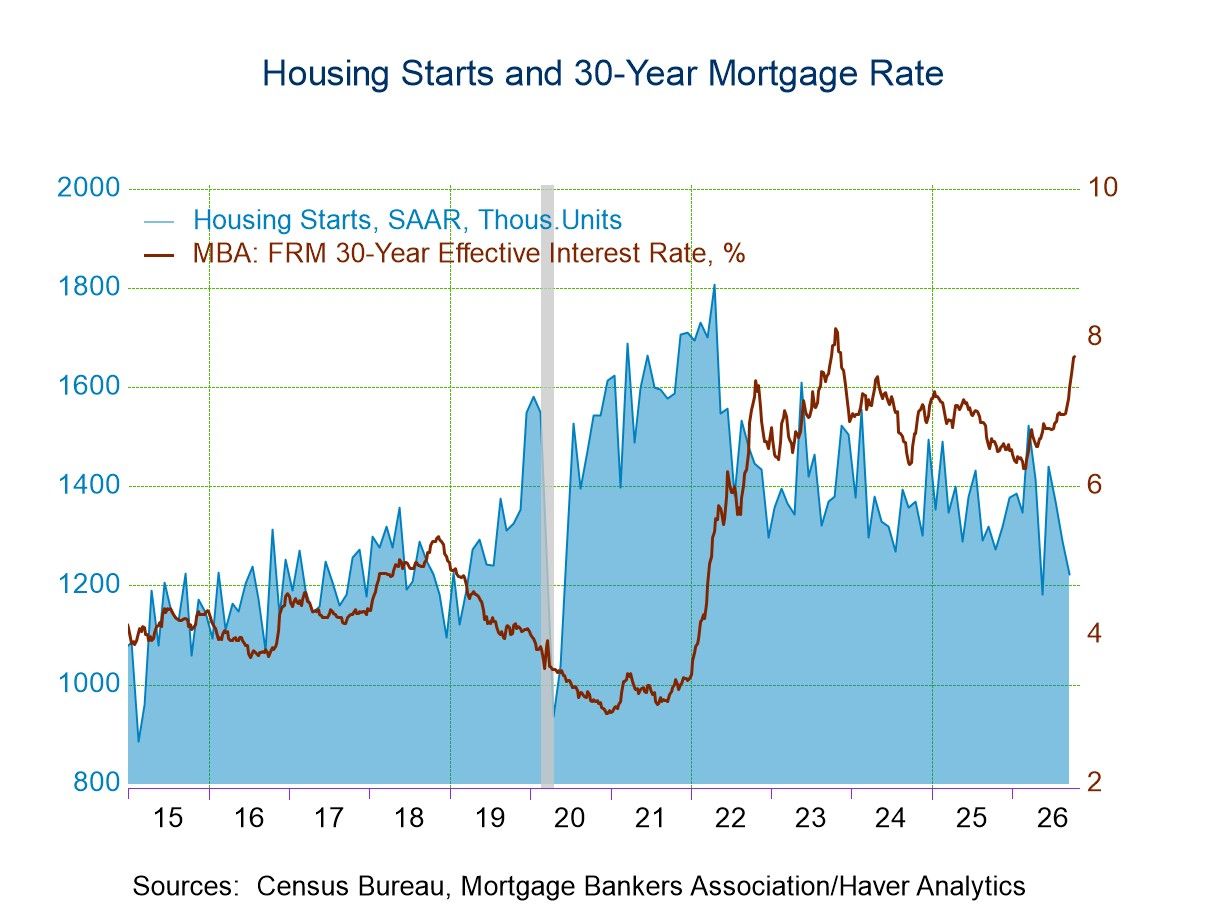
Weighed down by further rises in longer-term interest rates, housing construction fell markedly in September, declining an unexpected 5.2% m/m (-7.4% y/y) to 1.221 million units at an annual rate following a 5.9% monthly drop in August and a 4.9% monthly decline in July. The September level is the second lowest since the economy was emerging from the COVID shutdown in the spring of 2020. The Action Economics Forecast survey looked for a 2.0% monthly gain. Residential investment has been a persistent drag on real GDP growth recently, subtracting from quarterly real GDP growth in seven of the previous nine quarters. Today’s release shows total housing starts in Q3 to be meaningfully lower than in Q2, indicating that residential investment will be a drag on GDP growth in Q3.
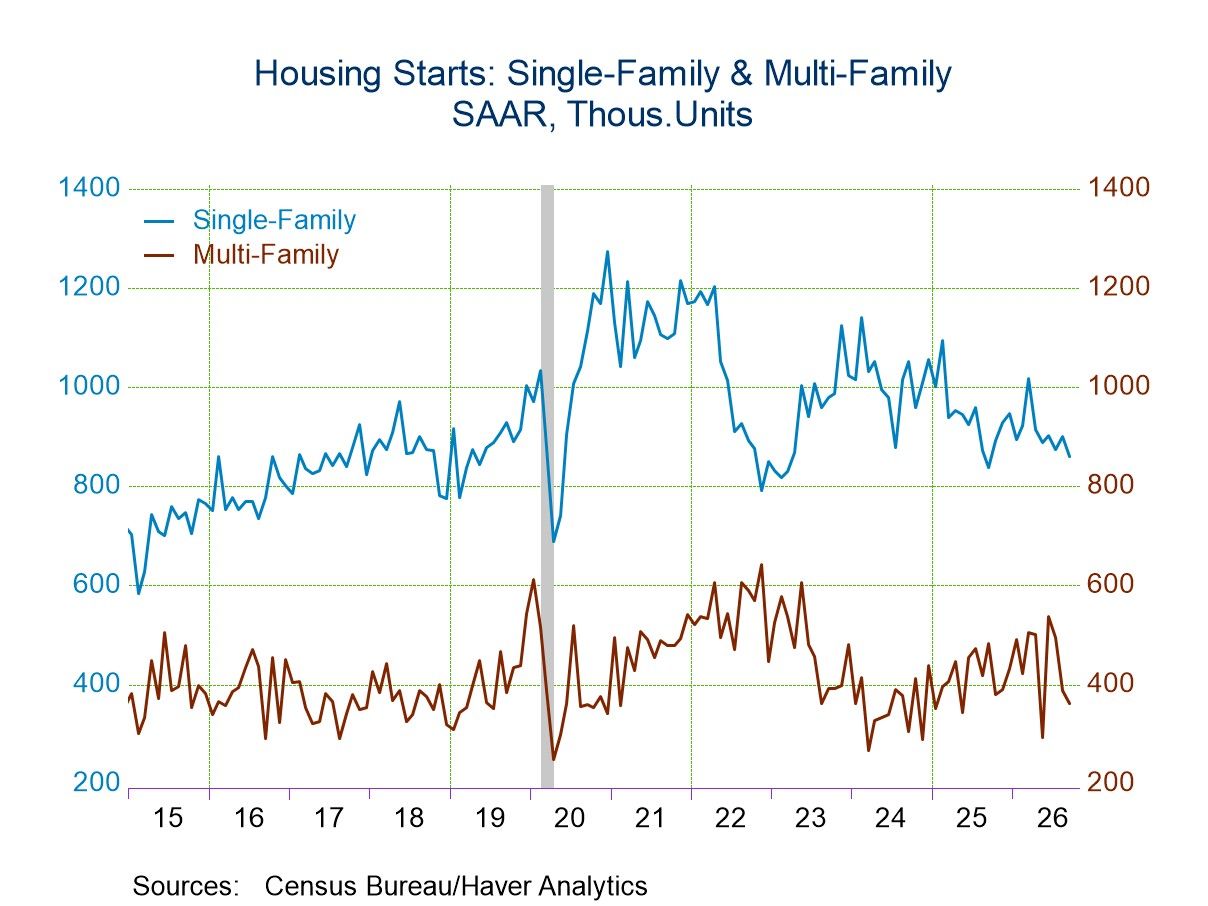
Single-family starts fell 4.6% m/m (+2.6% y/y) in September, the second monthly decline in the past three months, following a 2.9% monthly increase in August. Usually volatile multi-family starts have been even weaker recently. They fell 6.7% m/m (-24.9% y/y) in September, their fifth monthly decline in the past six months, on top of a 21.5% monthly drop in August.
Looking at the four major geographic regions, starts rose 6.1% m/m (+11.0% y/y) in the South. They were unchanged from August (-30.9% y/y) in the Northeast after a 43.3% monthly plunge in August. Starts in the Midwest posted the third consecutive double-digit monthly decline in September, falling 19.0% m/m (-19.4% y/y). Starts were even weaker in the West in September, plunging 23.2% m/m (-25.4% y/y) but this was after a 25.4% monthly surge in August.
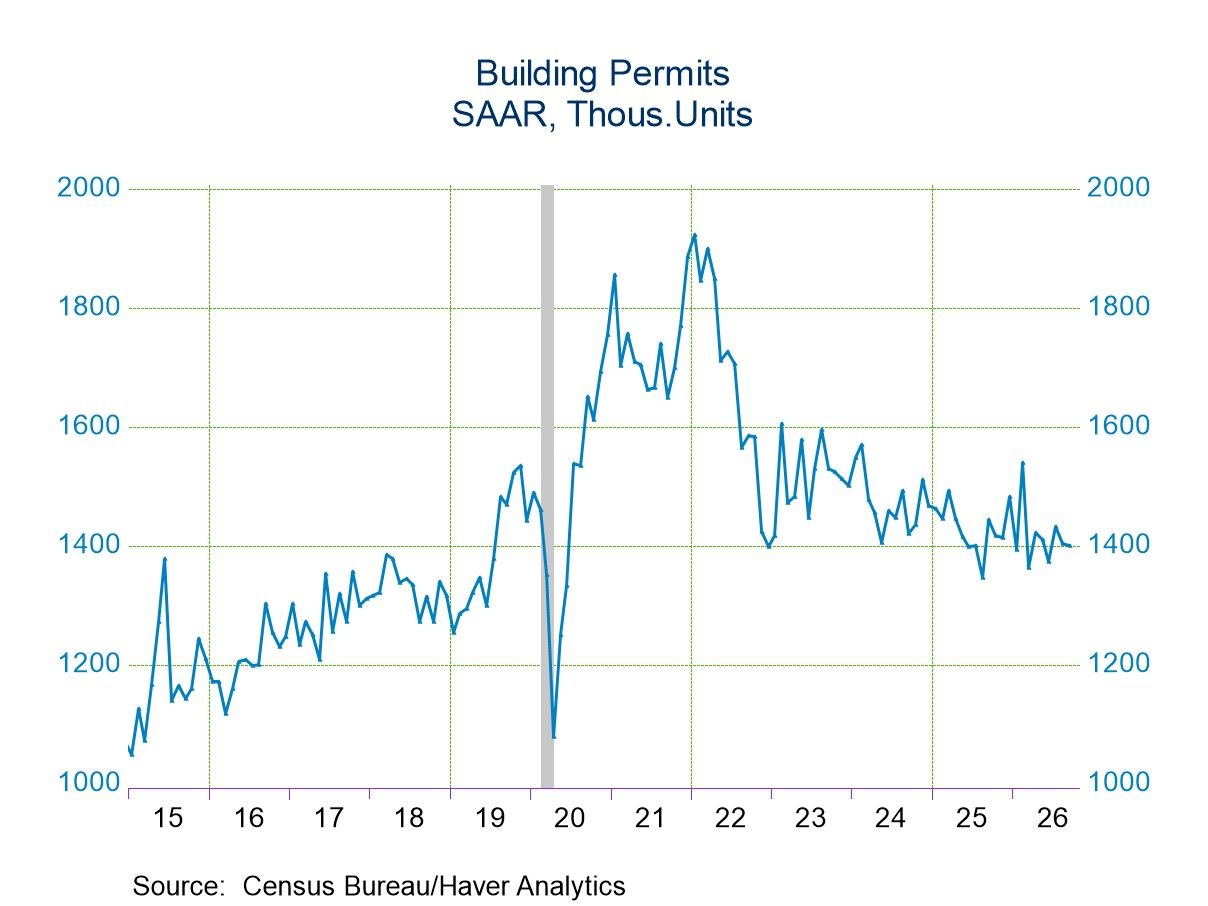
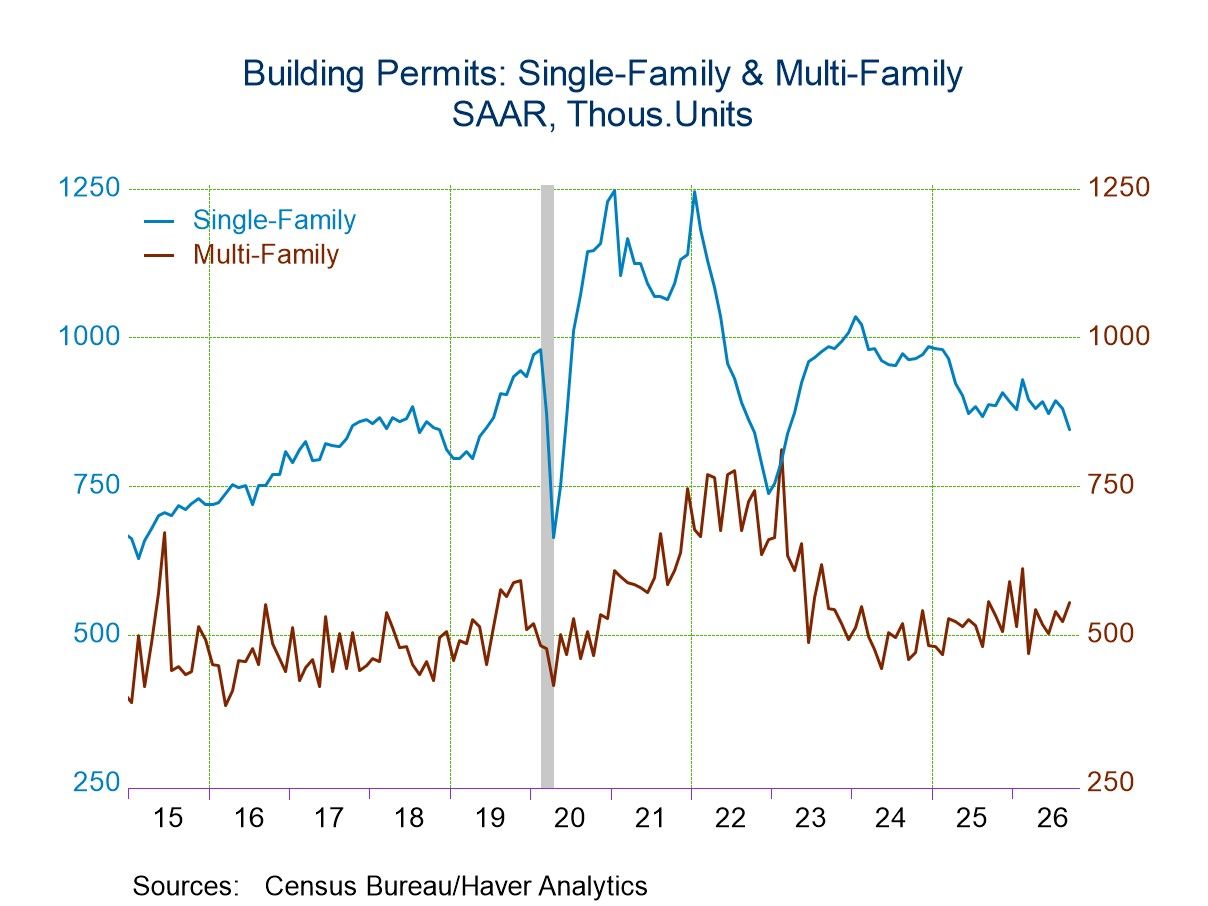
In comparison to the marked decline in housing starts in September, housing permits edged down only 0.2% m/m (-3.0% y/y) to 1.400 million units at an annual rate. This was the fourth monthly decline in the past five months. Expectations were for a small decline in September. Single-family permits fell 4.0% m/m (-4.8% y/y), their third monthly decline in the past four months. More volatile multi-family permits rose 6.1% m/m (-0.2% y/y), more than offsetting a 3.0% monthly decline in August.
Permits increased in three of the four major regions in September. They jumped 13.3% m/m (-2.0% y/y) in the Northeast but this increase failed to offset a 15.8% monthly drop in August. Permits rose a more moderate 1.5% m/m (-1.8% y/y) in the South after having been unchanged in August. They edged up 0.5% m/m (+4.4% y/y) in the Midwest, the third monthly gain in the past four months. By contrast, permits plunged 10.2% m/m (-11.3% y/y) in the West, the first monthly decline in the past three months.
The housing starts and permits figures can be found in Haver’s USECON database. The expectations figure is contained in the AS1REPNA database.

Sandy Batten
AuthorMore in Author Profile »Sandy Batten has more than 30 years of experience analyzing industrial economies and financial markets and a wide range of experience across the financial services sector, government, and academia. Before joining Haver Analytics, Sandy was a Vice President and Senior Economist at Citibank; Senior Credit Market Analyst at CDC Investment Management, Managing Director at Bear Stearns, and Executive Director at JPMorgan. In 2008, Sandy was named the most accurate US forecaster by the National Association for Business Economics. He is a member of the New York Forecasters Club, NABE, and the American Economic Association. Prior to his time in the financial services sector, Sandy was a Research Officer at the Federal Reserve Bank of St. Louis, Senior Staff Economist on the President’s Council of Economic Advisors, Deputy Assistant Secretary for Economic Policy at the US Treasury, and Economist at the International Monetary Fund. Sandy has taught economics at St. Louis University, Denison University, and Muskingun College. He has published numerous peer-reviewed articles in a wide range of academic publications. He has a B.A. in economics from the University of Richmond and a M.A. and Ph.D. in economics from The Ohio State University.
More Economy in Brief
 Asia