Asia| Oct 19 2026
Economic Letter from Asia: Chips and Rice
In this week’s Letter, we examine Asia’s contrasting fortunes in the IMF’s latest forecasts: strong growth among the economies benefiting from the AI boom, and rising inflation among those exposed to energy and food price shocks. The October WEO leaves the global growth forecast unchanged from April, but Taiwan and South Korea have received sharp upgrades, while Thailand and the Philippines face the largest upward inflation revisions among the Asian economies shown (chart 1). The gains in the two chip exporters rest heavily on semiconductor shipments, with exports at times contributing more to GDP growth than the headline rate itself (chart 2). That positioning captures substantial rent from the AI upcycle, yet it also concentrates risk. This month’s chipmaker-led selloff, sparked by a Chinese memory breakthrough, showed how quickly a single sector can drag down entire benchmarks (chart 3). The same exposure applies to growth, should competition intensify or demand falter. On inflation, Thailand and the Philippines have already absorbed an energy spike from the continued closure of the Strait of Hormuz (chart 4). A potential food shock now threatens to add a second layer, with rice futures rising and global production set to fall as a strong El Niño takes hold (chart 5). China, finally, saw growth pick up to 4.5% y/y in Q3, at the floor of its 4.5% to 5% target. Yet its two-speed pattern persists, with booming exports outpacing contracting investment and weak consumption, leaving growth reliant on external demand (chart 6).
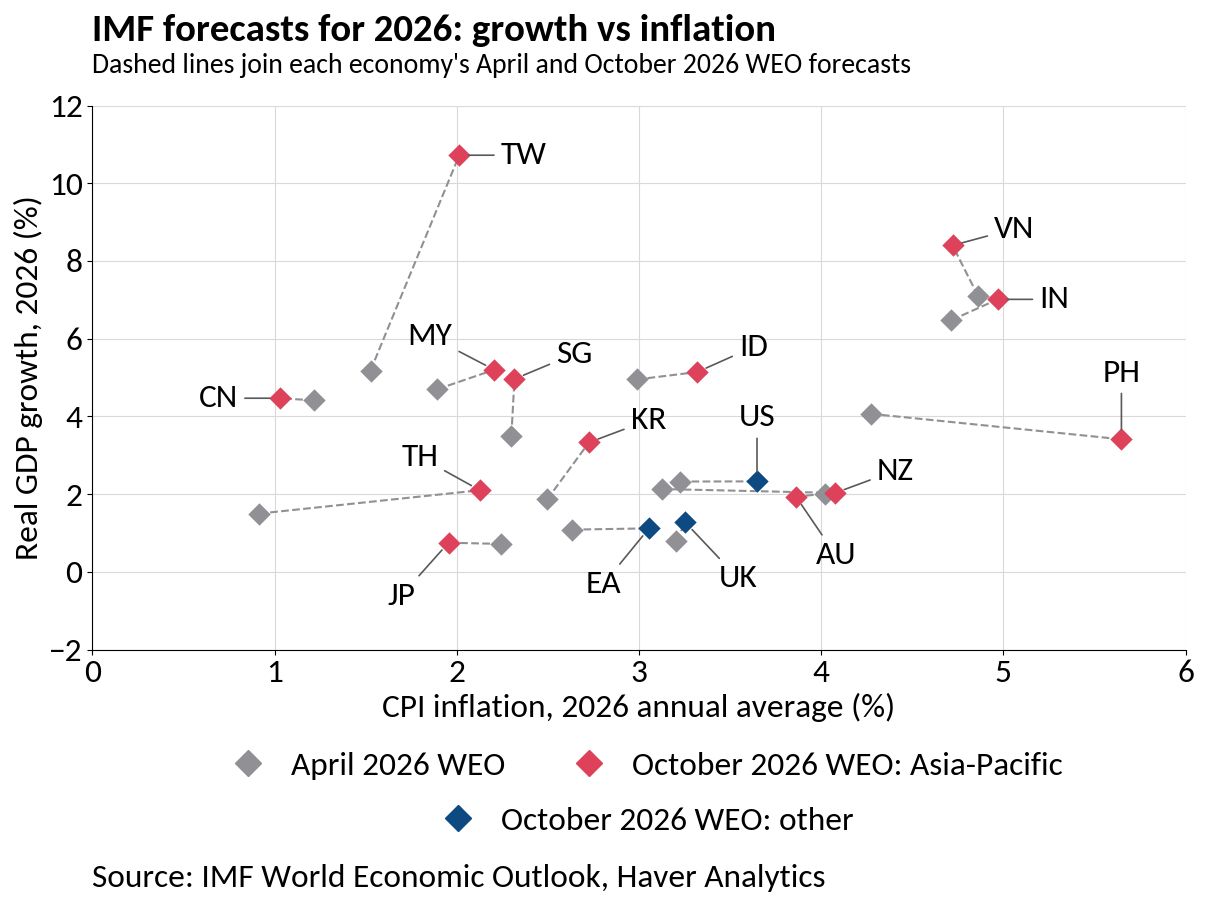
The latest IMF WEO forecasts The IMF’s October World Economic Outlook keeps global growth at 3.1% for 2026 compared to April forecasts, but the stable aggregate masks a marked reallocation across economies. Taiwan and South Korea stand out in Asia (chart 1), with Taiwan’s 2026 growth forecast roughly doubles to above 10%, while South Korea’s rises from below 2% to above 3%. Both upgrades owe much to the AI buildout, given their role as major producers and exporters of related goods. Inflation tells a different story. Thailand and the Philippines, along with the US and the euro area, all carry higher CPI forecasts than in April, shown by rightward shifts in the chart. The drivers are several and affect each economy with differing intensity. One is elevated oil prices, as the Strait of Hormuz remains effectively closed to commercial shipping. Another is food, as El Niño begins to weigh on crops. For China, growth expectations are little changed at 4.5%, but the price outlook has softened further, with average inflation now seen near 1%.
Chart 1: IMF World Economic Outlook forecasts
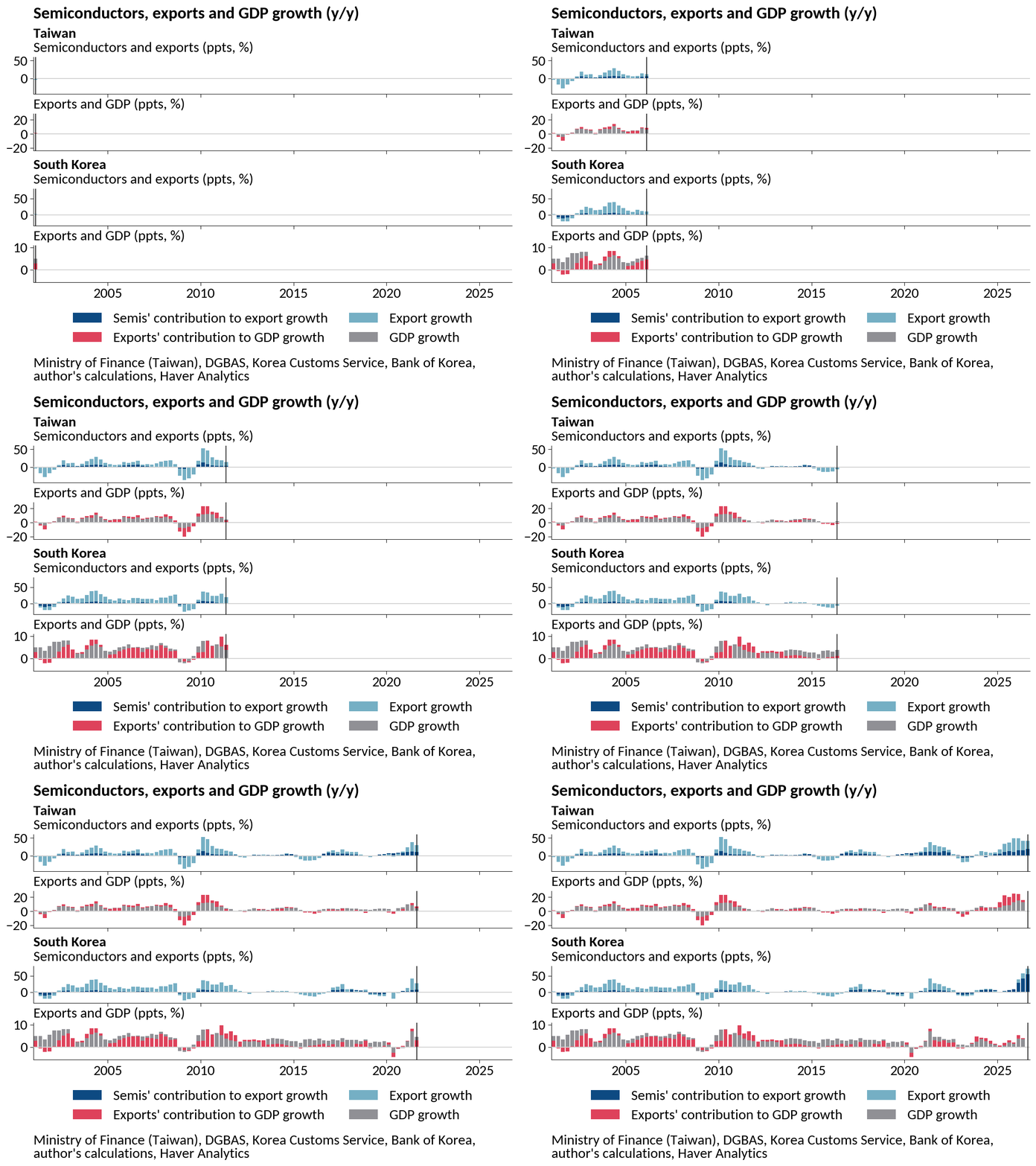
Growth and concentration risks The growth upgrades rest heavily on exports, particularly semiconductors (chart 2). This is a recent development: export growth in both economies has accelerated sharply only over the past two years. In Taiwan, the contribution of exports to GDP growth has exceeded the headline growth rate itself in recent quarters. In South Korea, semiconductors account for the bulk of nominal export growth, with chips alone contributing more than 50 percentage points as export growth neared 70% y/y. The positioning of both economies has allowed them to capture substantial rent from the AI upcycle. That same positioning, however, also concentrates their exposure to a single sector, a risk that has become more visible in recent weeks.
Chart 2: Taiwan and South Korea semiconductors and trade
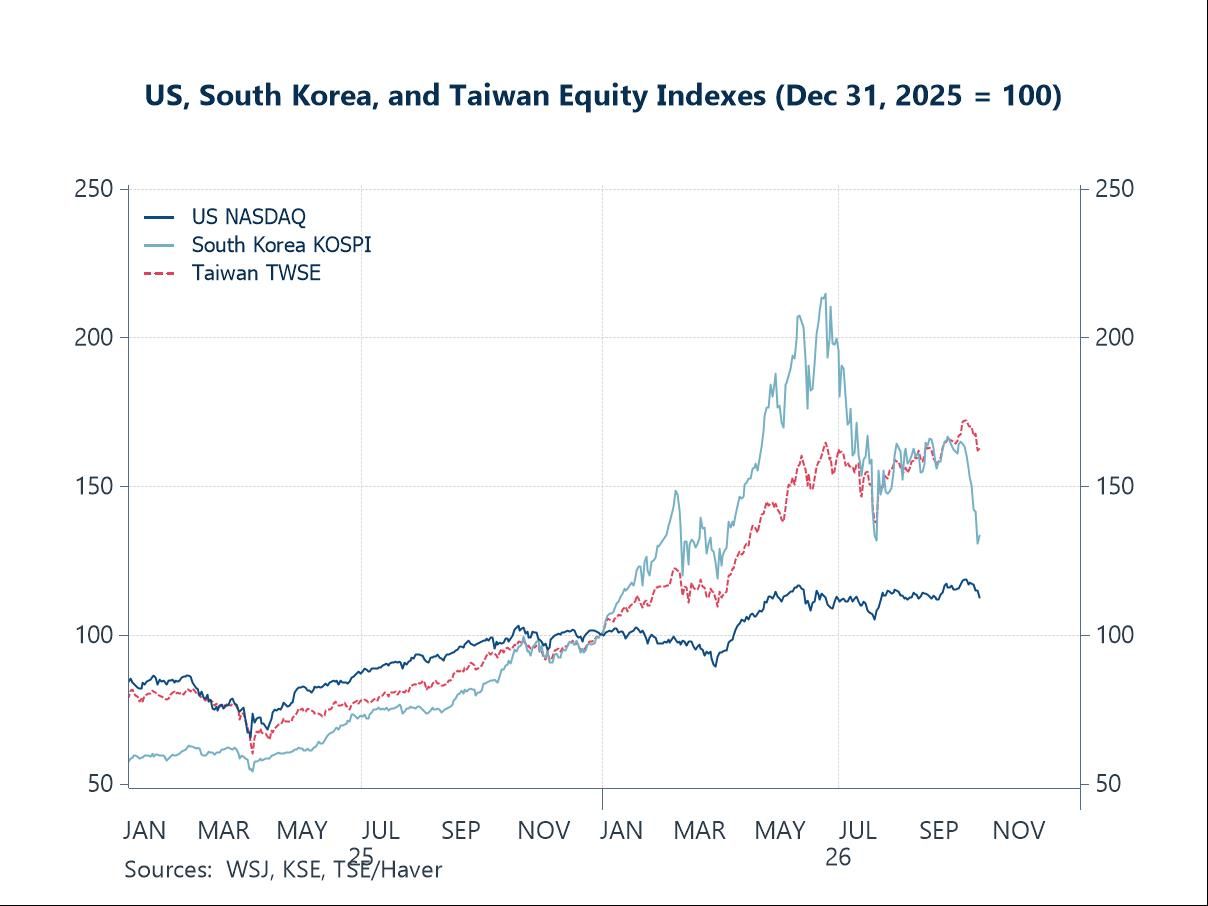
Concentration risks surfaced in financial markets this month, with chipmaker-led selloffs in Taiwanese, South Korean and US equities (chart 3). On 12 October, Chinese memory maker CXMT announced progress on a higher-density DRAM design, and the KOSPI fell 5.5% the next day as SK Hynix and Samsung slid. The rout deepened on 15 October, when the KOSPI fell nearly 9% and triggered a circuit breaker. Other drivers were also at play, including hotter-than-expected US inflation. Because chipmakers have gained weight in major indexes over the years, a selloff in that one sector now produces large moves in the broad benchmark. The KOSPI, which more than doubled from end-2025 to its June peak, has since given back much of that gain. The same logic applies to growth. High exposure lets an economy capture more of the upside in an upcycle. However, substantial alternative suppliers or a collapse in demand would erode that driver and leave a sizeable dent in overall growth.
Chart 3: US, South Korea, and Taiwan equity indexes
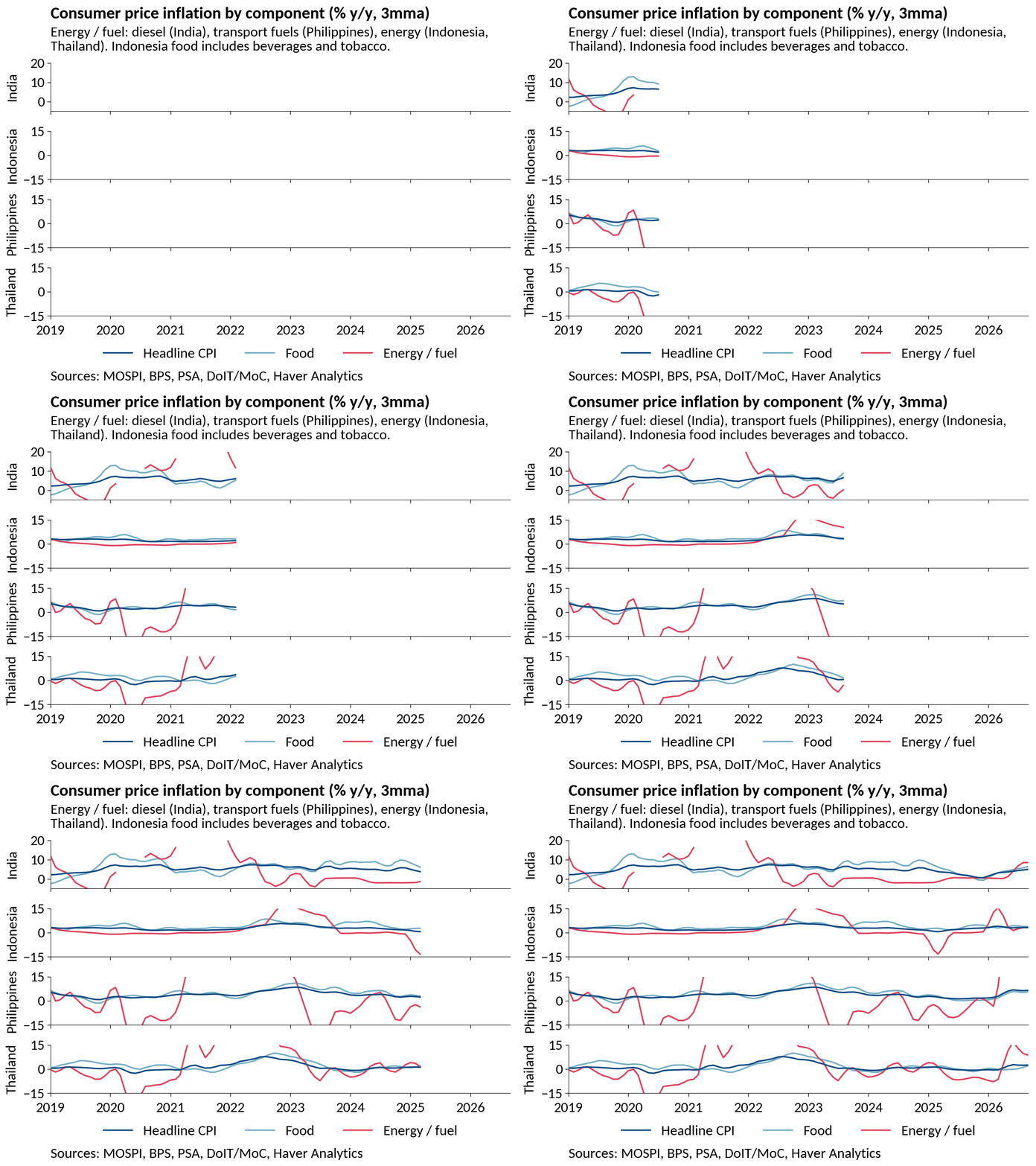
Inflation Turning to inflation in emerging Asia, Thailand and the Philippines saw the largest increases in their IMF average inflation forecasts, while Indonesia and India saw moderate upward revisions. As chart 4 shows, the former two have already undergone major inflation spikes through the energy channel. Transport fuel inflation in the Philippines surged in 2026, lifting headline CPI to around 6% y/y, while energy inflation in Thailand rose above 15% before easing. Much of this reflects surging oil prices from the continued closure of the Strait of Hormuz. The IEA has described the closure as the largest supply disruption in the oil market’s history. Food inflation, by contrast, has so far stayed relatively contained across all four economies. The looming threat of an adverse food supply shock, however, would add another layer of upward pressure. Should it materialise while the Strait remains closed, headline inflation would be pushed higher still.
Chart 4: CPI inflation in emerging Asia
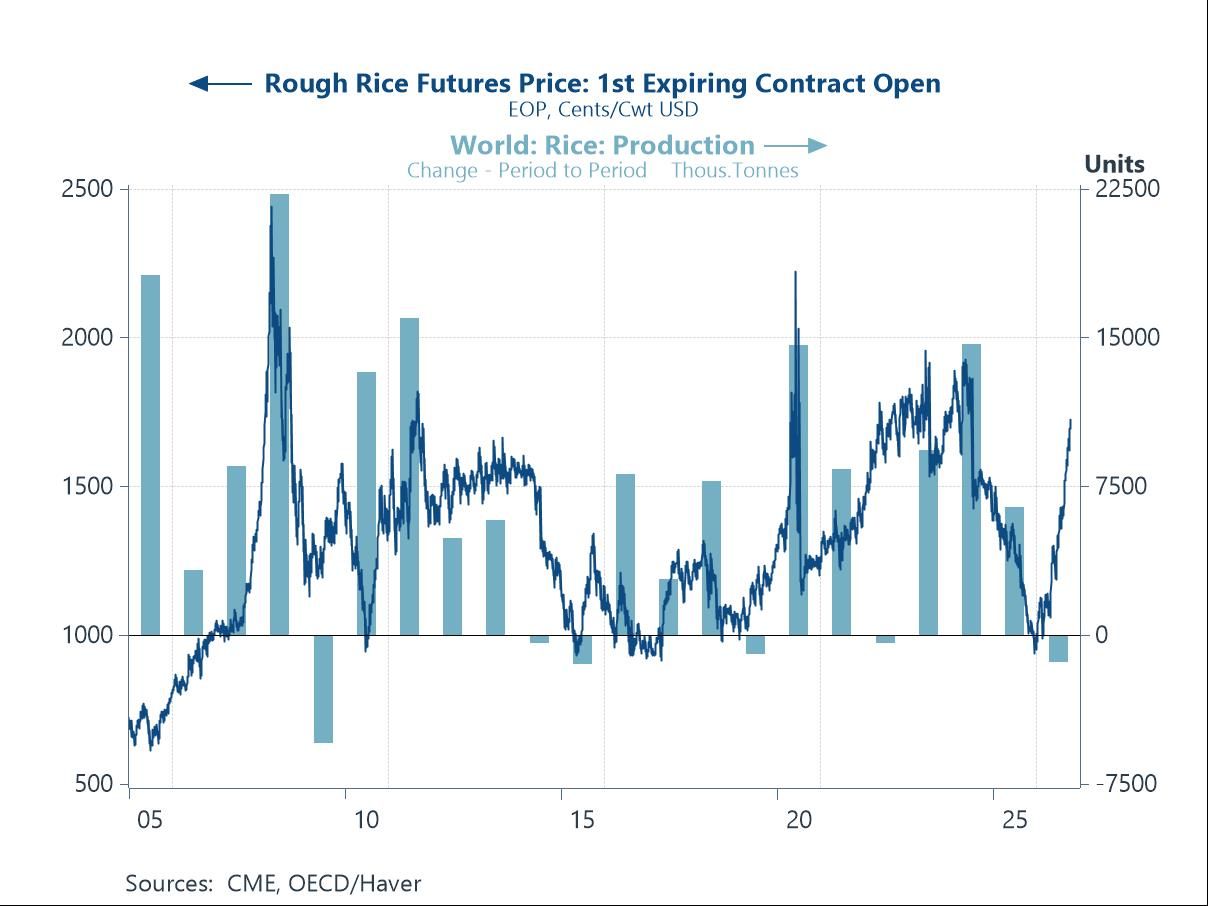
Commodity markets have already begun to move (chart 5). Although a food supply shock has not yet substantively materialised, markets are starting to price in a potential squeeze from adverse weather. Rough rice futures have rebounded sharply from their lows around the turn of the year, climbing back above 1,600 cents per hundredweight. On the supply side, OECD data point to a decline in world rice production this year. The weather outlook offers little relief. NOAA’s 8 October update expects a strong to very strong El Niño through January to March 2027, persisting through March to May. The WMO puts the likelihood of El Niño persisting through February 2027 at nearly 100%, with dry conditions expected across Asia and the Pacific. Given that persistence, supply-driven price pressure on rice and other staples may continue for some time yet.
Chart 5: Rice production and price
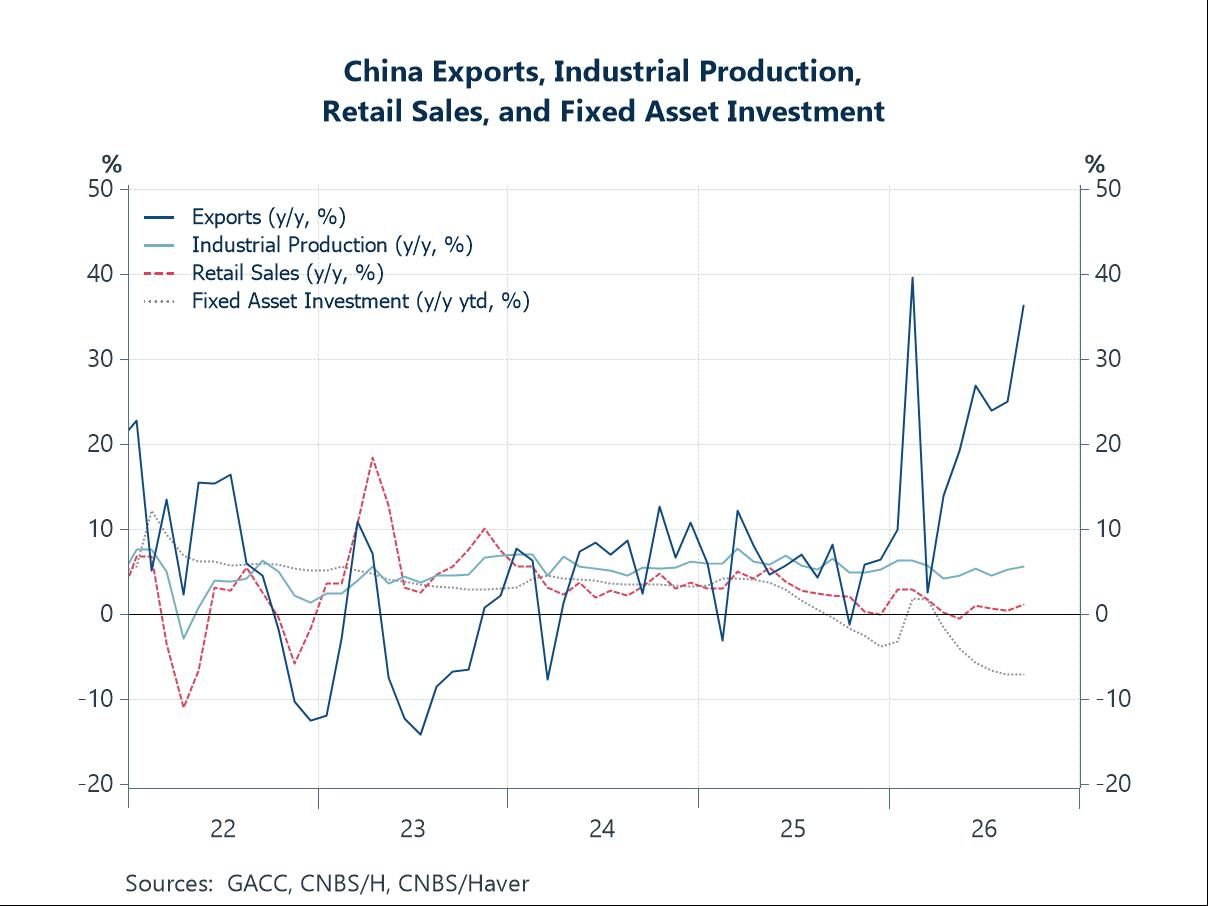
China China’s latest data show a pickup in growth but continue to describe a two-speed economy (chart 6). Real GDP growth accelerated to 4.5% y/y in Q3 from 4.3% in Q2, landing at the floor of the 4.5% to 5% target. In September, industrial production growth edged up to 5.5% y/y and retail sales growth to 1.1% y/y. Fixed asset investment, however, fell 7.2% y/y over January to September, matching the decline to August and underscoring persistent domestic weakness. The gap between the two sides of the economy remains wide. Exports grew 36.3% y/y in September, while retail sales growth has hovered near zero for much of the year. Outward-facing indicators such as exports and industrial production thus continue to outpace domestic-facing ones. Meeting this year’s growth target still hinges on the external sector, just as some trading partners push back against China’s widening surplus. A pivot towards consumption-led growth remains a tall task.
Chart 6: China exports, industrial production, retail sales, and fixed asset investment

Tian Yong Woon
AuthorMore in Author Profile »Tian Yong joined Haver Analytics as an Economist in 2023. Previously, Tian Yong worked as an Economist with Deutsche Bank, covering Emerging Asian economies while also writing on thematic issues within the broader Asia region. Prior to his work with Deutsche Bank, he worked as an Economic Analyst with the International Monetary Fund, where he contributed to Article IV consultations with Singapore and Malaysia, and to the regular surveillance of financial stability issues in the Asia Pacific region.
Tian Yong holds a Master of Science in Quantitative Finance from the Singapore Management University, a Master of Science in Analytics from the Georgia Institute of Technology, a Bachelor of Science in Mathematics from the Singapore University of Social Sciences, and a Bachelor of Science in Banking and Finance from the University of London.
More Economy in Brief