French Industry and Services Both Improve
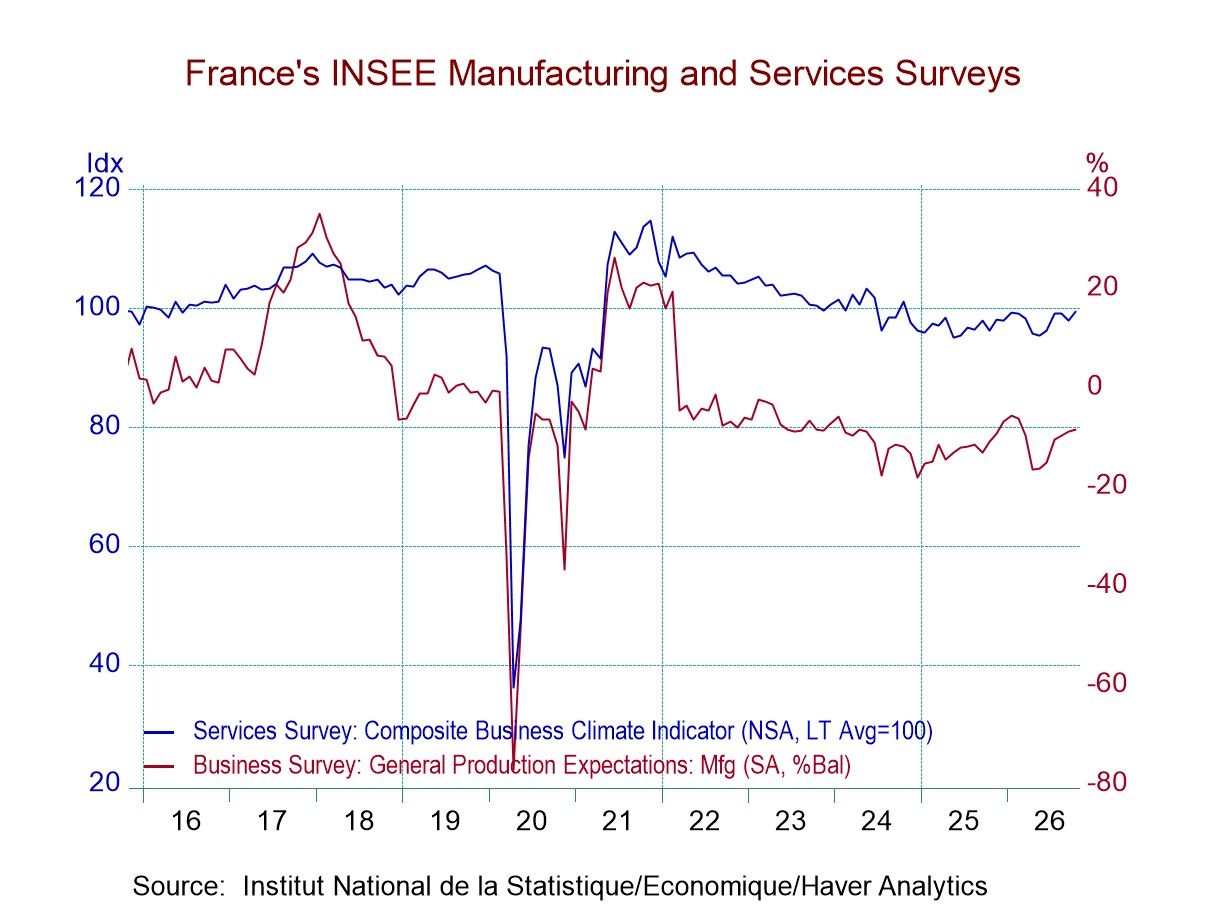
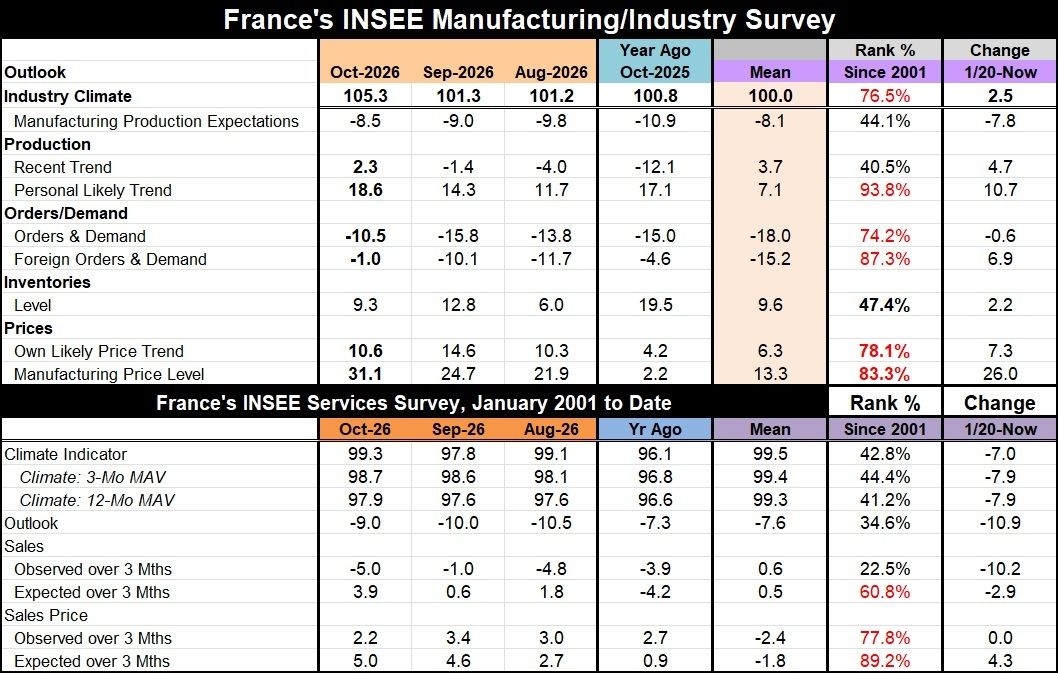
The INSEE survey for France that evaluates manufacturing and services sector firms shows a strong rebound for manufacturing in October and a solid rebound for services in the same month. However, the two sectors are experiencing significantly different environments, with the industry climate reading for manufacturing at a 76.5 percentile standing, putting it in the top 25 percentile of all performances back to 2001. The services climate reading is at a 42.8 percentile standing, leaving it below its historic median over the same period.
Manufacturing The manufacturing survey shows manufacturing production expectations improved slightly, moving from a -9 reading in September to -8.5 in October; the recent trend for production increased to 2.3 in October from -1.4 in September. While participants in the survey found the prospects for their own industry, the personal likely trend rose to 18.6 from 14.3 in September. The assessment of the industry trend is still a weak one with a 40th percentile standing; however, the personal likely trend is quite strong at a 93.8 percentile standing. This shows that participants have a much more upbeat view of their own industry compared to their expectations for the manufacturing sector as a whole. Since the survey is a broad one across sectors, these results make the survey somewhat inconsistent with itself.
Orders and demand improved sharply in October with the net rating of -10.5, sharply improved from -15.8 in September. The response for foreign orders and demand showed an even stronger positive shift to -1 from -10.1 in September. The rankings for orders and demand show a 74.2 percentile standing for the overall reading, while foreign orders & demand have an 87.3 percentile standing; both of these are quite strong.
The outlook for prices diverges, with firms seeing their own likely price and trend for their industry at 10.6 in October, lower than 14.6 in September. However, for the manufacturing sector price level, they look for an escalation to 31.1 in October from 24.7 in September. The own likely price trend has a 78.1 percentile standing, while the manufacturing price level has an 83.3 percentile standing; both are looking for significant upward pressure on prices.
Services The services survey in October shows an increase in the climate indicator to 99.3 from 97.8 in September; however, it still leaves the sector with a 42.8 percentile standing, below its historic median. The three-month average and the 12-month average of the climate gauge both show improvements; in both cases, they're relatively small, but a lot of that is the result of the smoothing. In terms of the rankings, the rankings for the three-month and 12-month measures are fairly similar to the ranking for the reading for the current month in October.
The outlook improved to -9 in October from -10 in September but still has only a 34.6 percentile standing, nearly a lower 1/3 standing for the outlook.
For sales, the observed performance over the last three months weakened to -5 in October from -1 in September. However, the expectations for three months ahead improved to 3.9 from 0.6 in September. The past observed trend is weak with a 22.5 percentile standing, while the expected result for the three months ahead has an above median, at a 60.8 percentile standing. With such a weak outlook, the turnaround on sales is surprising.
On the price side, there are slightly mixed results, with the observed trend over three months falling to 2.2 in October from 3.4 in September against the expected trend over the next three months, which moved up to 5 from 4.6 in September. The ranking of the past three-month trend is a 77.8 percentile standing; the ranking for the expected trend is a stronger 89.2 percentile standing.
Summing up For both services and industry outlooks, we see concerns or expectations of higher prices ahead. Manufacturing shows a split view on the recent growth trend versus the trend that respondents are expecting for their own industries, while for services, the overall industry expectation is upbeat despite a low ranking on the past three-month trend.
In assessing what these things mean for France, it's difficult to say because the country is involved in this current upheaval with nationwide protests, some of them of terrific intensity. One thing the survey tells us is that, at least at the time these demonstrations were occurring, the economy was performing fairly well. We'll have to look in the coming months to see how much of this dissatisfaction winds up undercutting what had been a relatively stable-to-strong economy with improving expectations, but also one layered with inflation concerns.

Robert Brusca
AuthorMore in Author Profile »Robert A. Brusca is Chief Economist of Fact and Opinion Economics, a consulting firm he founded in Manhattan. He has been an economist on Wall Street for over 25 years. He has visited central banking and large institutional clients in over 30 countries in his career as an economist. Mr. Brusca was a Divisional Research Chief at the Federal Reserve Bank of NY (Chief of the International Financial markets Division), a Fed Watcher at Irving Trust and Chief Economist at Nikko Securities International. He is widely quoted and appears in various media. Mr. Brusca holds an MA and Ph.D. in economics from Michigan State University and a BA in Economics from the University of Michigan. His research pursues his strong interests in non aligned policy economics as well as international economics. FAO Economics’ research targets investors to assist them in making better investment decisions in stocks, bonds and in a variety of international assets. The company does not manage money and has no conflicts in giving economic advice.
More Economy in Brief
 Global