

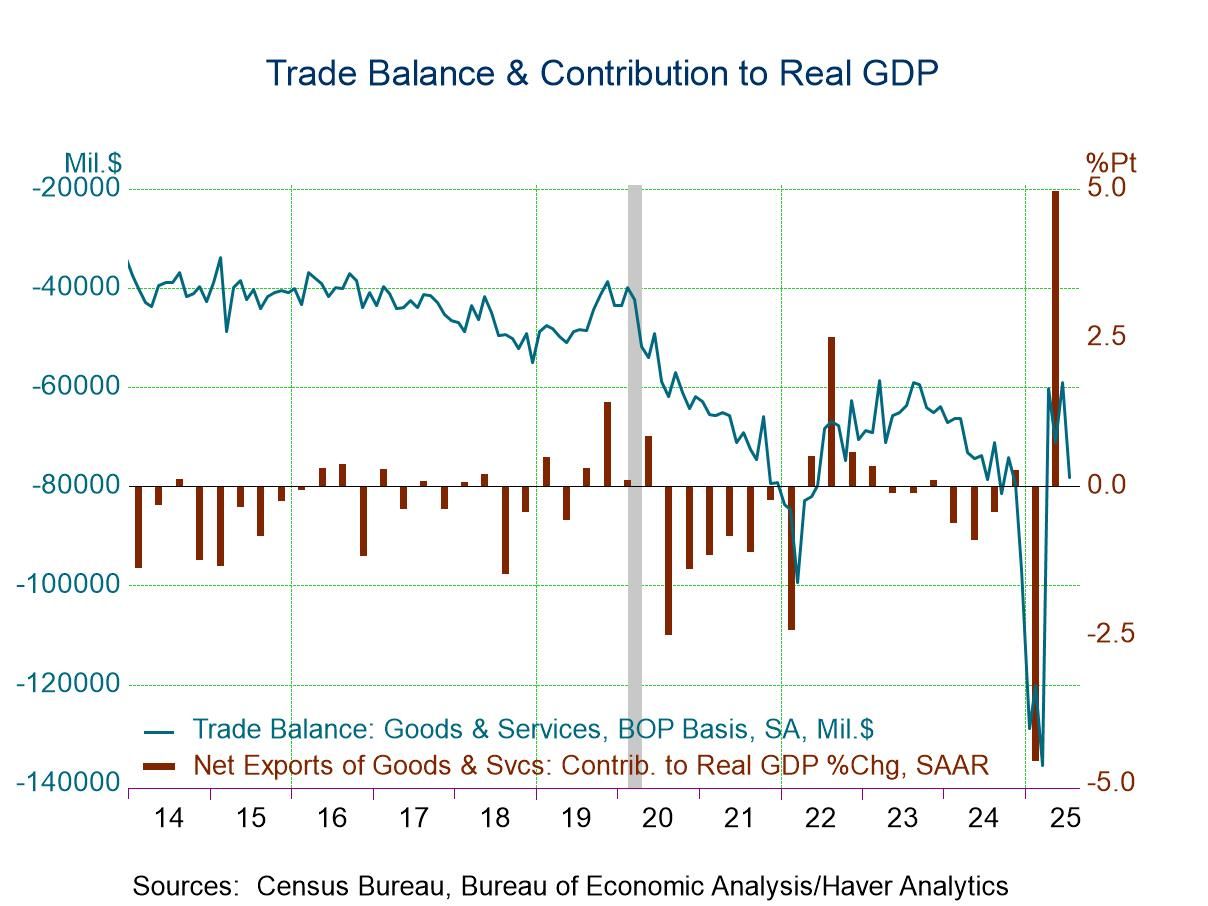
- The trade deficit widened to $78.3 billion in July from $59.1 billion in June.
- This was the largest deficit since March.
- Exports rebounded, increasing by 0.3% m/m after a 0.3% m/m decline in June.
- Imports surged, rising 5.9% following a 3.6% decline in June.
- The July import surge was led by imports of industrial supplies.
 USA| Sep 04 2025
U.S. Trade Deficit Widened in July
by:Sandy Batten
|in:Economy in Brief
 USA| Sep 04 2025
U.S. Nonfarm Labor Productivity Revised Up for Q2
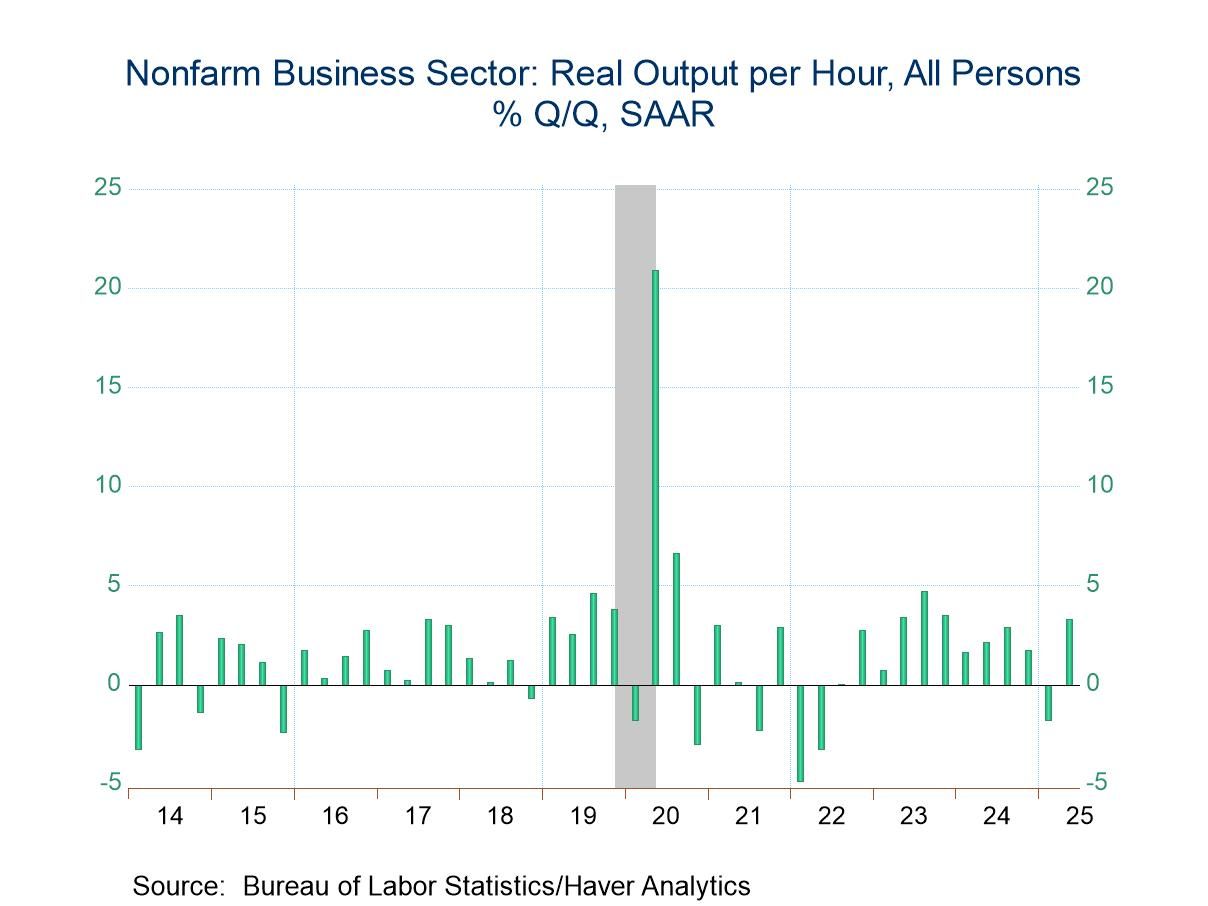
- Productivity jumped 3.3% saar in Q2, up markedly from 2.4% in the advance report.
- This is the largest quarterly rise in productivity since Q4 2023.
- Growth in nonfarm output was revised up to 4.4% from 3.7% previously while growth of hours worked was revised down to 1.1% from 1.3%.
- Compensation growth was revised up but the large upward revision to productivity still enabled growth of unit labor costs to be revised down.
by:Sandy Batten
|in:Economy in Brief
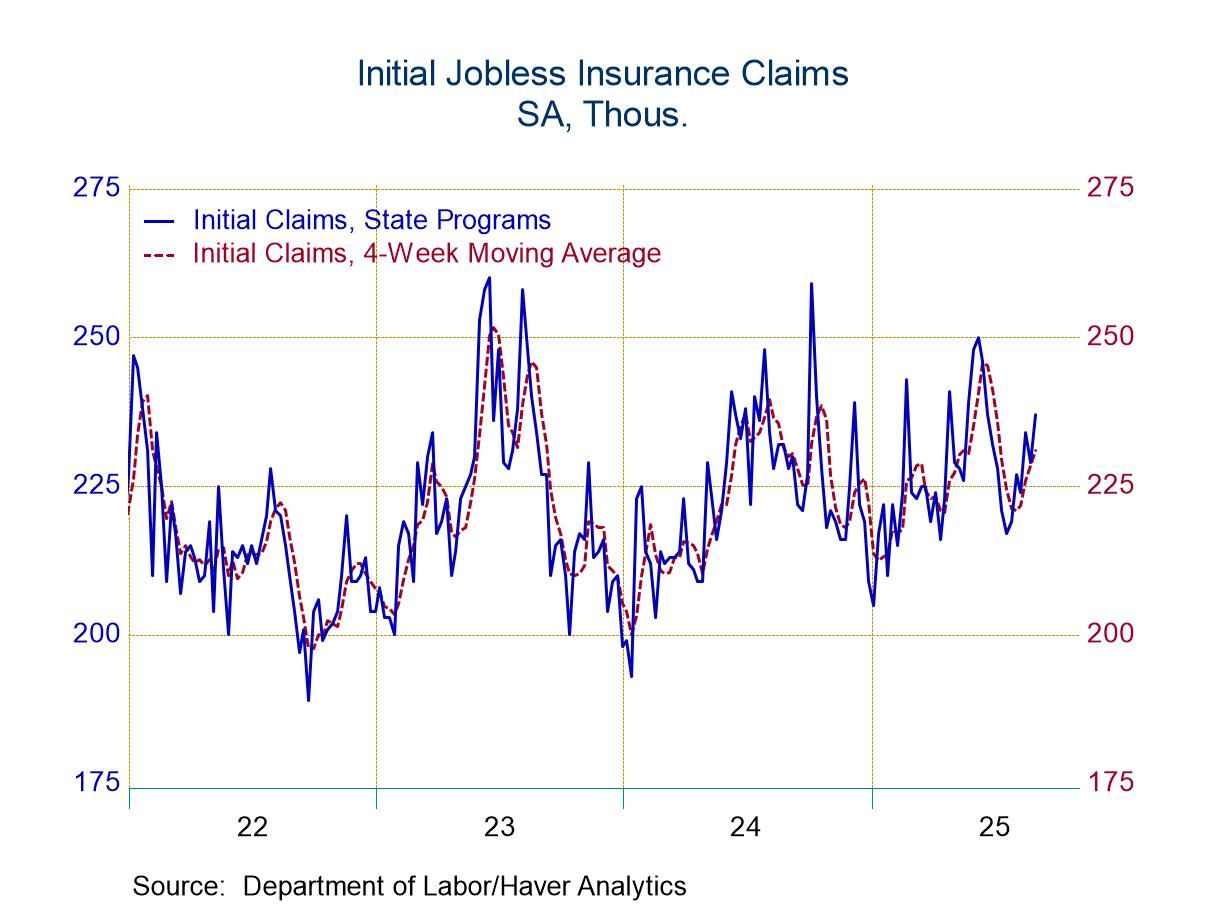
- Initial claims rose in latest week.
- Continuing claims declined.
- Insured unemployment rate holds steady.
 Europe| Sep 04 2025
Monetary Union Retail Sales Ease as Vehicle Sales Pop
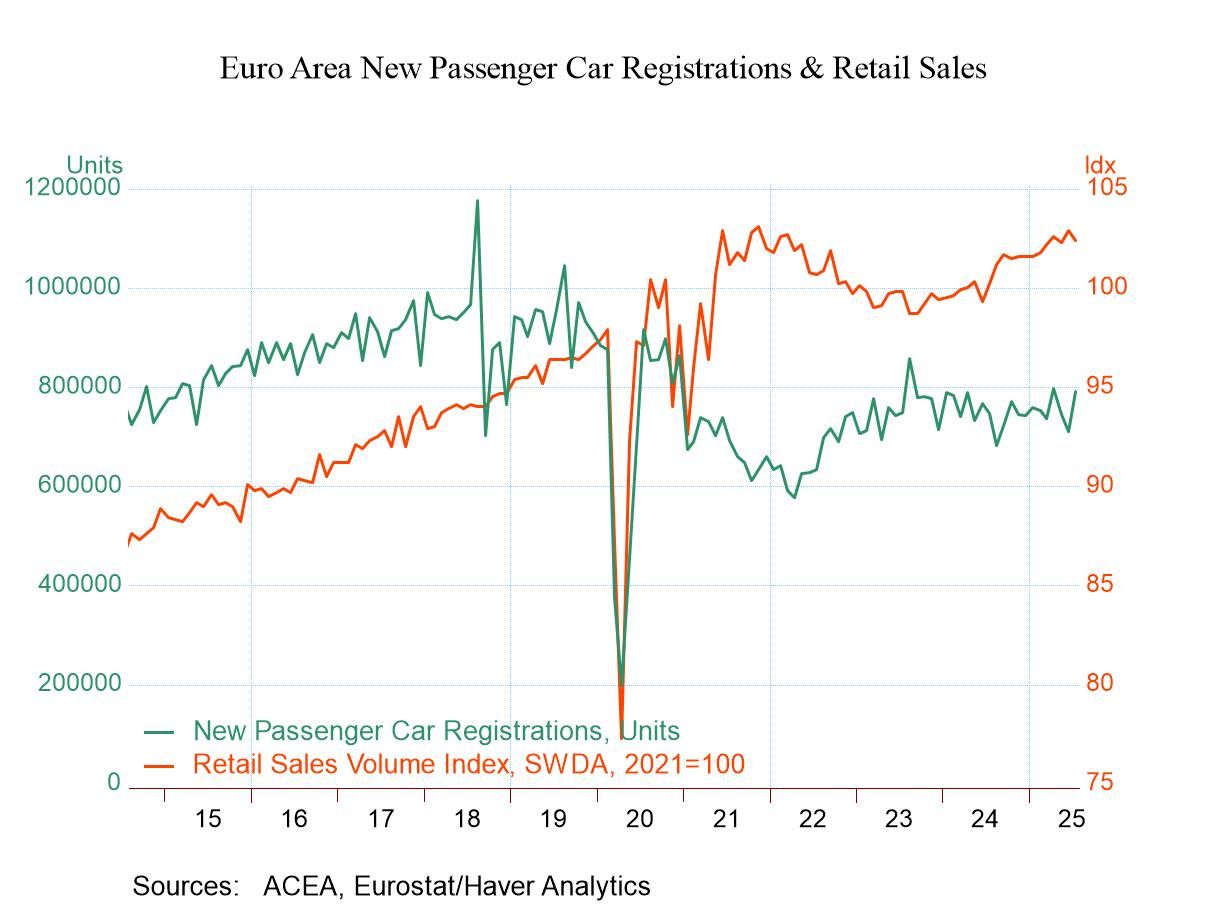
Retail sales volume in the euro area fell by 0.5% in July after rising by 0.6% in June. The three-month percent change is -0.8% at an annual rate; over six months real retail sales volumes are rising at a 1.6% annual rate and over 12 months they're rising at a 2.2% annual rate. The slowdown in retail sales volume growth has been steady from 12-months to 6-months to 3-months.
For motor vehicle registrations, the patterns are much choppier with an 11.5% increase in registrations in the EU in July after a drop of 4.6% in June, and a larger drop in May. Over 3 months monetary union motor vehicle registrations are falling at a 3.4% annual rate, after rising at an 8.7% annual rate over 6 months; over 12 months that gain is cut to a 5.9% annual rate. There's no clear trend here for motor vehicle registrations, except to note that over 3 months conditions are much weaker and that is mostly driven by June and May because July was quite strong. In the big picture, vehicle sales have been flat and moving sideways for quite some time in the monetary union- since COVID registrations are lower on balance by 10.5% even with the spike in sales in July.
Individual countries show quite different results. Germany is showing persistent deceleration in retail sales volume growth from 12-months to 6-months to 3-months, culminating in negative numbers for growth over 3 months and 6 months. For Denmark, a country that's not part of the single currency union, there's a hint of a slowdown with growth rates of 3.4% over 12 months and 3.6% over 6 months to give way to a 1.2% rate of increase annualized over 3 months. Both Sweden and Norway show real retail sales volumes in a slippage mode as growth rates ease over 6 months compared to 12 months and then ease again over 3 months compared to 6 months. For Sweden, the 3-month growth rate is a negative result at -5.7% at an annual rate.
In the quarter to date - and this is an early calculation since it's July - the monetary union is starting off with a negative growth rate of -1.2% at an annual rate for total retail sales volumes; this is affected strongly by a -6.5% annual rate reported by Germany, the largest economy and the euro area. There are positive growth rates on a quarter-to-date basis for the rest of the reporters in the table. The Netherlands logs a 21.9% annual rate increase; that strength has at least as much to do with the weak second quarter base as with surging sales in July.
Checking on the performance of sales back to January 2020 when COVID first appeared, total sales volume in the euro area are up 5.1% over that five-year span. Sweden logs no increase, Germany logs an increase of 2.1%, Norway logs an increase of 4.6%, with Denmark up by 4%. The strongest increases on this broad basis come from Spain with an 8.1% increase and the Netherlands with a 7.2% overall increase. Even so, for a five-year period, none of these growth rates are impressive. Clearly the European Monetary Union has been in a dead spot having a difficult time recovering from COVID, dealing with the war, and all of its displacement involving Russia and Ukraine, as well as the aftermath of the inflation from COVID, and what has been an ongoing restrictive monetary policy from the European Central Bank.
 USA| Sep 03 2025
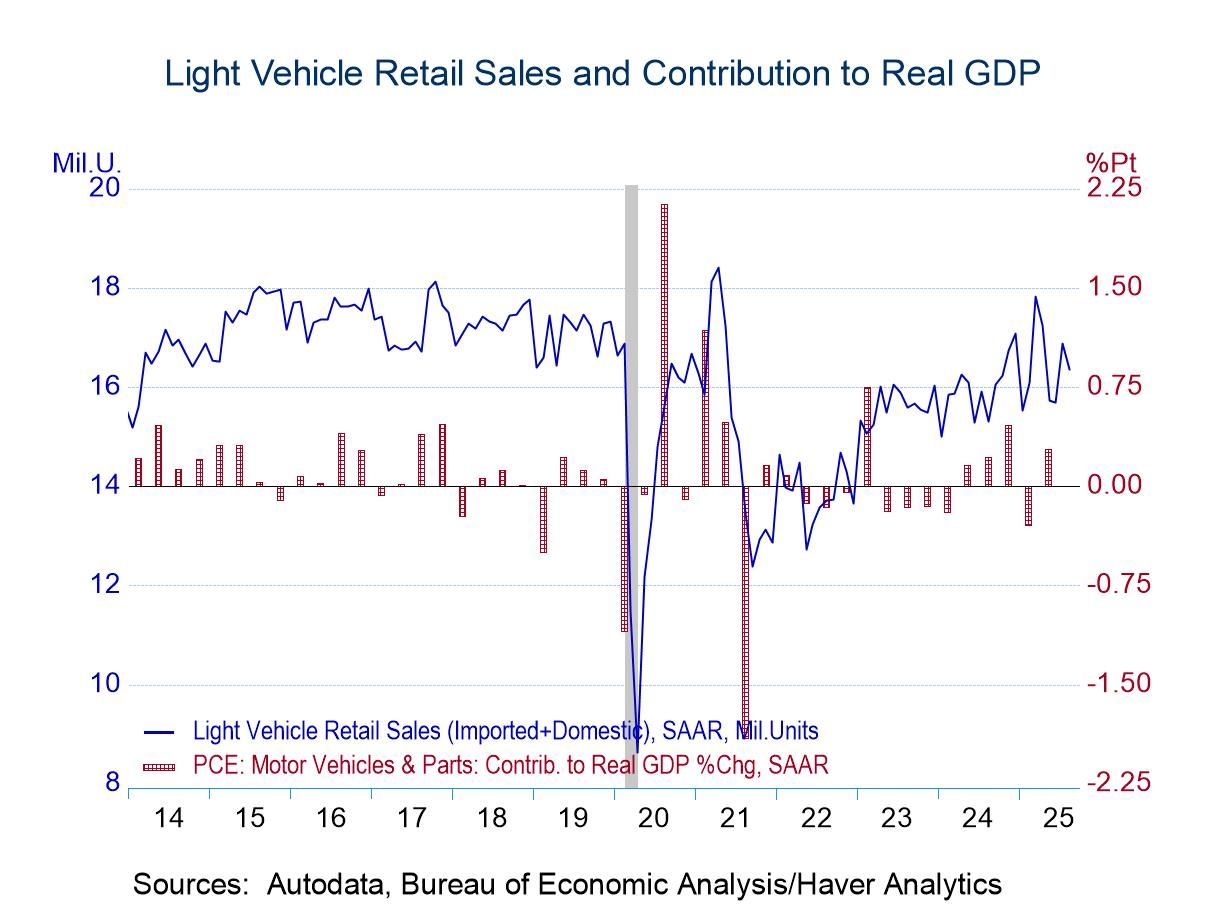
U.S. Light Vehicle Sales Ease in August
- Light truck sales decline while auto purchases improve.
- Domestic and import sales decline.
- Imports' market share steadies.
by:Tom Moeller
|in:Economy in Brief
 USA| Sep 03 2025
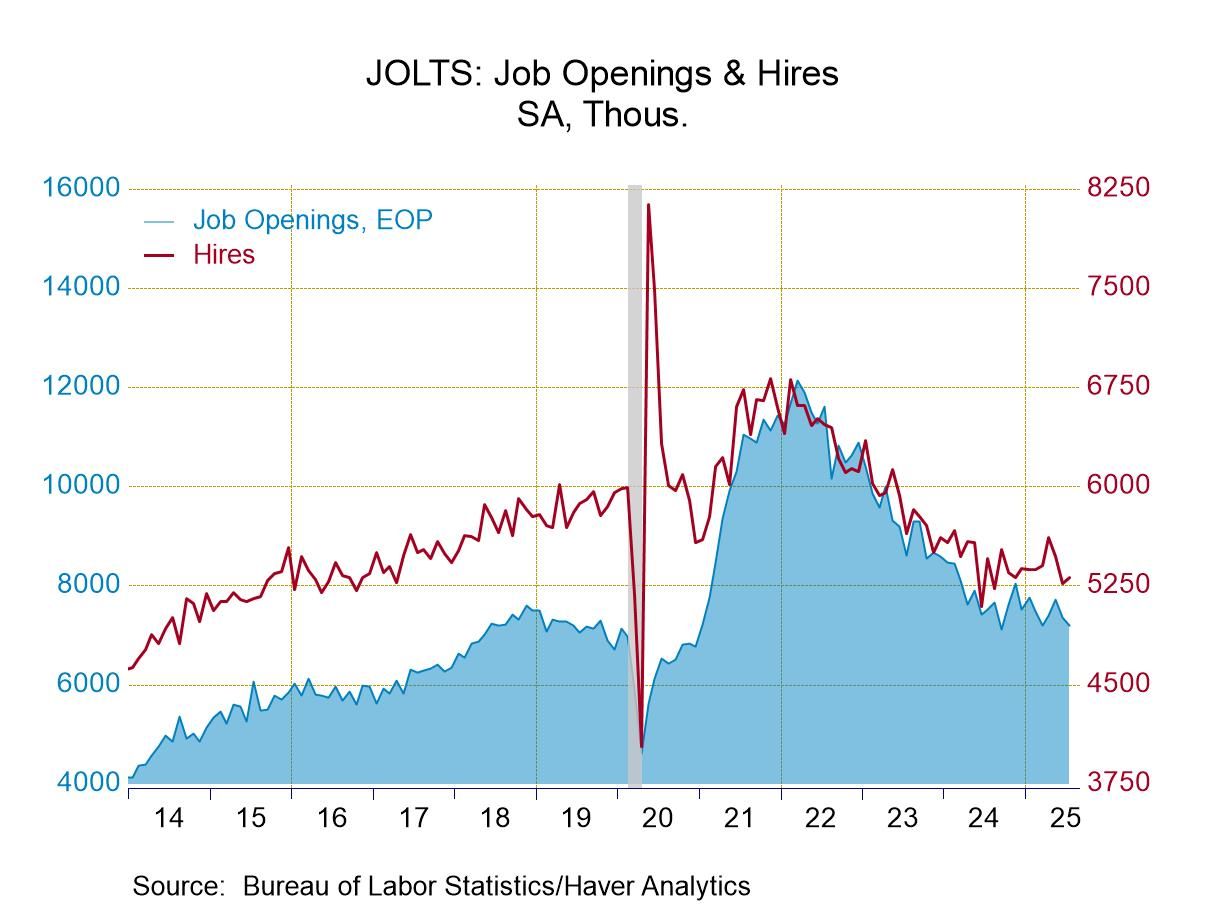
U.S. JOLTS – Job Openings Decline While Hiring Improves in July
- Job openings fall for second straight month.
- Hiring improves after two consecutive months of sharp decline.
- Separations fall, quits ease but layoffs rise slightly.
by:Tom Moeller
|in:Economy in Brief
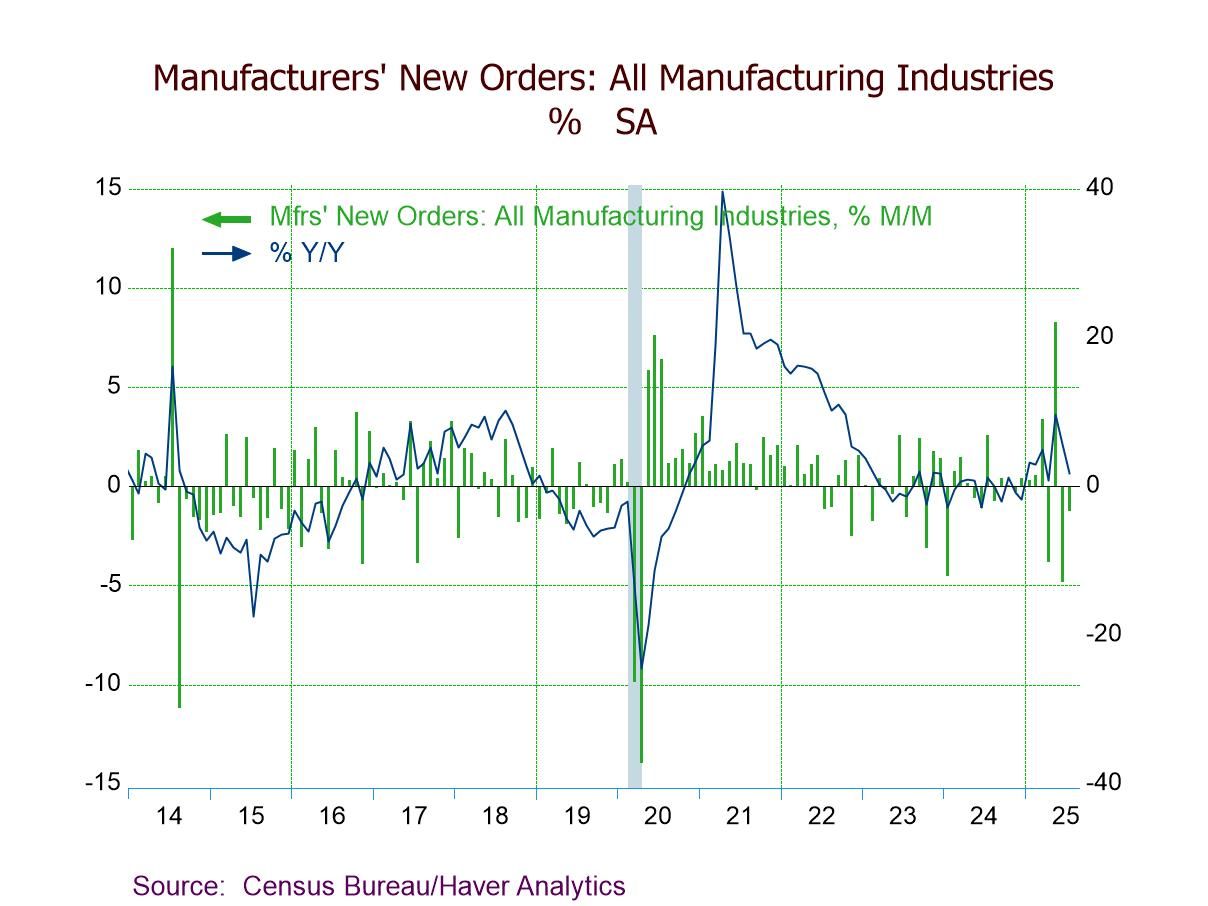
- Headline: -1.3% m/m; +1.6% y/y, the smallest y/y gain in three months.
- Durable goods orders (-2.8%) down, but nondurable goods orders (+0.3%) and shipments (+0.9%) both up three straight months.
- Transportation equipt. orders -9.5% m/m, w/ a 32.7% drop in nondefense aircraft & parts orders.
- Unfilled orders unchanged after two successive m/m increases.
- Inventories +0.3%, the third consecutive m/m rise.
 USA| Sep 03 2025
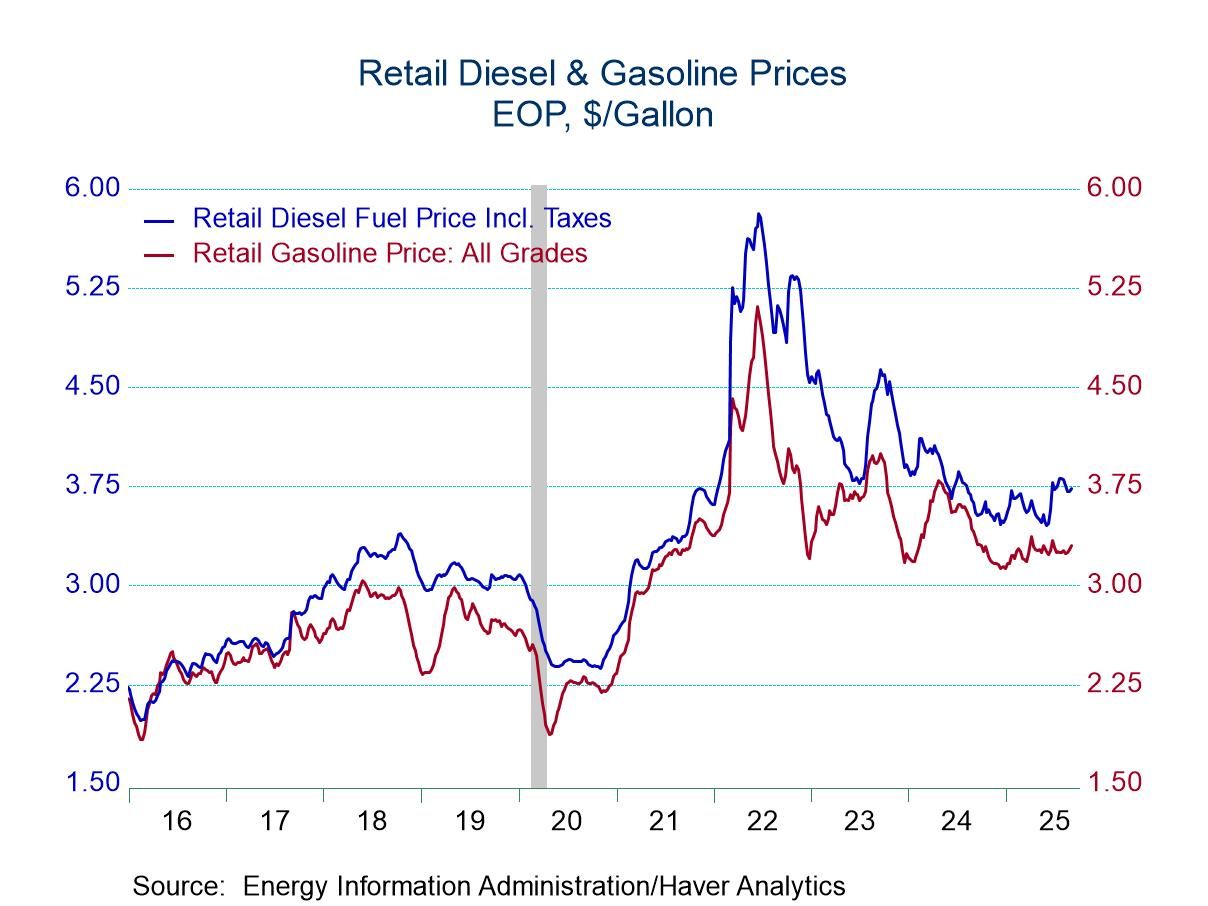
U.S. Gasoline & Crude Oil Prices Rise Last Week
- Gasoline prices increase to highest level in four weeks.
- Crude oil prices recover after earlier declines.
- Natural gas prices at early-June low.
by:Tom Moeller
|in:Economy in Brief
- of10Go to 9 page