Haver Analytics
Haver Analytics

Economy in Brief

  • The GfK survey for Germany improved to -25.1 from -27.6. It's the largest month to month rise and the climate index since May of 2023. The level of the climate index in January of 2024 at -25.1 is the strongest reading since August of 2023. The reading has a ranking in the 6.8 percentile of its ordered queue of observations, keeping it as a bottom 10 percentile reading to start the new year.

    The components of the climate index, economic and income expectations, and the propensity to buy index, each improved in December. The components lag the headline by one month. The economic index rose to -0.4 in December from -2.3 in November income expectations rose to -6.9 from -16.7 in November. The propensity to buy improved to -8.8 in December from -15.0.

    Economic expectations were at their strongest since July of 2023 and the same is true for expectations. However, the propensity to buy measure was last stronger back in March of 2022.

    The GFK headline as well as its components show improving trends. The chart at the top shows that climate has been engaged in a climb out from a very deep negative reading that bottomed out approximately one-year ago.

    The buying index is making a nice jump after a long period of flatness at lower levels. Income expectations are rising back and the neighborhood of a peak that they had seen back in July; economic expectations are making a slow climb up but are still well short of their best readings from earlier of 2023 that were experience in April. There has been some oscillation in the German economic and income expectations readings.

    Other Europe Confidence measures for other European countries in the table are stronger than for Germany. Italy and France have observations that are up to date only through November. Italy and France show month-to-month improvements in November compared to October. The Italian measure has a 63-percentile standing while the French measure has a 26 percentile standing. In Italy the standing is above its historic median whereas for France the index is well below its median and barely above the lower quartile compared to historical data back to 2002. The UK has a confidence rating up to date through December. The UK reading strengthened in November and in December rising to the level of -22 and December from -24 in November and from -30 in October before that. That is nearly back to the reading of -21 from September of 2023. However, it still has an extremely low percentile ranking in it's 29th percentile stuck between the Borders of the lower quartile and the lower third of its historic range.

    The GfK measure still shows a lot of weakness as the new year begins although there is a dig out in place; we can see the GfK climate measure it is gradually clawing its way to higher levels. Italian consumer confidence is the best of the lot in this table; French confidence is still weak and close to weakness we see in the UK. But in the UK at least is on a strong movement higher over the 12-months; much stronger than the gains being made by confidence in Italy and in France. However, for the most part, I characterize European confidence as weak and still challenged.

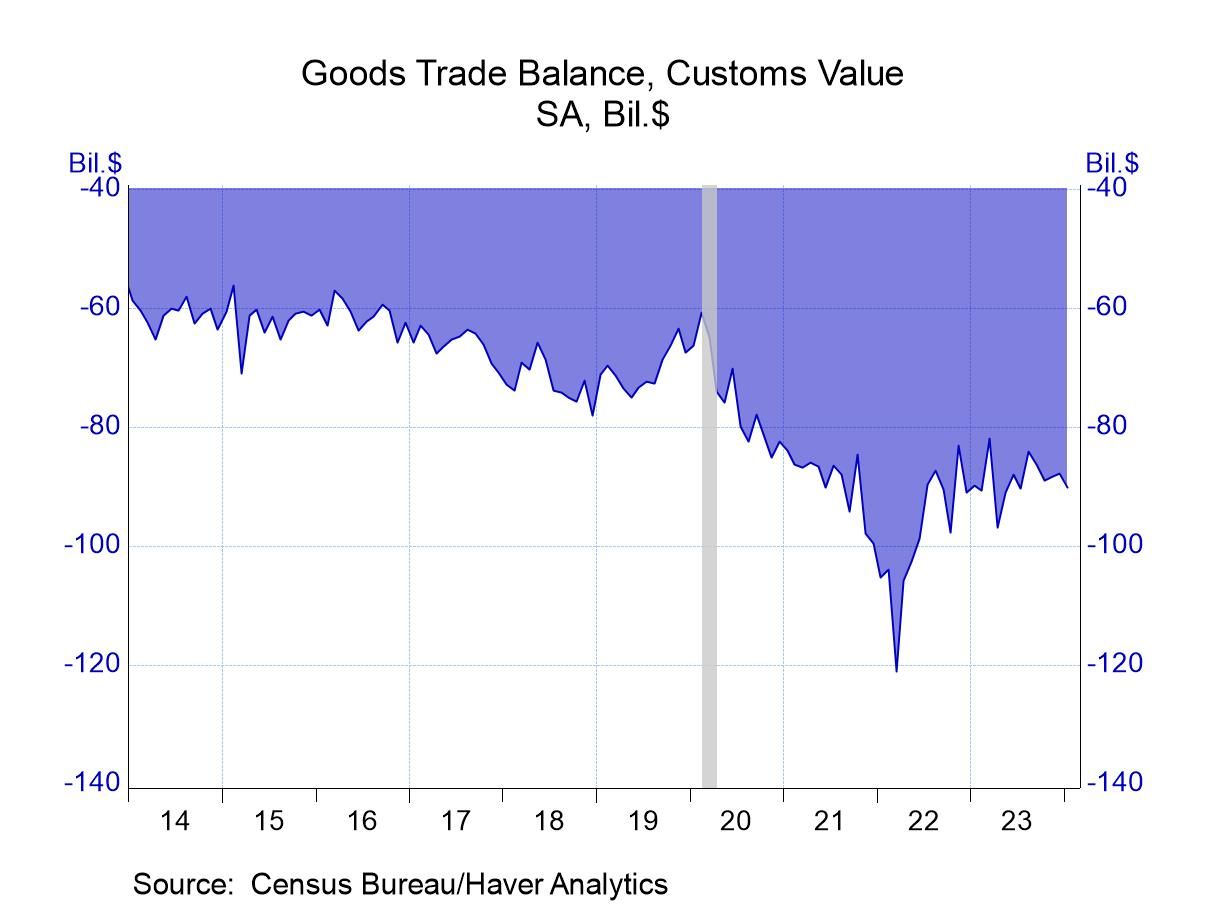
    • Deficit more than $16 billion smaller in Q3 due mostly to a narrowing of the goods deficit.
    • Services surplus widened modestly while primary income surplus narrowed.
    • The overall deficit narrowed to 2.9% of GDP, the lowest since Q1 2020, from 3.2% in Q2.
    • Mortgage applications declined by 1.5% in the December 15 week.
    • Mortgage applications for both loans to purchase and to refinance posted small weekly declines.
    • Effective mortgage interest rates dropped in the latest week, with the 30-year fixed rate down 23bps, the eighth consecutive weekly decline.
    • Gasoline prices have fallen for three months.
    • Crude oil costs ease.
    • Natural gas prices decline sharply.
    • Rise in starts is led by surge in single-family.
    • Activity improves across the country.
    • Building permits decline, led by multi-family.
  • Orders in the United Kingdom (UK) log a -23 reading in December, a weak reading that has a 29th percentile standing on data back to 1991. However, it's a significant improvement from November's reading at -35. It also represents a small improvement from October's reading of -26 for total orders. Still, compared to the 12-month average orders are weaker in December than what they averaged over the last 12-months.

    Export orders sketch a similar pattern as they rose to a - 23 reading in December from -31 in November and stand at the same level as in October. December export orders are just a tick weaker than what they have averaged over the past 12-months. Export orders register a 39-percentile standing in their historic queue of data.

    Finished stocks in the UK rose but continue to signal modest overall readings. The December reading of +11 has a 43 percentile standing; it's up from a reading of +3 in November and +4 in October. Inventory-building is only slightly faster than its 12-month average pace.

    The outlook for output volume in the next three months improved to +5 in December from -7 in November but that's still weaker than the +15 value from October. Historically the standing is weak, residing in the 36th percentile of its historic queue of data. However there is no new weakness signaled here; at + 5 the month’s reading is at the same level as its12-month average.

    Average prices in the next three months log a + 7 reading, weaker than November's +11 and identical with the October’s value of +7. The reading is lower than the 12-month average of 20, reflecting that inflation ran higher earlier in the year and it has been coming down. Inflation still has an elevated reading above its historic median; its queue percentile standing on data from 1991 is at a 56.9 percentile, leaving it at a small margin above its historic median on this timeline.

    Summing up The UK industrial report suggests expansion continues. Output volume is looked at as continuing to expand in the future and price pressures are expected to be less than what they've been - inflation will linger. Stocks are being built modestly. Total orders and export orders continue to sag, residing in the lower one-third of their historic range of values. The UK economy is still plodding along, however, it's still growing, and the industrial sector is expected to continue to grow.

    • Modest rebound recoups some of prior month’s decline.
    • Prospective buyer traffic increases moderately.
    • Improvement stretches across most regions of country.
  • Germany's IFO Climate gauge slipped to -21.2 in December from -18.3 in November. There was significant climate slippage in the manufacturing sector, in construction, in wholesaling, and in retailing. Only the service sector improved slightly in December compared to November, advancing to a - 1.7 reading from -2.5 in November. This is a common theme for the month as the service sector is the only one that is constantly resilient across the three IFO categories of Climate, Current Conditions, and Expectations.

    More on Climate The standings find the Climate readings exceptionally weak. The all-sector queue standing is at its 9.9-percentile, manufacturing is at its 8.6-percentile, construction has the strongest standing in its 25th percentile, wholesaling is at its 8.3-percentile, retailing is at its 21st percentile and services are at their 11.6-percentile. The readings are all in the bottom quartile or right at the border of that quartile as of December. All readings are in double-digit points below where they were in January 2020 just before Covid struck. The climate all-sector reading, the manufacturing reading, and the construction reading all are on their weakest marks since Russia's invasion of Ukraine took place. The wholesaling gauge is up 4.3% from that point, retailing is up 34%, and services are improved by 26% on that comparison. But on the comprehensive IFO gauges we see clearly that since Covid and the Russian invasion Germany has been reeling.

    Current Conditions The IFO current conditions gauge also showed broad weakness in December with the all-sector reading weakening and four of the five sectors weakening once again with services being the exception. The service reading crept up to 13.5 in December from 12.5 in November. The rankings for the current indices are stronger than for the climate gauge but still weak; only construction and retailing have current standings above their 50th percentiles which puts them above their medians. The all-sector index has a 13.6 percentile standing which is still quite low, manufacturing has a 25-percentile standing, services have an 18.7 percentile standing, and wholesaling has a 31.5 percentile standing.

    Expectations The expectations readings weaken across the board except for services. The services reading moves up slightly to -15.8 from -16.4. However, the all-sector summary reading falls to 23.2 in December from 21.7 in November; the all-sector standing is at its 8.8 percentile, once again, a very weak reading. All the percentile standings for expectations are in the lower 10% of their respective historic ranges. Expectations show an even more downbeat view the economy in Germany in December, worse than the readings for their current conditions or climate.

    Germany has been weak for some time these weak IFO readings are not coming out of the blue; they're not a surprise, and they're not different from the gauges we've been seeing from other German measures. However, the data from Germany currently are coming in weaker than data from most other European Monetary Union members. That's a problem since the German Economy is the largest economy in the monetary union. The IFO is ending the year on an extremely downbeat fashion with a set of extremely weak readings across the board.