Haver Analytics
Haver Analytics

Economy in Brief

  • United Kingdom
    | Mar 23 2022

    U.K. CPIH Flares...But Slows

    Inflation in the U.K. continues to run hot in February. The headline gauge CPIH rose 0.5% in February, the same as in January and in December. Sequential inflation rates for the U.K. show a 5.5% annual rate over 12 months, a 6.5% annual rate over six months, and a 6.2% annual rate over three months. Inflation shows signs of having peaked. These are early signs, preliminary, tentative signs, not irreversible, but encouraging.

    Core Inflation- a more complicated pattern The core measure, which is the CPIH excluding energy, food, alcohol beverages & tobacco, decelerated in February rising by 0.4% after gaining 0.6% in January and 0.3% in December. This core measure is up at a 4.5% pace over 12 months; it accelerates to 5.2% over six months; it edges higher to a 5.4% pace over three months. However, a plot of the three-month inflation rates for the core shows that inflation ticked off its highest pace of this cycle slowing in February compared to January (5.8% in January). However, that's only a one-month to deceleration, certainly not definitive.

    Inflation fighting complications from the virus ...again The Bank of England has begun to move to fight inflation. Like other central banks, it's concerned that inflation is high and has spread. However, the U.K., like much of Europe right now, is undergoing a resurgence of the virus. This new variant is very highly transmissible; it strikes Europe when countries in Europe are taking off their restraints. WHO claims that the constraints are being taken off too rapidly; it even uses the word ‘brutally’ to describe the policy of relaxation. Still, it's hard to tell why the spread has picked up. Restrictions were lifted and the new variant is much more transmissible-so what is responsible? A number of European countries, especially Germany, right now are undergoing sharp increases in their infection rates. This may be something that monetary policy is going to have to take account of even in the face of other challenges.

    Breadth of inflation and its rise monthly Among the 10 U.K. CPI categories in February, half of them show acceleration in inflation month-to-month compared to January. In January, five categories out of ten also had showed month-to-month acceleration. The proportion of acceleration in January and February was lower than in December when seven categories showed acceleration month-to-month. However, with five categories accelerating out of 10 monthly, the breadth of inflation is meeting some resistance to spreading.

    Sequential trends Turning to sequential growth rates, over three months only five categories show acceleration compared to six over six months. Over 12 months nine categories accelerated compared to 12-months ago. Over six months the breadth is still substantial with only a few categories resisting acceleration. It is not surprisingly that the 12-month inflation rate is substantially and widely higher across all commodity categories compared to 12-months ago. But over three months the mix of accelerating and decelerating is at the point of neutrality: five accelerate and five decelerate.

    The outlook The challenge for the future is going to involve dealing with this inflation spike, with higher global commodity prices, with rising oil prices, with the distortions caused by the war in Ukraine, with various sanctions NATO members and others have adopted, with ongoing problems from the virus, and with supply chain issues. The challenges really are many. For the time being, there is some good news with the three-month inflation rate edging down to 6.2% and the three-month core inflation rate off peak at 5.4% and with it barely having accelerated from six-months ago. But very clearly, inflation still is entrenched. The monthly increase at 0.5% for the headline and 0.4% for the core is too high. The risks for inflation are still substantial and monetary policy has a lot of different situations to juggle in order to solve the inflation riddle and to keep growth on track.

    • Purchase applications fall modestly.
    • Applications for refinancing are down sharply.
    • Mortgage interest rates surge.
    • Downward revision to January more than offset by upward revision to December.
    • Markets had expected an increase.
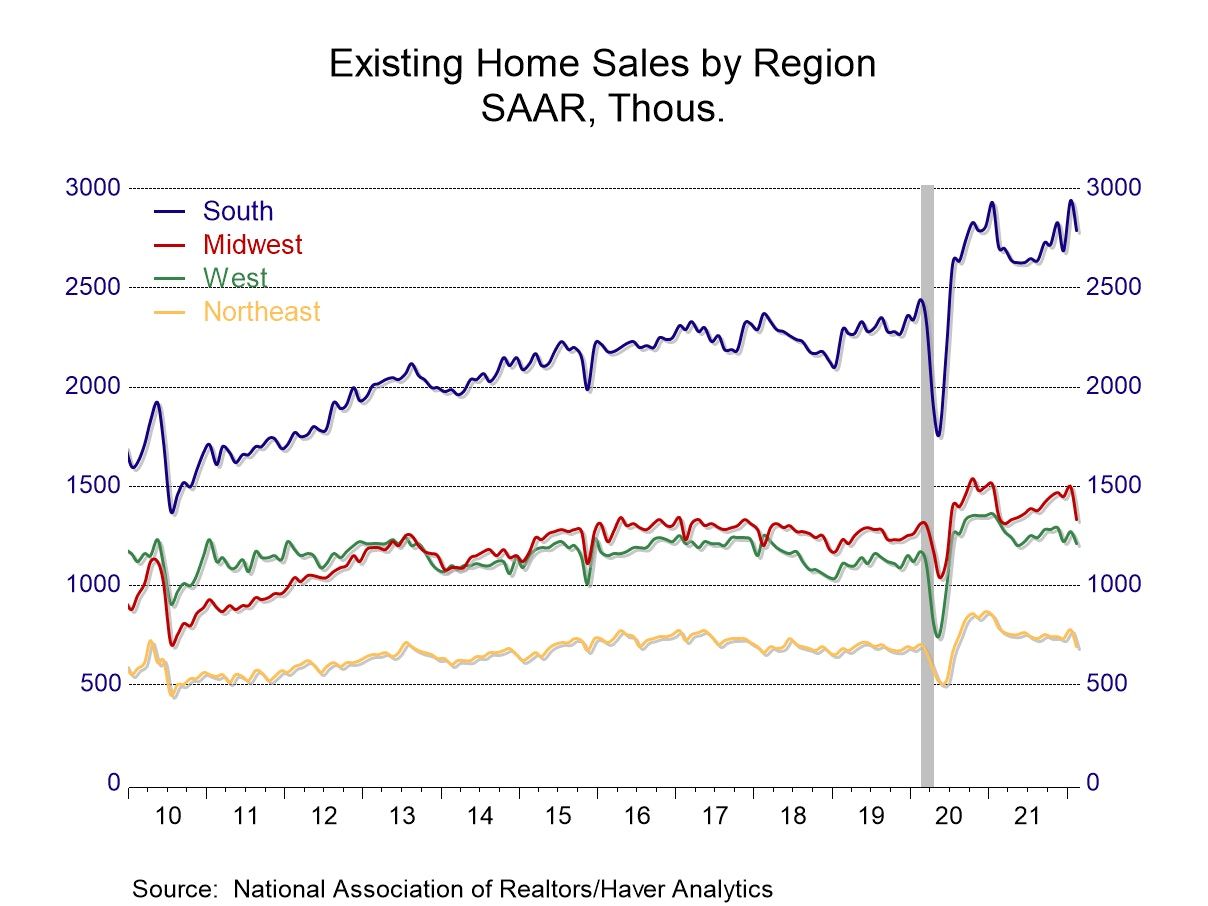
    • Sales rose in Northeast and Midwest but fell in South and West.
  • The U.K. CBI survey for March 2020 shows orders moving up to a net diffusion reading (up minus down) of 26 from 20 in February. That compares to a net of 24 in January. The January reading is above the three-month, six-month, and 12-month averages. It's a strong reading for orders and it shows that manufacturing in the U.K. is still carrying forward momentum. Export orders swung sharply higher in March moving to +7 from -7 in February. All the averages for prior periods, for three-months, six-months, and 12-months are negative values making the +7 reading for orders in March an extremely strong reading by recent standards. Stocks of finished goods improved to -8 in March from -14 in February; they too are stronger in March than they are over three-month, six-month and 12-month averages. Negative readings on stocks are quite common. Despite the pick-up in March, the index is still at a very weak level. For total orders, the queue standing is in the 99.7% (its highest reading on this timeline since 1991). Orders have never been higher than they are in March. Export orders have a 92.3 percentile standing, also very strong. For inventories of finished goods, however, despite their improvement, there is a 2.5 percentage point standing. That means the reading for stocks has been weaker only about 2.5% of the time, marking March as an extremely low reading, despite its recent strength. In the U.K., firms continue to have a hard time building inventory. While the outlook for orders and export orders is solid and strong, firms are having a difficult time getting ahead of demand because of supply constraints and other problems.

    Other industrial measures While the industrial production measure lags and it's only up to date through January, industrial production has been generally accelerating. It’s up at 3.7% over 12 months, it's up at a 2.3% pace over six months, and then it accelerates, rising at a 7.2% pace over the last three months. Industrial production in manufacturing continues to show some solid strength. Also, the PMI measure from Markit for the U.K. continues to float at a high level between 55 and 60. Its standing for February is at its 84th percentile; that's a relatively strong reading for U.K. manufacturing.

    Outlook for volume and prices The outlook for volume of output over the next three months ticked slightly lower in March, turning in a reading of 30 from February’s 31. However, the reading of 30 is still affirmed as a strong reading; it's above the three-month average of 28 and the six-month average of 29 and just below the 12-month average of 31. The percentile standing of this reading of 30 has a 95.1 queue percentile standing. Even though the March reading is only at this 12-month average, it's at what is historically a very strong reading for expected output. Average prices have moved up strongly in March to a reading of 80 from 77 in February and 66 in January. Here are the averages are quite telling: the 12-month average for prices three months ahead has a net rating of 54, that steps up to 69 over six months and steps up again to 74 over three months. Expectations for inflation continue to leapfrog. The March percentile standing for prices at 80 is in the 99.7 percentile mark. This is the highest reading for expected prices since at least 1991.

    • Gasoline prices partially reverse earlier gain.
    • Crude oil prices fall sharply.
    • Natural gas prices slip.
  • German inflation rose sharply in February, gaining 1.4% after rising 1.9% in January and 5.1% in December. These are increases month-to-month for the German ‘headline PPI,' the PPI excluding construction; they are exceptionally large month-to-month gains. The German PPI excluding energy rose by 1% in February following a 2.2% gain in January and a 0.6% gain in December. The heat is on…

    Sequential prices growth Over three months the headline PPI series is up at a 38.8% annual rate; over six months it's up at a 35.8% annual rate; over 12 months it rises at a 25.9% annual rate. These statistics show a slight acceleration for inflation with inflation running at an extremely rapid pace. Inflation data continue to be quite unsettling. For the PPI excluding energy, inflation is up at a 16.5% annual rate over three months; that's an acceleration from 12.5% over six months and a nearly identical 12.4% rise over 12 months. The inflation measure excluding energy is also extremely high and indicates that inflation is entrenched quite beyond the impact of energy on headline inflation.

    Quarter-to-date PPI In the quarter-to-date, the PPI headlines series is running at a 34.3% annual rate of increase at this point; that reflects the January plus February PPI indexes divided by the fourth quarter index average annualized. Calculated the same way, the German PPI excluding energy is up to 17.3% annual rate. Both are quite strong gains and certainly out of the tolerance range for the central bank. They contribute to the view that inflation not only remains problematic but that the problem is worsening.

    Compared to the CPI However, the European Central Bank looks at consumer price inflation, particularly at its HICP measure. In Table Germany's PPI, we have chronicled the behavior of the German domestic CPI as a point of reference. The CPI shows much smaller increases than the PPI but still strong increases and a demonstration of acceleration. The headline CPI is up at a 7.4% annual rate over three months; that accelerates from 6.7% over six months and that's up from 5.2% over 12 months. The German CPI excluding energy is up to a 3.7% annual rate over three months, compared to 3.5% over six months and a 3.2% pace over 12 months. Again, these are excessive rates of inflation compared to a target of 2% by the ECB for overall EMU inflation.

    Quarter-to-date CPI The CPI gains are not as outlandishly strong as the PPI inflation figures show. But in the quarter-to-date, inflation is unfolding rapidly; the CPI is up at 8.5% annual rate and the CPI ex-energy is up at a 4.3% annual rate. Inflation continues to accelerate and to be stubborn at extremely high rates of inflation.

    • Three of four components improve.
    • Three-month moving average eases.
    • Sales drop follows January increase.
    • Declines are spread throughout country.
    • Median price gain reverses earlier decline.