 Asia
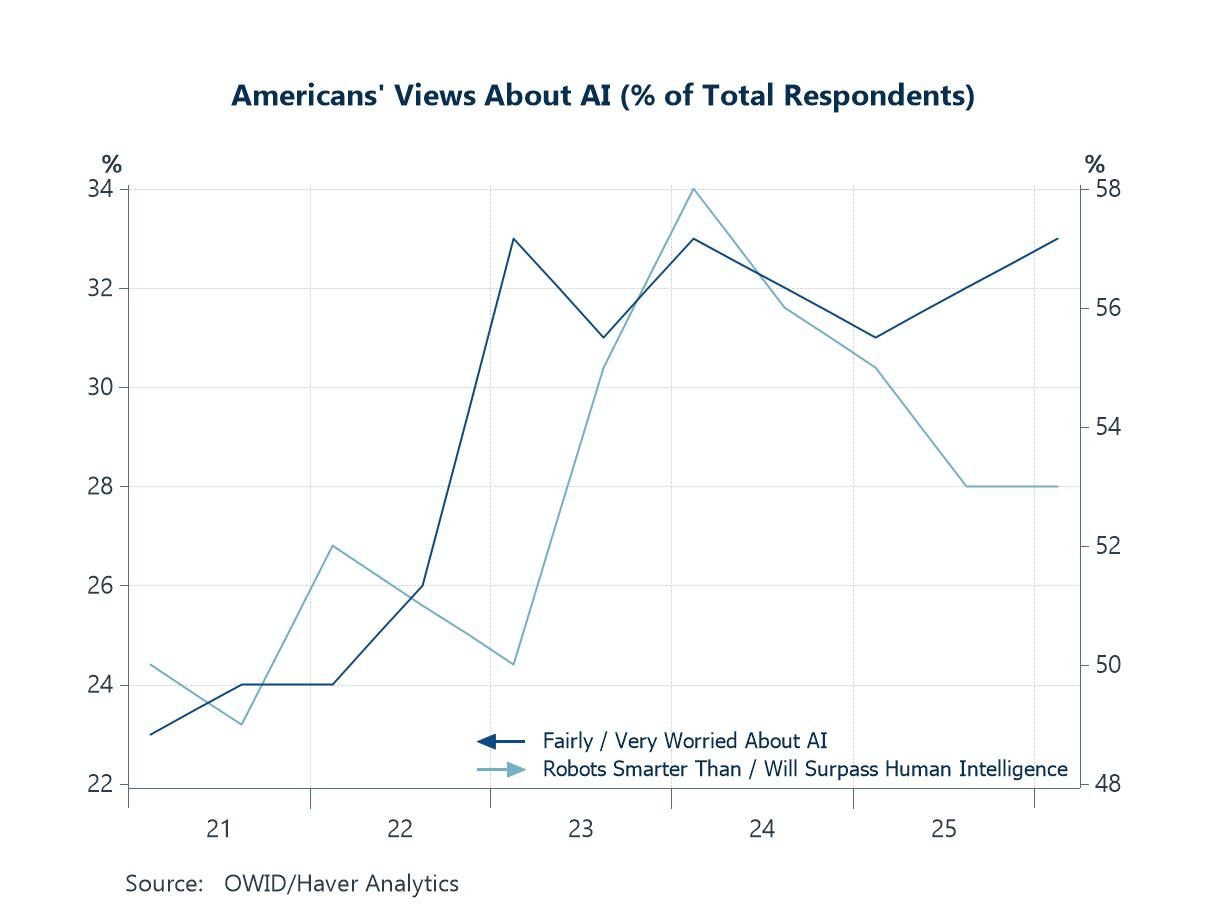
AsiaIn this week's Letter, we examine the underbelly of the AI boom, the risks that sit beneath its optimism. Start with the public mood: American concern about AI has grown alongside adoption over the past three to four years (chart 1). Those worries span mass job displacement, misuse of top-end models by bad actors, and fears of being left behind. The first of these is already surfacing: in June, AI was again the most cited reason for announced US layoffs, with year-to-date AI-linked cuts above 100,000 (chart 2). Technology led all sectors in overall cuts, though the data do not isolate how many were AI-driven. Among those hit, the young are arguably the most exposed to these labour effects. They enter a labour pool swollen by displaced professionals, just as AI masters the entry-level tasks where they would start. India and Indonesia illustrate the stakes on youth NEET, the share not in education, employment, or training, both above 20% and among Asia's highest (chart 3). Beyond the labour market, the same optimism reshapes asset prices. The rally has lifted AI-related valuations to historic highs and concentrated a few names in cap-weighted indexes (chart 4). That raises correlation and the risk of a sharper index fall should the rally unravel. The same concentration runs through economies via exports, from Taiwan's advanced chips to South Korea's memory (chart 5). Its footprint is physical too, and cuts both ways: data-centre investment has lifted growth in Johor, Malaysia (chart 6) while straining local power and water. None of this argues against riding the AI wave, which still promises real productivity and welfare gains. Rather, these are caveats that investors and policymakers must keep in view, since the story is not all upside.
AI-related concerns AI adoption has exploded over the past three to four years, and Americans' concerns have risen alongside it (chart 1). That is understandable, given how advanced and broad AI's proven applications have become. They now span everyday tasks and subject-specific work across fields such as finance and production, as well as tech and development, the sector AI was born in. Major concerns run from mass AI-induced job displacement to a more recent fear, that top-end models fall into the wrong hands and are used by bad actors. A further worry is distributional: AI advances are powerful and could deliver leaps in productivity, yet they may also leave many people behind. Those most exposed include workers already displaced from their jobs and people facing scarcer basic resources as AI demand competes for them. Others simply lack equitable access to AI tools or their benefits.