German Trades Surplus Balloons
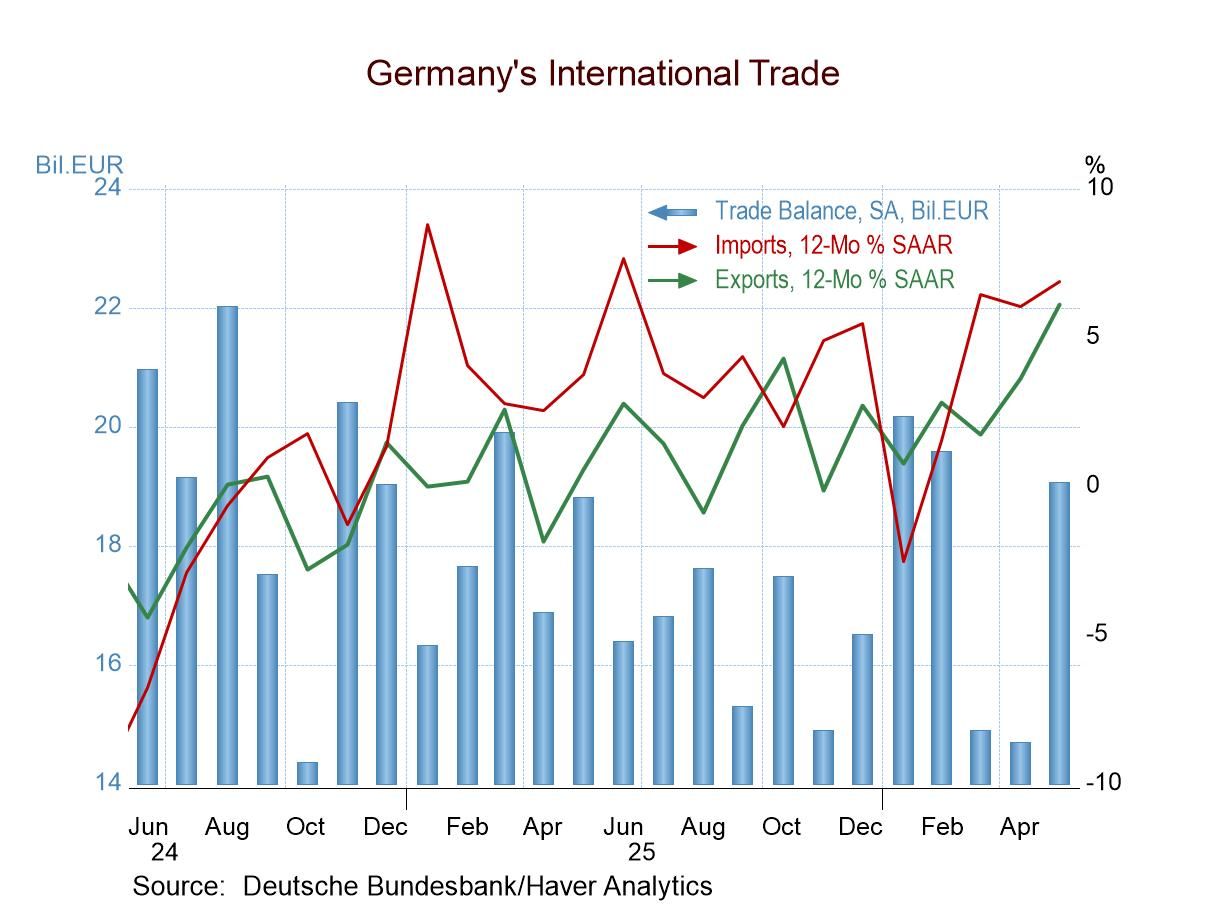
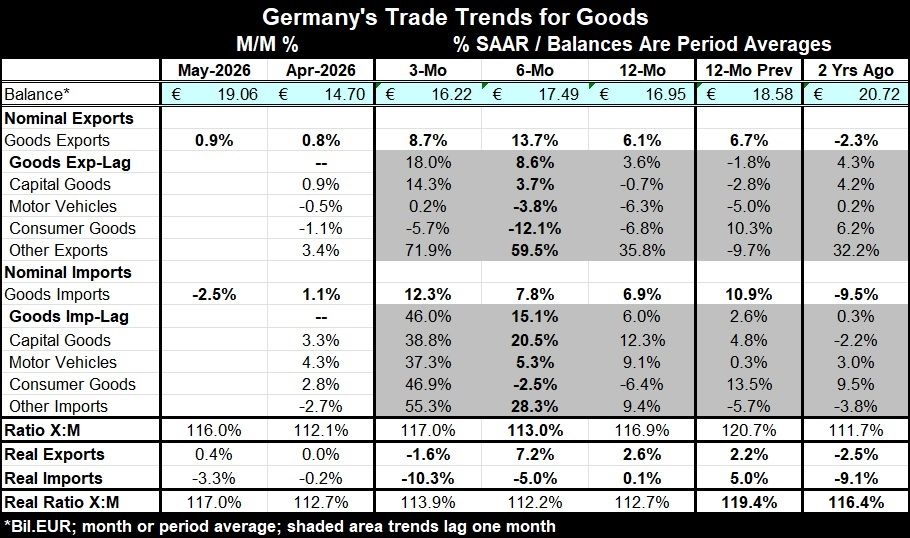
The German trade surplus surged in May to €19.1 billion from €14.7 billion in April. Exports rose by 0.9% in May while imports fell by 2.5%, creating a jump in the surplus month-to-month. In April, exports increased by 0.8% while imports rose by 1.1%.
Details on exports and imports lag by one month. In April, exports for motor vehicles and consumer goods declined, while exports of capital goods and other exports rose. On the import side, there were increases in imports ranging from 2.8% to 4.3% month-to-month across capital goods, motor vehicles, and consumer goods, but for the catch-all category ‘other’ imports fell by 2.7% month-to-month.
Flows adjusted for inflation showed an increase in exports of 0.4% in May while real imports fell by 3.3%. In April, real exports were flat while real imports fell by 0.2%.
The sequential behavior of real exports and real imports show independent activity. Imports log a clear weakening, rising 0.1% over 12 months, falling at a 5% annual rate over six months, and then falling at a 10.3% annual rate over three months. On the export side, real exports rose by 2.6% over 12 months, accelerated to a 7.2% annual rate over six months, but over three months have pulled back and fallen at a 1.6% annual rate. However, export growth still exceeds import growth over each of these horizons: 12 months, six months, and three months.
Trade trends paint a darkening picture of the German economy, with imports weak in real terms and trending even weaker, while activity on the export side of the equation pops over 12 months and six months but takes a hit over three months.
The situation in the Strait of Hormuz continues to muddy the waters for the future. Passage through the strait has been sharply stopped, stabilized, revived, and now is back to being destabilized. That makes the strait a major uncertainty zone; it's hard to tell how these effects are going to play out over the coming months for German trade results and everyone else's. The deterioration of conditions in the Strait of Hormuz is now unknowable because Iran has decided to start shooting at ships, further destabilizing the outlook.

Robert Brusca
AuthorMore in Author Profile »Robert A. Brusca is Chief Economist of Fact and Opinion Economics, a consulting firm he founded in Manhattan. He has been an economist on Wall Street for over 25 years. He has visited central banking and large institutional clients in over 30 countries in his career as an economist. Mr. Brusca was a Divisional Research Chief at the Federal Reserve Bank of NY (Chief of the International Financial markets Division), a Fed Watcher at Irving Trust and Chief Economist at Nikko Securities International. He is widely quoted and appears in various media. Mr. Brusca holds an MA and Ph.D. in economics from Michigan State University and a BA in Economics from the University of Michigan. His research pursues his strong interests in non aligned policy economics as well as international economics. FAO Economics’ research targets investors to assist them in making better investment decisions in stocks, bonds and in a variety of international assets. The company does not manage money and has no conflicts in giving economic advice.
More Economy in Brief
 Global| Aug 21 2026
Flash S&P PMIs Show Ongoing Improvement Amid Unsettled Geopolitics