Economy Watchers Poll Marks Revival—Still Weak; What’s Next Now with a New Rift?
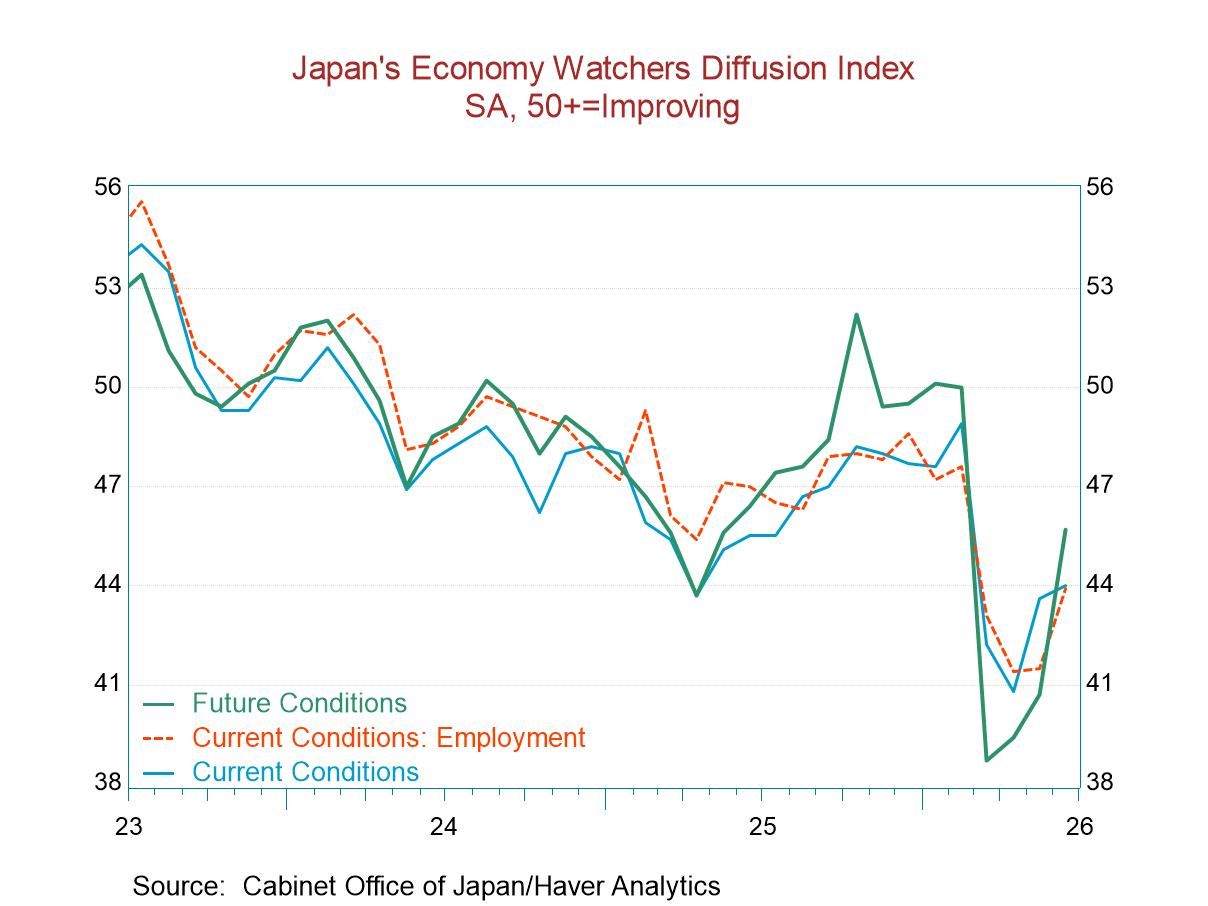
The Clash! The U.S.-Iranian clash in the Middle East resulted in a closure of the Strait of Hormuz that collapsed the economy watchers index in Japan earlier this year. However, as the war-like conditions settled down and the two sides have moved toward some kind of cease fire or a more permanent arrangement, in the wake of that comparative tranquility, the economy watchers index improved, and its future index improved more sharply. These comments applied to the data in the table and conditions up to the end of June.
New day dawning... However, the data in the table are unrelated to what has happened in the past two days, when Iran took potshots at a couple of ships in the Strait, causing the U.S. to retaliate and President Trump to declare that the ceasefire has now ended. The door remains open for some kind of talks; however, the president’s recent remarks carried in the newspapers has clearly stated that the ceasefire has ended, and the U.S. intends to hit Iran and has suggested that it intends to hit it ‘hard.’ At the same time, Mr. Trump has said the door remains open to continuing talk and negotiations if both sides still want to get together; however, he admits he is not optimistic.
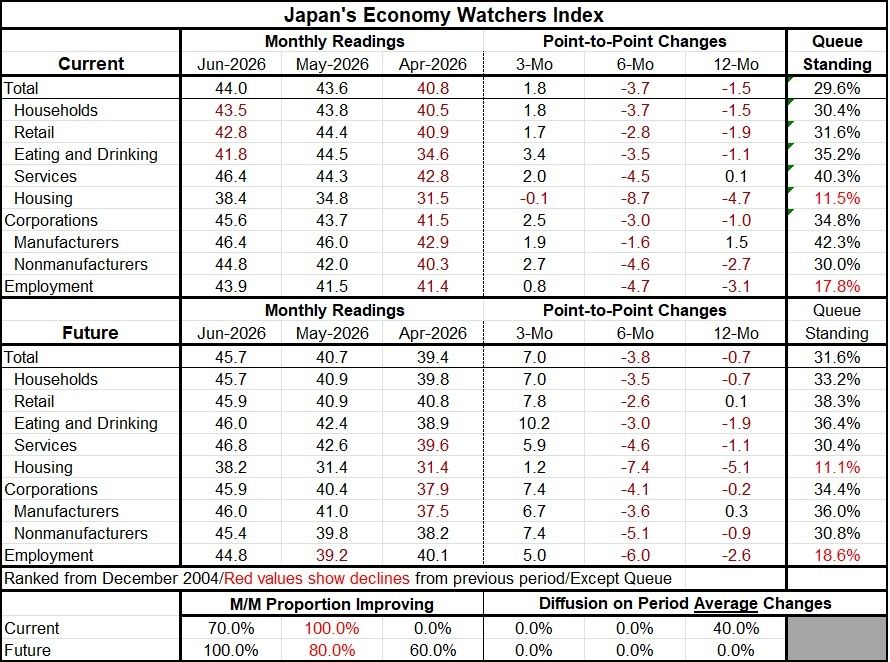
Precarious times and conditions So, these are precarious conditions. Oil prices have already responded and moved higher. We have Japan’s economic data for June showing some revival in the current index and some sharply higher revivals over the last few months in the future index. However, when the dust clears the queue standings of the current and future indexes are revealed, they are pretty similar, with the current index at a standing of 29.6% and the future index of 31.6%. Both the current and future readings coalesce around a 30-percentile standing, marking the two segments of the survey as usually stronger about 70% of the time which marks the latest readings as relatively weak. And that is before we take the new realities of July into account.
The current IS the future... There isn't too much point in talking about the two parts of the survey separately. The current and future surveys are simply not that different. This month, the lowest percentile standing in the current subindexes is housing, at an 11.5 percentile standing, followed by employment at a 17.8 percentile standing. In the future index, housing has an 11.1 percentile standing and employment has an 18.6 percentile standing; these readings are also the two lowest rankings in the future survey.
Sequential improvement is only point-to-point Over three months, we can see the point-to-point changes in the current index and some improvements in all of the components except housing. In the future index, the three-month changes show point-to-point improvements in all of the components. However, both surveys show point-to-point declines over six months and broad point-to-point declines over 12 months as well. Looking at the changes based on smooth data (shown at the bottom of the table), for the three-month averages compared to six-month averages and six-month averages compared to 12-month averages, conditions show no improvement. We see no improvements in the current or future indexes over three months or six months, and no improvement in the future index in the 12-month average compared to 12-month average of 12 months ago—although 40% of the components in the current index are improved over 12 months compared to 12 months ago.
Summing up The bottom line here seems to be that the opening of the armed conflict in Iran that led to the closure of the Strait of Hormuz was a terrible blow according to the economy watchers. However, once conditions settled down, the willingness to believe that conditions were going to get better and eventually open the Strait led to improved perceptions as things appeared to be headed back toward normal. Now, war-like conditions are back into effect for a period that's more recent than the tabular data can address. It seems likely that we are going to see the indexes decline once again if this current rupture in the normalization process is unable to be repaired soon. The responses and changes in the economy watchers index illustrate a couple of things: one, being that the Strait of Hormuz is very important; two, being that the survey participants were willing to believe that the former war participants could act in a civilized manner and reopen the Strait. The question now is whether the survey participants can believe that after one normalization agreement fell apart, the next agreement is one that they can believe in. That's what we will be waiting to see.

Robert Brusca
AuthorMore in Author Profile »Robert A. Brusca is Chief Economist of Fact and Opinion Economics, a consulting firm he founded in Manhattan. He has been an economist on Wall Street for over 25 years. He has visited central banking and large institutional clients in over 30 countries in his career as an economist. Mr. Brusca was a Divisional Research Chief at the Federal Reserve Bank of NY (Chief of the International Financial markets Division), a Fed Watcher at Irving Trust and Chief Economist at Nikko Securities International. He is widely quoted and appears in various media. Mr. Brusca holds an MA and Ph.D. in economics from Michigan State University and a BA in Economics from the University of Michigan. His research pursues his strong interests in non aligned policy economics as well as international economics. FAO Economics’ research targets investors to assist them in making better investment decisions in stocks, bonds and in a variety of international assets. The company does not manage money and has no conflicts in giving economic advice.
 Asia
Asia