

 Global| Aug 19 2026
The Contest for Capital
by:Andrew Cates
|in:Viewpoints
The world is being pushed to invest more than it has in decades.
A world on autopilot Every few months the International Monetary Fund publishes a projection of the world economy, and the Blue Chip panel of forecasters, along with other bodies, does something similar each month; together they help to set the consensus against which everything else is judged. It describes a world returning gradually to normal: global growth a little above 3%, inflation drifting back to target, and US policy rates continuing to ease from their peaks. Its most consequential feature is one that is easy to miss, because it sits in an accounting identity rather than being stated as a view: investment in the advanced economies is projected to remain close to 22% of GDP for the rest of the decade, essentially flat, with national saving tracking it (chart below). The large external imbalances — the US deficit and the surpluses of China, Germany and the oil exporters — are expected to persist more or less unchanged, and the real interest rate that balances saving against investment drifts gently lower. It is, in short, a forecast of continuity, and this piece argues that continuity may well be the wrong assumption.
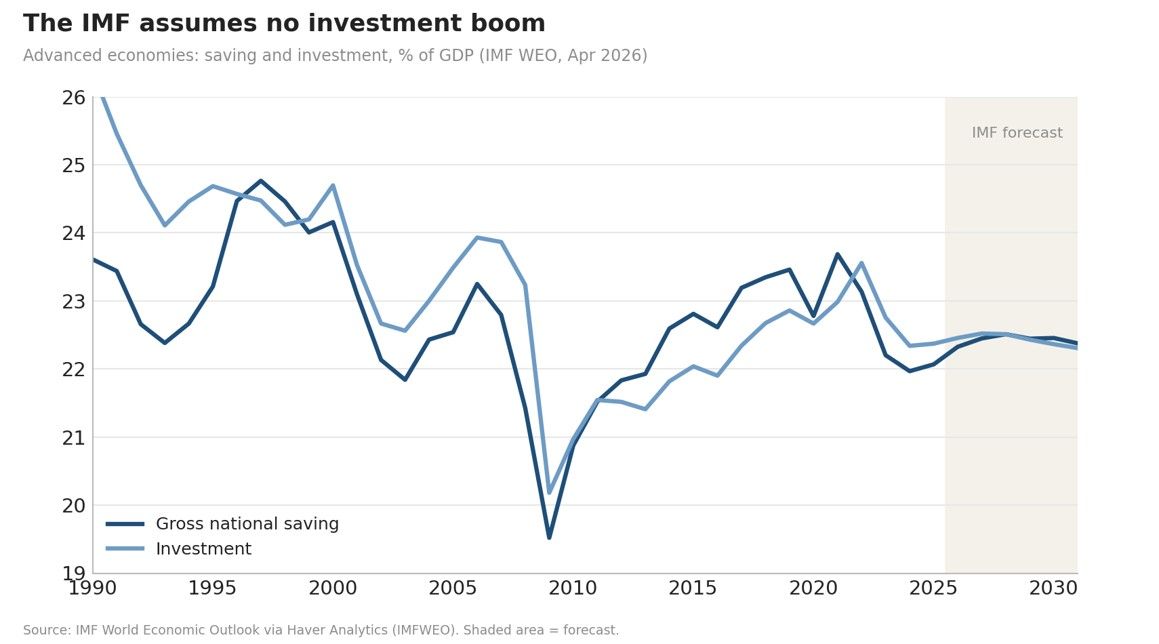
Chart 1: Advanced economies — gross national saving and investment, % of GDP (IMF WEO, Apr 2026)
Why investment must rise Set against that flat projection is a list of demands on the world's capital that is neither short nor easily deferred: decarbonising and electrifying the energy system; the grid capacity that artificial intelligence, electrification and reshoring are all drawing on at once; adaptation to a hotter, less stable climate; the data centres and robotics of the technology build-out; the critical minerals and water on which much of it depends; the reshoring of supply chains; higher defence spending, already underway across Europe (and, as Haver colleagues Peter D’Antonio and Shashwat Indeevar set out in Efforts to Mitigate Military Risk Have Unintended Consequences, with consequences that run wider than the headline numbers); and the pressure of ageing populations, which pushes firms to substitute capital for increasingly scarce labour. Most of these demands are, in large part, non-negotiable, and they bear on an advanced world whose investment rate is already low by its own historical standards. The point is not that the rich world should invest at the 40%-plus rate of a still-industrialising China. China's rate reflects the extensive build-out of a capital stock still equipping a fast-growing, urbanising economy; the advanced task is different in kind — not to widen a young capital stock but to transform a mature one, retiring the capital of the old economy and building the new that energy, technology, minerals and defence now require, while deepening capital per worker as labour grows scarce. That points to a rate below China's, but perhaps well above the one the consensus assumes: the level of investment appropriate to today's conditions has arguably risen.
The corporate anomaly — and its reversal To see why that matters, it helps to use the framework of the flow-of-funds accounts, in which the financial balances of the four sectors — households, companies, government and the rest of the world — must sum to zero: if one sector spends more than its income, another has to lend it the difference. Within that framework sits an unusual feature of the past two decades. In textbook terms the corporate sector is a net borrower, taking household savings and turning them into productive investment. Since the early 2000s, however, companies across the advanced economies have done the reverse, running persistent financial surpluses — generating more cash than they invested and returning the difference to shareholders through dividends and share buybacks. This corporate saving was an important, if under-appreciated, feature of the low-rate environment: the counterpart of investment that, vigorous though it has been, has run below what corporate cash flow could support, a contributor to the global saving glut and to the long decline in the equilibrium real interest rate (often labelled r*), and, through buybacks and the search for scarce assets, a support to asset prices.
This is why the shift now appearing in the data matters. In several of the major economies the corporate financial balance has begun to move from surplus towards deficit; Germany and France have already crossed into deficit, with others are close behind (see chart below). If this proves structural rather than temporary — as the investment needs set out above push firms to spend more than they earn — then a sector that supplied the world with saving for two decades becomes a net user of it instead. And it does so at a time when governments, already running large deficits, are in no position to take up the slack.
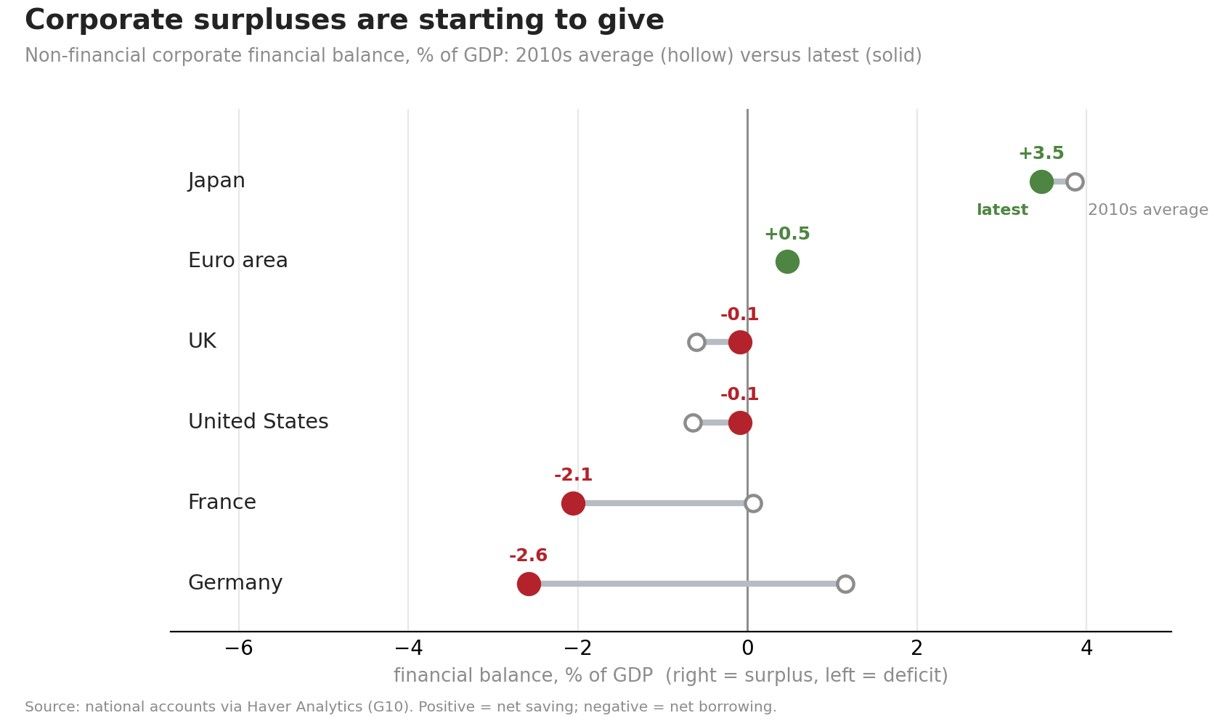
Chart 2: Non-financial corporate financial balance, % of GDP — 2010s average versus latest
This is not yet a story about corporate fragility. As I argued in June (see This Isn't 1999) the health of corporate balance sheets is exactly what distinguishes today from the leverage-fuelled boom of the late 1990s: US companies, in particular, have been investing while still generating more cash than they spend, financing themselves from profits rather than debt. That remains true, and it is reassuring for financial stability. But a surplus that reflects financial strength is also, in flow-of-funds terms, a corporate sector saving more than it invests — strength that has coexisted with investment running below what that cash flow could support. The shift now beginning is not a sign of weakness but its opposite: a financially sound corporate sector starting to put that strength to work, and moving from surplus towards deficit as it does. The risk it raises is not a balance-sheet bust but a macro one — as corporates stop supplying the world's saving and begin to absorb it, the claim on global capital rises.
Where the saving is — the glut, and China If the advanced economies are to invest more than they save, the shortfall must be financed from abroad — and the world's surplus saving is concentrated rather than evenly spread. Two decades ago Ben Bernanke described a "global saving glut": a large pool of desired saving built up in emerging Asia and among the oil exporters, flowing outward and holding down interest rates worldwide. That glut has not disappeared; it has become more concentrated. China now saves around 42% of its national income, roughly twice the advanced-economy rate, and because it does so in the world's second-largest economy the sums are very large. China's share of world saving has risen from about a twentieth at the turn of the century to more than a quarter today — over eight trillion dollars a year, comfortably more than the United States (see final chart below). The Gulf oil exporters add a further layer. This is the pool that any global increase in investment would ultimately draw on, and the IMF expects it neither to grow much faster nor to shrink.
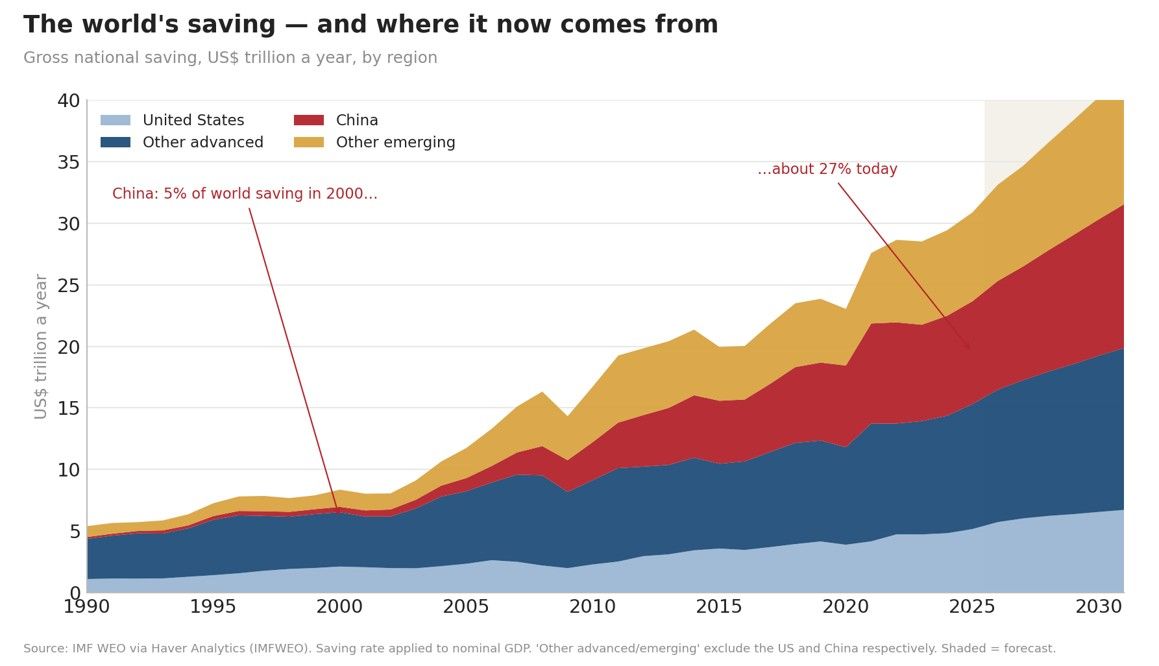
Chart 3: The world's saving, US$ trillion a year, by region (IMF WEO, Apr 2026)
The price This is where the tension lies. The consensus projects a rising claim on the world's capital that does not appear in its own numbers, alongside a pool of saving that is expected to stay broadly fixed. If investment rises while that pool is static and governments remain stretched, something has to adjust; and if no sector is willing to change its behaviour, the adjustment falls on the price of capital. The real interest rate, which fell for a generation as abundant saving met limited investment demand, is being pushed structurally higher, and long-term real yields are already at their highest in two decades. On this reading, the long period of cheap capital is coming to an end.
If that shift holds, it would be felt wherever an asset is valued by discounting future income — which is to say almost everywhere. The four-decade tailwind of falling rates that lifted bonds, equities and property alike would become a headwind, and returns would increasingly have to come from income rather than from rising valuations; the owner of real, cash-generating assets would tend to fare better than the leveraged holder of long-duration ones. Those, though, are conclusions for a more considered analysis. The point here is a simpler one: the world is likely to want more capital than it is currently set up to supply, and the competition to secure it is only beginning.

Andrew Cates
AuthorMore in Author Profile »Andy Cates joined Haver Analytics as a Senior Economist in 2020. Andy has more than 25 years of experience forecasting the global economic outlook and in assessing the implications for policy settings and financial markets. He has held various senior positions in London in a number of Investment Banks including as Head of Developed Markets Economics at Nomura and as Chief Eurozone Economist at RBS. These followed a spell of 21 years as Senior International Economist at UBS, 5 of which were spent in Singapore. Prior to his time in financial services Andy was a UK economist at HM Treasury in London holding positions in the domestic forecasting and macroeconomic modelling units. He has a BA in Economics from the University of York and an MSc in Economics and Econometrics from the University of Southampton.