

Korea Strikes Back
|in:Viewpoints
Korea is emerging from the extraordinary political turmoil of 2024–25, triggered by former President Yoon Suk Yeol’s declaration of martial law in December 2024 and subsequent impeachment. The Lee government has since consolidated its political position, winning 12 of 16 major mayoral and provincial contests in June.
Political upheaval was not the only challenge. Last year was difficult for Korean exporters too, and external headwinds remain. Korean goods continue to face 15% US import duties, with tariffs on certain products rising by a further 10–12.5% in July 2026 under measures related to forced-labour policies.
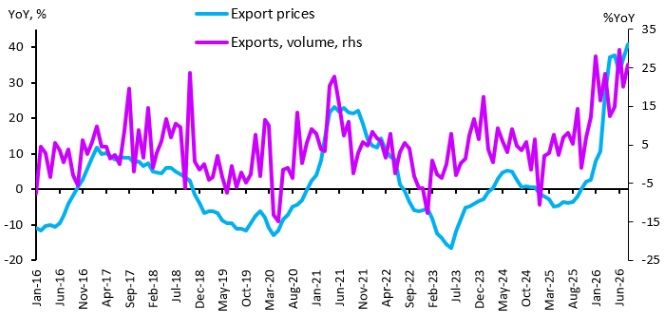
Yet Korea—and its exporters in particular—has bounced back. Riding the global semiconductor upcycle and successfully diversifying export markets, exporters have seen both volumes and pricing power rebound sharply. In August, export volumes rose at a double-digit rate for the ninth consecutive month, climbing 26% YoY, while export prices surged 40.7%.
Figure 1: Korea export volumes and prices
Source: Haver Analytics & Westbourne Research
Korean exporters are nimble. Production diversification is a game they have been playing for years, well before Trump’s 2025 global tariff war. Exploiting comparative advantages, particularly lower labour costs, Korean companies have expanded assembly operations and supply chains across Asia, increasing their resilience to global trade tensions.
Vietnam and Thailand are good examples. Korean intermediate and capital goods feed into local production and processing, with Vietnam emerging as an important production base for semiconductors, electronics, rubber and plastics, basic metals and electrical equipment.
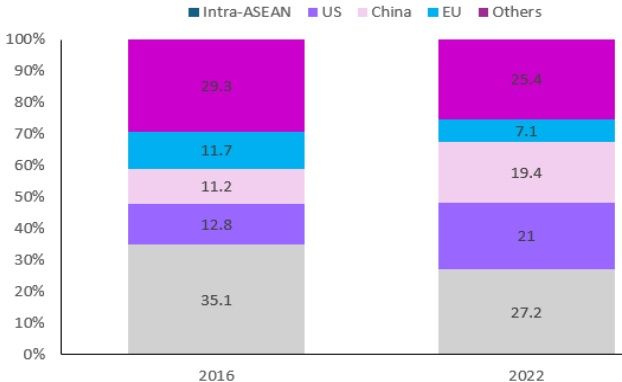
Increasingly, however, these ASEAN hubs are gateways to final demand elsewhere. The share of Korean chip and electronics exports to Vietnam ultimately destined for the US rose from 12.8% in 2016 to 21% by 2022, while China's share increased by more than eight percentage points to 19.4%. Meanwhile, the share absorbed by ASEAN final demand has fallen.
Figure 2: Final destination of Korean value added in chips & electronics exports to Vietnam
Source: BoK & Westbourne Research
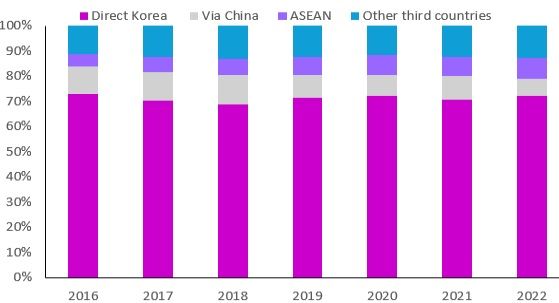
Korea has therefore pursued a two-pronged strategy: investing directly in major final markets, particularly the US, while continuing to use connector countries as production hubs.
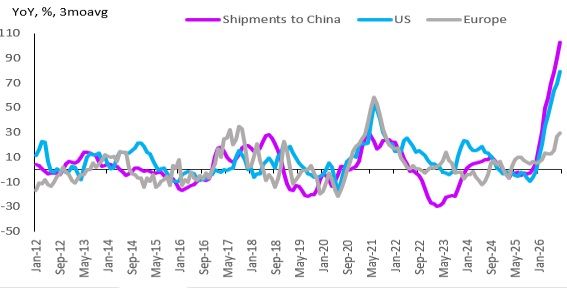
The strategy is working. Korean exporters continue to hold their own in major markets—in the US, riding the AI capex wave; in Europe, despite rising protectionism; and in China, despite cut-throat competition, rapid growth in indigenous Fourth Industrial Revolution technologies and weak consumer demand.
Figure 3: Routes through which Korean value-added reaches US final demand
Source BoK & Westbourne Research
Figure 4: Korean exports by destination
Source: Haver Analytics & Westbourne Research
Korea Inc.
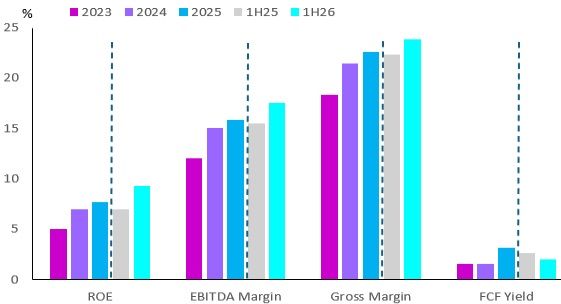
The corporate profit cycle is strengthening, and it is not just chip companies, although they lead the improvement. The cycle bottomed in 2022 but did not move into a firm upswing until 2024, when average returns and EBITDA margins of listed companies rose above their pre-Covid 2013–19 averages. Gross margins followed last year, with all three metrics continuing to improve in the first half of 2026.
More importantly, companies are now putting those profits to work. Until last year, free-cash-flow yields remained high even as valuations rose, suggesting companies were generating cash but not reinvesting it. This year that has changed.
Figure 5: Korea profit cycle metrics
Source: Bloomberg & Westbourne Research
The investment cycle has troughed. Real gross fixed investment has turned positive after contracting from 2Q24 through 4Q25, led by increased spending on IT and semiconductor capacity and R&D. Facilities investment strengthened for a second quarter, rising 6.5% YoY.
Construction remains the drag. Although the pace of contraction has eased, the sector is being squeezed by a weakening credit cycle, higher interest rates and property measures aimed at reining in prices and speculation.
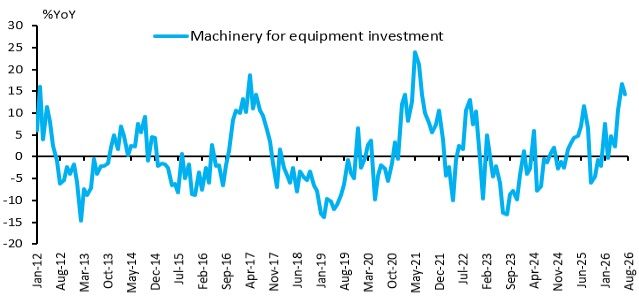
Even so, expect the investment cycle to swing upwards as IT-related capex gathers momentum and gross fixed investment begins to outpace economic growth. Leading indicators are supportive: inventory-to-shipment ratios have normalised, capacity utilisation and operating ratios have risen since May, manufacturers are the most optimistic in three months, and machinery demand for equipment investment is growing briskly.
Figure 6: Machinery for equipment investment
Source: Haver Analytics & Westbourne Research
The fortunes of Korea Inc.—large companies and the SMEs embedded in their supply chains—remain disproportionately tied to the global semiconductor cycle. For now, that cycle is driving investment higher.
There are risks. US hyperscalers are starting to pace investment, concerns about AI's unintended consequences are growing, and China's lower-cost open-source models pose an increasingly credible competitive challenge. But demand continues to outpace supply, while greater competition is accelerating innovation and demand for AI hardware.
There will be ups and downs. Korea's ability to weather a temporary slowdown rests on two things: market dominance and strong corporate balance sheets.
On the first, Korea is formidable. Samsung Electronics and SK Hynix dominate some of the fastest-growing semiconductor segments. As of 2Q25, Korea accounted for 63% of the global DRAM market, 83% of HBM and 47.5% of NAND chip supply.
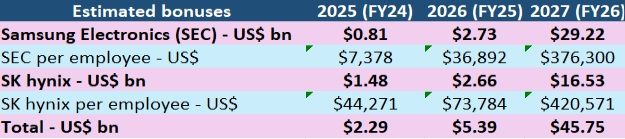
The Korean consumer Employees of Fourth Industrial Revolution companies—notably Samsung Electronics and SK Hynix—are sharing in their employers' good fortune. Higher bonuses are translating into greater spending on leisure and culture, dining out, automobiles and high-value discretionary goods.
Consumption in semiconductor-heavy regions is running almost 4% above less-exposed areas. The Bank of Korea estimates the marginal propensity to consume out of after-tax bonus payments at 27% in 2025 and 21% this year. The spillover is now large enough to be visible nationally, accounting for around 2% of last year's growth in private consumption.
Figure 7: Estimated bonuses
Source: BoK & Westbourne Research
Great. But not so fast.
First, the effect remains concentrated in Icheon, Hwaseong and Cheongju—the manufacturing hubs of Samsung Electronics and SK Hynix. Second, the BoK estimates the boost to 2027 GDP growth at just 0.06–0.09 percentage points. Third, semiconductors are not particularly labour intensive: the industry's employment-inducement coefficient is only 2.0 jobs for every KRW1bn of additional demand, compared with 4.9 for shipping and 4.3 for motor vehicles. Finally, overall consumption is also being supported by fuel-cost subsidies, EV purchase subsidies and stock-market wealth effects.
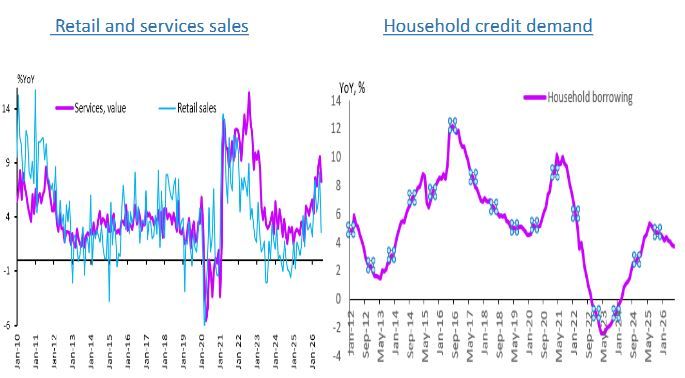
Figure 8: Consumption and household borrowing. Retail and services sales Household credit demand
Source: Haver Analytics & Westbourne Research
Economy-wide wage growth is less encouraging. Average wages rose 2.2% YoY in the first half, down from 3.6% a year earlier and barely keeping pace with inflation. Consumer inflation subsequently accelerated to 3.1% YoY in August, while interest rates are rising and household credit growth is beginning to soften.
The outlook is therefore for a modest, rather than spectacular, consumer recovery—although Korea's consumption story is still stronger than Japan's, where even robust nominal and real wage growth has failed to persuade households to spend.
Inflation and monetary policy
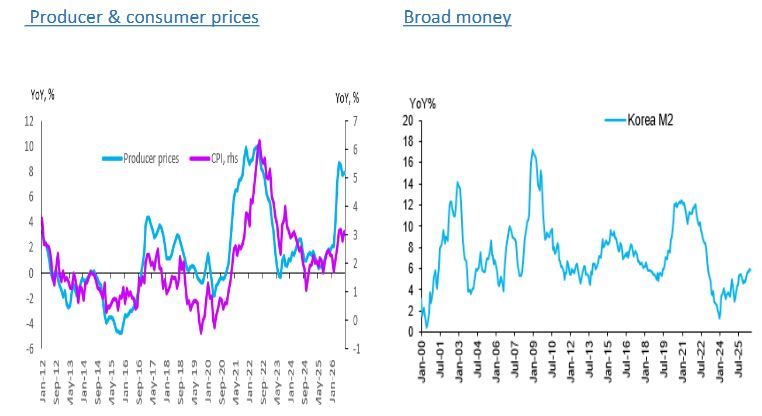
The BoK has tightened twice this year, most recently raising the policy rate by 25bp in August to 3%. Expect further hikes. Pipeline inflation remains significant, broad money growth is trending higher and the economy can absorb steeper borrowing costs: real lending rates have turned deeply negative.
Figure 9: Prices and money supply. Producer & consumer prices Broad money
Source: Haver Analytics & Westbourne Research
Where to invest?
We remain overweight Korean equities, with a bias towards semiconductors, electronics, electrical equipment, capital-goods industrials, export cyclicals and banks, the latter benefiting from improving net interest margins.

Sharmila Whelan
AuthorMore in Author Profile »The founder of Westbourne Research (www.westbourne-research.com), Sharmila Whelan is a seasoned Global Geopolitical-Macro Strategist with nearly three decades of experience advising buy-side clients on multi-asset investment strategies and asset allocations. Her career has been defined by her differentiated thinking, a deep understanding of the intricate connections between global geopolitics, macro and policy dynamics, and the Austrian business cycle approach to economic analysis. She has counseled governmental bodies such as the CIA, the US State Department, the British High Commission, DFID, and China’s NDRC.
Sharmila has held prominent roles in both London and Hong Kong, serving as Managing Director at Aletheia Capital, Director at Merrill Lynch Bank of America, Senior Economist at CLSA, and Asia Regional Economist at BP Plc. In 2022, Bloomberg recognised her as one of the UK's "12 New Expert Voices." She is a frequent media commentator on Bloomberg TV and radio, BBC World Business News, and CNBC, and is a sought-after speaker at high-profile events such as the Financial Times Wealth Summit and CFA UK & India conferences. Sharmila also contributes opinion pieces to Financial Times Professional Wealth Management and the Economist Group’s EIU.
 Global