

GDP, the AI Buildout, and the Real Interest Rate
by:Joel Prakken
|in:Viewpoints
Since the introduction of ChatGPT in November of 2023, investments in artificial intelligence (AI) have surged. Economists await indisputable evidence of a positive return on those investments manifested in faster trend growth of productivity. Meanwhile, a popular – albeit “partial” - narrative is that without the AI buildout the economy would have been considerably softer over the past three years than observed.
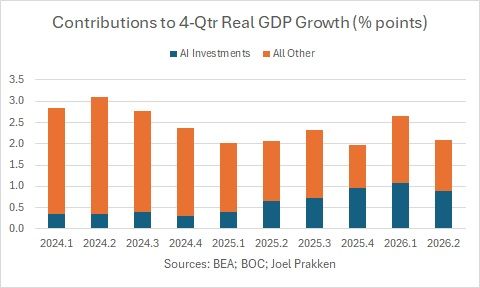
We can agree that, in an accounting sense, the contribution to recent growth of GDP made by AI investments - defined here as fixed investment in computers & peripheral equipment, in software and in R&D, as well as construction of data centers - has become quite significant. My first chart shows the recent decomposition of 4-quarter growth in real GDP (not compounded). Since early 2024, the contribution to growth of AI investments has (roughly) quadrupled and now accounts for roughly 40% of total GDP growth. Yet during that span GDP growth itself has not moved noticeably higher.
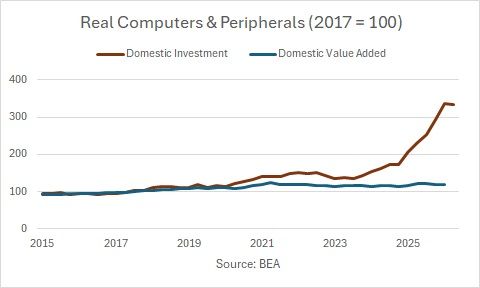
In a more “general” framework, I see two reasons that these investments have not raised overall growth by nearly as much as their accounting contribution has increased, if at all. First, a high percentage of these investments are imported and so are not included in the value of domestic production. For example, my second chart compares the quantity index for domestic production of computer and electronic products (from BEA’s industry data) to the quantity index for imports of computers and peripherals. Since the introduction of ChatGPT, domestic production has barely budged, while imports have exploded.
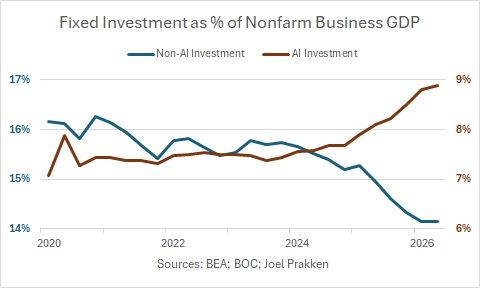
Second – and more important - the economy has been operating near full employment throughout this period. Given little evidence of faster trend growth of productivity, the resources devoted to AI investment must have been diverted from other competing uses. My third chart shows both AI investments and non-AI investments as a share of nonfarm business GDP. The increase in the former has been almost perfectly offset by a decline in the latter, suggesting that AI investments have merely “crowded out” expenditures on non-AI investments.
New uncertainties about the course of monetary policy under the Fed’s new chair, the conflict in Iran and the burgeoning federal debt all may have contributed to the recent rise in inflation-protected Treasury yields to record or rear-record highs. However, a little thought suggests the mechanism for redirecting investment towards AI capital is an increase in real interest rates as demand shifts towards those investments with higher expected rates of return. This fundamental pressure unlikely to abate any time soon.

Joel Prakken
AuthorMore in Author Profile »Joel Prakken is former Chief US Economist of S&P Global and IHS Markit, co-founder of Macroeconomic Advisers, and past president and director of the National Association for Business Economics. He has served as an outside advisor to the Congressional Budget Office, on the Advisory Panel of the Bureau of Economic Analysis, and as a consultant to the Joint Committee on Taxation. He holds a BA in economics from Princeton University and a PhD in economics from Washington University in Saint Louis.
 Global