

Chairman Warsh and M2 – He Almost Gets It
|in:Viewpoints
At the recent Jackson Hole annual Kansas City barbecue, Fed Chairman Warsh mentioned that if the Fed had paid more attention to the surge in the M2 money supply in 2021, it might have raised the federal funds rate sooner, which, in turn, might have moderated the sharp increase in consumer price inflation that ensued. Wow! The ghost of Milton Friedman, may his memory be a blessing, must have been talking to Warsh while he was at Stanford’s Hoover Institution. The Fed could do worse than paying more attention to the behavior of the M2 money supply. It could do better, though, by paying more attention to behavior of the sum of the monetary base (reserves of depository institutions held at the Fed plus currency) plus securities and loans on the books of depository institutions (broad thin-air credit). But where Fed Chairman does not quite get it is his continued emphasis on using the federal funds interest rate as the Fed’s operating instrument. If the ghosts of Milton Friedman and Robert Laurent (also, may his memory be a blessing) would have had more séance time with Warsh, they might have been able to convince him to abandon using the federal funds interest rate as the Fed’s policy instrument and instead directly set the level of depository institution reserves such that a constant rate of growth in a monetary quantity, be it M2 or thin-air credit, could be achieved. This would require some institutional changes such as the elimination of interest payments on reserves and the re-introduction of reserve requirements. (See, my August 25, 2026 commentary “A Modest Monetary Policy Proposal for Fed Chairman Warsh to Consider” for a discussion of these necessary institutional changes.)
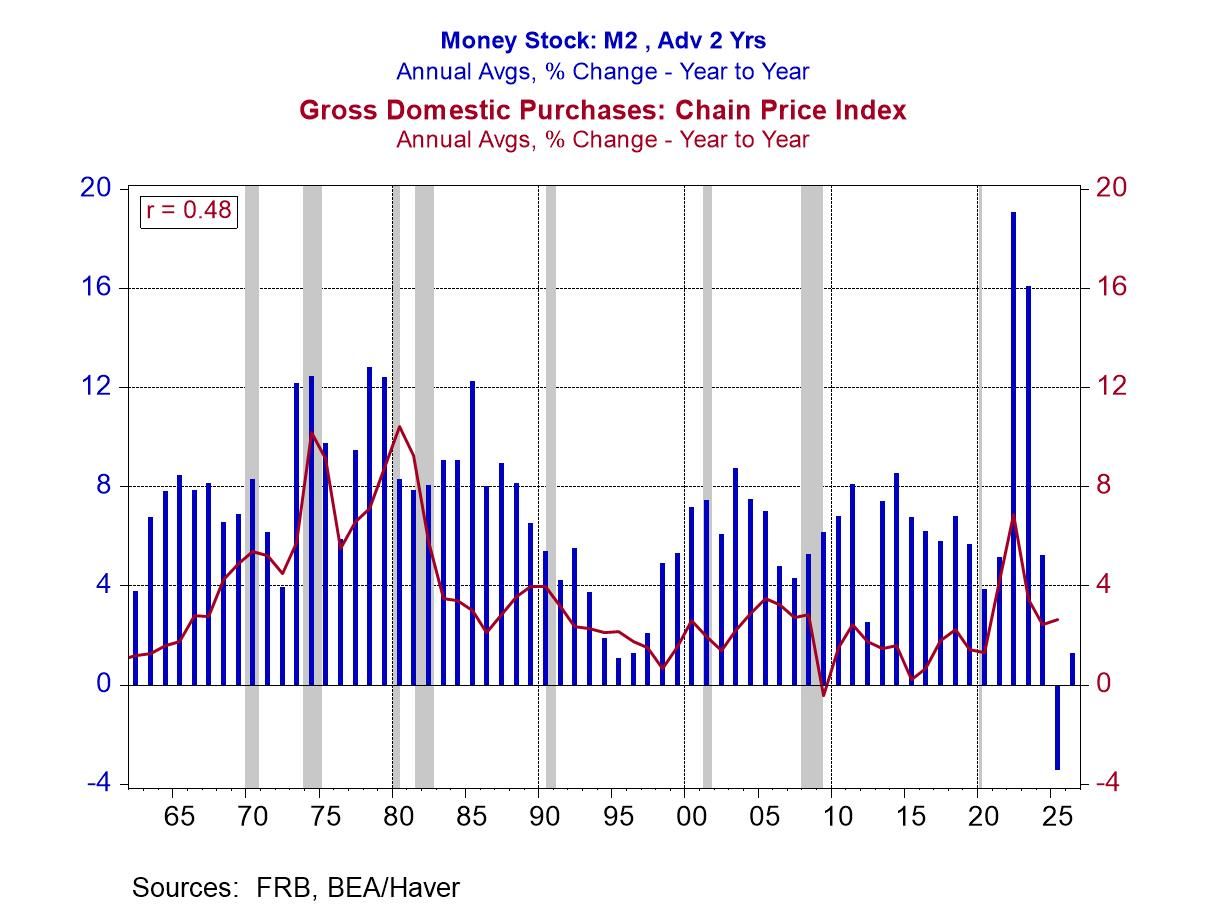
Let’s compare the relationship between percentage changes in the M2 money supply and thin-air credit with goods/services price inflation. Plotted in Chart 1 are the percent changes in the annual averages of the M2 money supply (the blue bars) vs. the percent changes in the annual averages of the Gross Domestic Purchases chain-price index (the red line) starting in 1960. The highest positive correlation between the two series occurs when percent changes in M2 are advanced (lead) by two years. The correlation coefficient is 0.48. Although a correlation coefficient of 0.48 is a long way from the maximum possible value of 1.00, it’s not bad for government work.
Chart 1
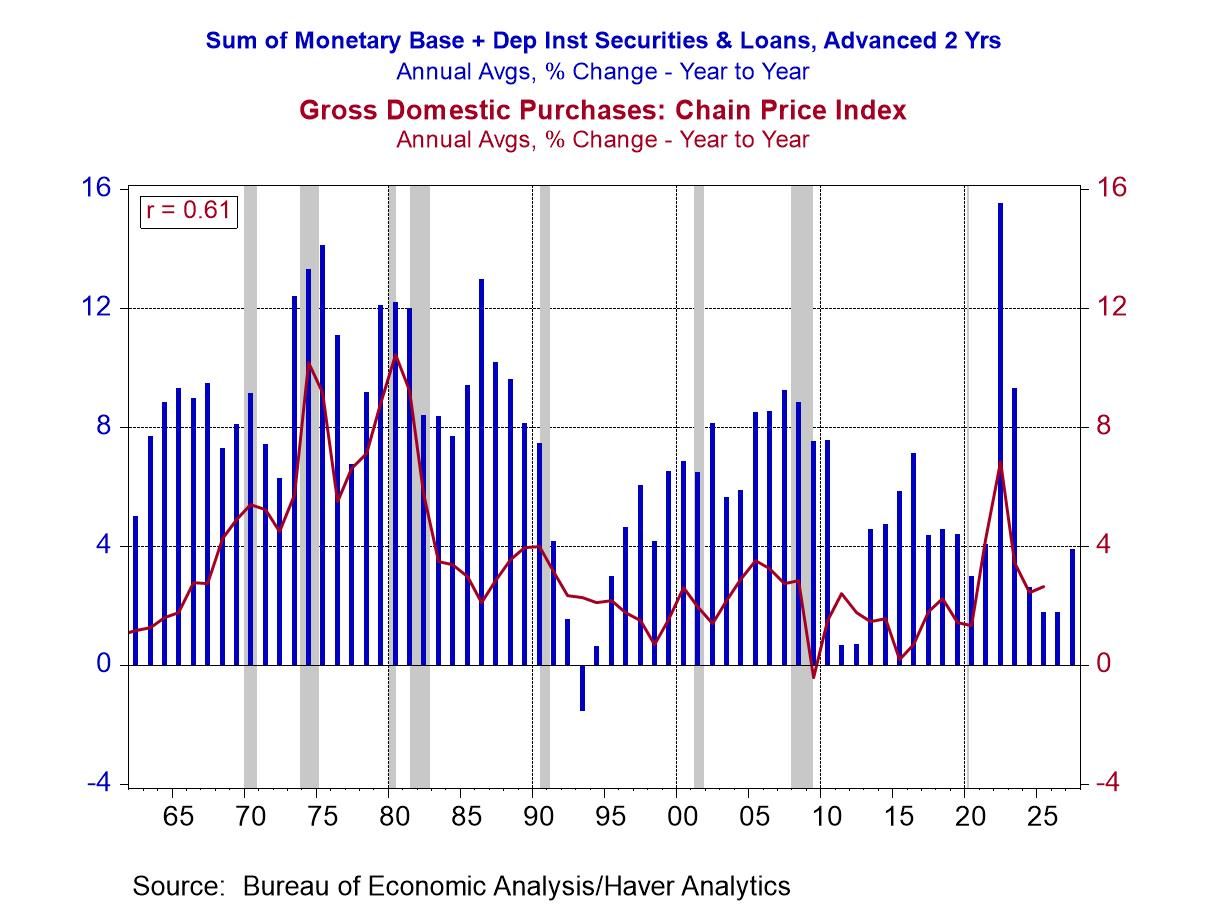
Now, let’s compare the relationship between percentage changes in “broad” thin-air credit (the sum of the monetary base plus the securities and loans on the books of depository institutions) and goods/services price inflation. Plotted in Chart 2 are the percent changes in the annual averages of thin-air credit (the blue bars) vs. the percent changes in the annual averages of the of the Gross Domestic Purchases chain-price index (the red line), again, starting in 1960. The highest positive correlation between these two series occurs when percent changes in thin-air credit are advanced (lead) by two years. The correlation coefficient is 0.61, better than M2’s 0.48.
Chart 2
So, whether its today’s percentage changes in the M2 money supply or thin-air credit, history indicates that the largest effect on goods/services price inflation occurs two years later. Chairman Warsh, you could do worse by using today’s behavior of M2 as an indicator of the behavior of inflation two years from now. But you could do better by observing the behavior of today’s thin-air credit. If you really want to go down in the annals of outstanding Fed chairpersons, Chairman Warsh, you will abandon federal funds rate targeting and adopt direct reserves targeting to achieve a constant rate of growth in thin-air credit. If you do this, I predict that periods of excessive goods/services price inflation or deflation will be avoided. I also predict that asset-price bubbles will be avoided. So, assign one of your “task forces” to investigate my recommendations and determine the optimal constant rate of growth in thin-air credit.
Note: I am as tired of writing about thin-air credit as you are reading about it. I believe that the Federal Reserve could do a lot worse in conducting monetary than making the necessary institutional changes that would enable it to achieve a steady rate of growth in thin-air credit. But, to quote my son: “No one listens to me!” So, I will attempt to find other issues to rant about in the coming months.

Paul L. Kasriel
AuthorMore in Author Profile »Mr. Kasriel is founder of Econtrarian, LLC, an economic-analysis consulting firm. Paul’s economic commentaries can be read on his blog, The Econtrarian. After 25 years of employment at The Northern Trust Company of Chicago, Paul retired from the chief economist position at the end of April 2012. Prior to joining The Northern Trust Company in August 1986, Paul was on the official staff of the Federal Reserve Bank of Chicago in the economic research department. Paul is a recipient of the annual Lawrence R. Klein award for the most accurate economic forecast over a four-year period among the approximately 50 participants in the Blue Chip Economic Indicators forecast survey. In January 2009, both The Wall Street Journal and Forbes cited Paul as one of the few economists who identified early on the formation of the housing bubble and the economic and financial market havoc that would ensue after the bubble inevitably burst. Under Paul’s leadership, The Northern Trust’s economic website was ranked in the top ten “most interesting” by The Wall Street Journal. Paul is the co-author of a book entitled Seven Indicators That Move Markets (McGraw-Hill, 2002). Paul resides on the beautiful peninsula of Door County, Wisconsin where he sails his salty 1967 Pearson Commander 26, sings in a community choir and struggles to learn how to play the bass guitar (actually the bass ukulele). Paul can be contacted by email at econtrarian@gmail.com or by telephone at 1-920-559-0375.
 Asia
Asia