

 Global| Sep 08 2026
The Economics of a Chokepoint Crisis
|in:Viewpoints
In recent months the maritime supply chain of oil and petroleum, especially via the Middle East, has come under immense strain. The ongoing disruptions to sensitive maritime chokepoints make the economics around it increasingly precarious. The Strait of Hormuz has been heavily restricted since March 2, 2026 and as of August 30, 2026 remains effectively closed. According to the EIA, prior to the conflict roughly a fifth of global oil consumption and LNG trade flowed through this chokepoint. There was a partial opening that lasted from June 17, 2026 to July 14, 2026. More recently on July 20, 2026 Yemen’s Houthi movement declared a naval blockade and maritime embargo on Bab el Mandeb strait. Together, the two disruptions have exposed the limited scope for rerouting and increased the risk of a more persistent energy-price shock. In this piece, we examine their impact on tanker shipping routes and Saudi Arabia’s oil trade, using IMF PortWatch data available in Haver’s TRANSPRT Database.
A closer look at chokepoints: Limitations of rerouting
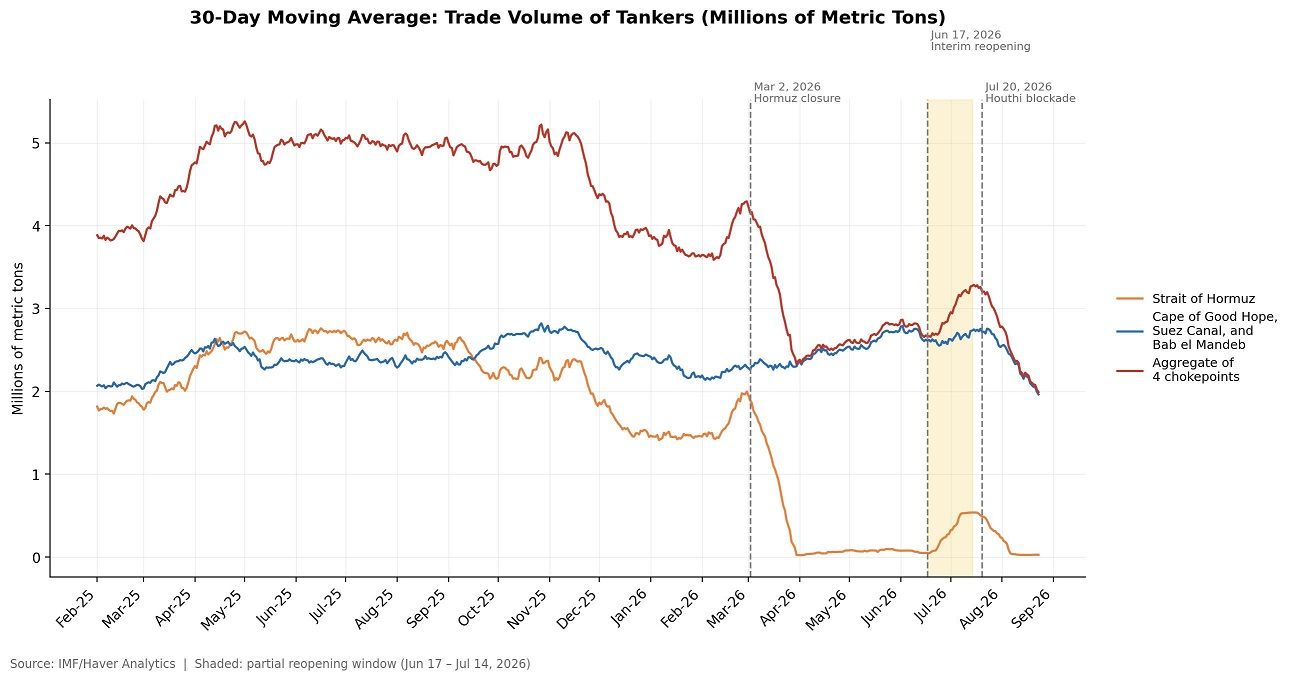
In the month following the closure of Strait of Hormuz, tanker trade volume through Hormuz collapsed to 22.8 thousand tons from 1.97 million tons over the previous 30 days. This difference in lost volume was not absorbed by the aggregate of the remaining chokepoints – Suez Canal (Egypt), Bab el Mandeb (Yemen) and Cape of Good Hope (South Africa) – as the net volume through the alternate corridor remained nearly steady and has actually begun to fall off in the latest month (Figure 1 Blue line).
There were some significant gains made during the partial reopening from June 17 to July 14, where Hormuz tanker volume regained 29.5 percent of its original value. However, the Houthi blockade (July 20) triggered a second, compounding decline, this time visible on all three lines (Figure 1). Hormuz dropped again, and the alternate corridor (which had shown slight gains at that time) dropped as well. These were not two independent shocks; the second disruption hit the very route ships had been relying on to cope with the first.
The US has maintained a strong naval presence in the region and has led Operation Prosperity Guardian, a multinational coalition set up in December 2023, which aims to protect commercial shipping in the Red Sea. The challenge is the asymmetry of the threat from the Houthis: cheap drone and missile attacks on tankers and naval escorts are hard to fully deter, so even a partial or a threatened blockade has proven effective.
Figure 1: Trade Volume of Tankers through Select Chokepoints
Impact on Saudi Arabia: Tanker Port Calls and Tanker Exports Tonnage
Saudi Arabia is at the center of these disruptions. Oil exports made up roughly 70-80 percent of its total export value over the past year. After the closing of the Strait of Hormuz, Saudi Arabia was able to reroute a share of its crude exports away from the Persian Gulf to the western Red Sea via its overland east-west (Petroline) pipeline. Breaking down the port calls and tanker export tonnage by the east-west ports during different phases of the chokepoint closures using the IMF PortWatch data shows the extent to which Saudi Arabia was able to manage the shock.
Figure 2: Saudi Arabia Port Calls (Tankers)
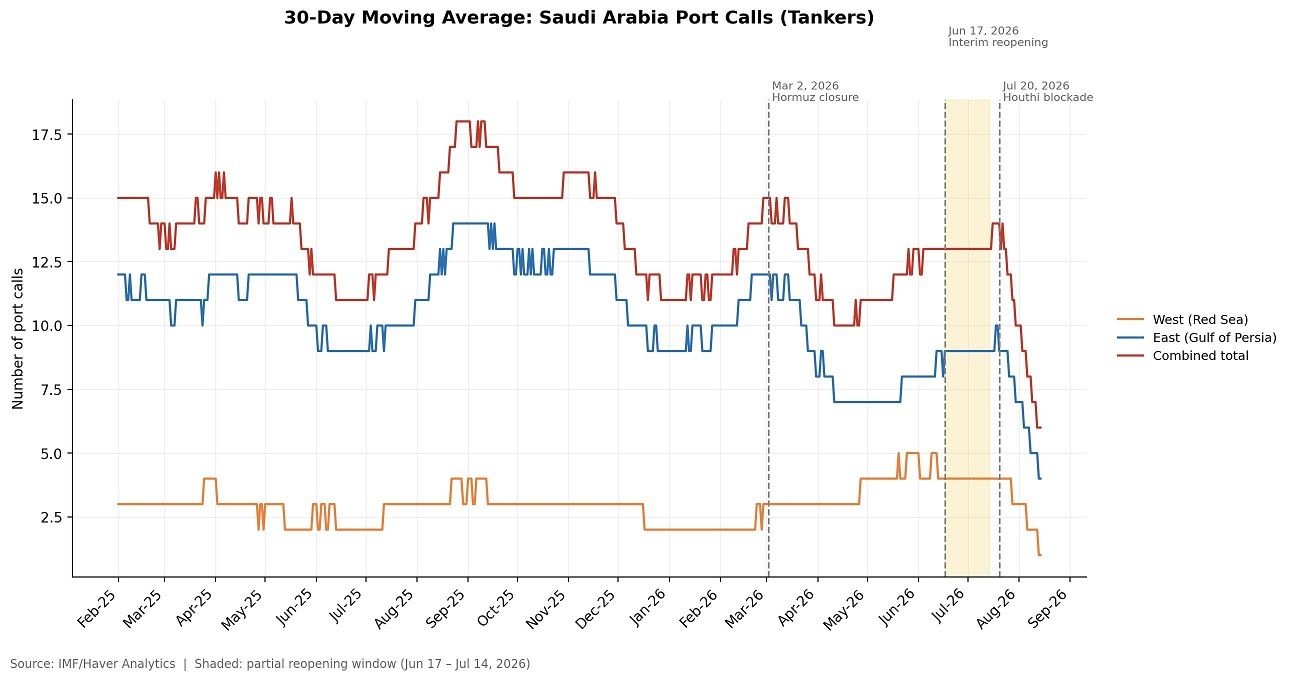
Figure 3: Saudi Arabia Tanker Exports through Ports
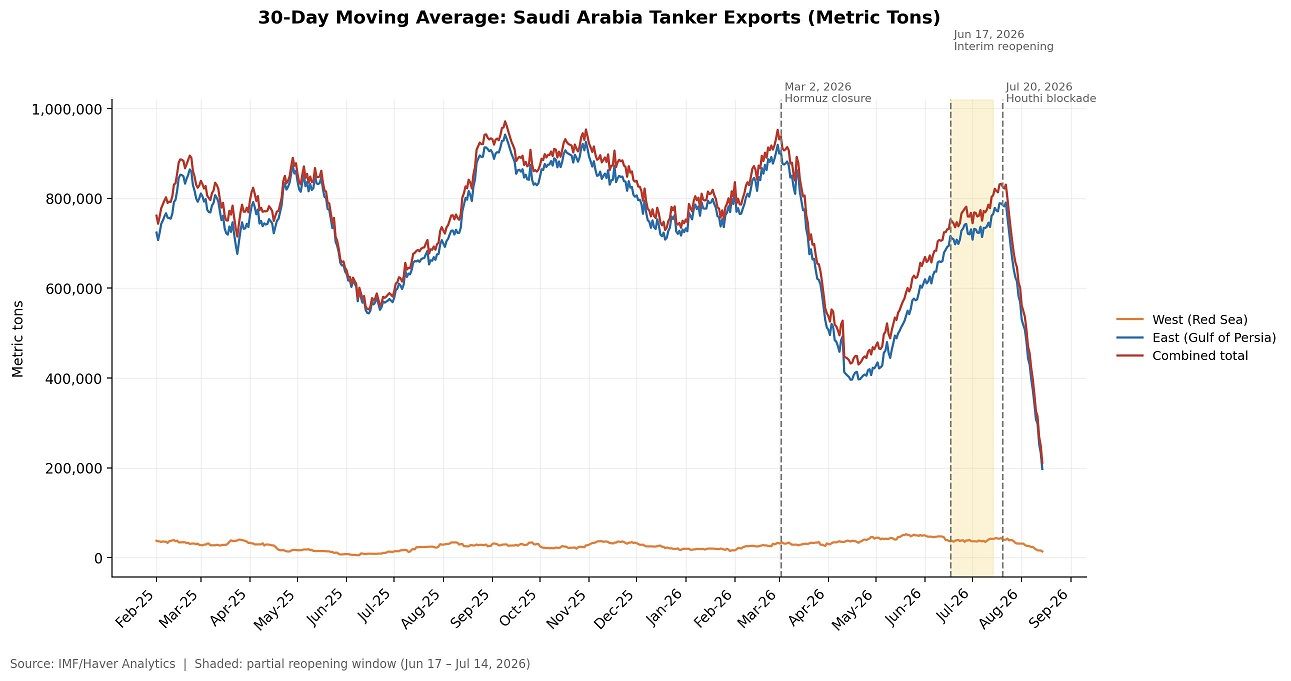
During the first 30 days of the closure of Hormuz, the average port calls per day on the western ports (Red Sea) increased to 2.9 per day from 2.6 per day (11.4 percent increase), whereas the eastern ports (Persian Gulf) decreased to 8.4 per day from 12.0 per day (29.8 percent decline) (Figure 2). Meanwhile, the export tonnage on the western ports increased only 0.7 percent and on the eastern ports decreased by 43 percent (Figure 3). The disproportionate changes, especially on the east coast (Persian Gulf), show that not only were fewer ships arriving but they were carrying less cargo as well. This shows that the Petroline did offer some flexibility, but was not enough to offset the loss of eastern export capacity. A more severe decline was seen on both coasts after the Houthi blockade.
Impact on Arabian Light Crude Oil Price
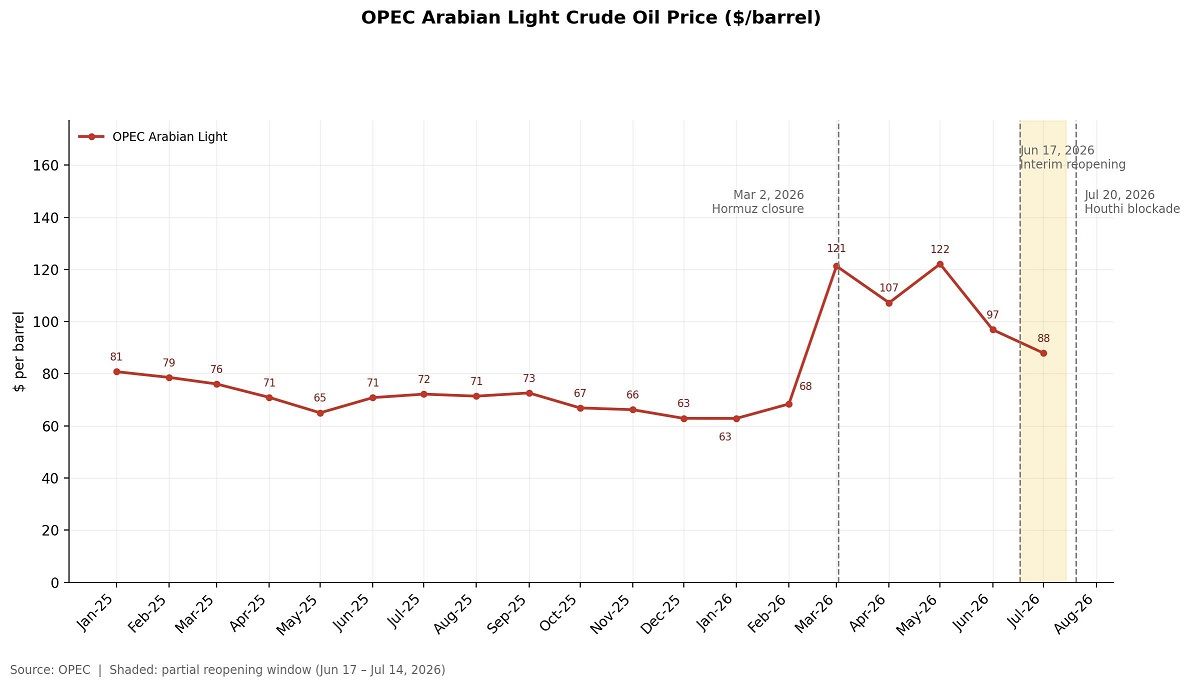
Due to supply scarcity through Hormuz, markets initially responded by driving up oil prices from $66 to $121 per barrel (Figure 4). This initial windfall helped Saudi Arabia offset its physical loss in trade volume with financial gains. Over the following months, prices fluctuated as alternate shipping routes and partial supply adjustments took hold, easing to around $97 during the interim reopening, which was well above pre-crisis levels. Notably even after the reopening ended, the price settled at $88 a barrel. However, it is unlikely this stability will continue as we start seeing the full effects of the Houthi blockade, which reintroduces the scarcity dynamic that led to the initial price spike.
Figure 4: Arabian Light Crude Oil Price per Barrel
Current energy demand has to be met, and the only short-term solution is a diplomatic resolution, as seen during the partial reopening of Hormuz. Otherwise, prices will likely be driven up, as evident after the first Hormuz closure, or at the very least remain highly sensitive to disruptions, causing fluctuations.
Such sustained energy-price volatility affects more than just Saudi Arabia's trade balance. Higher and less predictable energy prices push up inflation worldwide, raising costs for transportation, manufacturing, and shipping. This in turn slows down economic growth. If these chokepoints remain contested and viable alternatives, such as shipping routes or energy sources, aren't established, the risk isn't a one-time price shock, but a higher, more volatile energy baseline for the global economy.

Shashwat Indeevar
AuthorMore in Author Profile »Shashwat Indeevar is a Senior Economic Data Manager at Haver Analytics, where he has been part of the Research Team since 2017, working in both the New York and London offices. He focuses on the organization and presentation of large-scale datasets, the improvement of database-building processes, and the management of daily workflow. His economic research interests include global energy use, environmental sustainability, and artificial intelligence.
He holds a Master of Science in Management of Technology from New York University, where he studied finance, economics, and operations management. He also earned a Bachelor of Engineering in Electronics and Communications from Panjab University, India.