

 Global| Sep 02 2026
The age of abundance is over — and neither policy nor markets have caught up
by:Andrew Cates
|in:Viewpoints
Kevin Warsh used his first Jackson Hole address as chairman of the Federal Reserve last week to signal that the next move in US interest rates is more likely to be up than down. He is not alone. The European Central Bank raised rates in June and may go further, and several other central banks have turned hawkish. It is a puzzle. Growth has slowed, unemployment has drifted up, and core inflation across the advanced economies is not far above target. Why is the world's monetary tide turning towards tightening?
The official answer is that they are guarding against a shift in expectations. Supply-driven inflation need not persist; it does so only if firms and households come to expect it, and set wages and prices accordingly. Having misjudged the 2021 shock as transitory, central bankers are unwilling to take that chance a second time. So they are tightening not to reverse the shock, which no rate can do, but to keep expectations anchored.
That, though, is the lesser part of the story. The central banks are treating as a cyclical episode what is in truth a change of regime. For a generation the advanced economies enjoyed abundant supply and abundant capital: globalisation held down the price of goods, a global surplus of saving held down the price of money, and monetary policy had only to manage demand. Both conditions are now reversing, together. Supply has become scarce and costly; so has capital; and the two are related. The consequences are large. Inflation of this kind cannot be brought down by interest rates, only resisted at the cost of a recession. The real cost of capital has risen durably, not cyclically. And investors positioned for the old regime — a central bank that eases into every downturn, government bonds that hedge equities, real rates that subside to their former lows — are positioned for a world that will not return.
Supply has tightened on every front. In the past month alone the United States imposed 50 per cent tariffs on Canadian goods; American forces struck Iranian launchers at the Strait of Hormuz, returning Brent above $90; and a glacier collapse on the Nepal-Tibet border destroyed a regional trade route. Each raised costs, and none can be addressed by a policy rate. To these has been added a contraction in the supply of labour. The administration's immigration enforcement, recently extended to withdraw work authorisation from more than a million people, has reduced the workforce available to construction, agriculture and services, and raised wage costs in those sectors. None of this is a temporary deviation from a stable trend. The real cost of energy has risen for a quarter of a century to a record; reshoring is reconstructing supply chains at higher cost; and demographic change was tightening labour markets before enforcement intensified. The cheap and frictionless supply of the globalisation era has ended.
The data bear this out. Decompose US core inflation into demand- and supply-driven components and the demand-driven part has fallen to around one percentage point, with supply accounting for almost the entire excess over target (Figure 1). Across the G10, core rates are grouped close to target, none much above two and a half per cent (Figure 2). The demand that monetary policy governs has already been contained; wage growth is slowing, and market-based measures of inflation expectations remain near target. What sustains inflation above target is supply.
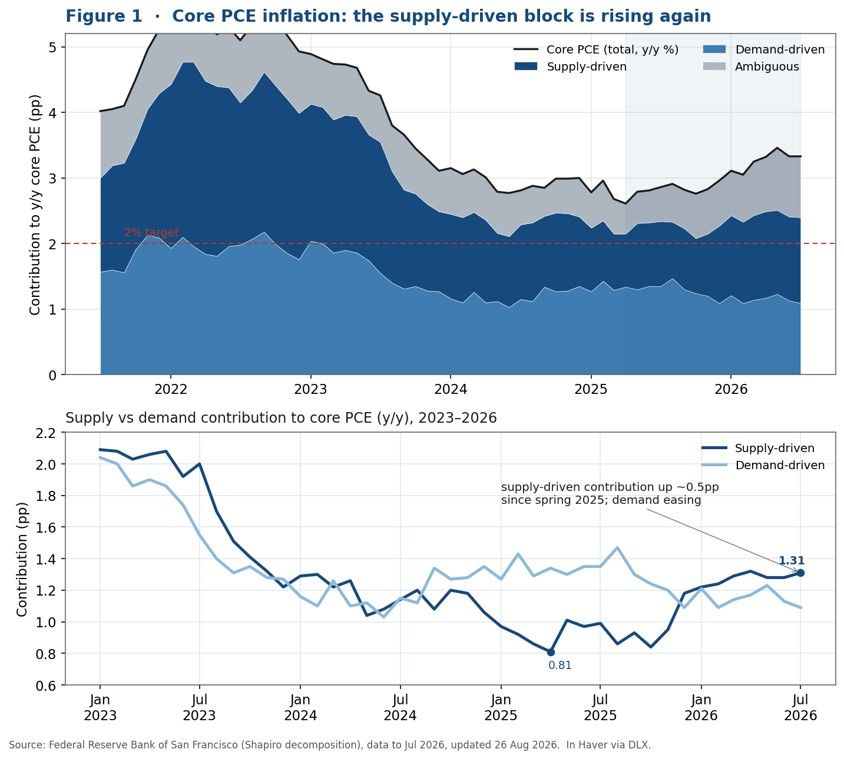
Figure 1. Supply- and demand-driven contributions to US core PCE inflation. Source: San Francisco Fed (Shapiro decomposition) via Haver Analytics.
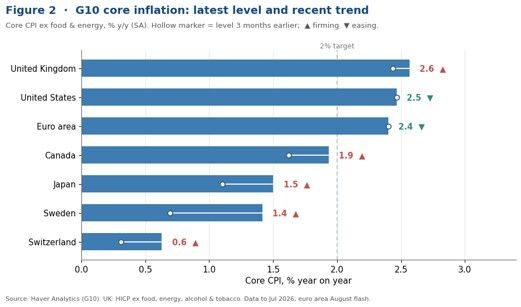
Figure 2. Core inflation across the G10 — latest level and three-month direction. Source: Haver Analytics.
Capital has moved in the same direction, and the investment boom is not the offset it appears to be. The advanced economies are being asked to invest on a scale not seen in decades — in artificial intelligence, the energy transition, defence, and the fiscal deficits that accompany them — while the pool of saving available to fund it is shrinking, as the corporate sector shifts from net lender to net borrower and China channels less of its surplus into Western assets. Artificial intelligence adds to the pressure rather than relieving it: data centres are heavy consumers of electricity, the energy transition brings forward the demand for power and metals, and any supply it may eventually release lies well beyond the capital it now absorbs. The price of capital has already adjusted. The real yield on advanced-economy government debt, having declined for four decades to a record low during the 2022 inflation, has risen to its highest since before the financial crisis (Figure 3). The era of near-zero rates was the anomaly, not the level to which policy will return.
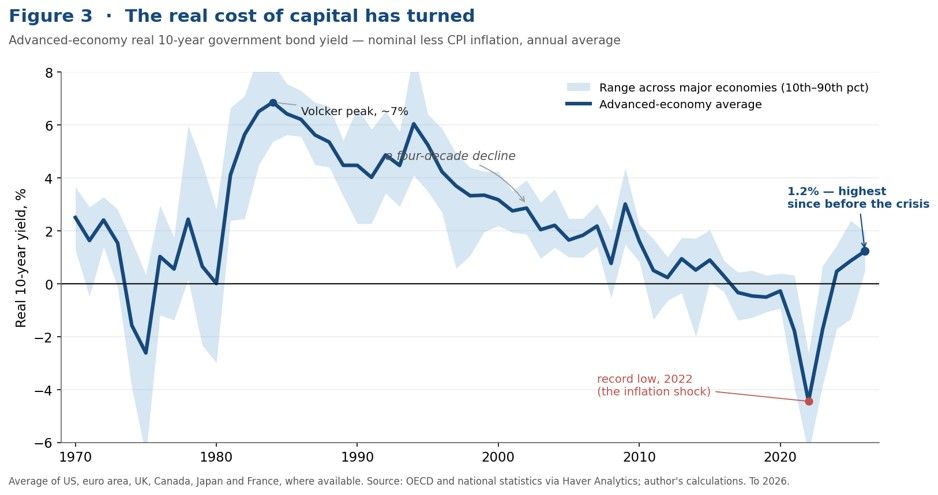
Figure 3. Advanced-economy real 10-year government bond yield (nominal less CPI inflation), annual average. Source: OECD and national statistics via Haver Analytics; author's calculations.
The central banks, in short, are applying the wrong instrument. They are using a tool that acts on demand against an inflation that originates in supply, and against a cost of capital that has risen for structural reasons; the most it can achieve is a recession that leaves those forces intact. A higher policy rate cannot lower the oil price, replace the workers being removed, or add to the supply of saving. The expectations they are defending show little sign of dislodging, while the recession they would risk in defending them is the greater danger.
Investors are making the opposite error, still positioned for a world that has ended. The central-bank put does not operate when growth and inflation diverge; bonds and equities fall together in a supply shock, as they did in 2022; and the real rate remains high because capital is genuinely scarce, not because policy is temporarily restrictive. The assets that benefit are claims on real resources — energy and its inputs; those most exposed are long-duration bonds and the highly valued equities that a low cost of capital supported. September's decision matters less than the regime that produced it. The age of abundance is over, and neither policy nor markets have adjusted to its end.

Andrew Cates
AuthorMore in Author Profile »Andy Cates joined Haver Analytics as a Senior Economist in 2020. Andy has more than 25 years of experience forecasting the global economic outlook and in assessing the implications for policy settings and financial markets. He has held various senior positions in London in a number of Investment Banks including as Head of Developed Markets Economics at Nomura and as Chief Eurozone Economist at RBS. These followed a spell of 21 years as Senior International Economist at UBS, 5 of which were spent in Singapore. Prior to his time in financial services Andy was a UK economist at HM Treasury in London holding positions in the domestic forecasting and macroeconomic modelling units. He has a BA in Economics from the University of York and an MSc in Economics and Econometrics from the University of Southampton.