

Q2 New Jersey GDP Trails Nation, but Income was Stronger
|in:Viewpoints
Summary
-
GDP growth gap of .5 percentage points in line with long-term trend.
-
Personal income performance one of the best in the nation.
-
2025 household spending trailed the nation.
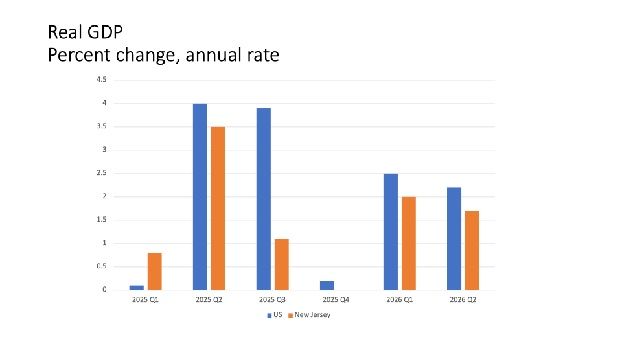
The US Bureau of Economic Analysis (BEA) estimates that New Jersey’s real GDP grew at a 1.7% annual rate in the second quarter of 2026. This is .5 percentage points under that nation’s 2.2% rate of growth. That gap was the same as in the first quarter of the year, and in line with the longer-trend of New Jersey’s growth averaging slower than the nation by roughly that amount.
The second quarter was the fifth straight to see New Jersey’s economy growing more slowly than the nation’s (despite the longer-term trend, there are times—such as the first quarter of 2025—in which growth here has been higher). The state GDP estimate is built up from estimates of output by industry. A softer performance in manufacturing was the main source of the second quarter gap, while a poorer performance in finance was the major culprit for that in the first quarter.
The story was decidedly difference for personal income. New Jersey’s 5.8% growth rate (in current dollars) was one of the 10 highest in the nation and well above the nation’s 4.8%. New Jersey outstripped the nation in most types of income, most critically in the central “net earnings” (employee compensation plus the earnings of noncorporate businesses) category.
The divergence between New Jersey’s GDP and income showing has been evident for some time. Which set of numbers is more reliable? Estimates of industry output at the state level depend upon some fairly arbitrary assumptions, which raise concerns with state GDP figures, especially the quarterly ones. At least the largest component of state personal income—wages—is fairly well-measured, and the figures for transfer payments to persons are likely reasonably good. The implication is that we may put just a bit more stock in the quarterly income numbers seems to be in loose agreement with the fairly robust numbers the state has been reporting on tax collections.
BEA has also released one bit more state economic data: an estimate of 2025 spending by New Jersey consumers. According to BEA, spending by New Jersey households increased 4.8% (not adjusted for inflation) last year, compared to the national figures of 5.3%--a gap comparable to that we typically see for GDP. State estimates of consumer spending, though, are subject to some of the same concerns as those for state GDP, resting on fairly arbitrary assumptions on the allocation of the national figures across the country.

Charles Steindel
AuthorMore in Author Profile »Charles Steindel has been editor of Business Economics, the journal of the National Association for Business Economics, since 2016. From 2014 to 2021 he was Resident Scholar at the Anisfield School of Business, Ramapo College of New Jersey. From 2010 to 2014 he was the first Chief Economist of the New Jersey Department of the Treasury, with responsibilities for economic and revenue projections and analysis of state economic policy. He came to the Treasury after a long career at the Federal Reserve Bank of New York, where he played a major role in forecasting and policy advice and rose to the rank of Senior Vice-President. He has served in leadership positions in a number of professional organizations. In 2011 he received the William F. Butler Award from the New York Association for Business Economics, is a fellow of NABE and of the Money Marketeers of New York University, and has received several awards for articles published in Business Economics. In 2017 he delivered Ramapo College's Sebastian J. Raciti Memorial Lecture. He is a member of the panel for the Federal Reserve Bank of Philadelphia's Survey of Professional Forecasters and of the Committee on Research in Income and Wealth. He has published papers in a range of areas, and is the author of Economic Indicators for Professionals: Putting the Statistics into Perspective. He received his bachelor's degree from Emory University, his Ph.D. from the Massachusetts Institute of Technology, and is a National Association for Business Economics Certified Business EconomistTM.
 Global