

Europe’s Growth Problem Is Also a Political Problem
by:Andrew Cates
|in:Viewpoints
Weak growth and divided governments complicate fiscal repair and the investment needed to improve productivity.
Europe is caught in a difficult circle. Weak growth is undermining confidence in governments, while political fragmentation makes it harder to agree on the reforms and budgets that might restore it. Higher debt-servicing costs leave less room to reconcile competing demands. Economic disappointment and political division risk reinforcing one another, limiting the ability to strengthen growth.
There is no painless way out. Spending cuts can depress activity and alienate voters, while further borrowing may add to the debt without improving the capacity to service it. Higher productivity offers a more promising escape: AI could raise incomes and tax revenues enough to ease the burden. But the investment needed to secure those gains competes for capital and energy, potentially raising Europe’s costs well before it raises European incomes.
That delay matters for monetary policy. Further ECB tightening might restrain inflation, yet also weaken investment and demand in economies struggling to grow. Europe must therefore improve its capacity to invest and govern while managing the immediate pressures on household incomes and public finances.
The difficulty of governing France illustrates the problem. Its minority government is struggling to secure support for a budget intended to curb the deficit. In Spain, a parliamentary defeat over measures to ease the housing crisis has prompted a snap election. In Germany, regional gains by the far-right AfD are putting the governing coalition under pressure. Different economic circumstances have produced a common difficulty: assembling durable support for difficult choices.
Those choices are becoming more expensive. Voters want better services and relief from living costs, while defence and energy security require greater spending. At the same time, governments must refinance debt issued when interest rates were much lower. Rising interest bills leave less room to satisfy these demands, making political agreement harder just as the cost of failing to reach it increases.
Weak growth weakens consent The roots of this difficulty extend well beyond the latest political disputes. The World Bank’s political-stability measure shows a broad deterioration across advanced economies over the past decade. Germany has suffered a particularly marked decline, whereas Greece and Italy have improved or held their ground after earlier periods of upheaval.
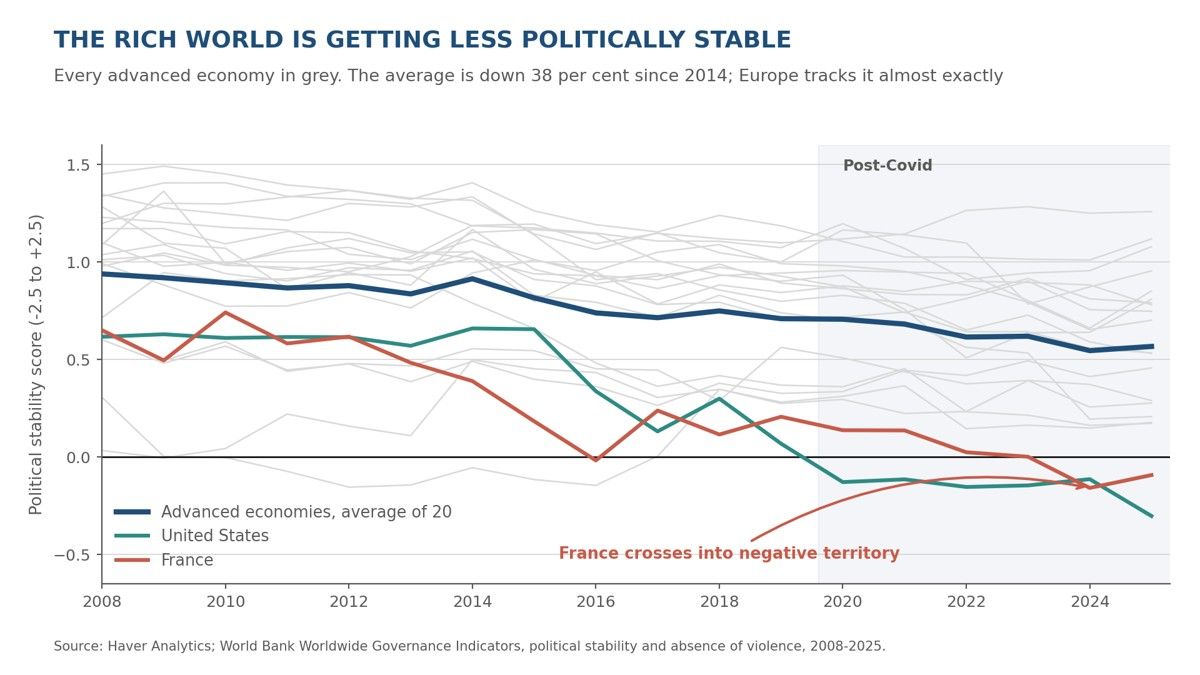
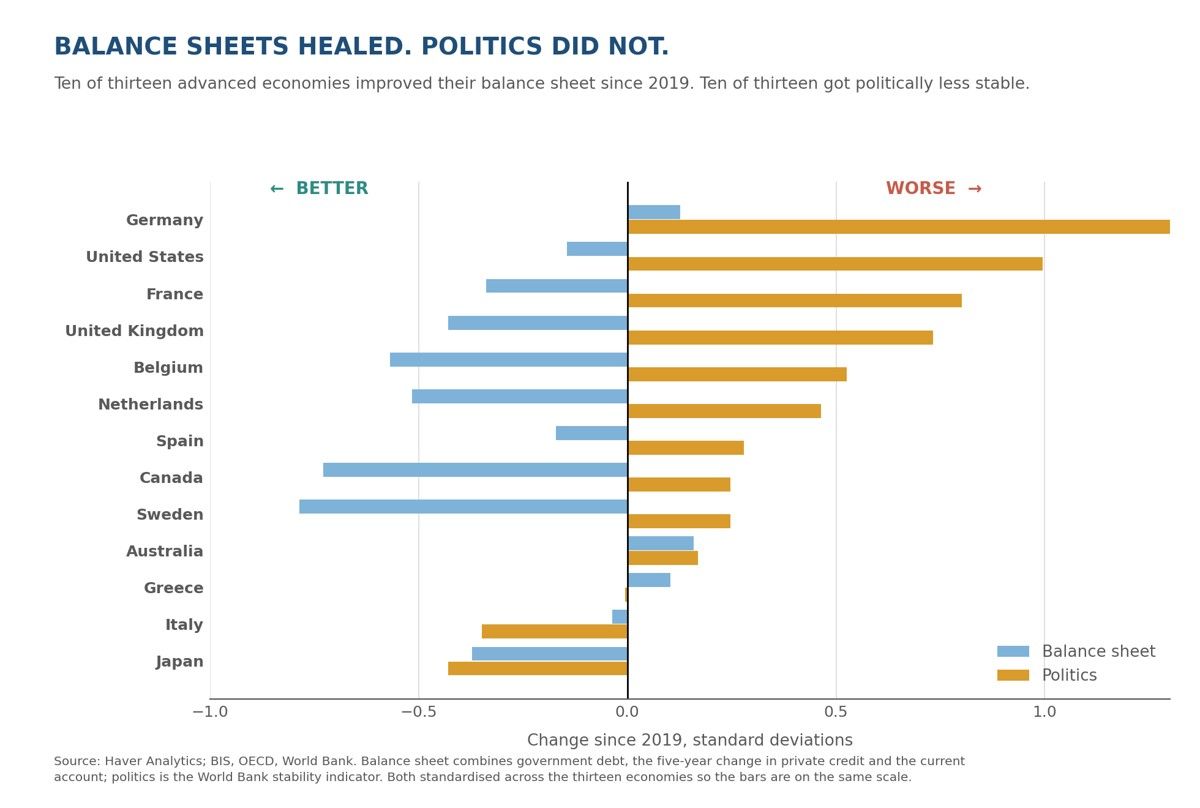
The familiar distinction between a stable European core and a fragile periphery is consequently less useful than it once was. More troubling, political confidence has weakened even in countries where debt burdens have become more manageable. Better financial ratios have not necessarily brought a stronger mandate to govern.
One reason is that the inflation surge after 2019 raised nominal incomes and reduced debt ratios without necessarily improving households’ living standards. Governments benefited from a change in the arithmetic that many voters experienced as a loss of purchasing power. That is a poor foundation on which to seek consent for further restraint.
The importance of living standards is apparent in the next exhibit. Across the countries examined, stronger gains in real output per person since 2019 have been associated with greater political stability, with Germany and Greece illustrating the contrast. The relationship does not establish causation, but it underlines the importance of growth to governments’ ability to sustain support for economic policy.
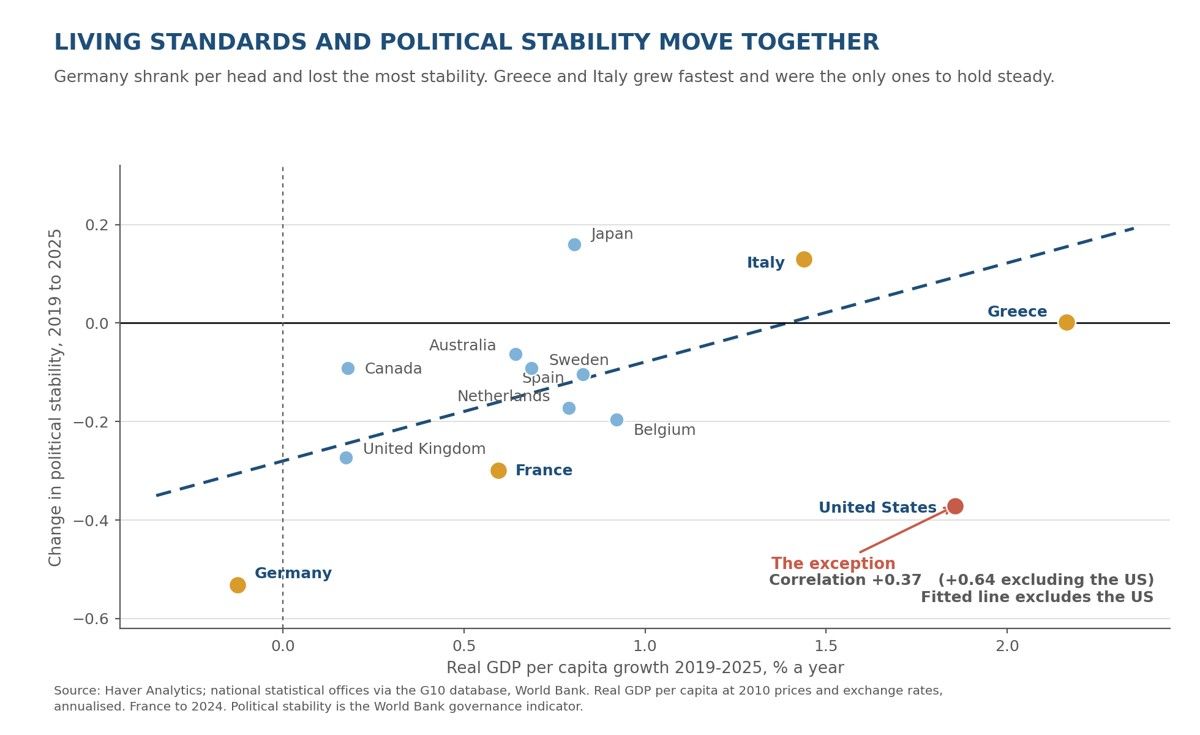
Voters are more likely to accept higher taxes or restrained spending when they believe their prospects are improving. Stagnation instead turns adjustment into an argument over who must bear the loss. As that argument obstructs reform and investment, the weakness of growth becomes both a cause and a consequence of political division.
The nationalist right has gained influence in this environment. In Germany, mainstream parties’ refusal to cooperate with the AfD limits its route to federal power, but its electoral strength already shapes the debate. Elsewhere, more governments involving the nationalist right are a credible prospect. Their ability to improve economic outcomes will depend on reconciling promises with available resources and carrying through reforms. Winning an election does not resolve the constraints that made voters restless.
Unequal capacity to adjust The scope for policy also depends on the balance sheets governments inherit. Europe’s aggregate position is not uniformly alarming: the composite of economic and political indicators below suggests overall vulnerability is no worse than a decade ago. Yet the differences between countries have widened, leaving a common monetary policy to operate across increasingly unequal economic circumstances.
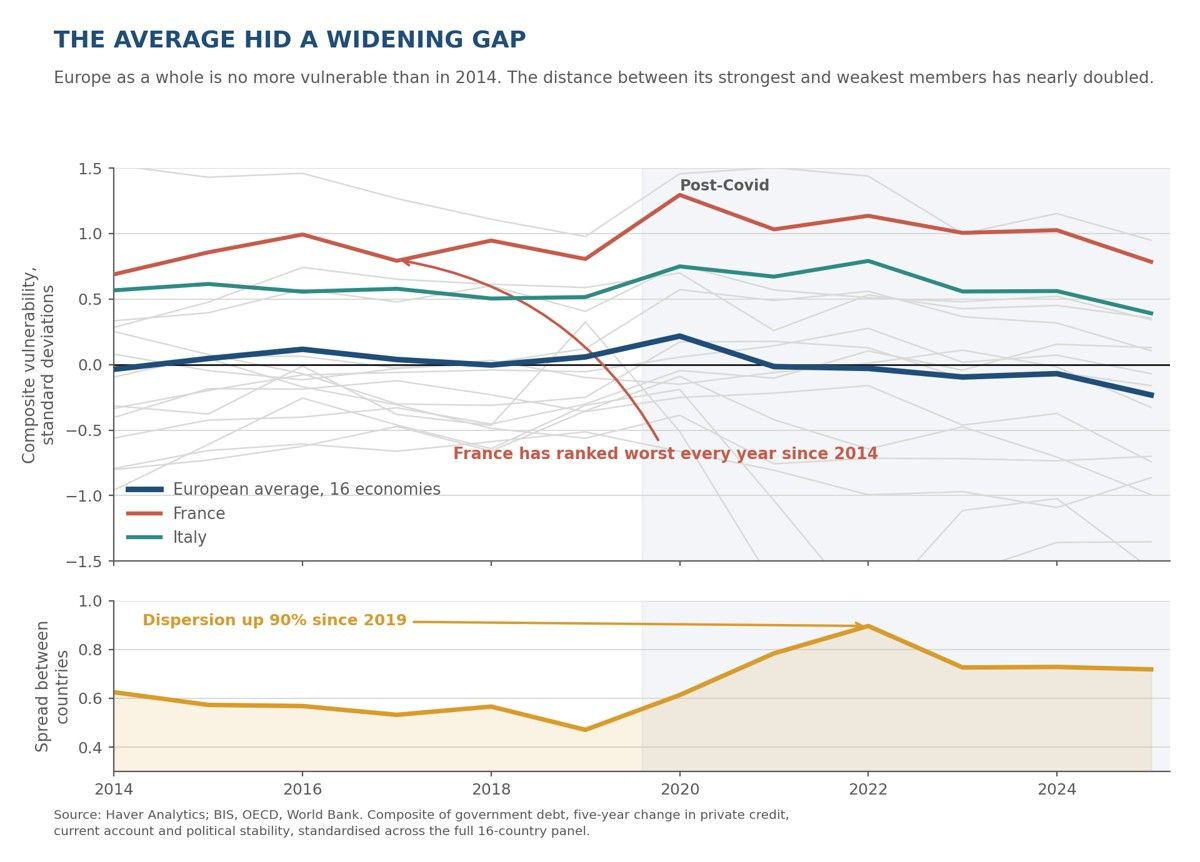
The country rankings show where those differences are concentrated.
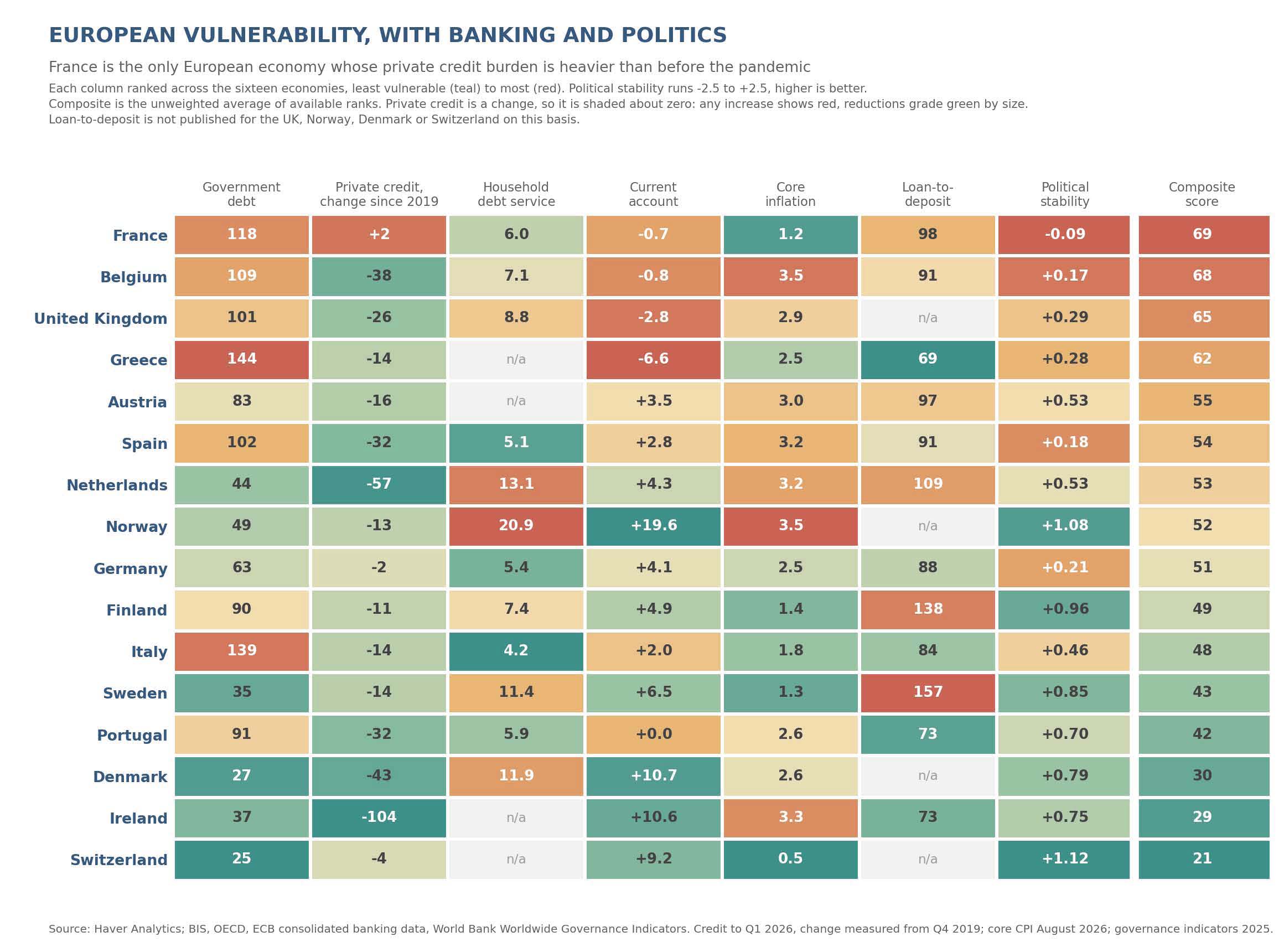
France’s debt burden extends beyond the state. Combined public and private borrowing is substantially greater relative to GDP than in Italy, and its private credit burden has increased since 2019. Higher debt-servicing costs can therefore restrain household spending and business investment as well as public expenditure. The resulting weakness in activity could further obstruct fiscal repair.
Italy’s large public debt, by contrast, is partly offset by lower private leverage, a current-account surplus and banks funded heavily by deposits. Greece has also reduced its public debt ratio substantially. These differences are another reason to set aside inherited assumptions about a sound core and a vulnerable periphery, and examine the resources and obligations of each economy as a whole.
The rankings should be read as a summary of these constraints, rather than a forecast of economic outcomes. What matters for policy is how debt, external balances and political capacity interact. A government with limited fiscal room and weak public support will find it particularly difficult to cushion a slowdown while maintaining investment.
Productivity offers support, not immediate relief Stronger growth would ease both the financial burden and the political struggle over how to bear it. With ageing limiting the expansion of Europe’s workforce, much of that growth must come from higher productivity. AI could contribute by enabling workers and businesses to produce more, supporting earnings, household incomes and the tax revenues needed to service public debt.
The difficulty is that the means of securing this improvement impose costs of their own. Computing capacity requires substantial investment, dependable electricity and stronger networks. Governments and technology companies are competing for the finance and physical resources needed to build them, while the returns arrive only as the technology is put to productive use.
Europe may therefore bear part of the cost of the global AI boom before capturing much of its benefit. Competition for capital raises borrowing costs, while expensive energy deters investment at home. Economies burdened by weak growth and heavy debt are least well placed to endure this delay.
Improving power supply, infrastructure and regulatory certainty would help attract the investment Europe needs. But these improvements take time and often require public money, adding to the immediate financing demands they are intended eventually to relieve. Productivity remains the most promising route out of the predicament. It cannot be treated as relief already delivered.
The ECB’s difficult interval The ECB must make policy while that adjustment is under way. Energy inflation may warrant restraint if it spreads into wages and broader price-setting. Yet further tightening could raise debt-servicing costs before new investment has expanded productive capacity, weakening the very spending on which a more durable improvement depends.
The case for caution is therefore economic, not simply political. Higher rates can restrain demand, but cannot supply electricity or secure parliamentary agreement. They can also weaken investment and make fiscal adjustment harder. The ECB must weigh the risk of persistent inflation against the danger of adding to the constraints on growth.
Monetary policy cannot resolve those constraints on its own. Governments must provide credible budgets and the conditions for productive investment, while the ECB judges how much demand restraint is needed to prevent inflation from becoming entrenched. Neither can safely assume that the other will compensate for failures within its own remit.
What would constitute progress? Progress will require more than a temporary improvement in debt ratios or a new set of investment commitments. Governments need to sustain agreement on budgets without sacrificing the spending that raises productive capacity. Businesses need the infrastructure and certainty to put new technology to work. Households need to see that adjustment can lead to better living standards.
The evidence to watch is consequently practical: whether announced budgets are implemented, whether investment expands productive capacity, and whether output per person and real incomes improve. These outcomes will determine whether fiscal pressures ease and political support strengthens, or whether weak growth continues to undermine both.
Higher productivity could break the circle linking weak growth and political division. Until its gains arrive, Europe must manage the costs of adjustment without undermining the investment needed to make that adjustment succeed. There is no easy solution, but the priority is clear: restore the capacity to deliver sustained improvements in living standards.

Andrew Cates
AuthorMore in Author Profile »Andy Cates joined Haver Analytics as a Senior Economist in 2020. Andy has more than 25 years of experience forecasting the global economic outlook and in assessing the implications for policy settings and financial markets. He has held various senior positions in London in a number of Investment Banks including as Head of Developed Markets Economics at Nomura and as Chief Eurozone Economist at RBS. These followed a spell of 21 years as Senior International Economist at UBS, 5 of which were spent in Singapore. Prior to his time in financial services Andy was a UK economist at HM Treasury in London holding positions in the domestic forecasting and macroeconomic modelling units. He has a BA in Economics from the University of York and an MSc in Economics and Econometrics from the University of Southampton.
 Global