

No mas: the Fed and Inflation
by:Ethan Harris
|in:Viewpoints
The employment report confirmed that the labor market is roughly in equilibrium. Now focus shifts to the August inflation data. I think a rate hike is quite likely on the 15th if the August data either match or exceed consensus forecasts.
In times like this, data dependence make sense
The Fed is often criticized for being too “data dependent.” Critics argue that tying policy to upcoming data: (1) makes the Fed backward looking, (2) adds to volatility as markets over-react to each release, and (3) signals the lack of a fundamental framework.
I disagree. After a period of hawkish or dovish news, there is always a period of high data dependence. At that stage incoming data becomes the final straw. In this instance high and rising inflation (chart) has created a strong focus on the August inflation data. After 65 months of above-target inflation, every member of the FOMC wants to hike if inflation does not return to target in a “timely manner.”
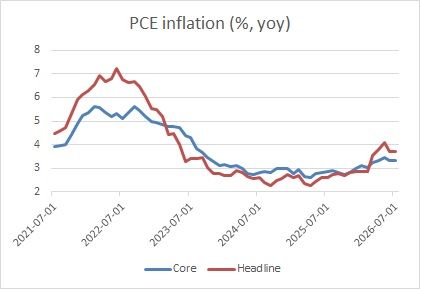
Source: BEA
The tipping point
The million-dollar question is what constitutes a “timely” return to target and what reading in August would confirm or contradict that goal? The best approach is to look at August inflation readings relative to consensus forecast. If the numbers are below consensus, the doves will have an argument to stand on and may get enough support to stay on hold. However. If they come in above consensus, it is game over: doing nothing would damage credibility. Indeed, now that the FOMC has put us all on high alert, even consensus-like numbers should be enough to trigger a hike.
I’m sticking to my forecast
Of course, in any given month anything can happen. However, my fundamental view is that inflation will remain sticky high. The labor market may be in equilibrium, but the overall economy seems hot, with GDP running persistently above estimates of potential output (chart). Monetary policy is loose, judging by easy financial conditions (and, incidentally, accelerating money growth). The evidence is growing that the neutral funds rate is around 4%, not 3%. Fiscal policy is easy.
Outside of the neutral signals from the labor market, leading indicators of consumer price inflation signal strength. The PPI is strong. Survey measures of input and output prices remain robust and supplier delivery times as slowing. There is likely more pass through from high energy prices and tariffs. The AI build out is far from over. The Cleveland Fed’s Inflation Nowcasting tool has core PCE accelerating to 3.4% in August and 3.5% September.
It doesn’t look like “mission accomplished” to me. I continue to see a high probability of a September hike and another hike in December.
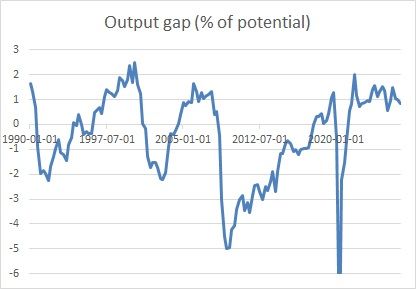
Source: CBO, BEA and author’s calculation

Ethan Harris
AuthorMore in Author Profile »Ethan Harris has a Ph.D. in Economics from Columbia University and was the Head of the Domestic Research Division at the NY Fed. He was Chief US Economist at Lehman Brothers from 1996 to 2008 and Head of Global Economics at Bank of America from 2009 to 2023. Currently he is the author of the blog Ethan on the Economy.
More Viewpoints
 Global| Sep 02 2026
The age of abundance is over — and neither policy nor markets have caught up
by:Andrew Cates