

No Free Lunch for the Fed or the Treasury
by:Ethan Harris
|in:Viewpoints
A surge in productivity growth could solve a lot of problems. It would mean higher government revenue and, combined with spending discipline, lower the budget deficits. Indeed, it is the centerpiece of Treasury Secretary Bessent’s deficit reduction plan. It could also mean easier Fed policy: if productivity increases are not matched by higher compensation growth, unit labor costs and inflation weaken, allowing the Fed to ease rather than hike. This was Warsh’s argument for rate cuts early this year (and he continues to talk about how great productivity is).
The case for and against a surge
Both Administration economists, and Warsh during his campaign for Fed chair, argue that growth-friendly Administration policies and the AI revolution mean higher trend growth. Tax cuts, they argue, stimulate investment and labor supply, while deregulation increases economic efficiency.
I’m skeptical for three reasons. First, we have seen this movie before, and it had a flat ending. Starting with President Carter and continuing with Reagan there was a major push for deregulation in the 1970s and 1980s. Indeed, it was much bigger than what Trump is doing. Reagan also implemented major tax cuts in marginal tax rates. Again, they were much bigger than what Trump has implemented.
And yet, history shows there was no pick-up in productivity or trend growth during this period. With the benefit of hindsight, the CBO has good estimates of what happened to trend growth during and following the “Reagan revolution.” They show productivity initially rebounding from the 1982 recession but then fading for the rest of the recovery (chart). A sustained pick-up did not happen until the “new paradigm” technology boost, starting in 1995.
In my youth, I co-authored a paper on The Supply-Side Consequences of U.S. Fiscal Policy in the 1980s at the NY Fed. We found early evidence that supply-side indicators, like investment, productivity and the labor supply did not respond to the policy changes. We then used a simple simulation model, to show that the crowding out of investment from surging budget deficits offset the benefits of lower marginal tax rates and deregulation. The CBO numbers confirmed those preliminary findings.
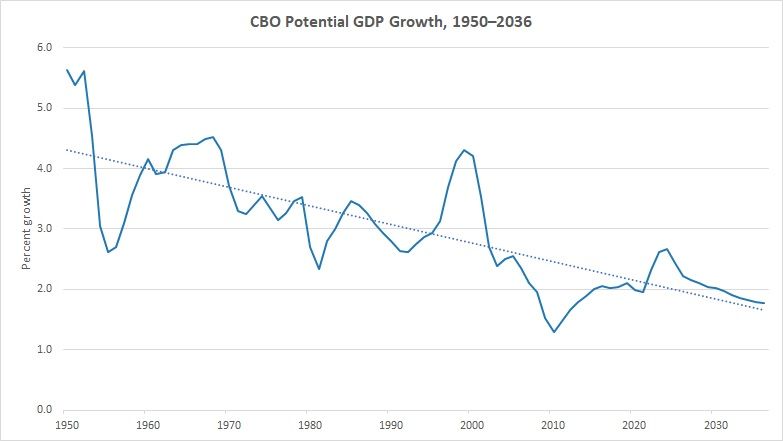
Source: CBO and author’s estimates.
The second reason for skepticism is that the Administration view of the supply-side of the economy is much too narrow. A fair and balanced view should include both positive and negative supply-side developments. The later includes, tariffs and tariff uncertainty, interventions in the private sector, an uncertain rule of law, energy shocks, big budget deficits and immigrant reduction policy. Putting it all together and it is not clear whether the supply-side picture is getting better or worse.
Third, while I think AI will boost productivity, it will take time to show up in the macro data. Even if it is adapted more quickly than past technologies it will still take time for companies to train and adapt workers to the new technology. It is also uncertain how much AI will disrupt the labor market, dampening the main source of government revenue.
The evidence
The early evidence shows a big negative shock to the labor force and an ambiguous impact on productivity. A combination of adverse demographics and immigrant reduction has caused growth in the labor supply to grind to a halt. Meanwhile, the growth in nonfarm labor productivity has been, erratic with no obvious trend (Chart). Data from the San Francisco Fed is more concerning. They estimate “multi-factor” productivity—taking out both the impact of labor and capital on growth and looking at pure efficiency gains. By their metric, productivity growth is up only 1.1% in the last year. Adjusted for the normal ups and downs of the business cycle, it has fallen 0.4% in the last year. Clearly the promised productivity surge is not here.
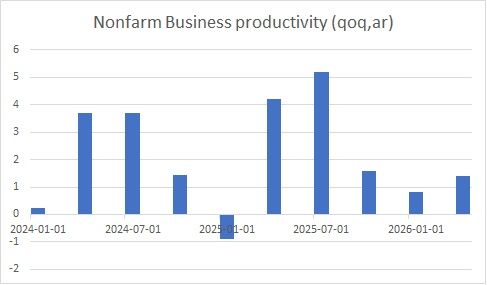
Source: BLS
Forward guidance on the outlook
Productivity did pick up a bit after the COVID shock as companies adopted technologies and flexibility work arrangements that improved output per hour. The chart below compares actual productivity to its 2006-19 trend. Unfortunately, it now seems to be moving in parallel to the old trend line. My guess is that there will be some pick-up in productivity as AI kicks in, but it will be largely offset by weakness in the labor market. Sorry, there is no free lunch for either the Treasury or the Fed.
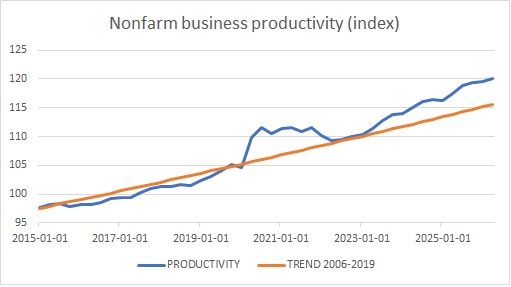
Source: BLS and author’s calculation

Ethan Harris
AuthorMore in Author Profile »Ethan Harris has a Ph.D. in Economics from Columbia University and was the Head of the Domestic Research Division at the NY Fed. He was Chief US Economist at Lehman Brothers from 1996 to 2008 and Head of Global Economics at Bank of America from 2009 to 2023. Currently he is the author of the blog Ethan on the Economy.
 Global