

A Modest Monetary Policy Proposal for Fed Chairman Warsh to Consider
|in:Viewpoints
Starting on August 27, 2026, and running through August 29, 2026, the Federal Reserve Bank of Kansas City will host its annual “barbecue” in Jackson Hole, Wyoming. The best and the brightest of monetary policy gurus from around the world will be there and the highlight of every conference is the comments by the chairman of the Federal Reserve Board. (For some reason, my invitation has repeatedly been lost in the mail.) The theme of the 2026 conference is “Financial Innovation: Implications for Payments Policy”. Although this is an important topic, is it really the most pressing issue for the Federal Reserve to be considering? Of course, I am biased, but I believe that Fed should be discussing a superior way to conduct its monetary policy so as to more consistently achieve an inflation target, especially in an environment of random shocks to the aggregate supply of real goods and services. For whatever reason, these random shocks seem to have been occurring more frequently in recent years. So, I humbly suggest that Fed Chairman include in his remarks that the Federal Reserve operate in a manner such that the sum of depository institution reserves and the securities and loans on the books of depository institutions grow at some constant rate. (Depository institutions are commercial banks, saving institutions and credit unions. Commercial banks dominate depository institutions.) In what follows, I will provide empirical evidence demonstrating that growth in the nominal annual averages of this sum, let us call it “thin-air” credit, has a relatively high correlation with future growth in the nominal annual averages of domestic aggregate demand and the future rate of inflation associated with domestic aggregate demand. In addition to having relatively high correlations with growth in nominal domestic aggregate demand and the associated inflation rate, a constant rate of growth in “thin-air” credit will prevent cumulative increases or decreases in the rate of inflation. I will provide the rationale for why I believe 5-1/2 percent would be a reasonable target rate of growth in thin-air credit. I also will explain how the Federal Reserve can achieve, with precision, whatever target rate of thin-air credit growth it chooses without operating via a federal funds rate target. Not only would this modest proposal eliminate persistent overshoots and undershoots of the Fed’s inflation target, it would simplify the Fed’s communication challenges. In terms of forward guidance, all the Fed chairman would need to say at the end of every Federal Open Market Committee (FOMC) meeting is that the committee intends to have the sum of depository institution reserves plus securities and loans grow at a steady annual rate of 5-1/2 percent.
Plotted in Chart 1 are the year-over-year percent changes in the annual averages of the sum of depository institution reserves at the Federal Reserve, securities and loans (the blue bars) and the year-over-year percent changes in the annual averages of nominal Gross Domestic Purchases (the red line). (Monetary policy primarily influences domestic aggregate demand. That is why I have chosen nominal Gross Domestic Purchases as the “dependent” variable rather than Gross Domestic Product, because the latter involves exports, which is more of a function of foreign demand for US goods and services.) The gray shaded areas represent periods of recession. The highest correlation between these two series starting with 1955 data occurs when thin-air credit is advanced by one year. That correlation is 0.52 (shown in the upper left corner of the chart). This implies that growth in thin-air credit leads growth in nominal Gross Domestic Purchases by one year. So, what happens to thin-air credit this year has its largest effect on nominal Gross Domestic Purchases next year.
Chart 1
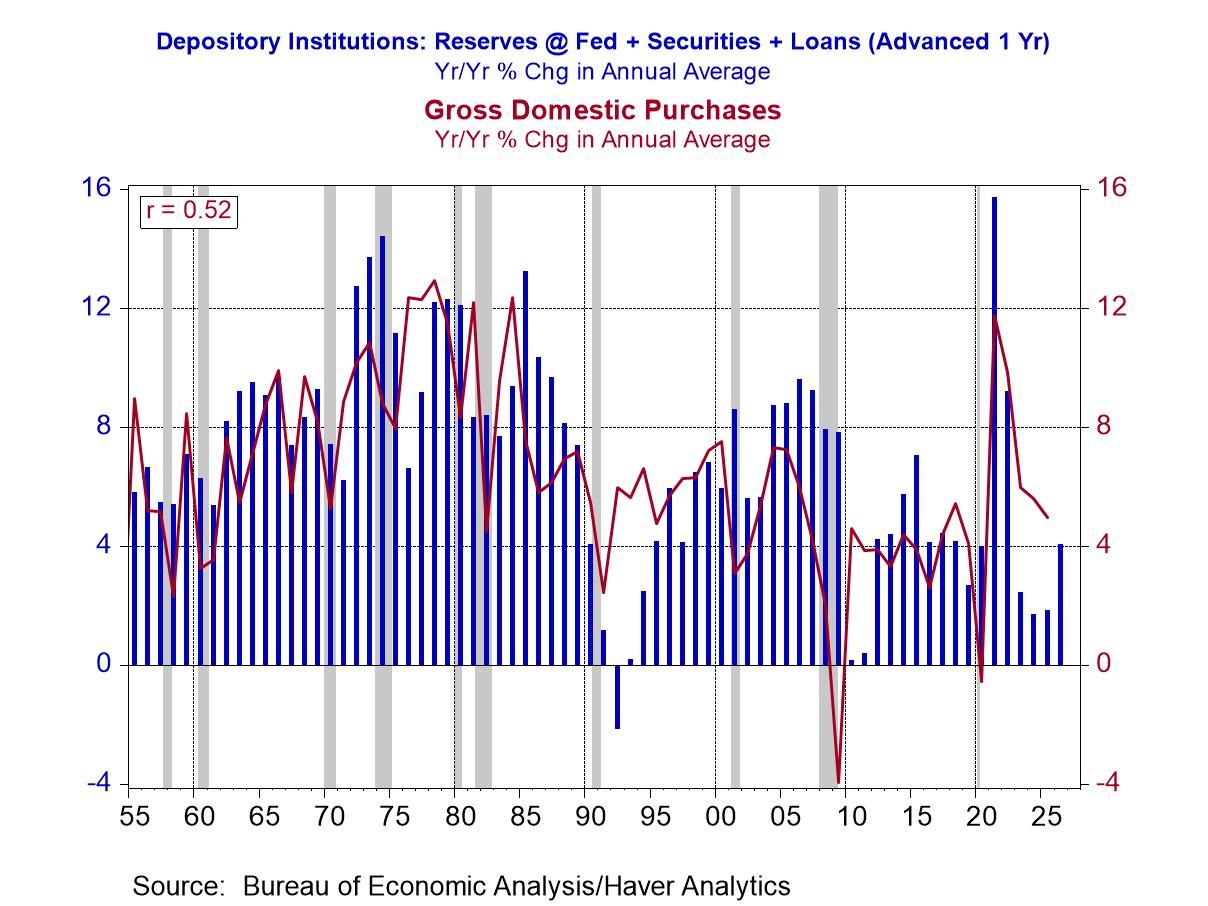
A correlation coefficient of 0.52 falls short of the highest possible 1.00. But a correlation coefficient of 0.52 is nothing to sneeze at. Moreover, the correlation has the “correct” sign, positive, suggesting that faster growth in thin-air credit is generally associated with faster growth in nominal Gross Domestic Purchases, with a one year lag. Back in the days when I got paid to forecast, if I got the “sign” right, I considered it a good forecast. I know, that’s a low bar. On the other hand, I did win the Blue Chip economic forecasting award one year. Even an olfactory-challenged pig finds a truffle occasionally.
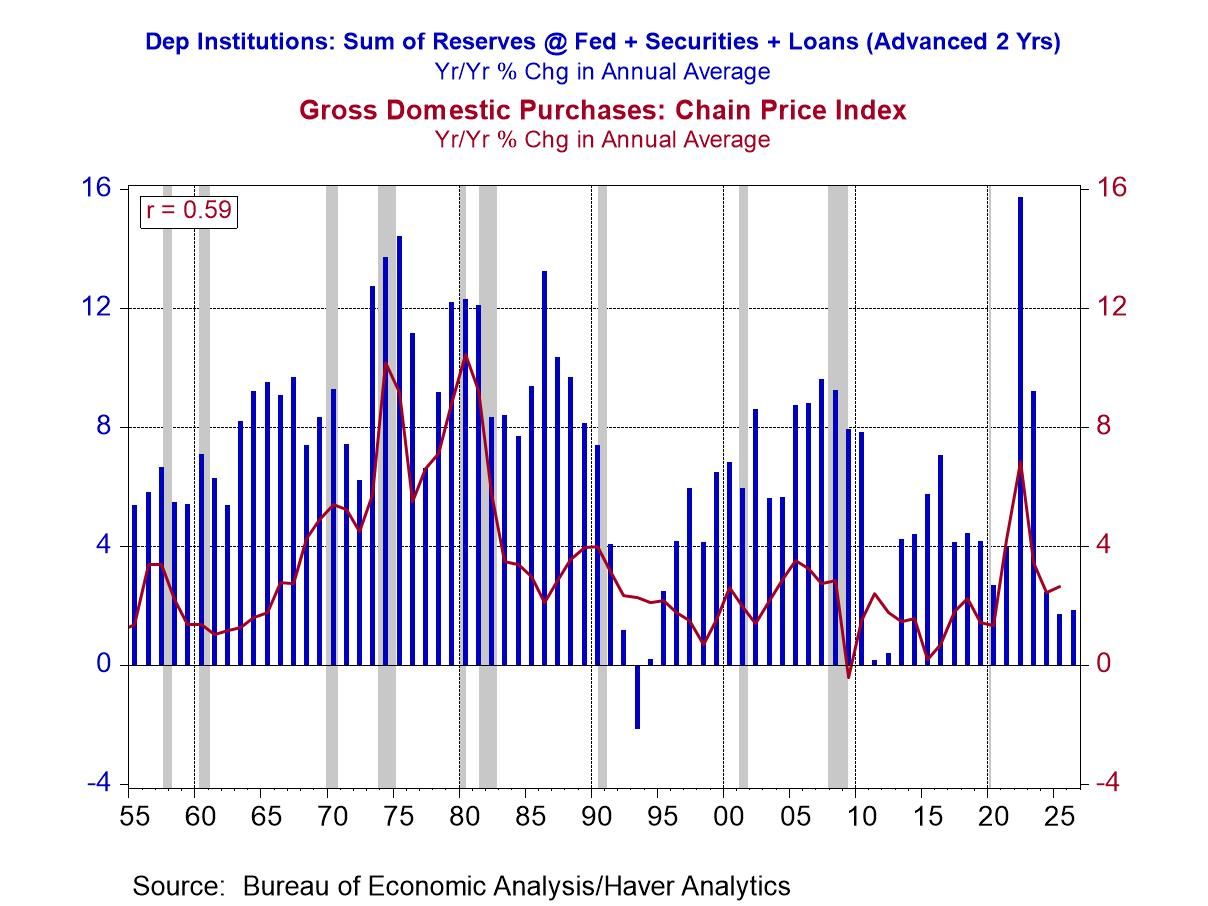
Plotted in Chart 2 are the year-over-year percent changes in the annual averages of the sum of depository institution reserves at the Federal Reserve, securities and loans (the blue bars) and the year-over-year percent changes in the average annual averages of chain-price index of Gross Domestic Purchases (the red line). The highest correlation, 0.59, between these two series starting with 1955 data occurs when thin-air credit is advanced by two years. So, what happens to thin-air credit this year has its largest impact on inflation two years later.
Chart 2
For those who have not read some of my prior commentaries, let me briefly explain the concept of “thin-air” credit and its implications. When the Federal Reserve purchases, say, $100 million of securities from the market, the asset item on the Fed’s balance sheet, securities, increases by $100 million, matched by an increase in the liability item, reserves at depository institutions, by $100 million. For the depository institution system, its asset item, reserves at the Fed, increases by $100 million and its liability item, customer deposits, increases by $100 million. Where did the Federal Reserve obtain the funds to purchase $100 million of securities? Figuratively, out of “thin air”. The Federal Reserve, in effect, “printed” $100 million. If the depository institution system increases its loans by $900 million, changes in the depository institution system’s balance sheet are an increase in the asset item, loans, by $900 and an increase in the liability item, customer deposits, by $900 million. Where did the depository institution system get the funds to make $900 million of loans? Figuratively, out of “thin air”. The depository institution system created $900 million of credit figuratively out of thin air. There are rare exceptions, but most entities take out loans to increase their current spending. That spending can take the form of newly-produced goods and services, previously existing goods and/or newly-issued/previously-issued financial securities (equities, bonds, crypto currency). Nominal Gross Domestic Purchases measures the nominal dollar amounts of expenditures on newly-produced goods/services. I am unaware of any aggregate measure of expenditures on previously-produced goods or financial instruments. This is why I believe that the correlation between percent changes in thin-air credit and changes in nominal Gross Domestic Purchases is less than1.0. Similarly, I am unaware of any aggregate measure of prices that would include the prices of financial assets or previously-produced goods. Again, this is why I believe that the correlation between percent changes in thin-air credit and the chain-price index of Gross Domestic Purchases is less than 1.0. I wish some enterprising econ/finance PhD candidate would write a thesis on creating aggregate measures of total nominal spending (transactions) and an aggregate price index that includes the prices of financial/nonfinancial assets and previously-produced commodities. As an aside, I suspect that when the Federal Reserve engages in massive amounts of securities purchases (Quantitative Easing), subsequent transactions in financial assets and their prices are greater than transactions involving goods and services and their prices. The reason I suspect this is that the ultimate sellers of securities to the Federal Reserve are inclined to replace those sold securities with other securities. Again, this could be a topic for a PhD candidate.
As I have noted in previous commentaries, the uniqueness of thin-air credit is that the recipients of thin-air credit are able to increase their current spending whilst no other entity need reduce its current spending. This is not generally true with respect to non-thin-air credit. Because lenders other than the Federal Reserve and the depository institution system are unable to create credit figuratively out of thin air, these lenders generally have to reduce their current spending, i.e., increase their current saving, in order to transfer spending power to borrowers. Thus, when non-thin-air credit is granted, there is no net increase in aggregate spending. The exception to this is if the non-thin-air credit lender runs down its deposit holdings when extending credit. This is the equivalent of an increase in the velocity of deposits.
From 1955 through 2025, the compound annual growth in real Gross Domestic Purchases has been 3.0 percent. I do not know how the Federal Reserve decided that 2 percent annual inflation should be the goal. But let us accept it and let us stipulate that the price index that should grow at a 2 percent annualized growth is the Gross Domestic Purchase chain-price index (all items). This would give us a target rate of growth in nominal Gross Domestic Purchases of 5 percent annualized. In the 70 years ended 2025, nominal Gross Domestic Purchases grew at a compound annualized rate of 6.35%. During this same period, the compound annualized growth in thin-air credit was 6.90 percent. Not one-for-one, but perhaps close enough for government work. So, if the Fed accepted a growth target of 5 percent annually for nominal Gross Domestic Purchases, an annual growth target for thin-air credit of around 5-1/2 percent ((5.0 + (6.90 – 6.35) = 5.55)) would seem appropriate. I am sure that one of Fed Chairman Warsh’s ace task forces could refine this.)
The Fed would not control the quantity of thin-air credit by direct targeting of the federal funds rate. Rather, the Fed would re-introduce reserve requirements on depository institutions – not on their deposits, but rather on the sum of their holdings of securities and loans. (Interest payment on reserves would be eliminated. For a discussion of the folly of paying interest on reserves, see my commentary “Want to Reduce the Size of the Fed’s Balance Sheet? Eliminate Interest Paid on Reserves”.) The reserves the Fed provided in week one would determine the maximum amount of loans and securities that the depository system could hold in week two. This is similar to the money-multiplier that Money and Banking 101 students were supposed to learn and discussed by Robert D. Laurent, my former colleague at the Federal Reserve Bank of Chicago, in a 1979 Journal of Money, Credit and Banking article entitled “Reserve Requirements: Are They Lagged in the Wrong Direction?” The Fed’s precise control of thin-air credit would result in weekly volatility in the federal funds rate and more volatility in interest rates at the short end of the yield curve. Assuming, which I do, that a steady rate of growth in thin-air credit would reduce the volatility in the growth of nominal Gross Domestic Purchases and would result in the Fed achieving its inflation target more consistently than it does under a federal-funds targeting operating procedure, increased interest-rate volatility would seem to be a small price to pay.
What if 5-1/2 percent is the “incorrect” annual growth rate for thin-air credit? What if the “correct” growth rate were instead 4-1/2 percent. In this case, if the Fed were to persist with 5-1/2 percent thin-air credit growth, the worst that would happen is that the inflation would settle in at some steady rate higher than 2 percent. But, the inflation rate would not persistently move higher and higher. Contrast this with a federal funds rate target set too low. In this case, the inflation rate would continually move higher and higher. This was pointed out by Larry R. Mote, yet another former colleague of mine at the Federal Reserve Bank of Chicago (I was blessed by being surrounded by some brilliant economists at the Chicago Fed) in a 1988 commentary “Looking Back: The Use of Interest Rates in Monetary Policy”.
What would happen if the Fed were achieving 5-1/2 percent growth in thin-air credit (which it would be doing if it made the changes in reserve accounting discussed above) and a negative shock to aggregate supply were to occur? Immediately, the inflation rate would spike up and growth in real aggregate supply would decline. But because growth in nominal aggregate demand would not change, the inflation rate would, with a lag, move back down to its pre-shock rate. Households and businesses would spend more of their nominal incomes on the goods/services that increased in price because of the negative supply shock, leaving less nominal income to spend on other goods/services. This would induce a decline in the prices (or a diminution in their rate of increase), which would return overall inflation to its pre-shock rate.
What would happen if artificial intelligence were to result in a permanent increase in the rate of productivity growth and thin-air credit were to continue to grow 5-1/2 percent annually? Growth in real GDP and real aggregate spending on goods and services would be higher and inflation lower. Would this be a bad thing?
I am a big believer in “first, do no harm” when it comes to monetary policy. I also agree with Fed Chairman Warsh that the Fed talks too much (see my commentary “Festivus 2022: I Gotta Lotta Problems with You People at the Fed ‘cause You Talk too Much”). So, I present to Fed Chairman Warsh a modest proposal. Have the FOMC operate such that the sum of depository institution reserves at the Fed plus depository institution holdings of securities and loans grow at a steady annualized rate of 5-1/2 percent. If Warsh’s brain trust believes that a different rate of growth in thin-air credit would be more appropriate, go for it. In the immortal words of my 11-year-old grandson when I told him I was about to embark on sailing voyage across Lake Michigan: “Papa, what could go wrong?”

Paul L. Kasriel
AuthorMore in Author Profile »Mr. Kasriel is founder of Econtrarian, LLC, an economic-analysis consulting firm. Paul’s economic commentaries can be read on his blog, The Econtrarian. After 25 years of employment at The Northern Trust Company of Chicago, Paul retired from the chief economist position at the end of April 2012. Prior to joining The Northern Trust Company in August 1986, Paul was on the official staff of the Federal Reserve Bank of Chicago in the economic research department. Paul is a recipient of the annual Lawrence R. Klein award for the most accurate economic forecast over a four-year period among the approximately 50 participants in the Blue Chip Economic Indicators forecast survey. In January 2009, both The Wall Street Journal and Forbes cited Paul as one of the few economists who identified early on the formation of the housing bubble and the economic and financial market havoc that would ensue after the bubble inevitably burst. Under Paul’s leadership, The Northern Trust’s economic website was ranked in the top ten “most interesting” by The Wall Street Journal. Paul is the co-author of a book entitled Seven Indicators That Move Markets (McGraw-Hill, 2002). Paul resides on the beautiful peninsula of Door County, Wisconsin where he sails his salty 1967 Pearson Commander 26, sings in a community choir and struggles to learn how to play the bass guitar (actually the bass ukulele). Paul can be contacted by email at econtrarian@gmail.com or by telephone at 1-920-559-0375.
 Global