

U.S. Treasury Yields and Oil Prices
|in:Viewpoints
10-year Treasury yields averaged 4.2% in the 12 months ending February 2026. They now hover near 5%, a significant increase. Besides higher oil prices, several explanations are plausible. Real rates have risen associated with the sustained healthy economic growth and higher expected rates of return on investment, particularly reflecting the booming AI buildout that is involving more debt financing. Inflationary expectations have remained generally well-anchored, but market-based measures have risen a few tenths of a percent. And the persistence of budget deficits and projections of ever-rising government debt-to-GDP may be exerting pressure on yields.
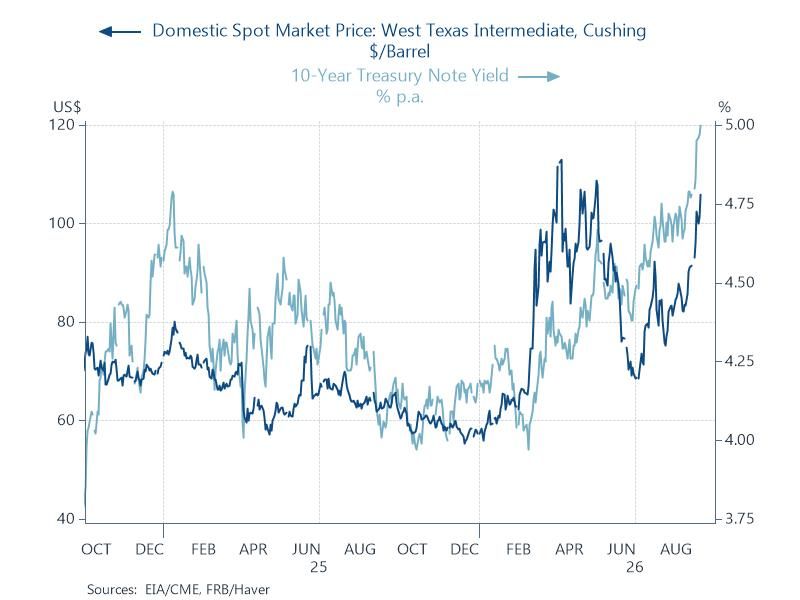
This note focuses on oil prices and yields. As a temporary negative supply shock to the economy, the higher oil prices are supposed to hurt economic activity which may be associated with lower real rates and are not supposed to impact intermediate and longer-run inflationary expectations. But Chart 1 shows convincingly that short-run movements in WTI oil spot prices (measured in 21-day changes in dollar-per barrel) and 10-year Treasuries (21-day percentage point changes) have been very closely correlated since end of February 2026 when the bombing in Iran commenced. Chart 2 shows that the levels of the Treasury yields and oil prices.
WTI rose dramatically from $65/barrel end-of February to the high-$90s end-of-March, bounced around and rose to $108 in May and plummeted to $70 in early July during the temporary ceasefire and then ratcheted up during the summer to its current above $102. Treasury bond yields rose and fell and rose again with these fluctuations.
Chart 1. 10-Year Treasury Yields and WTI Oil Prices
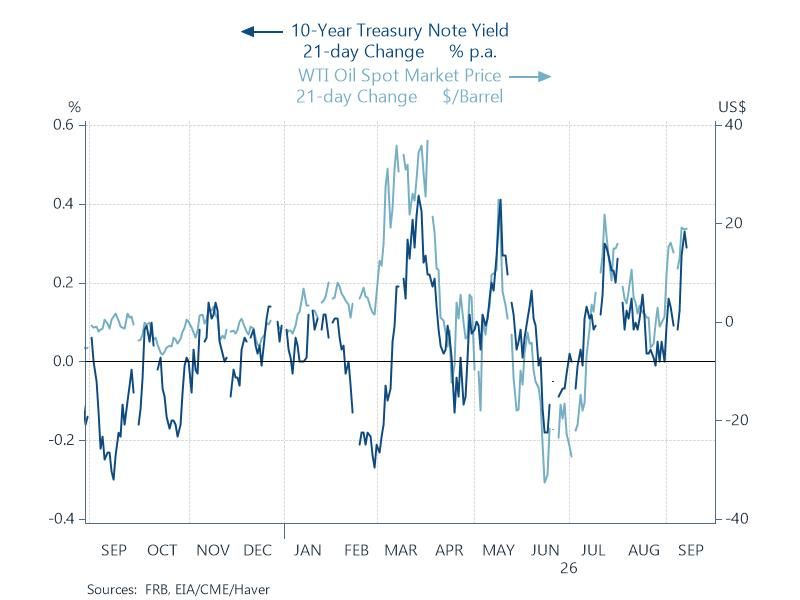
Chart 2. 10-Yr US Treasury Yield and WTI Oil Prices
This note is not to understate my serious concerns about the mounting budget government debt, its plausible impact on interest rates that raises debt service costs, and how the persistent deficit spending is allocating national and financial resources and adversely affecting economic activity. Rather it highlights the sizable impacts the higher oil prices associated with the war in Iran have on treasury yields. A resolution of the Iran war that brings down oil prices would materially lower Treasury yields.

Mickey D. Levy
AuthorMore in Author Profile »Mickey Levy is a macroeconomist who uniquely analyzes economic and financial market performance and how they are affected by monetary and fiscal policies. Dr. Levy started his career conducting research at the Congressional Budget Office and American Enterprise Institute, and for many years was Chief Economist at Bank of America, followed by Berenberg Capital Markets. He is a Visiting Fellow at the Hoover Institution at Stanford University and a long-standing member of the Shadow Open Market Committee.
Dr. Levy is a leading expert on the Federal Reserve’s monetary policy, with a deep understanding of fiscal policy and how they interact. He has researched and spoken extensively on financial market behavior, and has a strong track record in forecasting. Dr. Levy’s early research was on the Fed’s debt monetization and different aspects of the government’s public finances. He has written hundreds of articles and papers for leading economic journals on U.S. and global economic conditions. He has testified frequently before the U.S. Congress on monetary and fiscal policies, banking and credit conditions, regulations, and global trade, and is a frequent contributor to the Wall Street Journal.
He is a member of the Council on Foreign Relations and the Economic Club of New York, and previously served on the Panel of Economic Advisors to the Federal Reserve of New York, as well as the Advisory Panel of the Office of Financial Research.
Dr. Levy holds a Ph.D. in Economics from University of Maryland, a Master’s in Public Policy from U.C. Berkeley, and a B.A. in Economics from U.C. Santa Barbara.
 Asia
Asia