

 Global| Aug 18 2026
Efforts to Mitigate Military Risk Have Unintended Consequences
The world has become more fragmented politically in the past decade, which has heightened global risk and uncertainty. The diminished sense of security has caused many countries to increase military spending. While this may be a rational response for individual countries, collectively, the rise in military spending has been alarming and seems to be leading the world toward even more risk and uncertainty. This in turn may feed the need for more security. In addition, the devotion of so much of the world’s resources to military spending may be damaging for the global economy.
According to the Stockholm International Peace Research Institute (SIPRI), world annual military expenditure reached $2.8 trillion (in constant 2024 terms) in 2025. That figure represented a 41 percent increase in the past ten years. However, half of that rise occurred in the past three years. We looked at the SIPRI Military Expenditure dataset (available in Haver’s GLSECTOR database) to understand how and why military spending is changing across countries and regions.
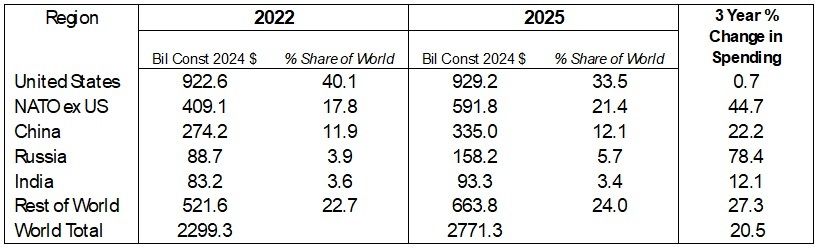
Worldwide gains in military spending The rise in military spending has been widespread. Between the years 2022 and 2025, 45 of the top 50 countries in terms of military spending posted increases, with an average gain among that group of 41.8 percent. NATO spending (excluding the US) jumped by 44.7 percent, while non-NATO military spending increased by 29.2 percent.
Surprisingly, US military spending was essentially flat during this time. As a result, US military spending declined as a share of world spending by 6.6 percentage points to 33.5 percent. However, the Trump Administration has proposed a $1.5 trillion military budget for 2027, a roughly 60 percent increase from the 2025 spending listed in Figure 1. If that budget is enacted, then in 2027 the US's increase alone would be equivalent to 20 percent of 2025's entire world total. And we know that other countries both in NATO and Asia are ramping up spending as well.
Figure 1: Select Country and Region Military Spending
Spotlight on Europe The most notable trend in these data has been the meteoric rise in military spending in Europe since the start of the Russia-Ukraine War. As the chart shows, European military spending has nearly doubled since before the war, in 2021. At first, spending by Russia and Ukraine skyrocketed. But since then, the rest of Europe (essentially the European NATO countries) has been ramping up military spending as well (see Figure 2).
Figure 2: Military Spending in Europe in Billions of Const 2024$
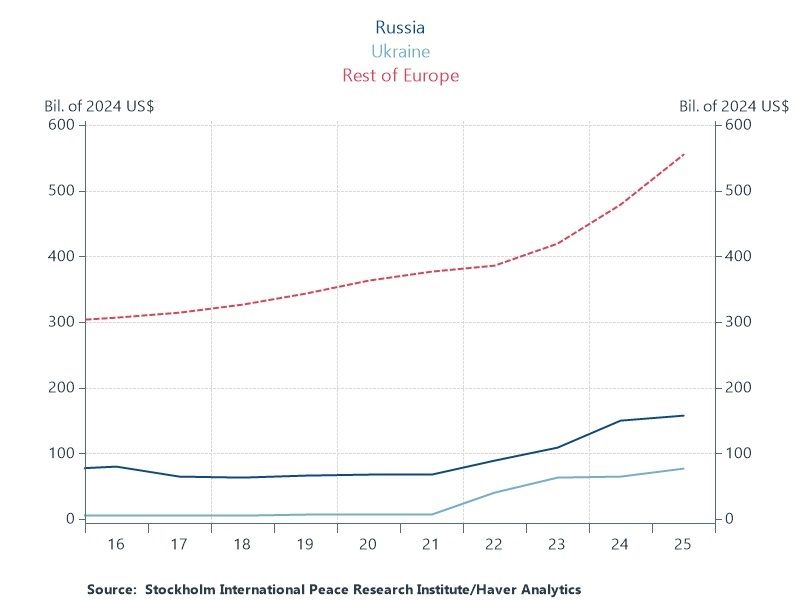
The notable increase in spending by European NATO nations has accounted for 39 percent of the global rise from 2022 to 2025. More recently, partly as a result of a push from President Trump at the start of his second term in 2025, NATO committed to a new defense investment plan. NATO members agreed to increase their military expenditures to 5 percent of GDP annually on core defense requirements (3.5 percent) as well as defense and security related spending (1.5 percent) by 2035. This is a significant increase from their previous target of 2 percent of GDP.
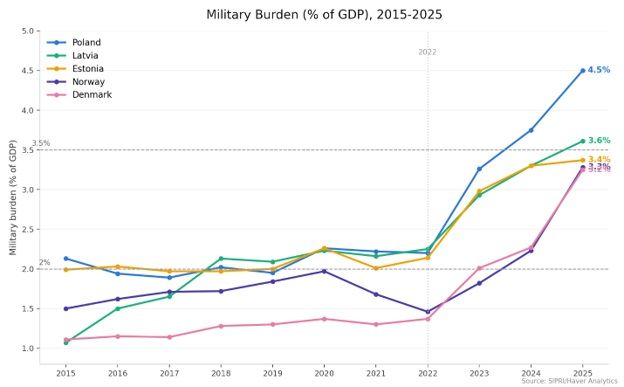
The rise in military spending as a percent of GDP has already begun in parts of Europe, especially among those countries that that feel vulnerable to Russia. As of 2025, the highest military burden among NATO members has been taken on by Poland (4.5 percent), Latvia (3.6 percent), Estonia (3.4 percent), Norway (3.3 percent) and Denmark (3.3 percent) (see Figure 3). All of these countries share a border with Russia, except for Denmark, which is boosting spending to shore up vulnerabilities in Greenland.
While Eastern Europe is taking on the larger relative economic burden, Western Europe still pays the larger bill. In absolute terms, Germany, United Kingdom, France and Italy account for 20 percent of NATOs spending at $304.7 Billion (in constant 2024 terms). Meanwhile, Russia and Ukraine have military burdens of 7.5 percent and 39.5 percent of their respective GDPs.
Figure 3: Select European NATO Military Burdens
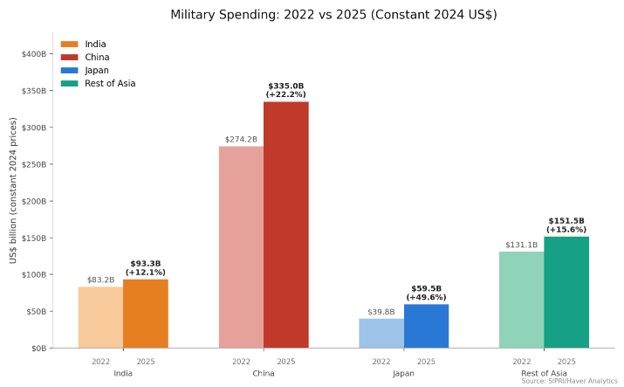
A closer look at Asia NATO is not the only set of countries ramping up military spending. From 2022 to 2025, Chinese military expenditures have increased by 22.2 percent, focused on modernization and its regional claims. India has seen steady growth amounting to a 12.1 percent increase over the same time. India is motivated by dual-front deterrence on its borders with China and Pakistan. Adding to that is India’s self-reliance initiative (Atmanirbharta in Defense), which aims to harness domestic defense production, increase R&D, and reduce imports.
Meanwhile Japan saw the largest military spending increase in Asia, rising 49.6 percent. It contends with growing concerns about China’s strategic dominance, escalating tensions over Taiwan, and North Korean missile tests. Japan also announced a policy change in December 2022 to increase defense spending from its historical level of around 1 percent of GDP to 2 percent by FY2027, supported by a ¥43 trillion five-year defense spending plan. The rest of Asia followed suit, by increasing spending by 15.6 percent (see Figure 4).
Figure 4: Asian military spending
Possible effects on the global economy The recent rise in military spending could lead to even more military spending as perceived risks escalate. At the same time, the sharp increase in resources devoted to military around the world could well have deleterious effects on the global economy. Unless governments cut spending elsewhere, which seems unlikely, global government budgets will command an increasing share of economic output, leaving the private sector with a smaller share. This could hinder productivity growth and limit living standards.
Importantly, increased borrowing for military purposes means that these governments are dissaving at a much higher rate. At a time when borrowing needs are already skyrocketing as a result of the surge in AI investment, the drain on savings posed by rising military spending may pressure the investment-saving balance even more. The savings used to finance the AI investment has to come from somewhere. The combination of increased investment and drains on savings could in turn push global interest rates higher. The recent rise in global yields may partly reflect this pressure.
European countries may feel an economic pinch from the dramatic rise in military spending, especially countries bordering Russia. Take Poland for example. Its military burden sits at 4.5 percent in 2025, financed in part through a budget deficit of roughly 7 percent of GDP. Debt-to-GDP has risen from 48.8 percent to 59.7 percent between 2022 and 2025. As a result, Moody's and Fitch Ratings have changed their outlook on Polish sovereign debt to negative while affirming their long-term ratings. Rising military spending in the Baltics is adding to fiscal deficits, albeit on a smaller scale. The question is whether the attendant strains on finances ends up creating new economic problems in Europe and elsewhere.

Peter D'Antonio
AuthorMore in Author Profile »Peter started working for Haver Analytics in 2016. He worked for nearly 30 years as an Economist on Wall Street, most recently as the Head of US Economic Forecasting at Citigroup, where he advised the trading and sales businesses in the Capital Markets. He built an extensive Excel system, which he used to forecast all major high-frequency statistics and a longer-term macroeconomic outlook. Peter also advised key clients, including hedge funds, pension funds, asset managers, Fortune 500 corporations, governments, and central banks, on US economic developments and markets. He wrote over 1,000 articles for Citigroup publications. In recent years, Peter shifted his career focus to teaching. He teaches Economics and Business at the Molloy College School of Business in Rockville Centre, NY. He developed Molloy’s Economics Major and Minor and created many of the courses. Peter has written numerous peer-reviewed journal articles that focus on the accuracy and interpretation of economic data. He has also taught at the NYU Stern School of Business. Peter was awarded the New York Forecasters Club Forecast Prize for most accurate economic forecast in 2007, 2018, and 2020. Peter D’Antonio earned his BA in Economics from Princeton University and his MA and PhD from the University of Pennsylvania, where he specialized in Macroeconomics and Finance.

Shashwat Indeevar
AuthorMore in Author Profile »Shashwat Indeevar is a Senior Economic Data Manager at Haver Analytics, where he has been part of the Research Team since 2017, working in both the New York and London offices. He focuses on the organization and presentation of large-scale datasets, the improvement of database-building processes, and the management of daily workflow. His economic research interests include global energy use, environmental sustainability, and artificial intelligence.
He holds a Master of Science in Management of Technology from New York University, where he studied finance, economics, and operations management. He also earned a Bachelor of Engineering in Electronics and Communications from Panjab University, India.