Global| Aug 18 2026
ZEW Survey Shows Some Stability and Improvement
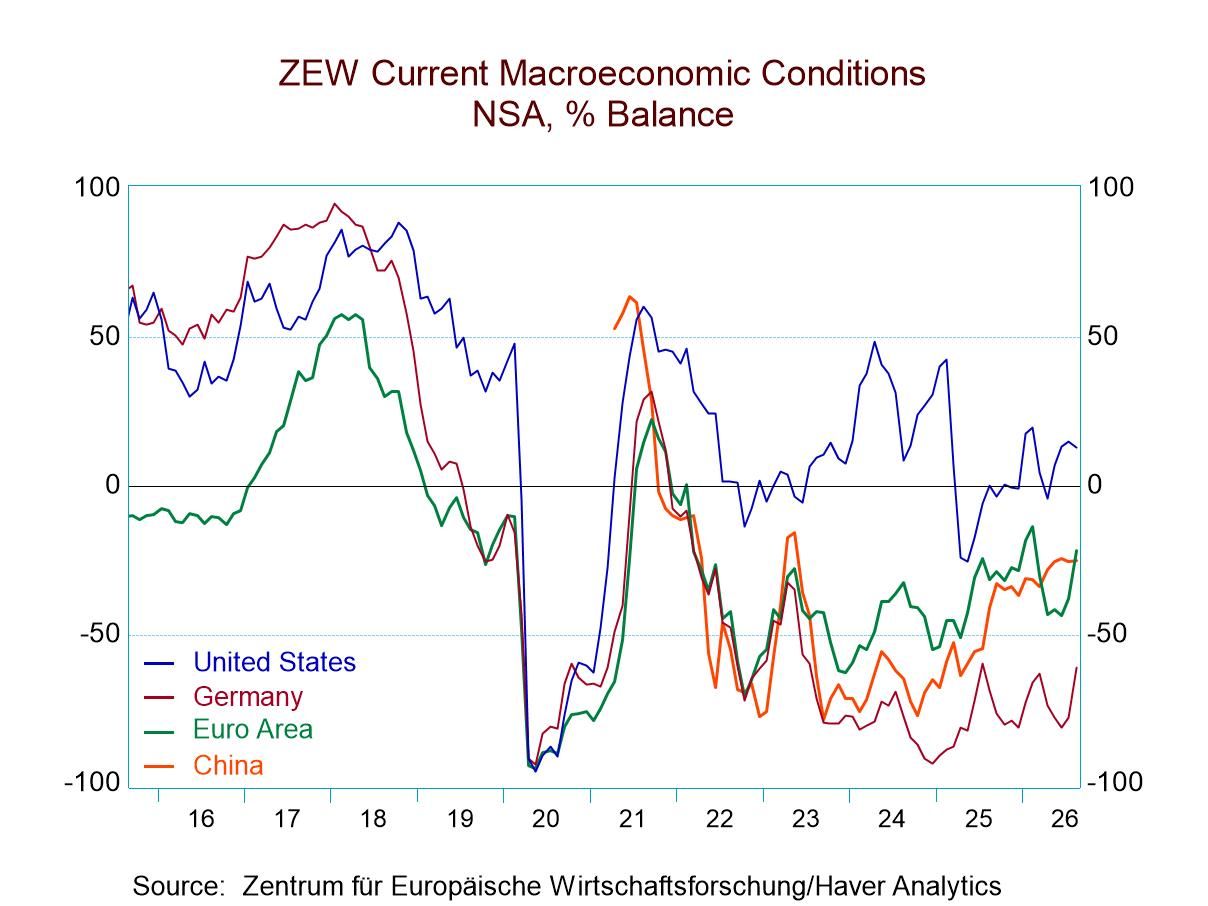
The Economic Situation: This month the ZEW series from German financial experts shows improving economic situations. Two of the four featured economies improve: the euro area improves to a reading of -21.5 in August from -37.7 in July, and the German economy advances to -61.1 from -77.6. The U.S. worsens to a reading of 12.9 in August from 14.9 in July, and the Chinese assessment is nearly unchanged at -25.1 in August compared to -25.2 in July. Apart from these diffusion readings and quite different from the diffusion readings is the Chinese ranking in a top position with a 73.8 percentile standing. The euro area has a 56.6 percentile standing. The U.S. has a 41.7 percentile standing. Germany has a 30.9 percentile standing. Only China and the euro area have standings above the 50th mark, which place them above their historic medians for their respective periods.
Macroeconomic expectations: Macroeconomic expectations are provided for the country-level readings for Germany, the U.S., and China. All three countries make an improvement in August, with the largest improvement coming from Germany and the smallest improvement coming in China. The standings show that, in terms of macroeconomic expectations, Germany’s economy has a 58.8 percentile standing, the U.S. has a 48.2 percentile standing, close to its median but below it, and China has a 41.5 percentile standing.
Inflation expectations: The inflation expectations poll in August compared to July shows all countries with a drop off, including large drop-offs, in inflation concerns. Euro area expectations fall to 2.4 in August from 10.4 in July. In Germany, that expectation falls to a net diffusion reading of 1.8 from 14.9 in July. There is a sizeable drop off in China too, which logs 5.3 in August compared to 12.9 in July. The U.S. improvement is smaller at 11.8, down from 15.0 in July. While the diffusion readings are different across these countries, the percentile standings are fairly similar. The euro area, Germany, and China all have percentile standings in the range of roughly 36th to 38th percentile, while the U.S. percentile standing is lower at its 26th percentile. Despite what we are seeing in markets, the ZEW experts are undeterred in their inflation outlooks.
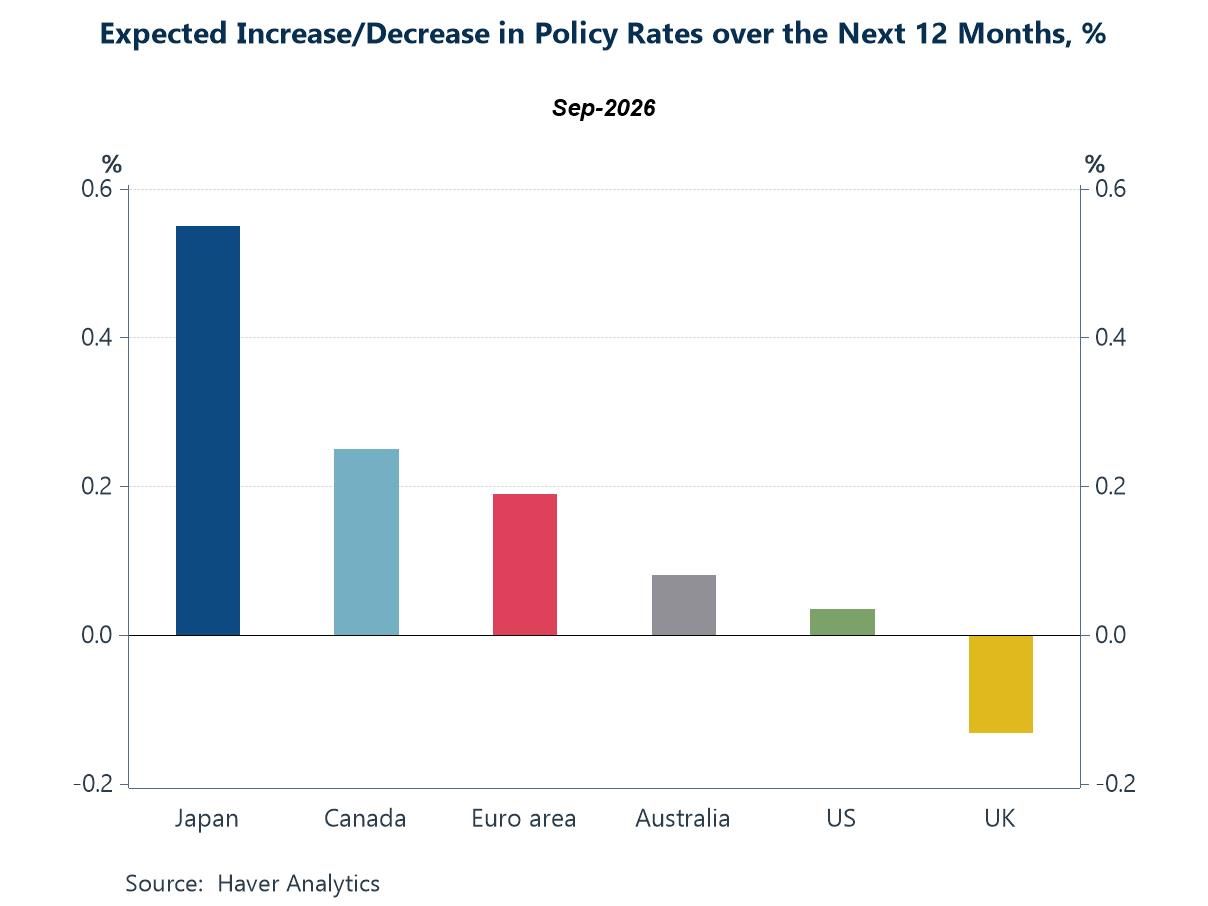
Expectations for short-term rates: Short-term interest rate expectations don't change in the euro area. There is some further backing off in the U.S. and substantial downshifting in China where there's a sign change to -2.1 in August from plus 8.8 in July. In August, the euro area has a nearly 80th percentile standing for its diffusion value. The U.S. has a slightly below-median 48th percentile standing, and China has a slightly above median standing at its 52nd percentile.
Long-term rates moderate: Long-term interest rate expectations show some moderation in August to pair with moderate queue standings. Germany falls to 24.2 in August from 27.7 in July, the U.S. steps back to 27.7 from 30.8 in July, and China backs down to a diffusion value of 12.3 from 17.0 in July. Germany and the U.S. have rankings around their 33rd percentile mark, while China has a ranking around its 55th percentile mark. Despite the lower diffusion reading, Chinese long-term rate expectations are high relative to historic experience in relation to the U.S. and Germany.
Upbeat on Stocks: One interesting feature is the positive outlook on stocks in August, with all four responding areas, the euro area, Germany, the U.S., and China, logging diffusion values close to 40. These are up from readings that were bunched around the 20 to 25 diffusion mark in July. Despite the clustering of the diffusion values, the queue percentile standings vary quite a lot. For China, the current reading, which is the weakest diffusion reading for stocks in the table of the four, has a 92.3 percentile standing. The U.S. has a 74.4 percentile standing, and the euro area has a 59.3 percentile standing. Germany has the lowest percentile standing, just below its median at a 49.7 percentile mark.
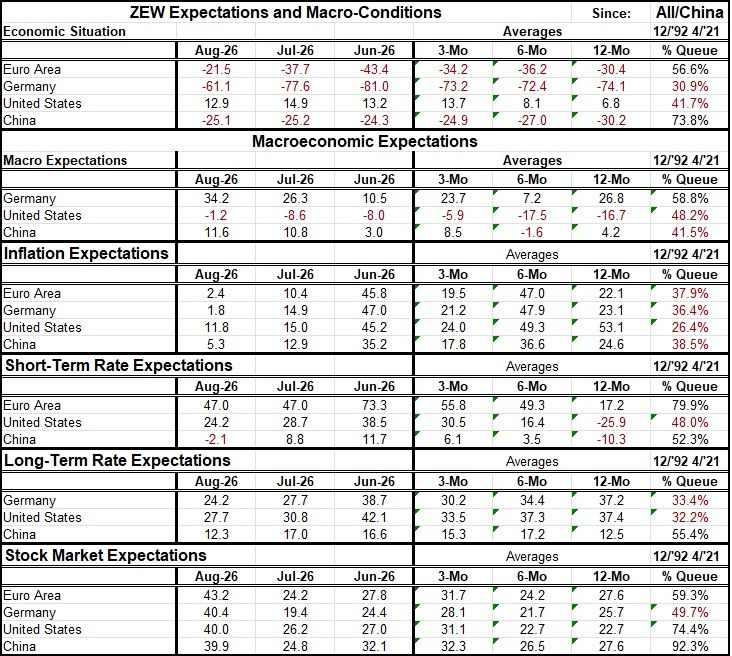
The ZEW experts seem to be expecting a greater prospect of short-term interest rate increases based on the queue standings they report this month. Inflation expectations are relatively low by historic standards; however, that doesn't mean that interest rates can't or won't increase. Long-term interest rates seem to be in a pretty good spot, with 33rd percentile standings, except for the higher standing in China. All around, the ZEW experts are quite upbeat on the prospects for stocks that are well-supported by the low queue standings for things like short-term rate expectations, inflation expectations, and stable readings particularly in Germany and the U.S. for long-term interest rates. These expectations are particularly helpful in terms of the outlook for the stock market.

Robert Brusca
AuthorMore in Author Profile »Robert A. Brusca is Chief Economist of Fact and Opinion Economics, a consulting firm he founded in Manhattan. He has been an economist on Wall Street for over 25 years. He has visited central banking and large institutional clients in over 30 countries in his career as an economist. Mr. Brusca was a Divisional Research Chief at the Federal Reserve Bank of NY (Chief of the International Financial markets Division), a Fed Watcher at Irving Trust and Chief Economist at Nikko Securities International. He is widely quoted and appears in various media. Mr. Brusca holds an MA and Ph.D. in economics from Michigan State University and a BA in Economics from the University of Michigan. His research pursues his strong interests in non aligned policy economics as well as international economics. FAO Economics’ research targets investors to assist them in making better investment decisions in stocks, bonds and in a variety of international assets. The company does not manage money and has no conflicts in giving economic advice.
More Economy in Brief