Asia| Oct 05 2026
Economic Letter from Asia: Food for Thought
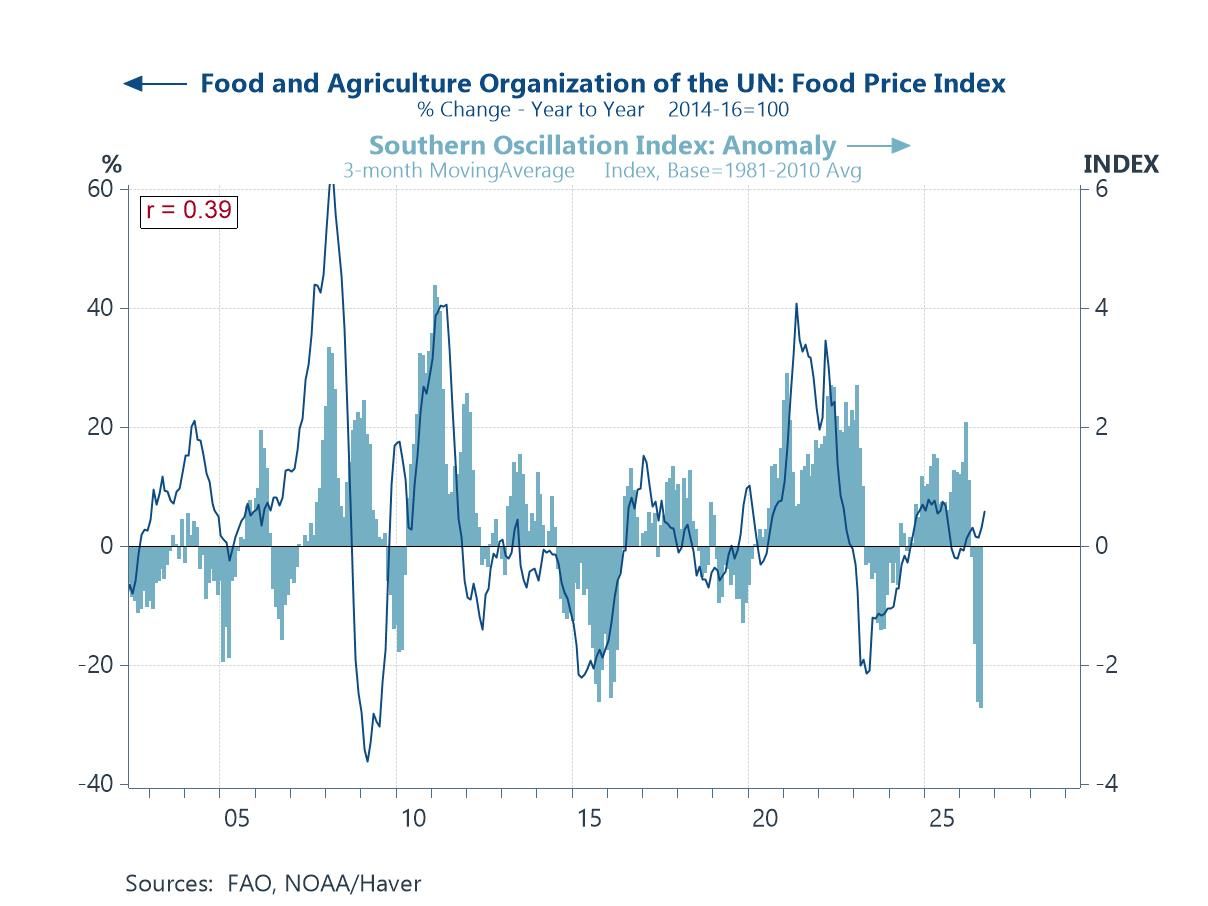
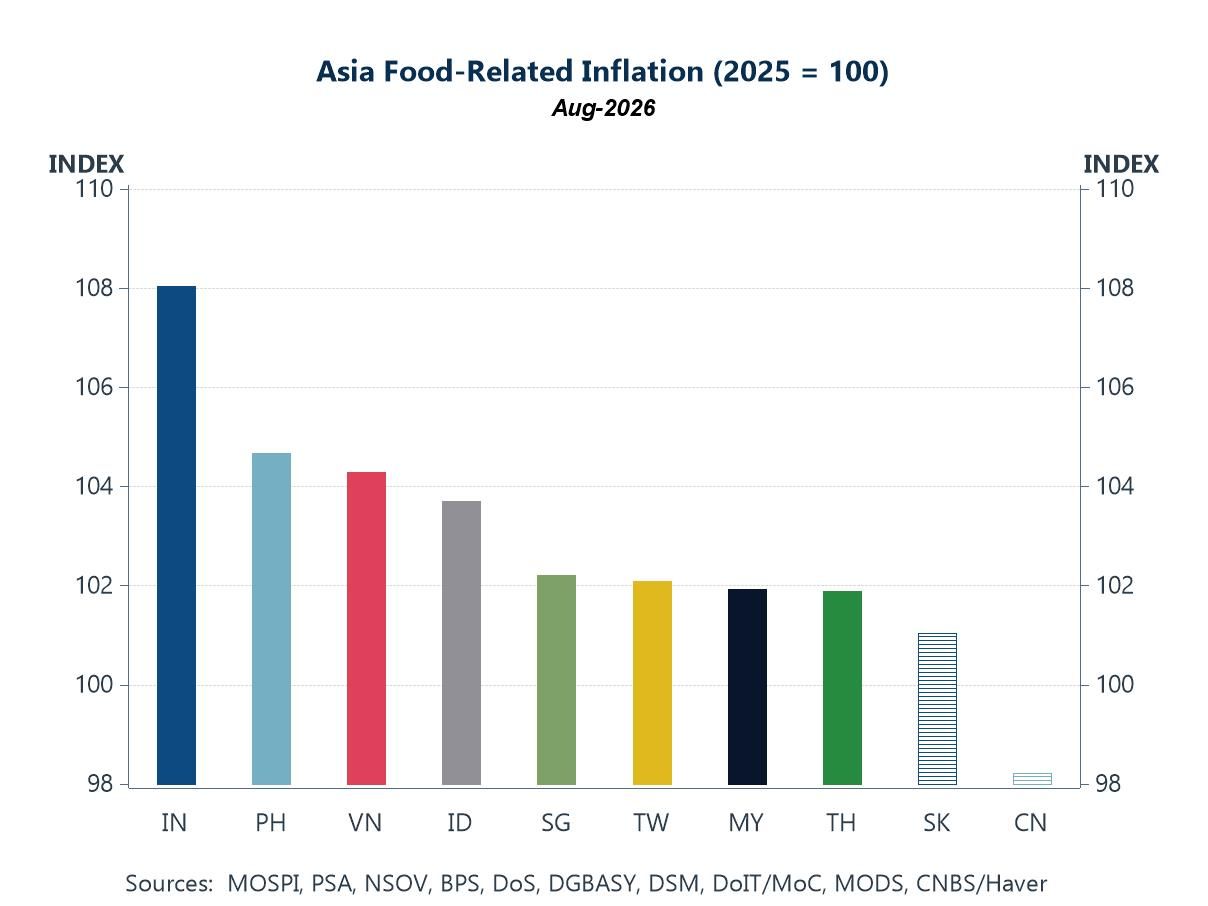
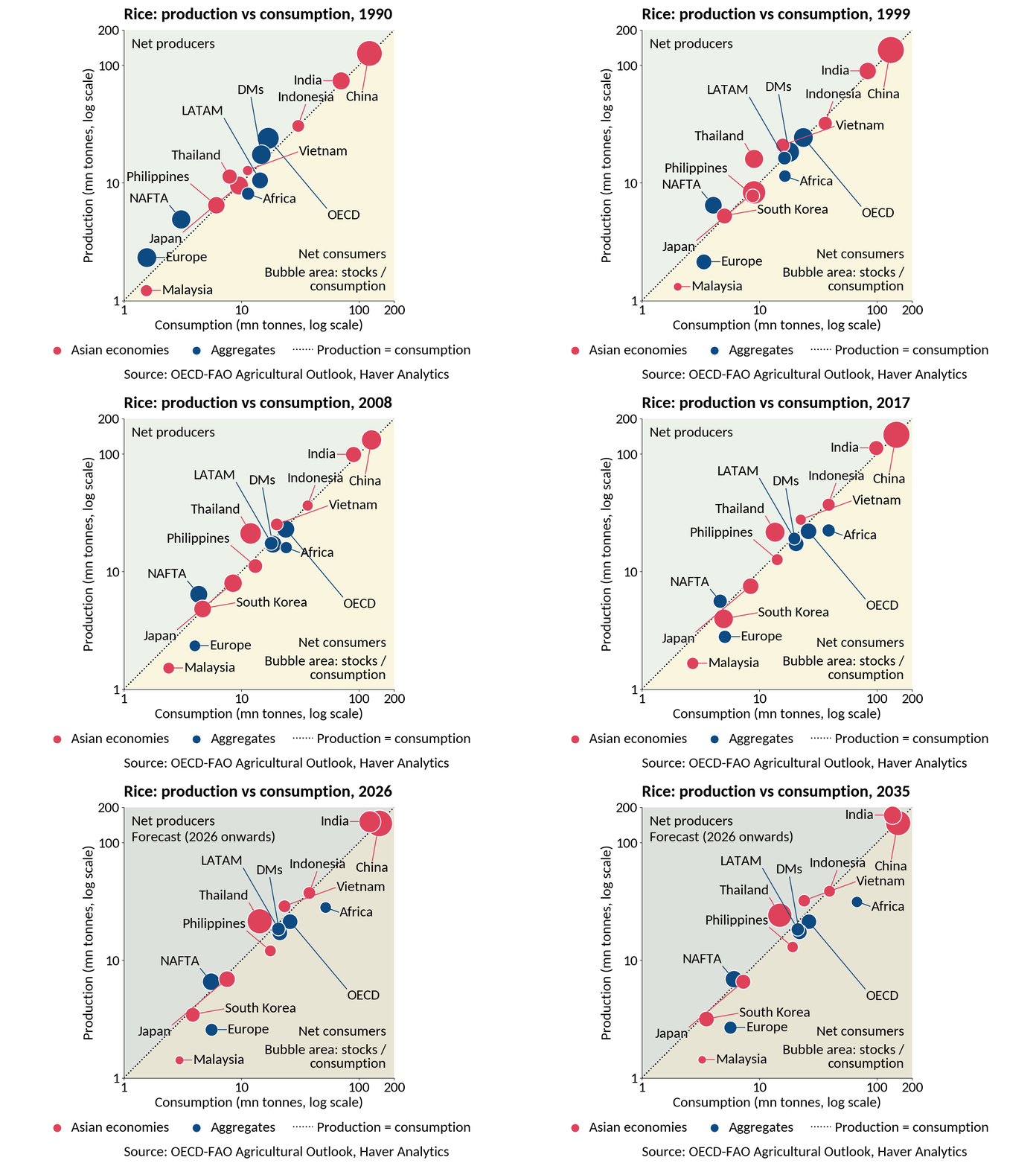
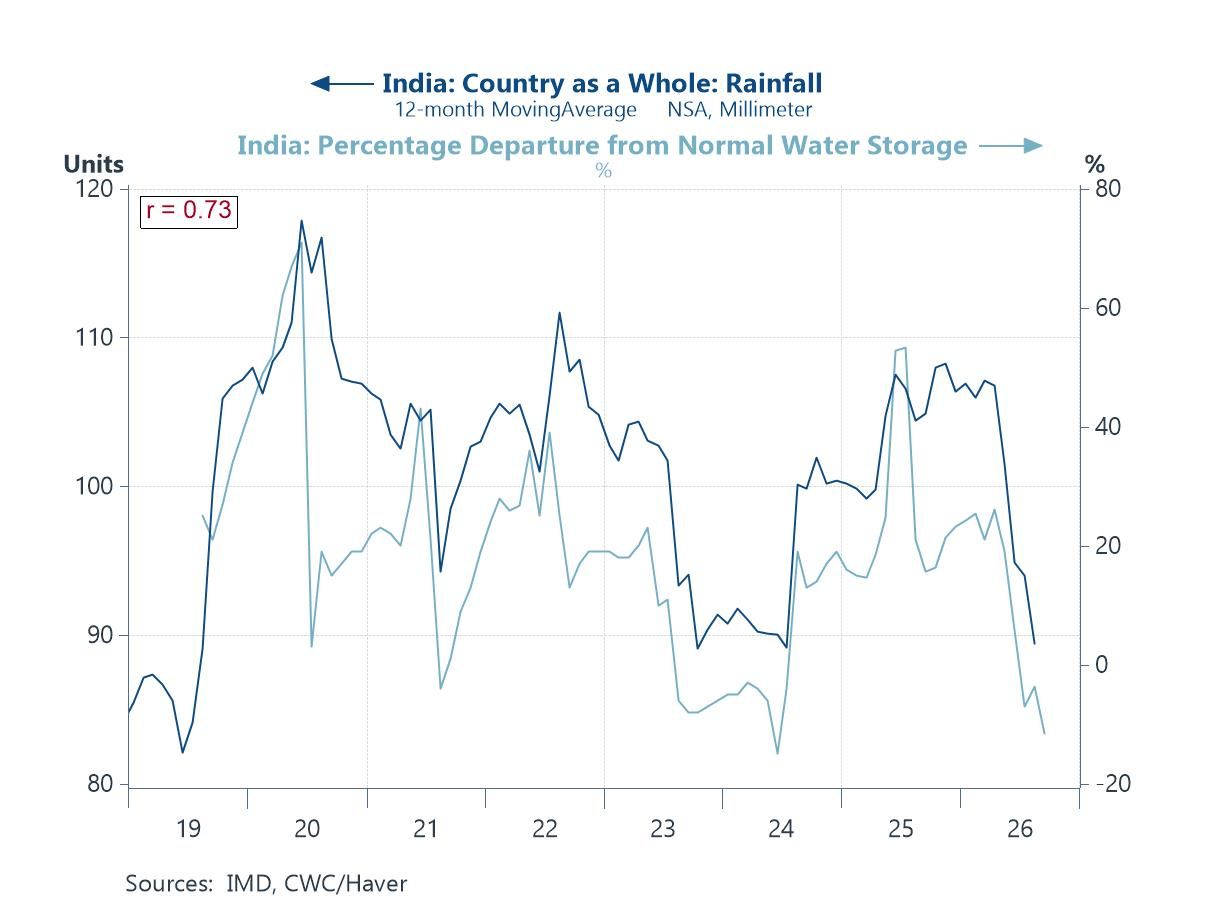
In this week's Letter, we examine how a strengthening El Niño is adding a food and weather shock to an Asia already absorbing an oil shock. El Niño is now in full swing, with the Southern Oscillation Index at its lowest in over two decades, and its fullest effects may only arrive next year (chart 1). Food prices are already turning up, and food price levels have risen most in India, the Philippines, Vietnam and Indonesia (chart 2). That adds a second source of inflation on top of the oil price surge that followed the disruption of shipping through the Strait of Hormuz. On the supply side, drought is hurting rice producers just as fuel and fertiliser costs climb, raising the risk of a significant negative supply shock. The most exposed are net rice consumers with thin stocks, such as the Philippines (chart 3). India shows how quickly conditions can deteriorate: its monsoon ended with its largest deficit since 2015, and reservoir storage has slipped below normal (chart 4). The effects reach beyond food. Drier conditions have fed peat and forest fires in Indonesia, pushing Singapore's air quality into the unhealthy range for the first time since 2023 (chart 5). For policymakers, El Niño adds food security, water security and inflation management to a list already crowded by the energy shock and geopolitics. The most agriculture-reliant economies, India, Indonesia and Vietnam, face a double hit to growth and prices (chart 6). Should food inflation force central banks to tighten further, the growth cost would rise again.
El Niño and food prices El Niño is now in full swing. The Southern Oscillation Index has plunged to around -2.7 on a three-month average basis, its lowest reading in over two decades and below even the 2015 trough (chart 1). Ocean temperatures tell the same story. The Niño 3.4 index, the main gauge of El Niño, tracks sea surface temperature anomalies in the central and eastern equatorial Pacific. A sustained reading of +0.5°C or more signals El Niño conditions, while readings above +1.5°C mark a strong event. The index reached +1.8°C in August, and the event is expected to persist into 2027. Its fullest effects may therefore only emerge next year, as weather damage to harvests feeds through to food supply with a lag. Food prices are already moving. Growth in the FAO Food Price Index has turned up to around 6% y/y, partly reflecting El Niño weather effects on crops. With food carrying a heavy weight in consumer baskets across emerging Asia, a sustained rise in global food prices would quickly find its way into regional inflation.
Chart 1: Food prices and the Southern Oscillation Index (SOI)
That pass-through is already visible. Food price indices across the region have risen above their 2025 averages, led by India at around 8% higher by August (chart 2). The Philippines, Vietnam and Indonesia follow at roughly 4% to 5%, with Singapore, Taiwan, Malaysia and Thailand near 2%. China is the exception, with food prices still about 2% below their 2025 average. Food-related pressure, owing to El Niño weather and crop effects, has nudged up headline CPI inflation in several of these economies. This adds a second source of inflationary pressure on top of the oil price surge that followed the disruption of shipping through the Strait of Hormuz since March. In the Philippines, inflation is running at around twice the central bank's target. For governments and central banks, the two shocks together complicate both fiscal and monetary policy.
Chart 2: Food-related inflation in Asia
El Niño and food supply One key driver of the food price surges in parts of Asia is El Niño, specifically the extended droughts now affecting rice producers. Those impacts compound higher input costs for fuel and fertiliser, which stem from the near-closure of the Strait of Hormuz during the US-Iran conflict. Around a third of global seaborne fertiliser trade normally passes through the strait. Reduced rice planting due to higher input costs, coupled with weaker yields from poor weather, is setting up a negative supply shock. Among the most vulnerable are net consumers, which need more rice than they produce, and economies with low stocks relative to consumption (chart 3). The Philippines stands out on both counts, sitting well inside net consumer territory with thin stocks. By contrast, India, Thailand and Vietnam remain net producers.
Chart 3: Rice production vs. consumption
India serves as an example of how quickly conditions can deteriorate. Average rainfall, on a 12-month moving average basis, has fallen back to the lows of the 2023 to 2024 dry spell (chart 4). The decline has been abrupt, coming after rainfall held near its highs of recent years through 2025. As a result, India's water storage has swung from over 20% above normal around the turn of the year to roughly 12% below normal, the deepest shortfall since mid-2024. The two series have tracked each other closely, with a correlation of 0.73 over the period shown. The speed of that reversal underscores the severity of India's current water situation. It also matters beyond India's borders. As one of Asia's largest rice producers, India's harvest has a direct bearing on regional supply (chart 4).
Chart 4: India rainfall and water storage
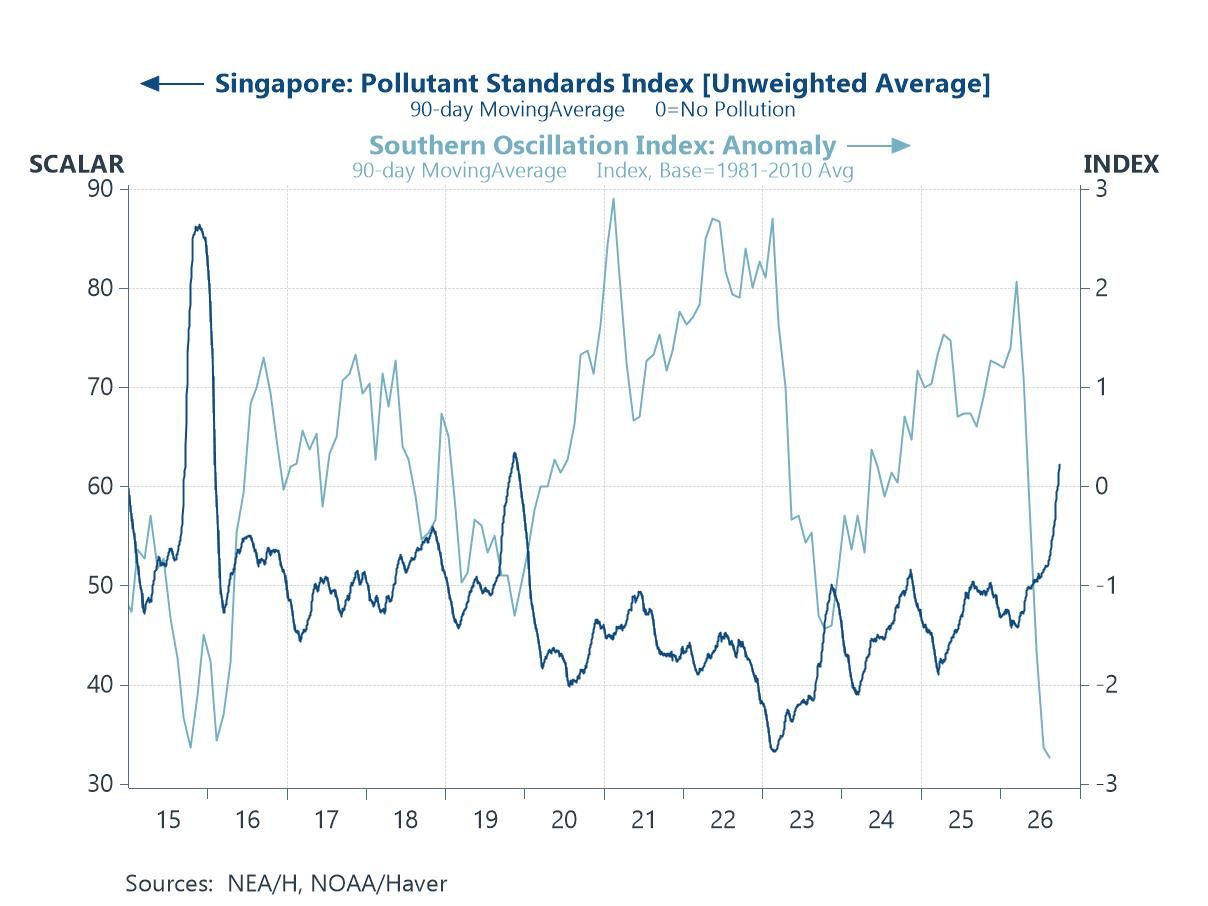
El Niño and health El Niño’s effects go beyond food prices; they also carry environmental and health costs for Asia. Parts of the region, such as Singapore, are now experiencing seasonal haze, as smoke from peat and forest fires is carried across borders by prevailing winds (chart 5). The fires this year have burned mainly in Sumatra and Kalimantan in Indonesia, with smaller clusters in Peninsular Malaysia. Singapore's PSI, on a 90-day average basis, has climbed to around 62, its highest since the 2019 episode, as the Southern Oscillation Index has plunged. On 4 September, the PSI entered the unhealthy range for the first time since October 2023. This year's extreme El Niño is expected to prolong drier conditions, worsening air quality and its health effects. The episode highlights the indirect link between El Niño and pollution, through weather that leaves peatland easier to ignite and harder to extinguish.
Chart 5: Singapore Pollutant Standards Index vs. Southern Oscillation Index (SOI)
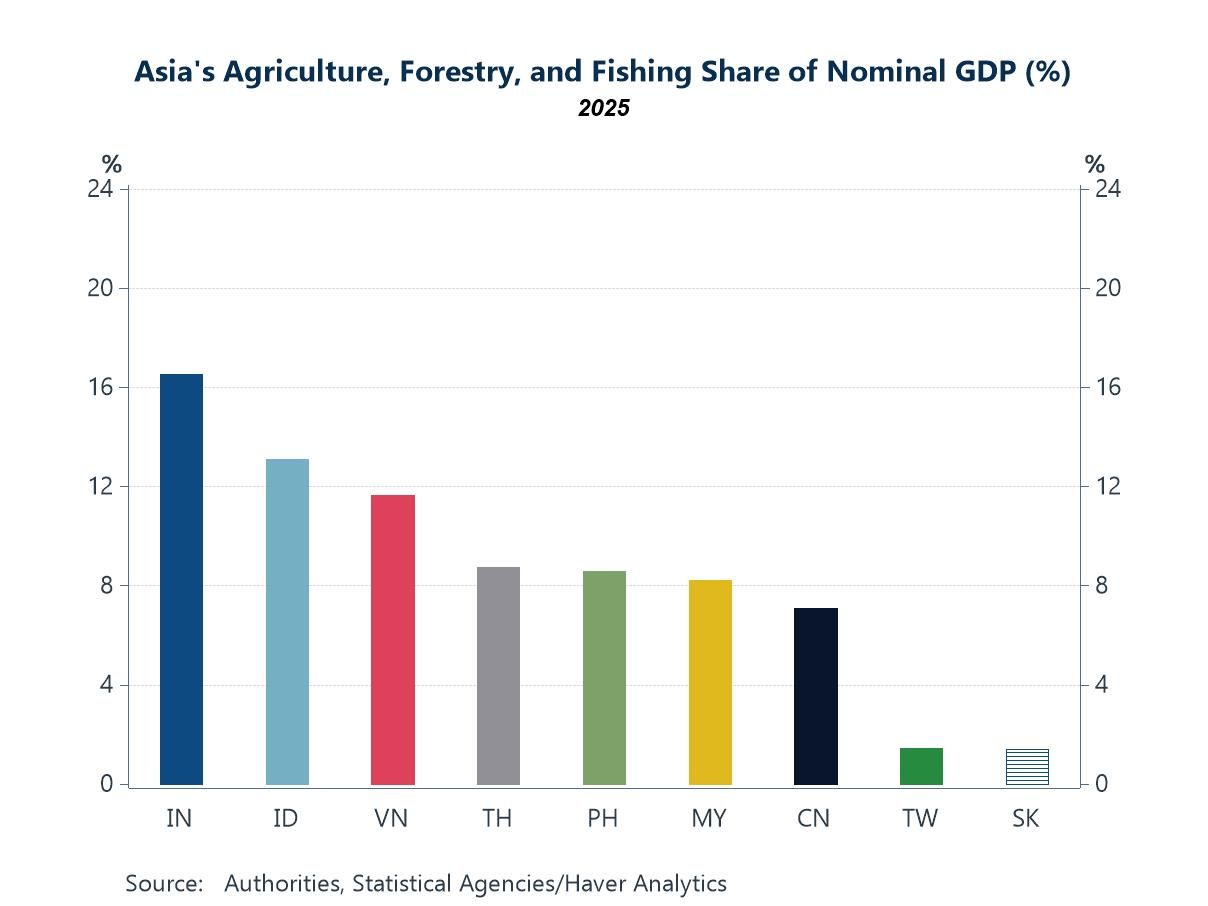
El Niño and policy Policymakers now have another issue to grapple with, on top of the energy supply shock from the Middle East, global geopolitics and domestic pressures. El Niño raises concerns ranging from food security, given the adverse supply shock, to water security, given drought-induced rainfall shortfalls. It also complicates inflation management as food prices rise, and adds demands for mitigation against hotter and drier conditions. For the more agriculture-reliant economies, the impact could be a double hit. Agriculture, forestry and fishing accounted for around 16% of nominal GDP in India in 2025, 13% in Indonesia and 12% in Vietnam (chart 6). These economies face a hit to growth as well as higher prices. To compound matters, food-driven inflation could force central banks to tighten policy further, adding to the growth cost.
Chart 6: Asia’s agriculture share of GDP

Tian Yong Woon
AuthorMore in Author Profile »Tian Yong joined Haver Analytics as an Economist in 2023. Previously, Tian Yong worked as an Economist with Deutsche Bank, covering Emerging Asian economies while also writing on thematic issues within the broader Asia region. Prior to his work with Deutsche Bank, he worked as an Economic Analyst with the International Monetary Fund, where he contributed to Article IV consultations with Singapore and Malaysia, and to the regular surveillance of financial stability issues in the Asia Pacific region.
Tian Yong holds a Master of Science in Quantitative Finance from the Singapore Management University, a Master of Science in Analytics from the Georgia Institute of Technology, a Bachelor of Science in Mathematics from the Singapore University of Social Sciences, and a Bachelor of Science in Banking and Finance from the University of London.
More Economy in Brief