U.S. Construction Spending: Home Improvement and Data Centers Drove Spending in August
Summary
- August headline gain narrowly based.
- Data center heat remains on.
- Public construction’s quiet gains continued.
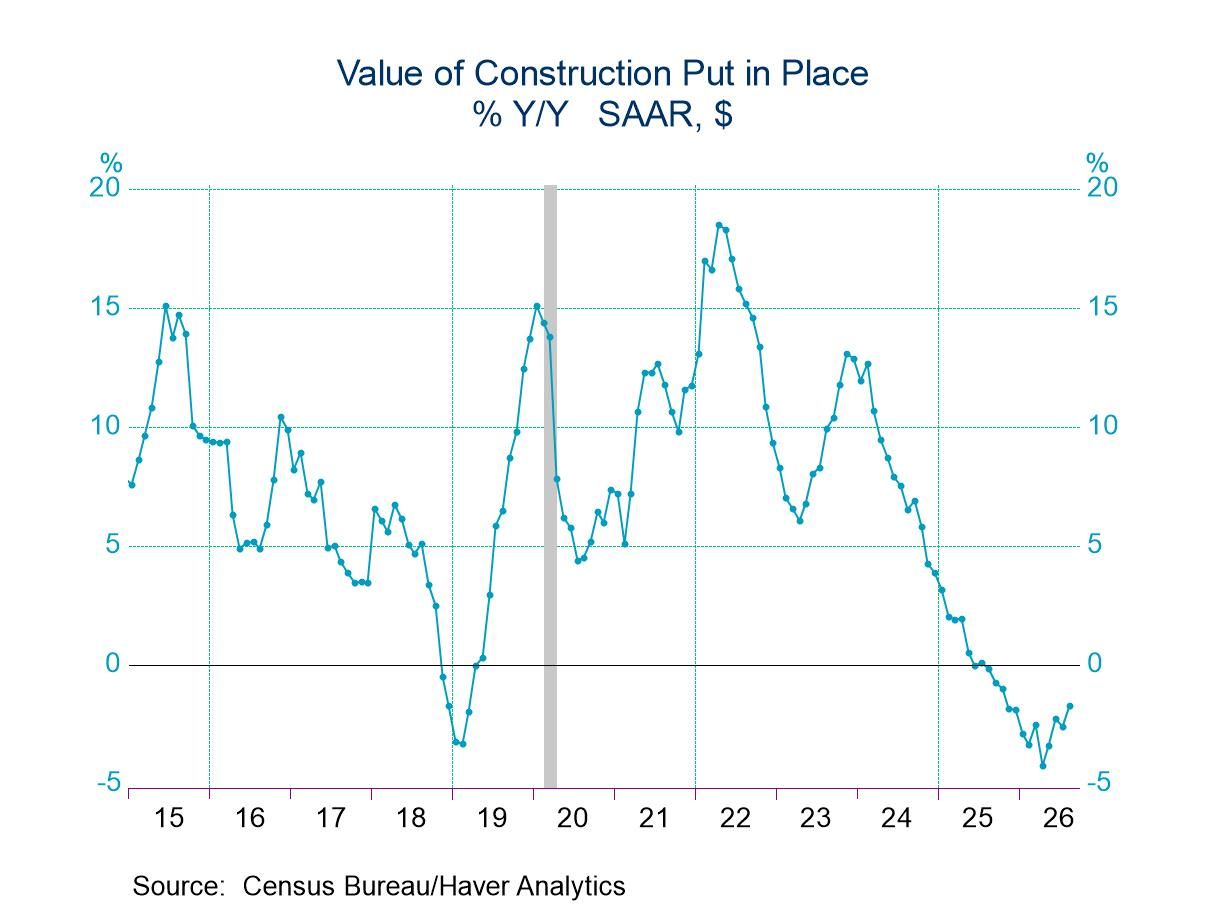
The U.S. Construction Spending report revealed total construction spending rose 0.9% month-over-month (MoM) in August following a 0.1% monthly decline in July. Over the last three months, nominal construction spending advanced at a 6.6% annualized rate, the best showing on this basis since March 2024. Near-term performance also pushed the six-month trend into positive territory (1.2% annualized) for the first time since February 2025. Recent traction, however, has not pulled the smoother year-over-year (YoY) rate out of the red. August’s -1.7% YoY figure extended the negative streak to 13 months.
Private construction (up 1.1% MoM, -3.1% YoY) accounted more of the headline advance than public construction (up 0.2% MoM). Half of the private construction gain was driven by home improvements (up 2.5% MoM). This component of residential construction has been volatile this year, so the sequential improvement is not an all-clear signal. In fact, home improvements’ August level is still about 8% below the 2026 high point (in March) and nearly 10% below the September 2025 cycle top.
Data centers drive one-third of private construction’s August increase on another strong monthly showing (up 7.5% MoM). The extraordinary AI-related expansion pushed the annual trend to a 73.2% YoY rate. Moreover, the data center share of private construction rose above 5% in August for the first time ever. The progression over the last three Augusts revealed a 1% share in 2023, a 2% share in 2024 and a 3% share in 2025. Construction spending on power facilities also has been swept up in the AI boom. August’s 0.9% MoM rise was the fifth straight, the longest stretch of gains in over a year. The momentum lifted the five-month annualized rate to 16.9% in August, the highest since December 2023. Recent improvement also supported the smoother YoY trend; the 9.7% annual pace was the best since June 2024.
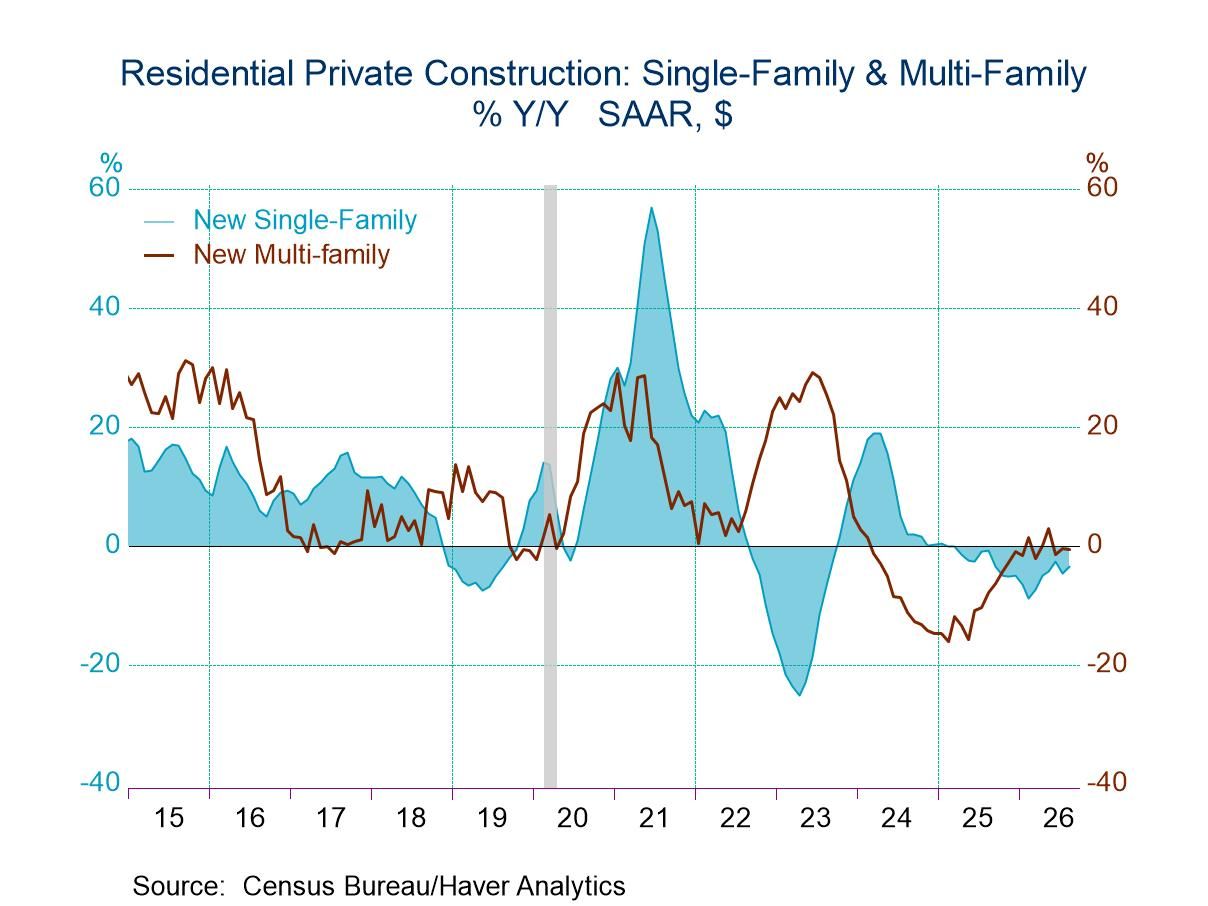
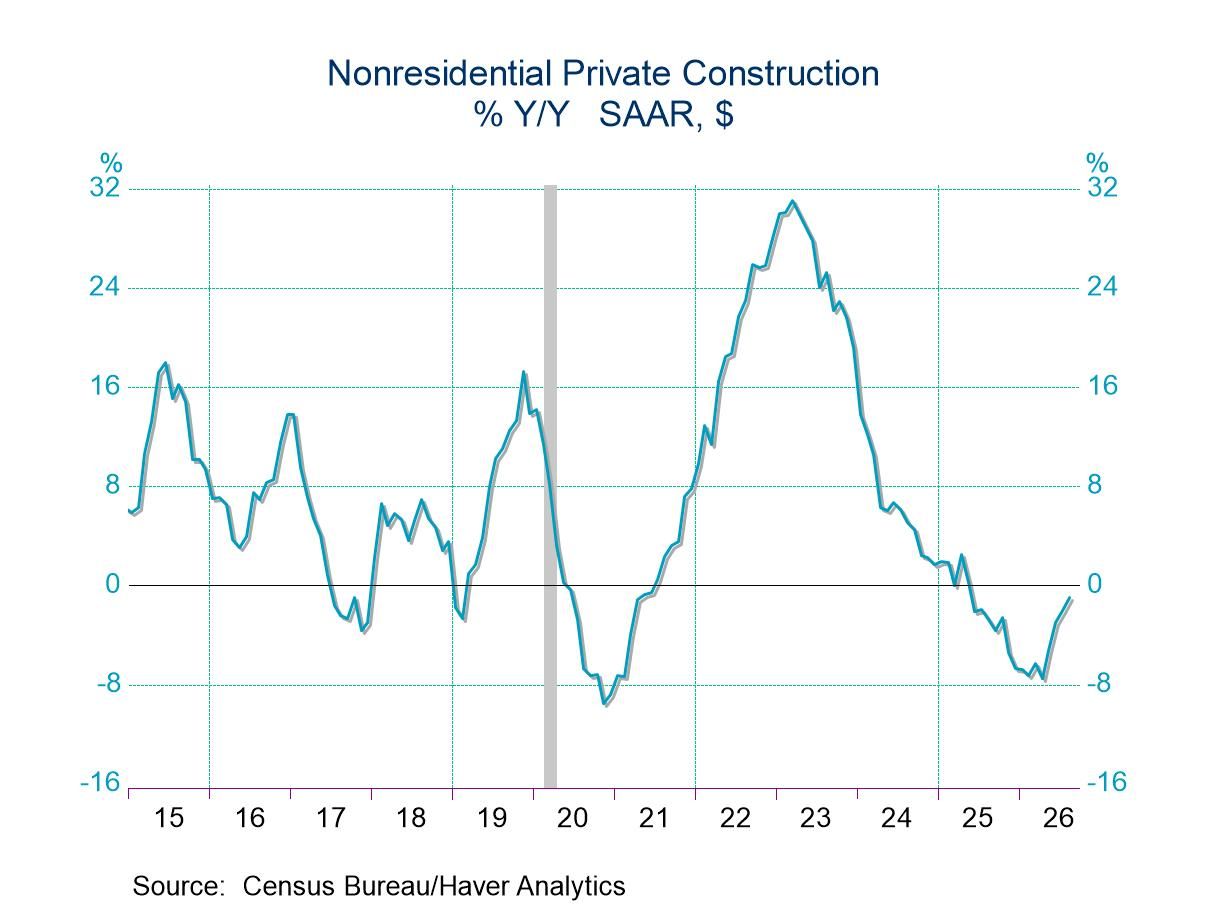
Elsewhere in the private space, everything else was up modestly on the month (single-family and multifamily both up 0.2% MoM and nonresidential ex-data centers up 0.3% MoM). Even with the upticks, it did little to change the YoY trends that remain in negative territory (nonresidential ex-data centers -5.9%, single-family residential -3.5%, multifamily residential -0.6%).
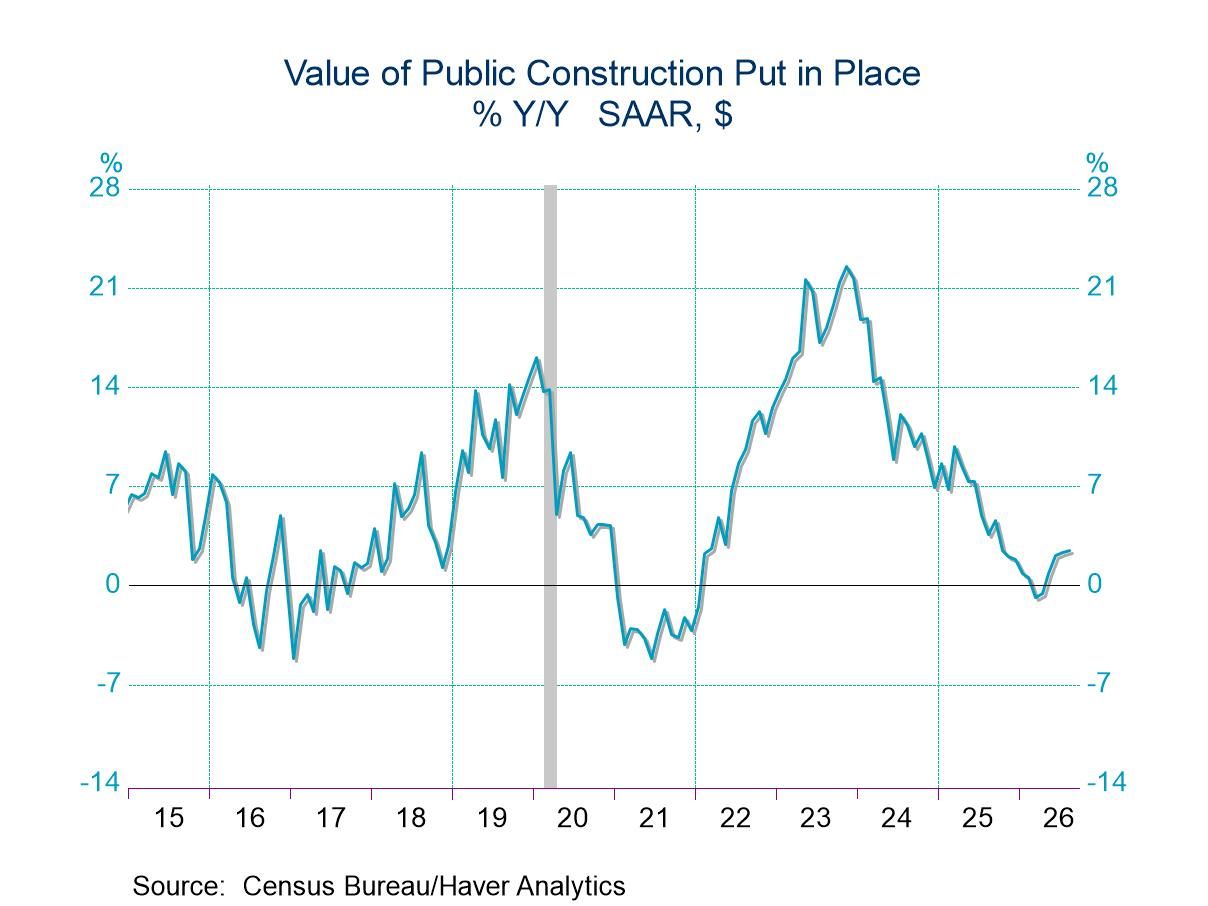
The value of public construction spending continued its quiet gains, extending its winning streak to the six months ended August. On a YoY basis, public construction posted a 2.5% rate, the best performance in eleven months. Highway construction (up 0.1% MoM/4.4% YoY) has been a key support factor.
Construction spending, as it is denominated in nominal dollar terms, can be considered an aggregate budget measure for construction labor trends. Recent construction spending performance could be contributing to the acceleration in job creation in the sector, as reported by payroll provider ADP earlier this week. September’s 15,000 MoM advance for ADP construction payrolls was the best showing since March’s 32,000 MoM increase. It also extended the construction jobs’ winning streak to nine months.
The construction figures can be found in Haver's USECON database. The expectations figure is from the Action Economics Forecast Survey in AS1REPNA.

Jonathan Basile
AuthorMore in Author Profile »Jonathan Basile is Street veteran of more than three decades with extensive experience analyzing the global macro environment from the perspectives of sell-side economist, sovereign analyst, and buy-side strategist. He joined Danielle DiMartino Booth at Quill Intelligence in June 2025 as Director of Research where he regularly taps his assets for the firm’s key products, Weekly Quill, Saturday Intelligence Briefing, and Daily Feather.
The prior 11 years were spent at AIG’s and Corebridge Financial’s Investment arms as Head of Global Macro Strategy where his macro and market knowledge were utilized by key stakeholders, like the CIO teams, portfolio managers and third-party clients. Before the Corebridge spin-off from AIG, he built the Global Macro desk from scratch to become an integral part of the active investment process. He streamlined investment practices by steering a centralized monthly global macro discussion allowing subsequent asset-class meetings to be focused on strategy. Jonathan’s tactical rate views were frequently employed by public credit portfolio managers and traders. His storytelling prowess was displayed in a colorful weekly rant whose internal distribution grew steadily and organically.
Jonathan’s past experience with the likes of Dr. Lacy Hunt, Christopher Low, Ian Shepherdson, Elliott Platt, Dr. Neal Soss, and Kathleen Stephansen (twice) prepared him for almost anything thrown his way from the economy and the markets. His years at HSBC, DLJ and Credit Suisse combined saw him cover the economies of the US, Canada, Japan and the UK. He has been recognized as a four-time winning team member of the Marketwatch US Forecaster of the Month and was ranked by Bloomberg as a top forecaster of the Canadian economy.
Jonathan is married with three children – one of which is a Red Sox fan in a Yankees household. You can find Jonathan running or biking on weekends or catching for his men’s baseball team during the spring and summer. He holds a BA in Economics from Princeton University.
More Economy in Brief
 Global