September Employment Report
Summary
- Disappointing change in nonfarm payrolls
- Marginal increase in unemployment
- Modest increase in average hourly earnings
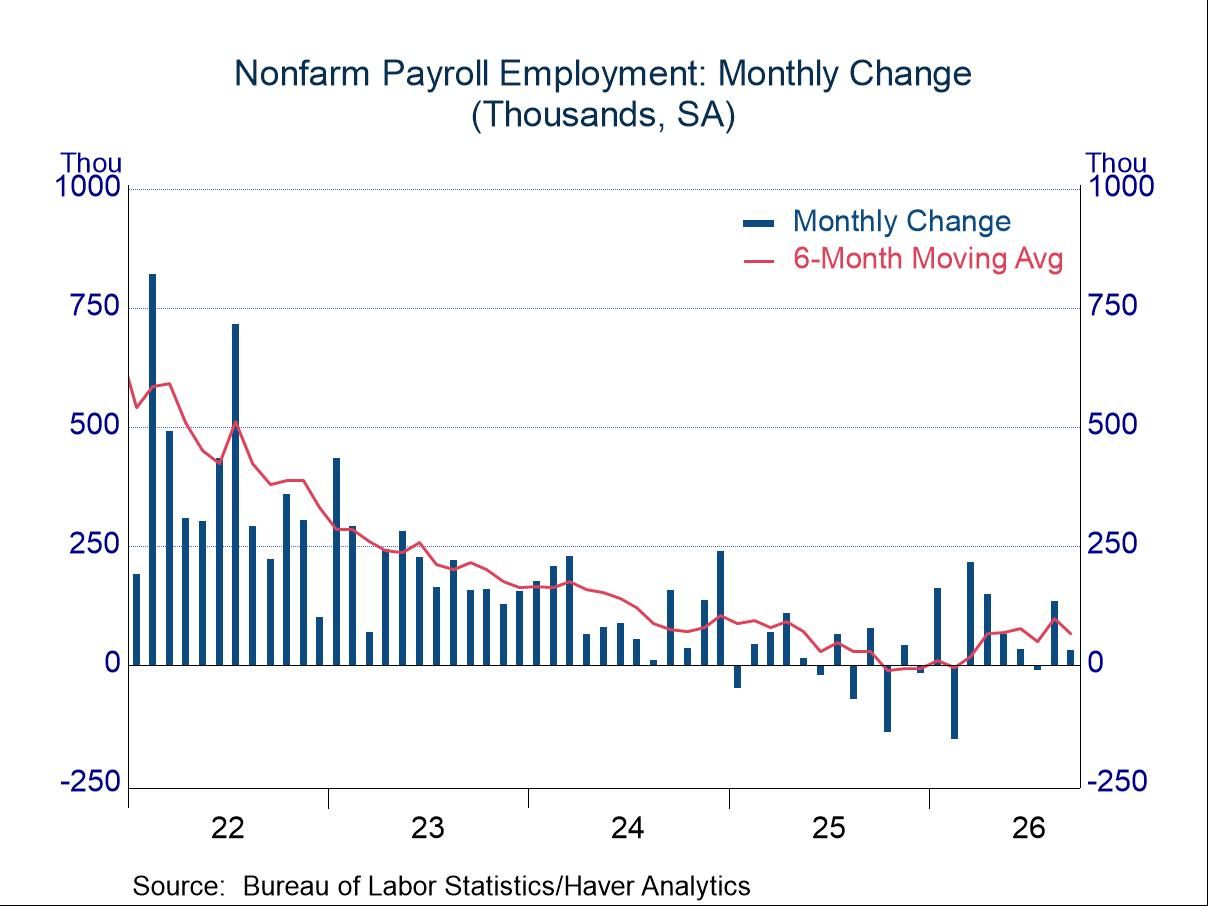
Nonfarm payroll employment rose 29K in September, notably below the expected increase of 85K. Moreover, results in the prior two months were revised lower by 60K, with adjustments in July and August contributing about equally. The new figures left the average monthly increase so far this year at 68K, an improvement from the average of 10K in 2025 but light relative to historical norms.
By industry, construction and manufacturing performed reasonably well with gains of 11K and 9K, respectively. These sectors were decidedly weak last year, but they have posted gains in most months this year (average advances of 10K and 8K year-to-date). Retail trade is another area that is improving this year after a poor performance in 2025. Retailers added 6K jobs in September, but combined results in the prior two months were revised lower by 14K (still up year-to-date with an average monthly gain of 7K). The business service sector also is on a recovery track this year, but September brought a notable setback: employment fell by 9K and results in July and August were revised lower by 36K (still up year-to-date, 12K on average).
Three areas were weak last year and remain on soft paths so far this year. The information sector lost an average of 4K jobs per month last year and is cutting at an average pace of 11K so far this year. This is a broad area, encompassing firms involved in movie production, broadcasting, publishing, libraries, and tech-related areas; all have been soft. The financial service industry did little hiring last year (fewer than 1K jobs per month), and it has cut at an average rate of 12K per month so far this year. Government employment fell at an average rate of 15K last year and 2K so far this year. The federal government has led this retreat in employment, but state governments trimmed payrolls last year and have continued to do so this year. Local governments have made only modest additions to payrolls since mid-2025.
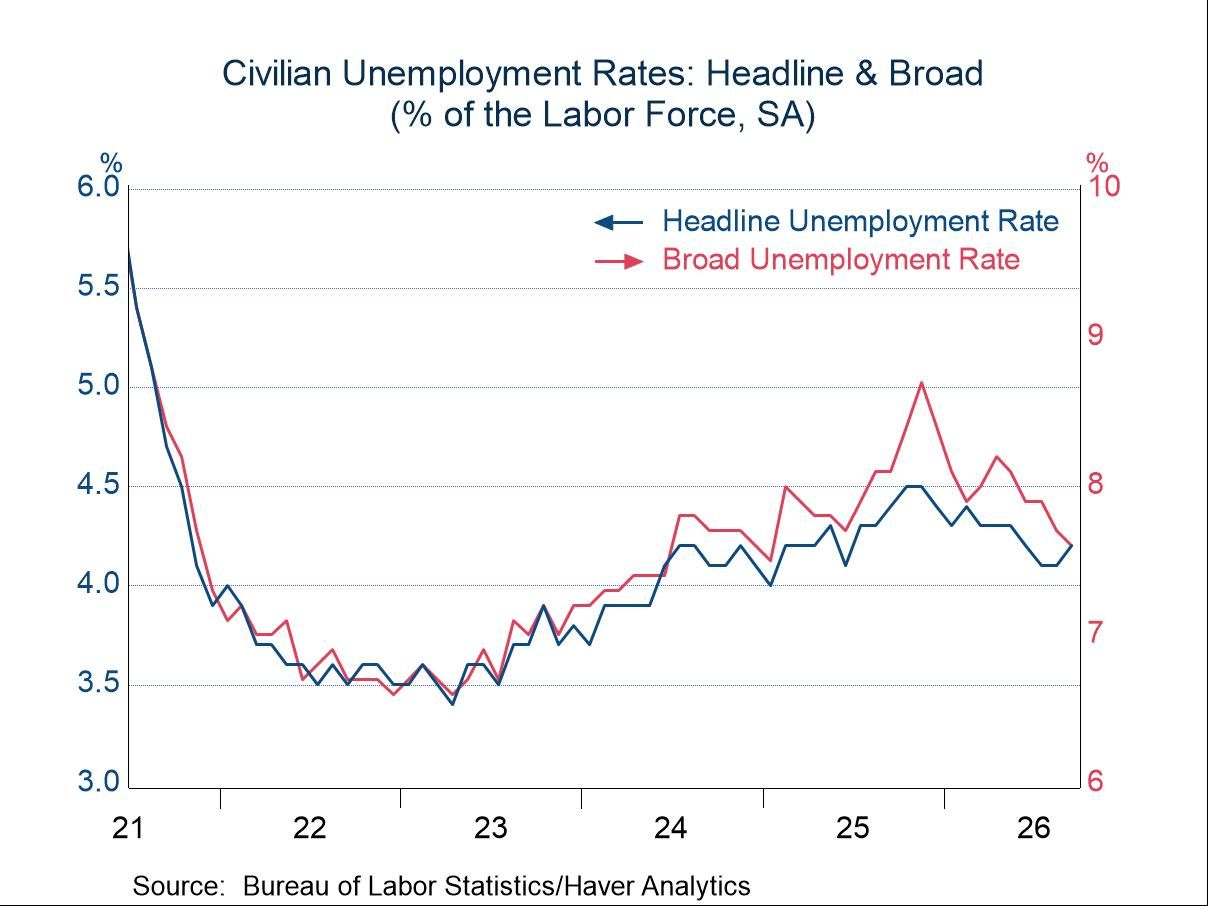
The unemployment rate reportedly rose 0.1 percentage point to 4.2%, but if calculated with more precision, the change was less than 0.1 percentage point (4.176% vs. 4.141%). In addition, it was a benigh increase in joblessness in that the labor force expanded solidly (485K), but employment as measured by the household survey rose by a slightly smaller amount (406K). The broad unemployment rate (the U-6 measure) fell 0.1 percentage point to 7.6%. The number of individuals working part-time involuntarily rose in September, but this increase was offset by a drop in the number of individuals marginally attached to the labor force. (Marginally attached individuals are defined as those that would like a job and have looked in the past 12 months but have not searched in the past four weeks.)
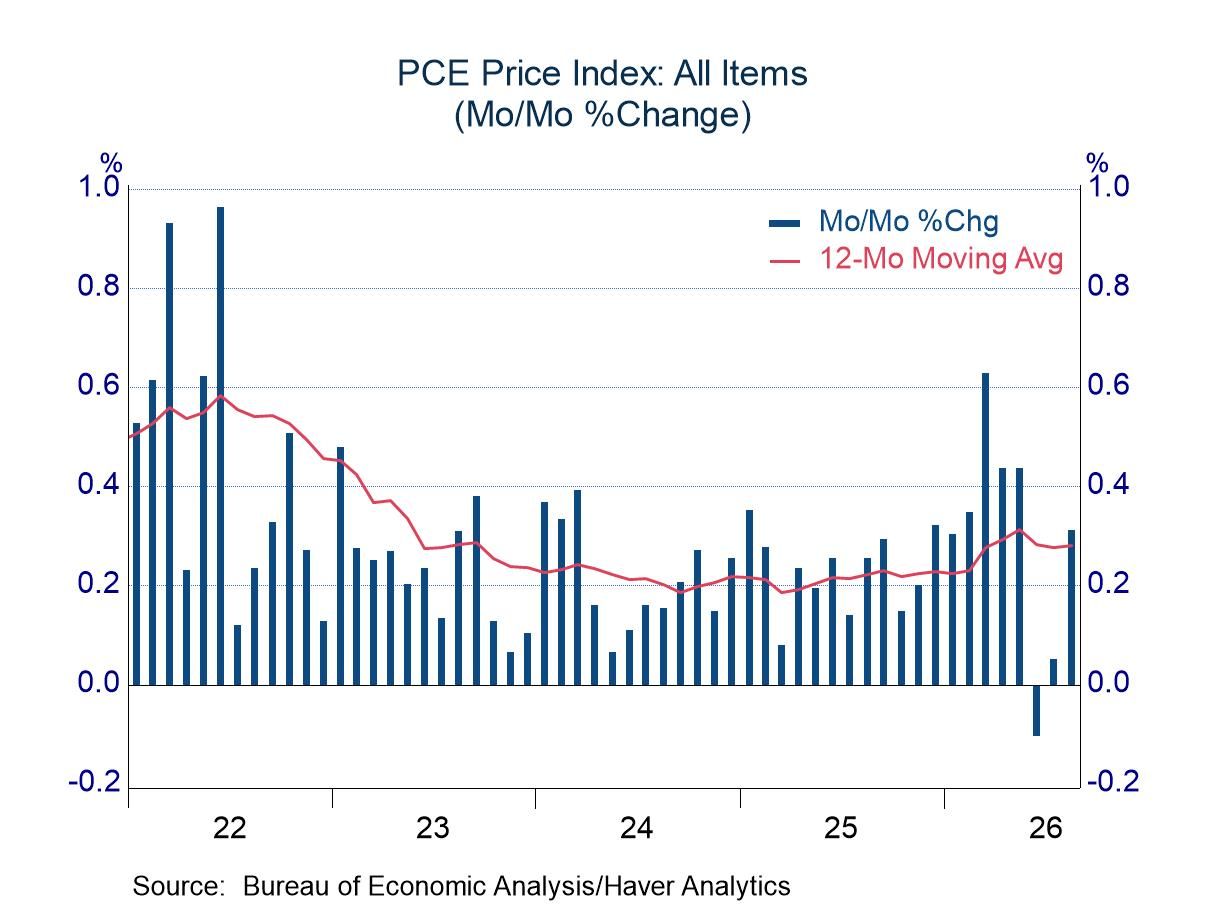
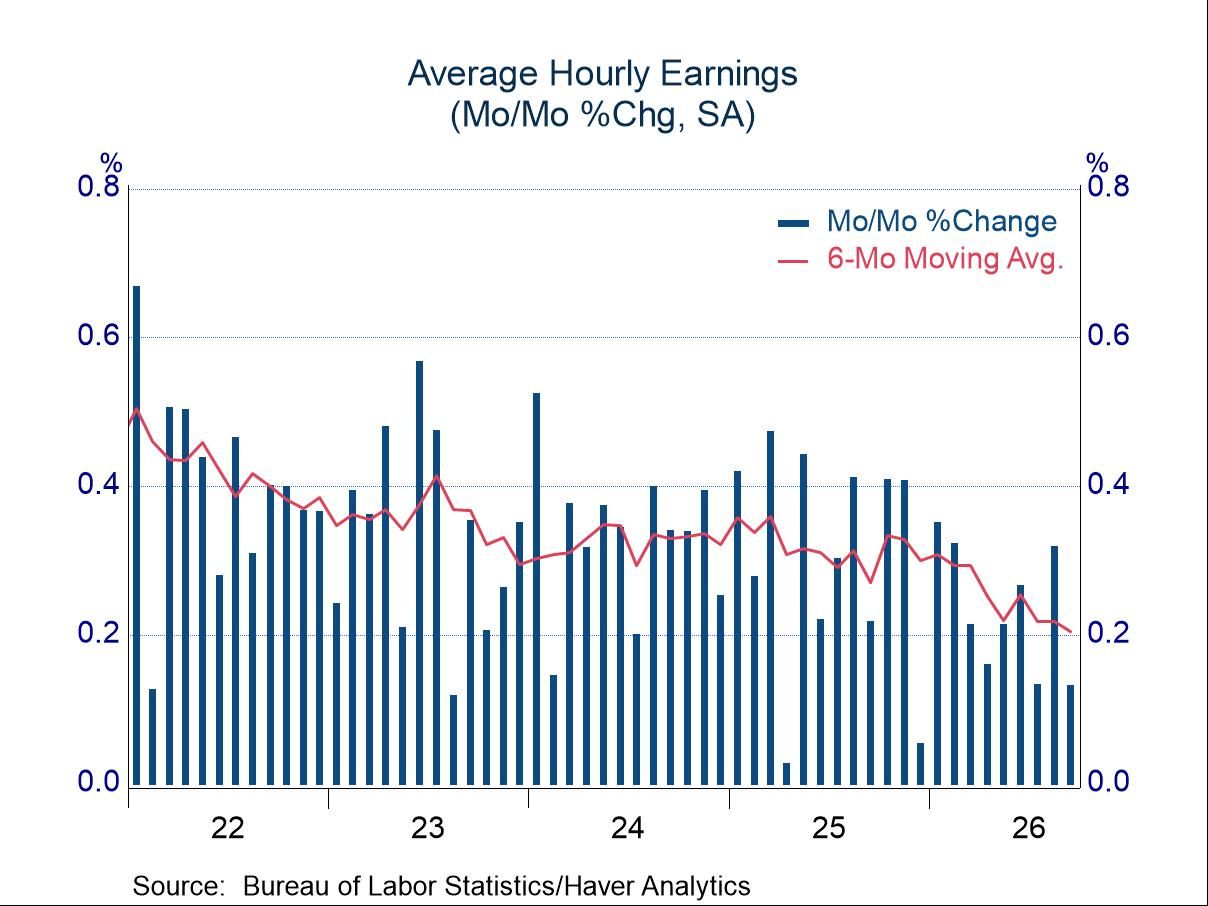
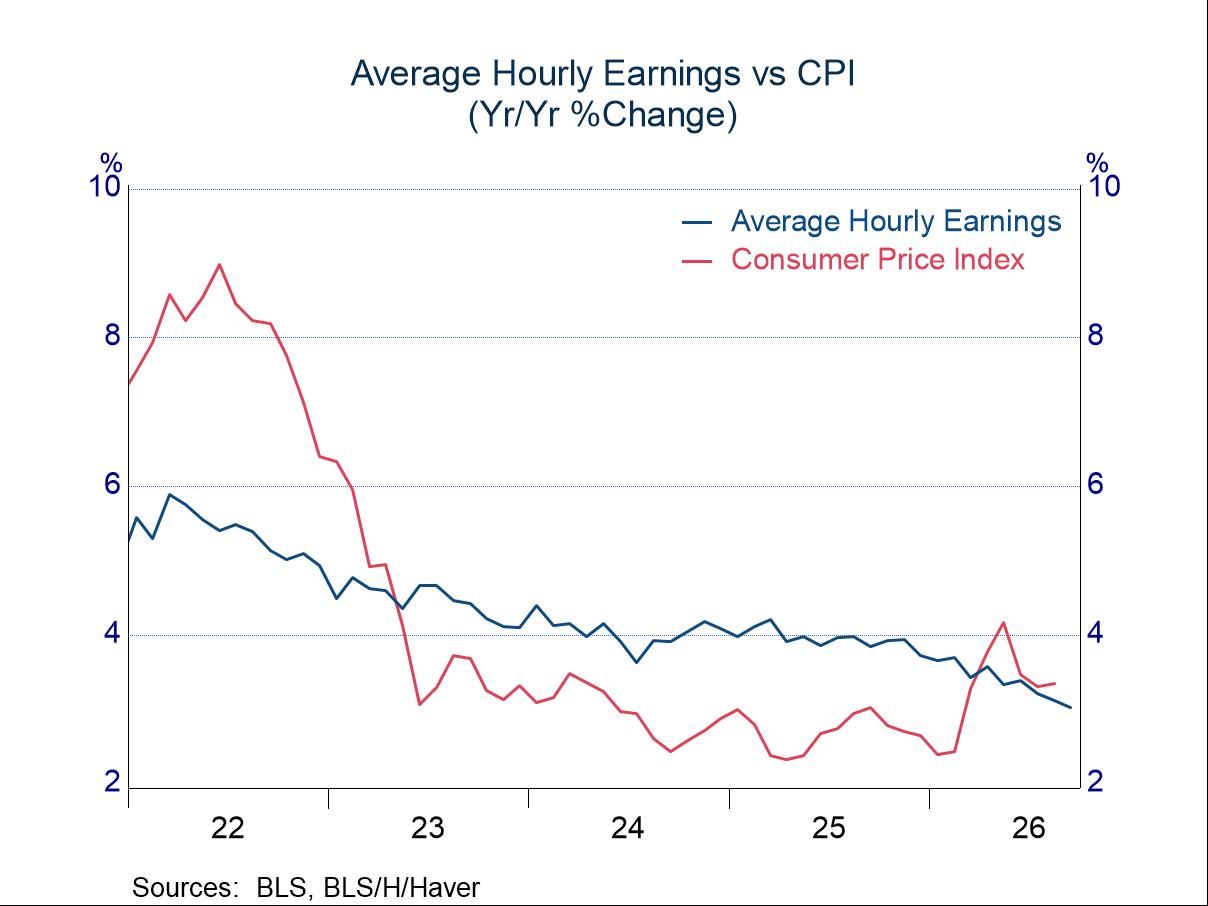
Average hourly earnings rose 0.1% in September, lighter than the expected increase of 0.3% and a reading in the low end of the recent range. The year-over-year change of 3.0% continued a downward trend that began in 2022 (chart, below left). Many observers have noted that wage growth is no longer keeping pace with inflation. This is true, although the differential has not been large and it followed gains in purchasing power by working individuals in the prior few years (wages did trail inflation during the burst in 2021-22). The relationship between wage growth and inflation waxes and wanes over time; from a long-term perspective, wage growth has bested inflation more often than not.

Michael J. Moran
AuthorMore in Author Profile »Before joining Haver Analytics in 2025, Michael J. Moran was the chief economist of Daiwa Capital Markets America Inc. He was responsible for preparing the firm’s economic forecast and interest rate outlook. He traveled frequently to visit the clients of Daiwa Capital Markets and wrote weekly economic commentary. Mr. Moran also was involved in the flux of financial markets, as he spent a portion of each day on Daiwa’s trading floor interpreting economic statistics and Federal Reserve activity for traders and salespeople. Mr. Moran is quoted frequently in the financial press, and he appears regularly on cable news shows. He also has published articles in several journals and periodicals. Before joining Daiwa Capital Markets America, Mr. Moran worked as an economist at the Federal Reserve Board in Washington, D.C. where he analyzed a broad range of issues dealing with the financial sector of the economy and regularly briefed the Board of Governors. He was on the faculty of Pennsylvania State University from 1979 to 1980 and taught on a part-time basis at George Washington University from 1980 to 1987.
Mr. Moran received his Ph.D. in economics from Pennsylvania State University in 1980 and a B.S. in business administration from the University of Bridgeport in 1975. He was a CFA charter holder from 2002 until 2016.
More Economy in Brief
 Global