U.S. Trade Deficit Narrowed in April
by:Sandy Batten
|in:Economy in Brief
Summary
- The deficit in goods and services narrowed to $55.9 billion in April from a downwardly revised $56.6 billion in March.
- Exports rose 2.6% m/m, led by a 33% monthly jump in petroleum exports.
- Imports increased by 2.0% m/m, led by a 5.8% m/m rise in capital goods imports.
- The goods deficit narrowed to $83.7 billion, and the services surplus narrowed to $27.8 billion.
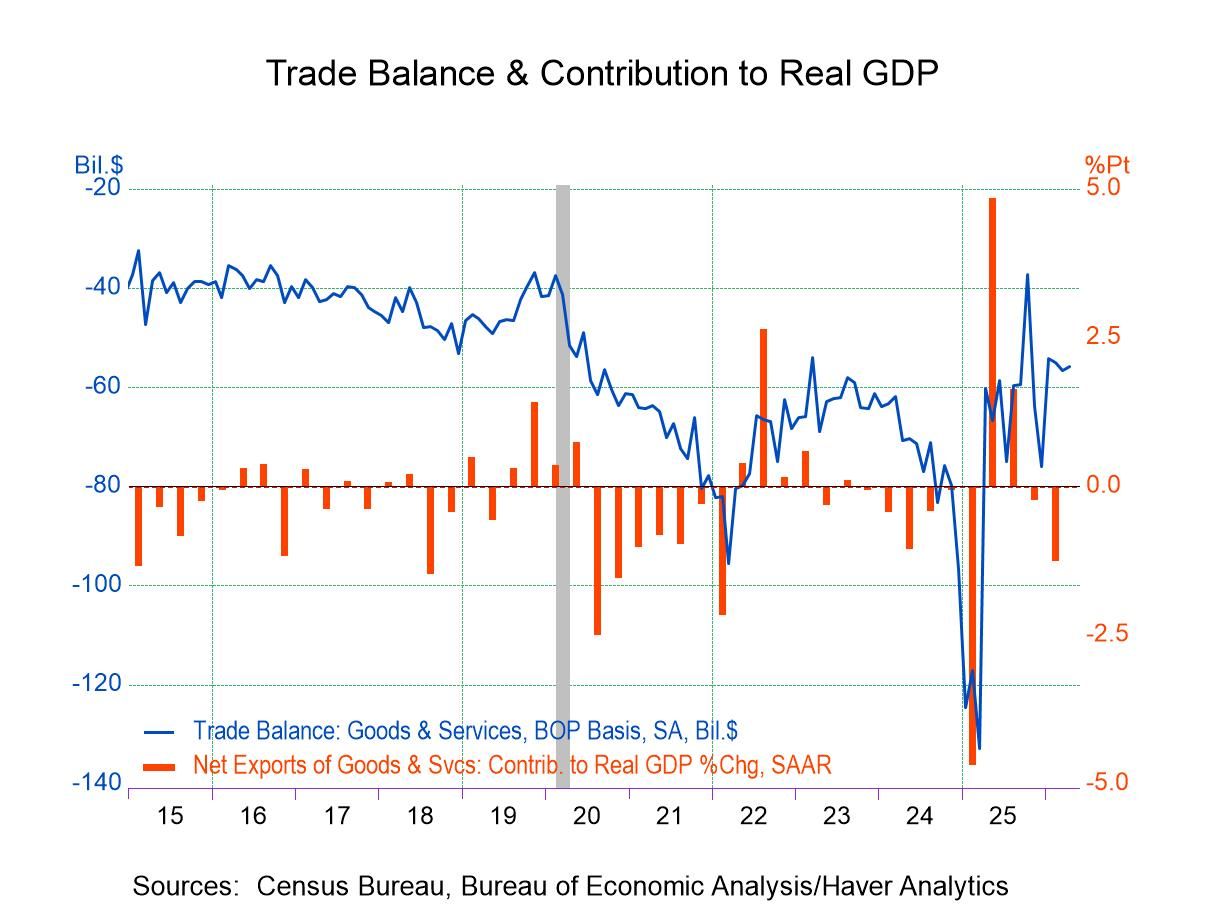
The U.S. trade deficit in goods and services (BOP basis) narrowed to $55.9 billion in April from a downwardly revised $56.6 billion March (previously -$60.3 billion), according to the U.S. Census Bureau. The Action Economics Forecast Survey looked for a deficit of $55.5 billion. The goods deficit declined to $83.7 billion in April from a downwardly revised $86.1 billion in March (previously -$88.7 billion) while the services surplus narrowed to $27.8 billion from an upwardly revised $29.5 billion in March (previously +$28.4 billion).
The real (inflation-adjusted) trade deficit in goods narrowed to $84.3 billion (2017$) in April from a downwardly revised $85.9 billion in March (previously -$90.8 billion). The April figure is in line with the Q1 average, indicating that net exports could be a net neutral for Q2 GDP growth. Net exports subtracted 1.3%-points from GDP growth in Q1 and 0.2%-point in last year’s fourth quarter.
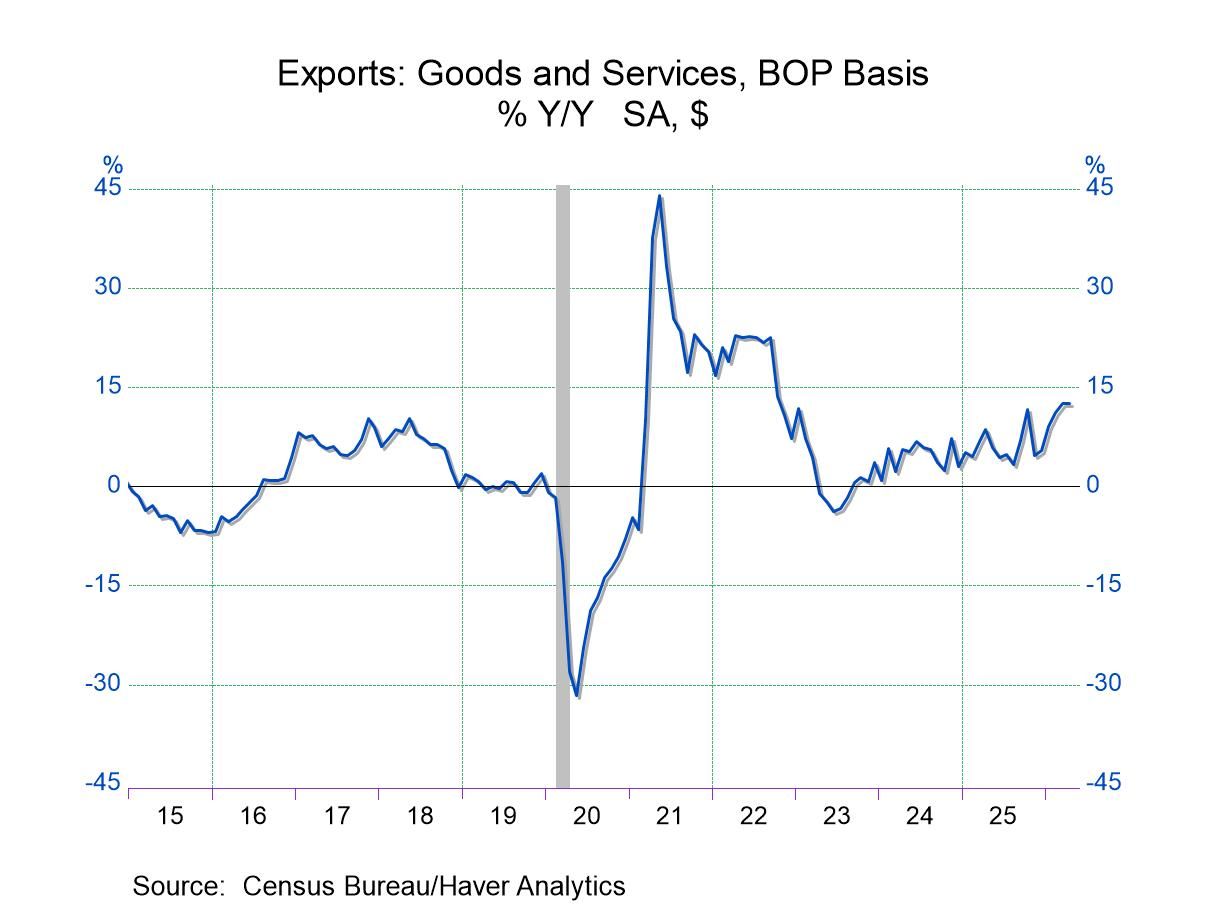
Exports of goods and services increased 2.6% m/m (12.6% y/y) in April versus an upwardly revised 2.2% monthly gain in March (previously 2.0% m/m). Over the four months of this year, exports have risen 14.7%. Goods exports (Census basis) increased 3.8% m/m (16.0% y/y) in April, once again led by a surge in petroleum exports. They jumped 33.3% m/m in April on top of a 34.7% monthly surge in March. The April-March jumps in petroleum exports were the largest since June 2008. The $9.2 billion increase in exports of petroleum and petroleum products more than accounted for the $8.1 billion increase in total goods exports in April. However, there was also strength in other exports. Capital goods exports excluding autos jumped 6.1% m/m, their fifth monthly gain in the past six months. Nonfood consumer goods exports excluding autos rebounded in April, rising 7.9% m/m, almost completely reversing the 8.4% monthly plunge in March. By contrast, auto exports fell 2.6% m/m, the first monthly decline in three months, and food and feed exports slipped 0.3% m/m, their second monthly decline in the past three months. Services exports fell 0.4% m/m (+5.1% y/y) in April. Maintenance and repair services fell 5.0% m/m; transport declined 2.2% m/m; travel fell 1.5% m/m.
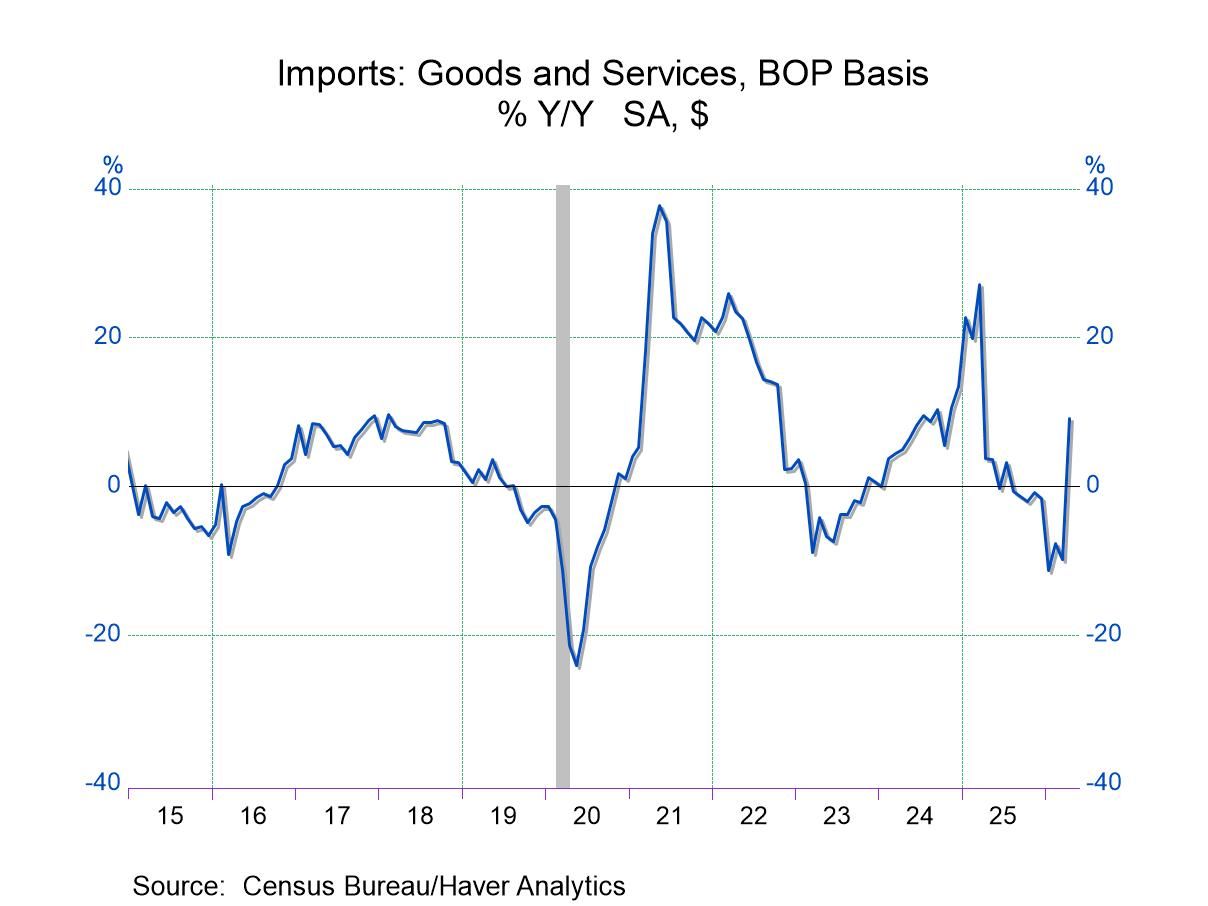
Imports of goods and services rose 2.0% m/m (9.1% y/y) in April following an unrevised 2.3% monthly gain in March. The annual comparison is distorted by an outsized fall in imports last April (particularly of nonmonetary gold) that had followed a surge in imports in March that was an attempt to front-run tariff increases. Goods imports (Census basis) increased 2.0% m/m (10.1% y/y). The rise in imports had a distinct AI flavor. It was led by a marked gain in imports of capital goods (up 5.8% m/m), which included a 6.8% increase in computer imports and a 19.1% m/m jump in semiconductor imports. The $7.0 billion increase in capital goods imports more than accounted for the $5.9 billion rise in total goods imports. Industrial supplies exports fell 1.7% m/m; auto imports declined 1.4% m/m; and imports of nonfood consumer goods ex autos slipped 0.5% m/m. Service imports rebounded in April, rising 1.6% m/m following a 1.8% monthly decline in March. Travel increased 2.2% m/m; transport jumped 4.1% m/m; insurance services rose 2.2% m/m.
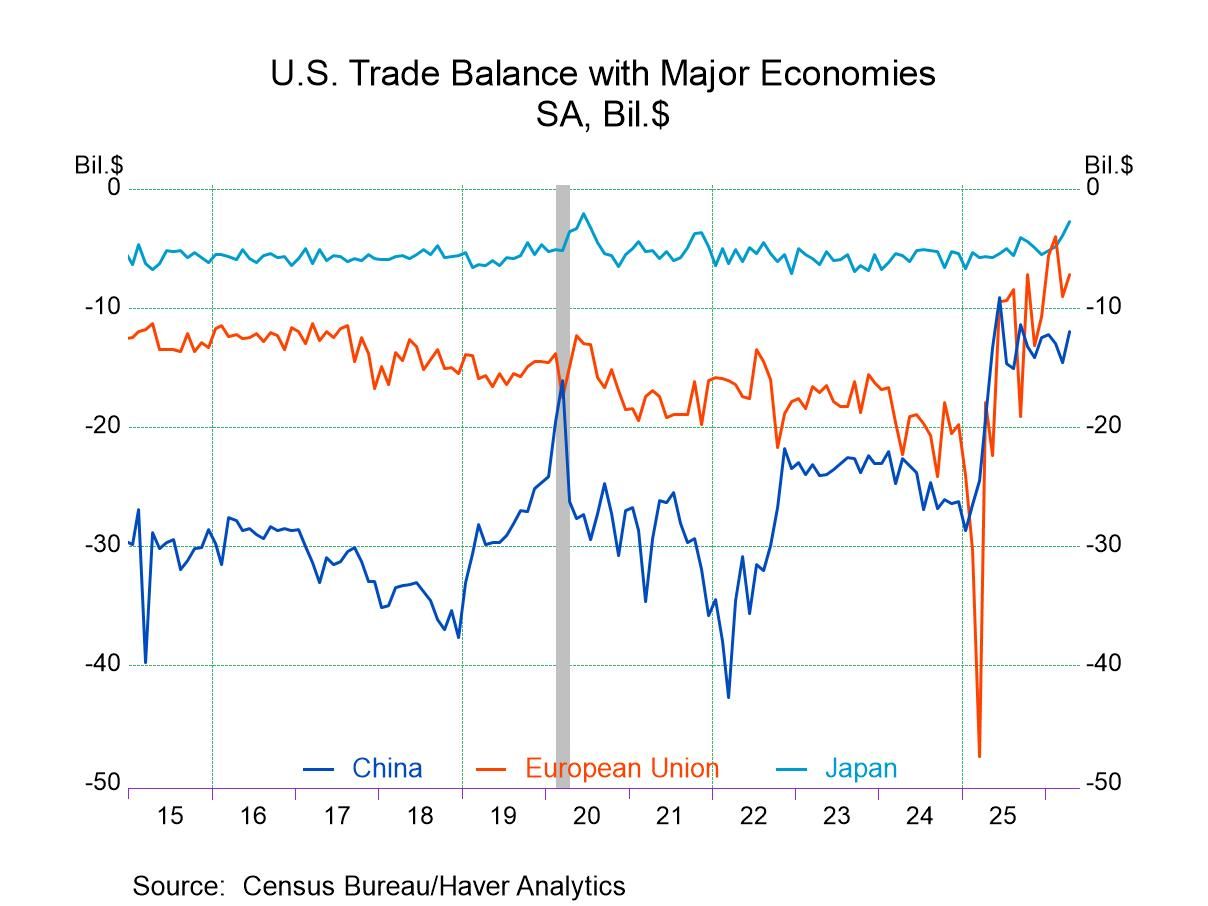
By country, the goods trade deficit with China narrowed to $12.0 billion in April from $14.6 billion in March. The trade deficit with the European Union narrowed to $7.2 billion from $9.0 billion in March. The trade deficit with Japan declined to $2.8 billion in April from $4.0 billion in March.
The international trade data can be found in Haver’s USECON database. Detailed figures on international trade are available in the USINT and USTRADE databases. The expectations figures are from the Action Economics Forecast Survey in AS1REPNA.

Sandy Batten
AuthorMore in Author Profile »Sandy Batten has more than 30 years of experience analyzing industrial economies and financial markets and a wide range of experience across the financial services sector, government, and academia. Before joining Haver Analytics, Sandy was a Vice President and Senior Economist at Citibank; Senior Credit Market Analyst at CDC Investment Management, Managing Director at Bear Stearns, and Executive Director at JPMorgan. In 2008, Sandy was named the most accurate US forecaster by the National Association for Business Economics. He is a member of the New York Forecasters Club, NABE, and the American Economic Association. Prior to his time in the financial services sector, Sandy was a Research Officer at the Federal Reserve Bank of St. Louis, Senior Staff Economist on the President’s Council of Economic Advisors, Deputy Assistant Secretary for Economic Policy at the US Treasury, and Economist at the International Monetary Fund. Sandy has taught economics at St. Louis University, Denison University, and Muskingun College. He has published numerous peer-reviewed articles in a wide range of academic publications. He has a B.A. in economics from the University of Richmond and a M.A. and Ph.D. in economics from The Ohio State University.
More Economy in Brief
 Global