Japan’s IP Emerges as Stronger
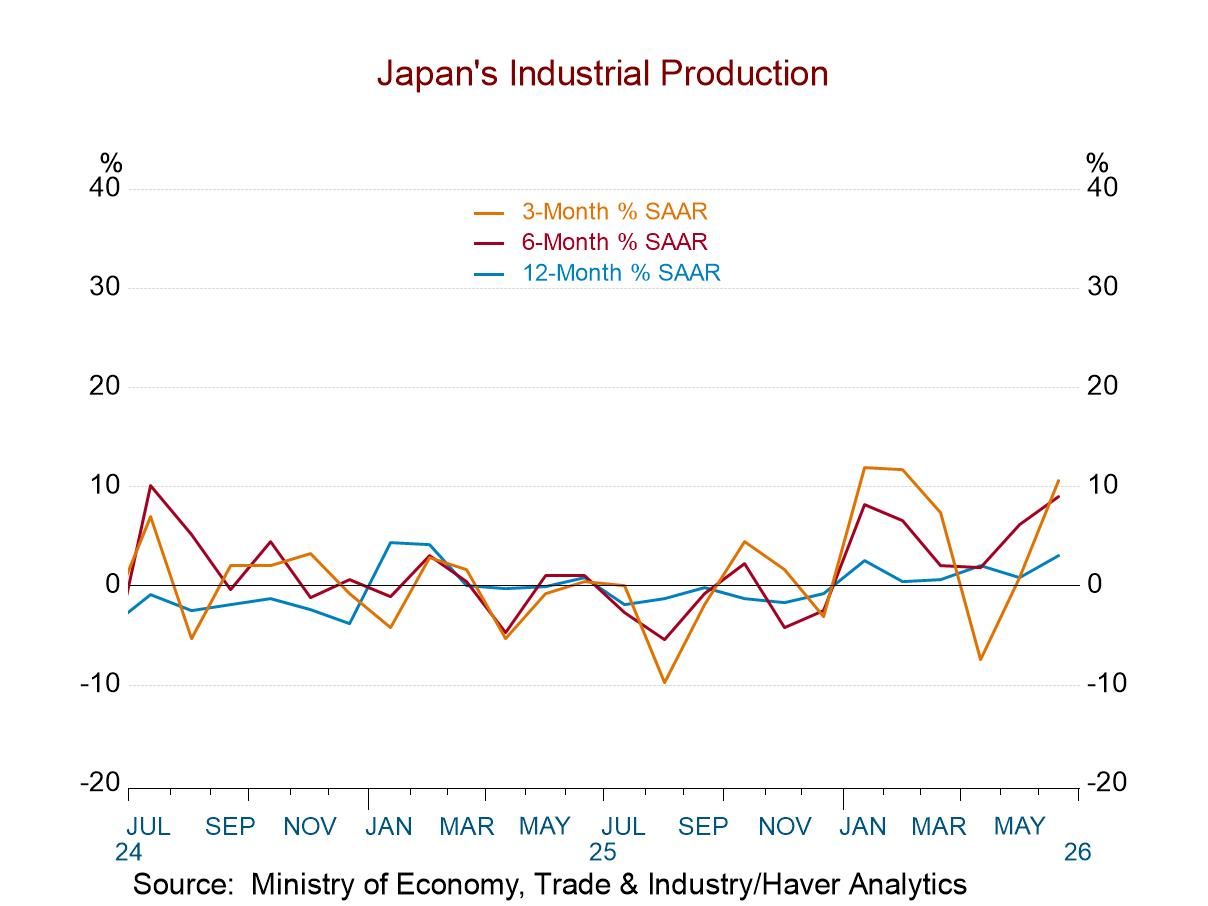
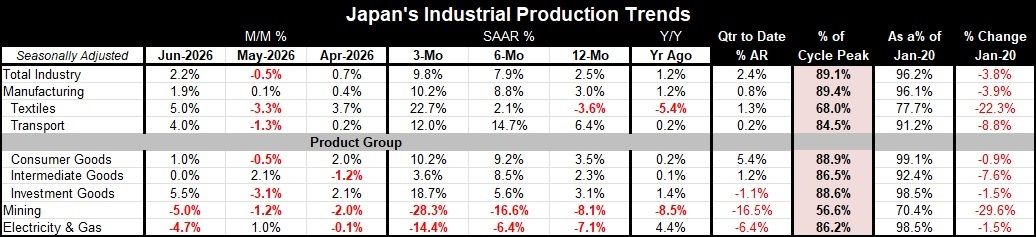
Japan's industrial production was revised up to show a 2.2% gain in June after falling by 0.5% in May. Industrial production in Japan is accelerating, showing a 2.5% growth rate over 12 months, a 7.9% annual rate over six months, rising to a 9.8% annual rate over three months. Manufacturing is accelerating in step with the total industry measure.
Key industries like textiles and transportation show acceleration underway or something close to it. In the case of transportation equipment, a 6.4% growth rate over 12 months rises to 14.7% over six months, although it steps back to a 12% growth rate over three months. That's still a great acceleration over its growth rate for the full 12 months, doubling that pace.
Japan's mining industry shows all negative numbers, with declines in each of the last three months and with sequential growth rates showing sharper and faster declines in output over shorter periods.
Utilities delivering gas and electric services showed a sharp decline of 4.7% in June. Sequential growth rates for this sector are negative as well but equivocally decelerating. We see a -7.1% pace over 12 months, which improves to -6.4% over 6 months, and then worsens sharply to a -14.4% annualized rate over three months.
The just-ended quarter (quarter-to-date) shows industrial production up 2.4%, with manufacturing up only 0.8%, both at annual rates. Consumer goods output is up with a sharp 5.4% annual rate in the quarter, and intermediate goods output is up by 1.2%. Investment goods output is declining at a 1.1% annual rate, and mining is falling at a 16.5% annual rate. Electricity and gas utilities show growth rates in the quarter as negative as well.
Japan has had a difficult run since COVID struck. All of the industry breakdowns in the table show declines compared to their levels of activity in January 2020, five and a half years ago. That is stunning and widespread weakness. The economy is adapting. Manufacturing is showing some encouraging acceleration over the past year despite challenges aided by yen weakness. Global conditions are still touch-and-go with such high oil prices and turbulent conditions in the Middle East.

Robert Brusca
AuthorMore in Author Profile »Robert A. Brusca is Chief Economist of Fact and Opinion Economics, a consulting firm he founded in Manhattan. He has been an economist on Wall Street for over 25 years. He has visited central banking and large institutional clients in over 30 countries in his career as an economist. Mr. Brusca was a Divisional Research Chief at the Federal Reserve Bank of NY (Chief of the International Financial markets Division), a Fed Watcher at Irving Trust and Chief Economist at Nikko Securities International. He is widely quoted and appears in various media. Mr. Brusca holds an MA and Ph.D. in economics from Michigan State University and a BA in Economics from the University of Michigan. His research pursues his strong interests in non aligned policy economics as well as international economics. FAO Economics’ research targets investors to assist them in making better investment decisions in stocks, bonds and in a variety of international assets. The company does not manage money and has no conflicts in giving economic advice.
More Economy in Brief
 Asia
Asia