Japan’s Economy Watchers Regain Faith Steadily
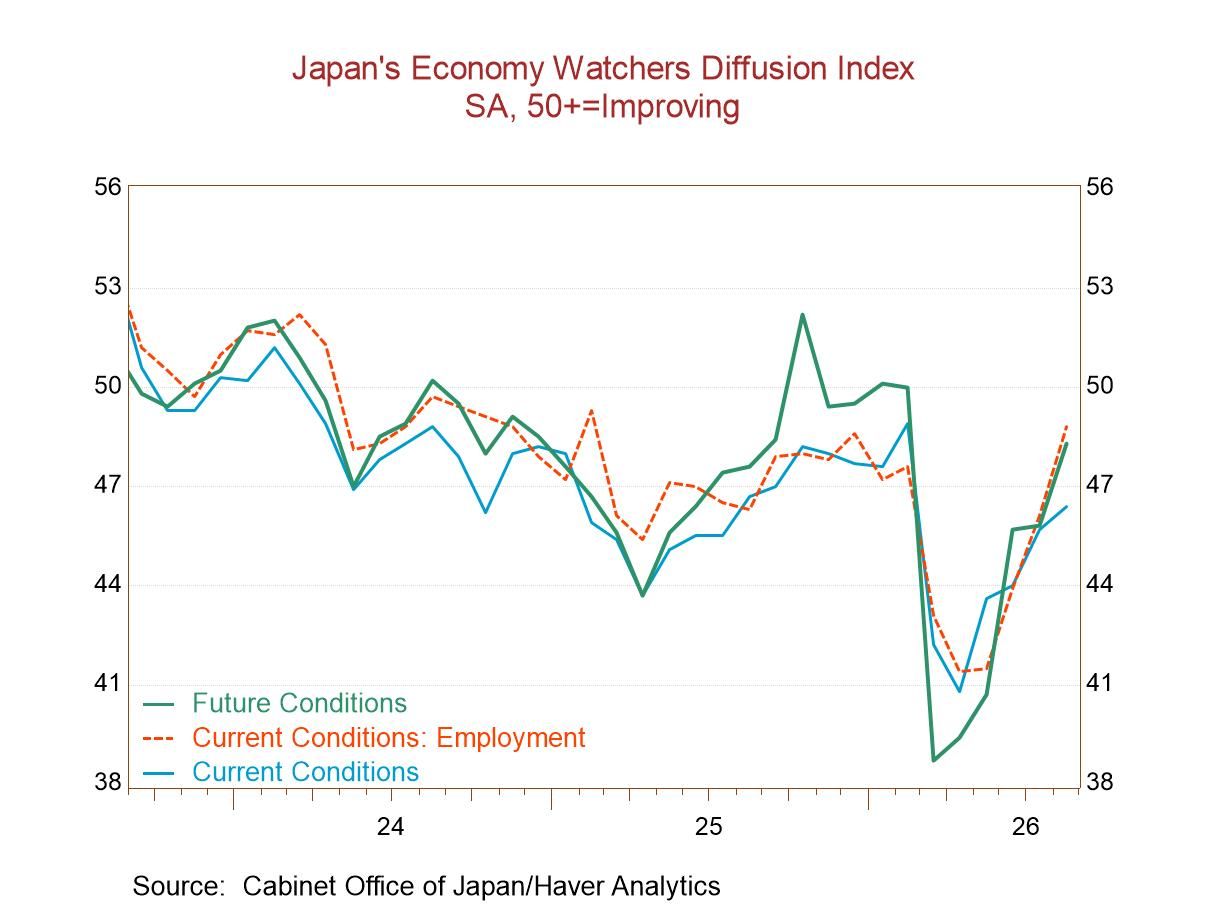
Japan's economy watchers are not in a state of bliss, but they have gradually been improving their outlook after suffering a severe setback when the attacks on Iran began.
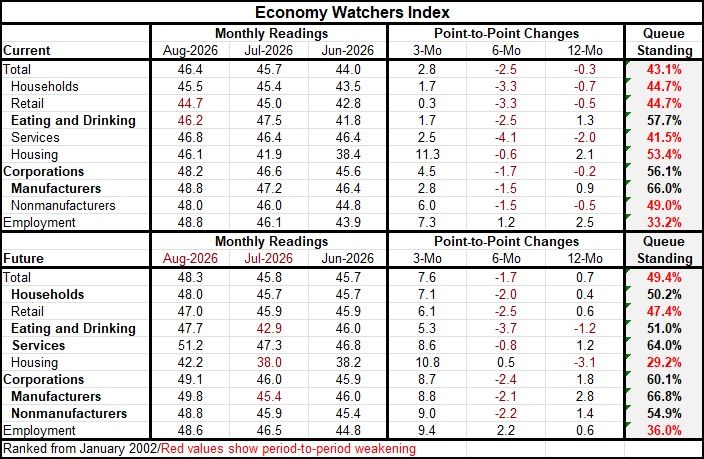
The current index for economy watchers, which is a diffusion index, at 46.4, is below 50 and therefore indicates some deterioration in attitudes about the economy. However, the reading reflects an improvement, and there has been an ongoing improvement in the current situation.
The future reading, similarly, has been improving; in August, the future index is at 48.3, also indicating some deterioration, but less than a month ago, with an ongoing improvement visible there as well.
Standings The percentile standings of the current index and the future index show slightly stronger readings for the future than for current assessments. The future index has a 49.4 percentile standing, placing it near its median for the evaluation period that goes back to August 2005. The current situation has a standing at its 43rd percentile, about 7 percentile points below its median for that period.
Current Index The current index shows three readings above their 50th percentile standings: eating & drinking places, corporations, and corporate manufacturers. However, even so, all of the current readings in August have diffusion values below 50, indicating that all are showing deterioration, although less deterioration than in the previous month.
Future Index The future reading itself is below its 50th percentile; however, six components are above their 50th percentiles. These include the overall assessment of households, the reading for eating & drinking establishments, services, corporations, including both manufacturers and nonmanufacturers as separate readings. The future reading for housing is extremely weak, with a 29.2 percentile standing, and employment has only a 36th percentile standing in the future index; that's similar to its weak 33rd percentile standing in the current index.
The lagging performance of employment in both indexes is certainly worrisome because that's the basis for jobs and spending. On the other hand, the future reading for households is above its 50th percentile. Households in the current index show a 44.7 percentile standing, below their median as well as below 50 overall, but not weak in a way that is especially worrisome.
The graph shows that there is an ongoing improvement in the assessments by the economy watchers. Their assessments dropped very sharply at the time of the Middle East conflict and the threat to oil supplies. Those assessments have since been recovering quite steadily and have moved to positions back closer to neutral, although still not to the point of registering growth. Among the current and future readings, only the reading for the service sector of the future shows a diffusion value in August above 50, indicating actual expansion; at least there's one, and that's a start.

Robert Brusca
AuthorMore in Author Profile »Robert A. Brusca is Chief Economist of Fact and Opinion Economics, a consulting firm he founded in Manhattan. He has been an economist on Wall Street for over 25 years. He has visited central banking and large institutional clients in over 30 countries in his career as an economist. Mr. Brusca was a Divisional Research Chief at the Federal Reserve Bank of NY (Chief of the International Financial markets Division), a Fed Watcher at Irving Trust and Chief Economist at Nikko Securities International. He is widely quoted and appears in various media. Mr. Brusca holds an MA and Ph.D. in economics from Michigan State University and a BA in Economics from the University of Michigan. His research pursues his strong interests in non aligned policy economics as well as international economics. FAO Economics’ research targets investors to assist them in making better investment decisions in stocks, bonds and in a variety of international assets. The company does not manage money and has no conflicts in giving economic advice.
More Economy in Brief
 Asia
Asia