U.S. NFIB Small Business Optimism Cools in August Amid Lower Business Expectations
Summary
- NFIB Small Business Optimism Idx down 1.1 pts. to 98.7 in Aug., still above its 52-year avg. of 98.0.
- Uncertainty Idx down 2 pts. to 89, remaining above the historical avg. of 68.
- Expectations for economy down 5 pts. to 10%, lowest since May.
- Hiring plans down 3 pts. to 17%; earnings trends down 3 pts. to -19%.
- Expected real sales down 1 pt. to 6%, a three-month low.
- Plans to expand business unchanged at 12%, highest since Feb.
- Firms raising avg. selling prices steady at 31%, lowest since April.
- Top three business concerns: labor quality (23%), taxes (16%), and inflation (16%).
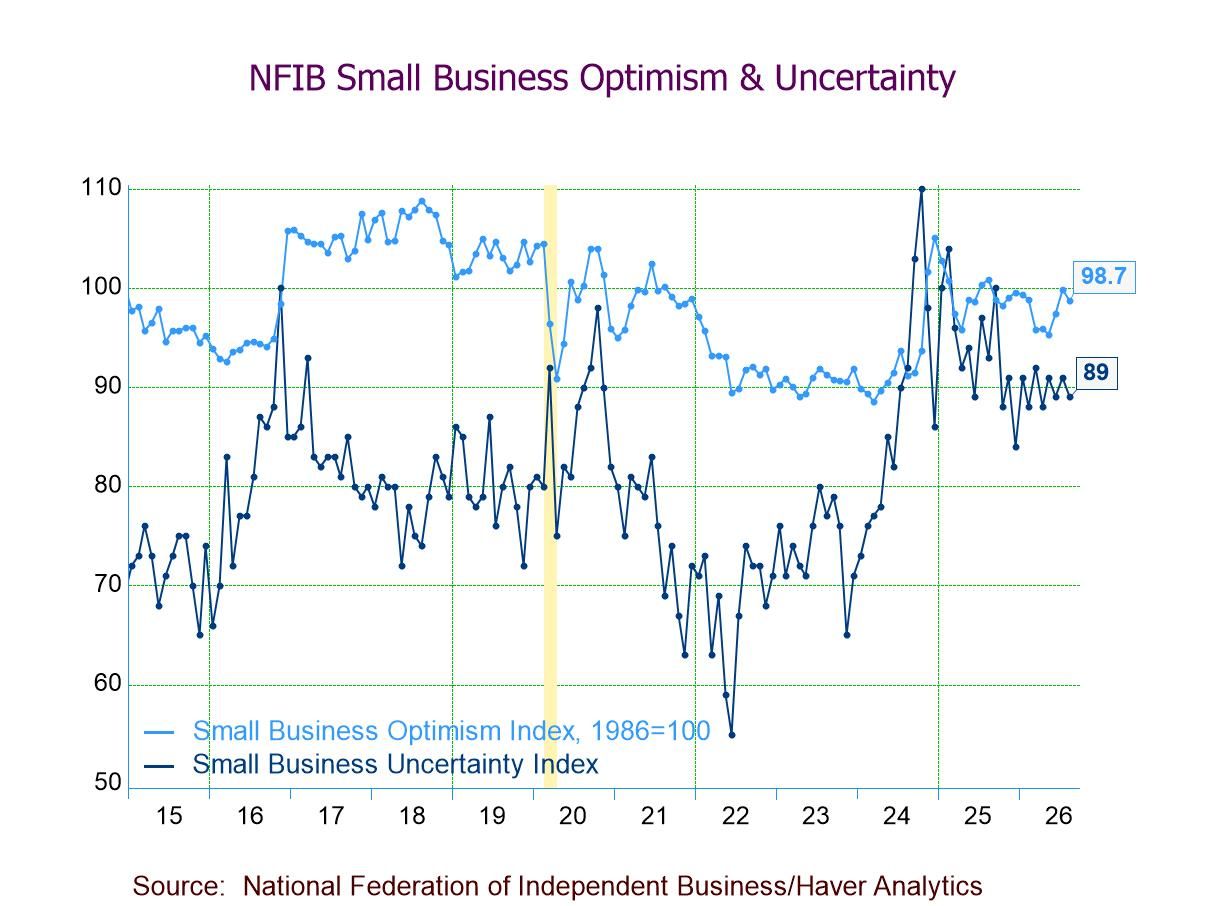
The NFIB Small Business Optimism Index slipped to 98.7 in August after a 2.4-point gain to 99.8 in July, according to the Small Business Economic Trends survey from the National Federation of Independent Business, indicating small business sentiment cooled slightly from July’s 11-month high. The decline was driven by weaker expected business conditions as well as decreases in earnings trends and plans to increase employment. The index was above its 52-year average of 98.0 for the second consecutive month and above a low of 88.5 in March 2024, albeit below 100.8 in August 2025 and a peak of 105.1 in December 2024. Six of the 10 index components fell, two rose, and two were unchanged. The NFIB Small Business Uncertainty Index declined to 89 in August following a two-point increase to 91 in July, remaining well above its historical average of 68. The index was up from its recent low of 84 in December 2025 and a low of 65 in November 2023, while below its record high of 110 in October 2024.
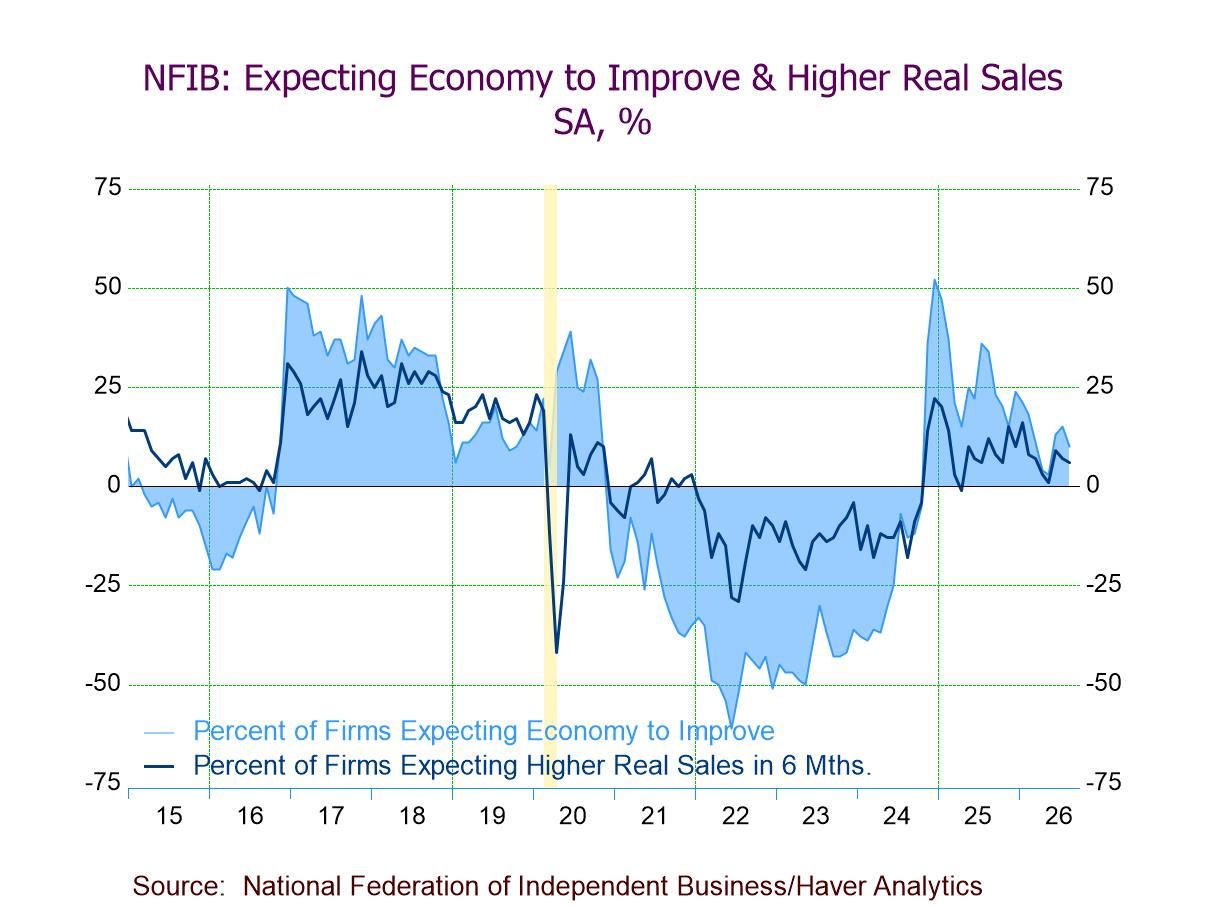
The outlook for business conditions in the next six months, while down in the August survey, remained positive for the 22nd straight month. The net balance of respondents expecting the economy to improve fell to 10% in August, the lowest level since May, following a two-point increase to 15% in July; these readings were far below a high of 52% in December 2024 but significantly above a record low of -61% in June 2022. Expected real sales dipped to a net 6% in August, a three-month low, from 7% in July; the latest result was below a high of 22% in December 2024 but above a low of -18% in August 2024. A net -9% of respondents reported higher nominal sales in the past three months, down from -4% in July and June and marking the lowest reading since November 2025; the measure remained above a low of -20% in October 2024 but below the recent positive reading of 1% in February and a peak of 9% in June 2021.
Plans to expand the business held at 12% in August and July, the highest level since February; the latest figure was below a high of 20% in December 2024 but above a low of 2% in March 2023. Plans to make capital outlays edged down to 24% in August from 25% in July (the highest reading since December 2024); these numbers were below a high of 28% in November 2024 and a peak of 31% in October 2021. Expected credit conditions improved to -2% in August from -4% in July; this result matched a high of -2% in December 2024 and remained above a low of -11% in November 2023. Meanwhile, a net -1% of respondents viewed current inventory stocks as “too low” in August, slightly up from -2% in July; the series had been negative since June 2025, with zero readings only for two months (June 2026 and August 2025); the positive reading of 1% was recorded in May 2025.
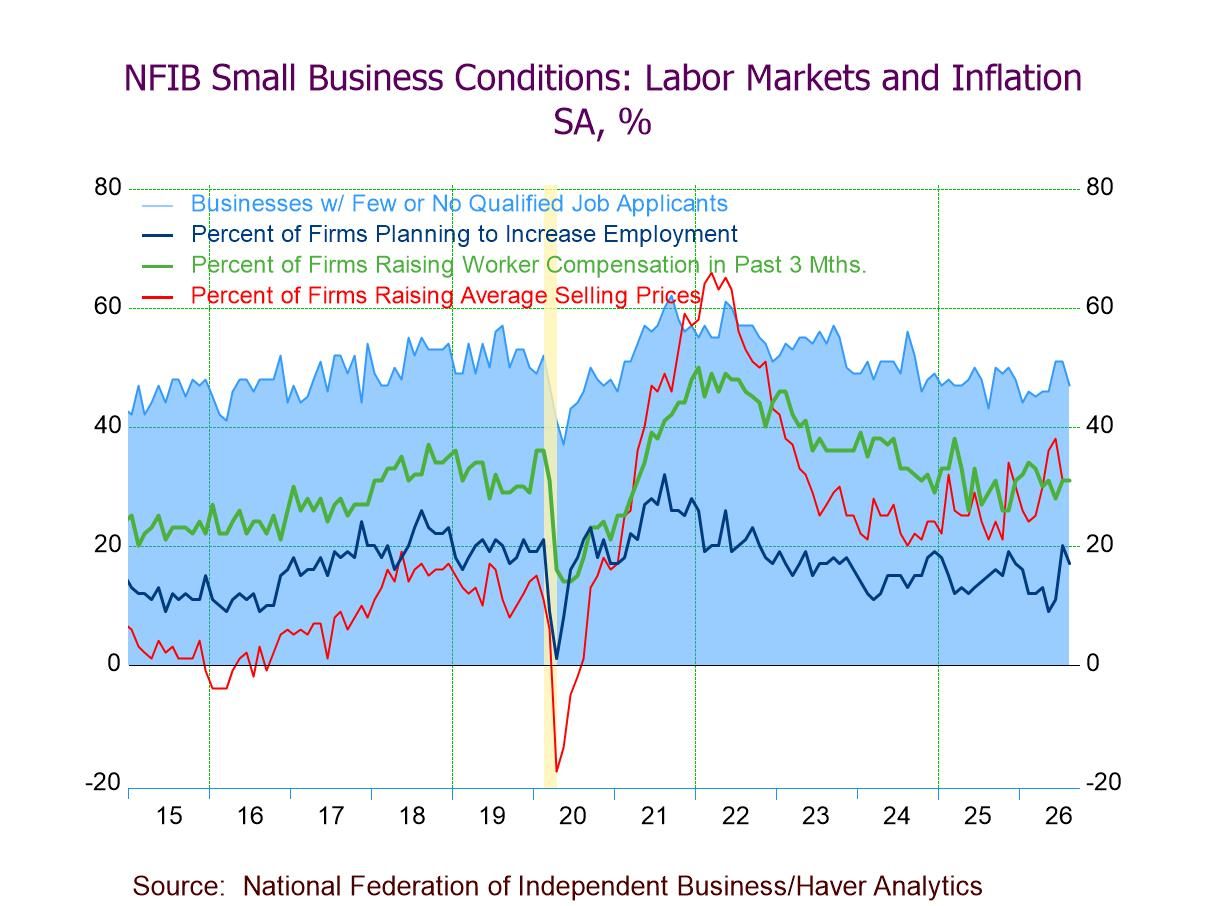
On the labor front, 47% of respondents reported that qualified workers to fill job openings were hard to find in August, down from 51% in July and June (the highest level since September 2024). These numbers were above a low of 43% in August 2025 but below a high of 56% in August 2024 and a peak of 62% in September 2021. A net 17% planned to increase employment in August, down from 20% in July (the highest level since October 2022); it remained above its most recent low of 9% in May but below a peak of 32% in August 2021. Notably, 35% reported positions not able to be filled in August, slightly down from 36% in July (the highest reading since June 2025); these figures remained below a high of 51% in May 2022.
Overall earnings trends had remained in negative territory since December 2019. The measure fell to -19% in August following a four-point increase to -16% in July. These readings were below the most recent high of -14% in February and a high of -5% in June 2021 but above a low of -37% in August 2024.
On the pricing front, actual and expected selling prices remained at an inflationary level, indicating continued inflationary pressures. The net percent of firms raising their average selling prices held at a still-elevated 31% in August and July, the lowest level since April, after a two-point increase to 38% in June. The latest reading was up from a low of 20% in August 2024 but well below a peak of 66% in March 2022. The percentage planning to raise prices registered at 28% in August and July, also the lowest since April, following a two-point decline to 32% in June; these readings remained above a low of 21% in April 2023.
Wage inflation remained relatively high in the August survey. A net 31% of respondents raised compensation during the last three months, unchanged from July and equaling May’s reading. It was above a low of 26% in November 2025 but below a high of 46% in February 2023 and a peak of 50% in January 2022. A net 18% of firms planned to raise worker compensation in the next three months, down from 19% in July (the highest level since February); this remained below highs of 28% in November 2024, 30% in November 2023, and 32% in October 2022.
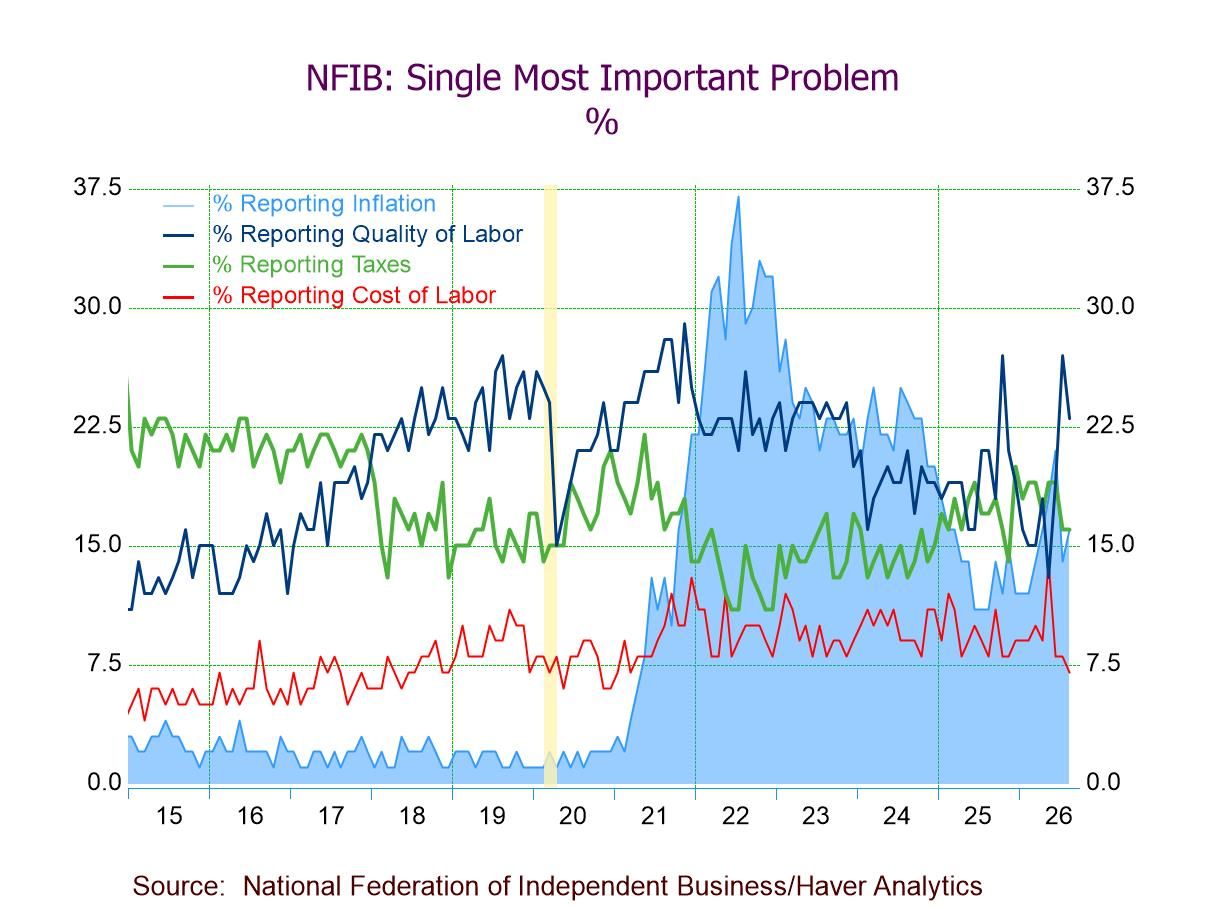
Labor quality was cited as the single most important problem facing small businesses, as reported by 23% of NFIB members in August, down from 27% in July (the highest since October 2025). Taxes ranked second as the next most important problem (alongside inflation), as reported by 16% of respondents in August, unchanged from July and representing the lowest since November 2025. Inflation also remained a key challenge for small businesses, as reported by 16% of respondents in August, up from a four-month low of 14% in July; these readings were well below a peak of 37% in July 2022. Other concerns (in August vs. July) included poor sales (10% vs. 8%), government requirements (9% vs. 7%), insurance cost/availability (8% vs. 8%), labor costs (7% vs. 8%), and competition from large businesses (4% vs. 7%).
According to the Small Business Administration, there are 33 million small businesses in the United States, which employ 62 million workers. The NFIB surveys anywhere from 500 to 2000 respondents each month and the typical firm employs 10 people and reports gross sales of about $500,000 a year. The NFIB figures can be found in Haver’s SURVEYS database.

Winnie Tapasanun
AuthorMore in Author Profile »Winnie Tapasanun has been working for Haver Analytics since 2013. She has 20+ years of working in the financial services industry. As Vice President and Economic Analyst at Globicus International, Inc., a New York-based company specializing in macroeconomics and financial markets, Winnie oversaw the company’s business operations, managed financial and economic data, and wrote daily reports on macroeconomics and financial markets. Prior to working at Globicus, she was Investment Promotion Officer at the New York Office of the Thailand Board of Investment (BOI) where she wrote monthly reports on the U.S. economic outlook, wrote reports on the outlook of key U.S. industries, and assisted investors on doing business and investment in Thailand. Prior to joining the BOI, she was Adjunct Professor teaching International Political Economy/International Relations at the City College of New York. Prior to her teaching experience at the CCNY, Winnie successfully completed internships at the United Nations. Winnie holds an MA Degree from Long Island University, New York. She also did graduate studies at Columbia University in the City of New York and doctoral requirements at the Graduate Center of the City University of New York. Her areas of specialization are international political economy, macroeconomics, financial markets, political economy, international relations, and business development/business strategy. Her regional specialization includes, but not limited to, Southeast Asia and East Asia. Winnie is bilingual in English and Thai with competency in French. She loves to travel (~30 countries) to better understand each country’s unique economy, fascinating culture and people as well as the global economy as a whole.
More Economy in Brief
 Global