German PPI Shows Pressure but Backs Off in June
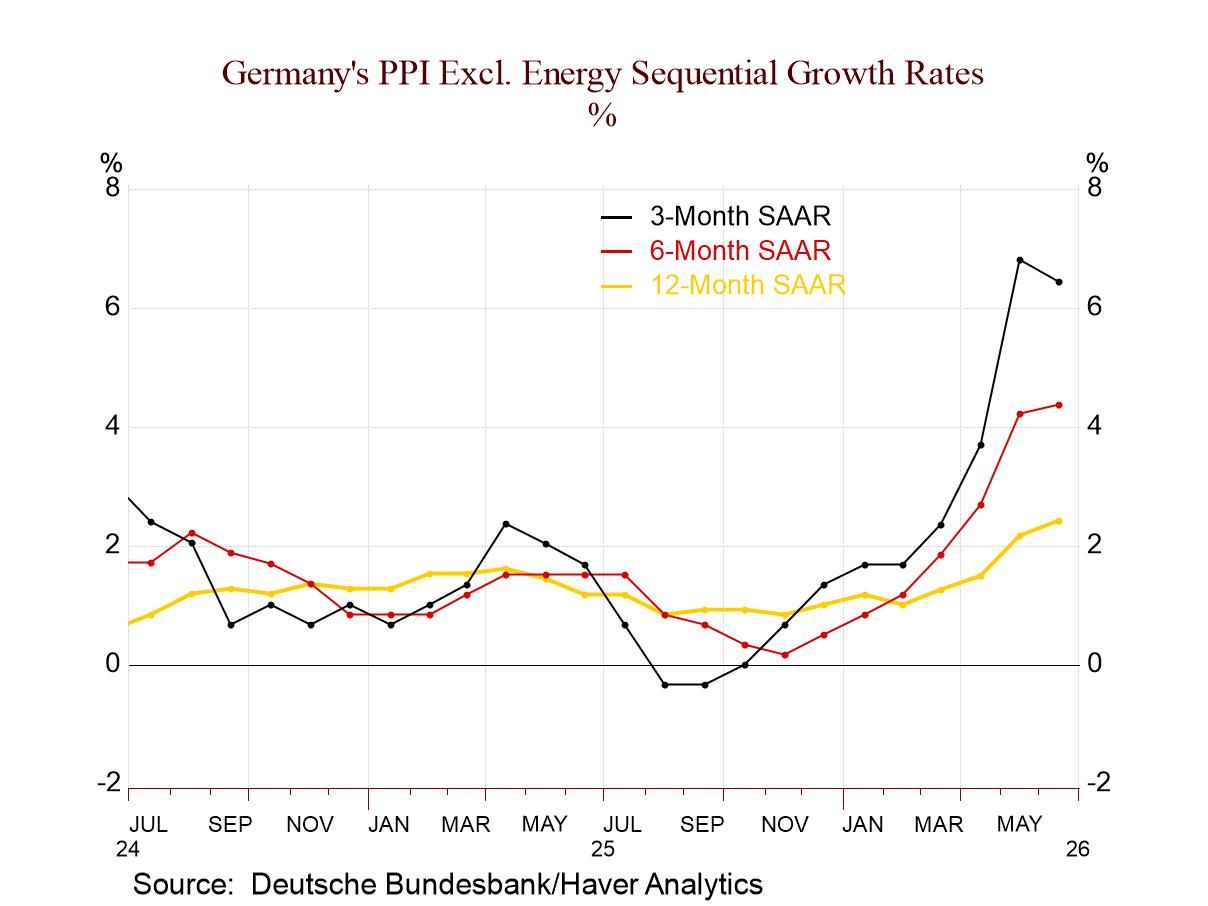
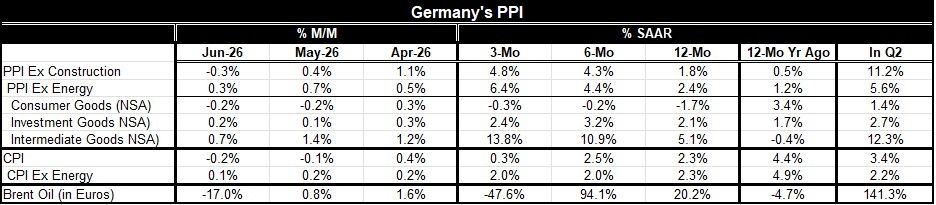
The German PPI excluding construction fell by 0.3% in June following three months of increases. Sequentially, the PPI is accelerating, with a 1.8% rise over 12 months, a gain at a 4.3% annual rate over six months, and a gain at a 4.8% annual rate over three months. They are joined by PPI excluding energy index, which also shows an accelerating pattern, rising 2.4% over 12 months, at a 4.4% annual rate over six months, and then at a 6.4% annual rate over three months.
The inflation picture for in June is fine if you restrict your view to the headline, where it dropped by 0.3%. However, the PPI excluding energy rose by 0.3% in June after rising by 0.7% in May and by 0.5% in April, definitely a string of unruly increases for producer prices in Germany.
Sector trends: The sector inflation metrics are not seasonally adjusted; as a result, a sequential trend may not be as reliable. On the other hand, when data aren't seasonally adjusted, it's often because the statistical authorities haven't detected stable patterns of seasonality and so they present the data as not seasonally adjusted. Let’s look at the sector trends, NSA. For consumer goods, prices fall by 1.7% over 12 months, followed by a 0.2% annualized fall over six months and at a 0.3% annual drop over three months. The pattern is not particularly reassuring as the pace of decline is waning sequentially, although consumer goods are producing declines and showing price weakness. Investment goods, on the other hand, show prices steadily expanding, by 2.1% over 12 months, by 3.2% annually over six months but then stepping back slightly toward a 2.4% annual gain over three months. Not surprisingly, the inflation fire is really cooking under intermediate goods, where raw materials have a bigger role. Intermediate goods prices are up by 5.1% over 12 months; unadjusted prices are up at a 10.9% annual rate over six months and then at a 13.8% annual rate over three months. This is clearly the source of the price pressure in the PPI.
Energy prices: Energy prices are only part of the problem, however, and we can see in the energy prices at the bottom of the table that they are producing some strange and unstable price trends. Brent oil prices measured in euros fell 17% month-to-month in June after rising by 0.8% in May and by 1.6% in April. Sequentially, Brent prices are up by 20.2% over 12 months and up at a 94.1% annual rate over six months, but then they fall to a 47.6% annual rate over three months. Against that background, prices in the second quarter compared to the first quarter show an increase at a 141.3% annual rate. These metrics explain why it's hard to pin down the oil-price impact on the PPI. The quarter-to-quarter changes are enormous, the three-month change is extremely weak, but that follows an extraordinary annualized gain over six months, and in June alone oil prices fell sharply by 17%. It is hard to keep track of the oil-price passthrough cycle. So, we're going to have to wait for these trends to sort themselves out to get a better fix on the impact of oil and energy prices. However, we know that the recent good news on oil has since been rescinded as the Strait of Hormuz, which was briefly open, is shut again and the U.S. and Iran have scrapped their fledgling ceasefire agreement.
Euro area—what matters: Policy in the euro area is made based upon inflation for the whole union, not just for Germany, but it pays closer attention to the CPI than the PPI. Germany is still the largest economy in the monetary union, and its CPI is up 2.3% over 12 months, up at a 2.5% annual rate over six months, and rising at a 0.3% annual rate over three months. The CPI excluding energy for Germany is considerably more stable, up by 2.3% over 12 months and then rising at a 2% annual rate over both six months and three months. German ex-energy CPI prices appear to be calm, with inflation arrested; however, we can't say the same thing for the PPI ex-energy, with the inflation rate in a clear accelerating mode.
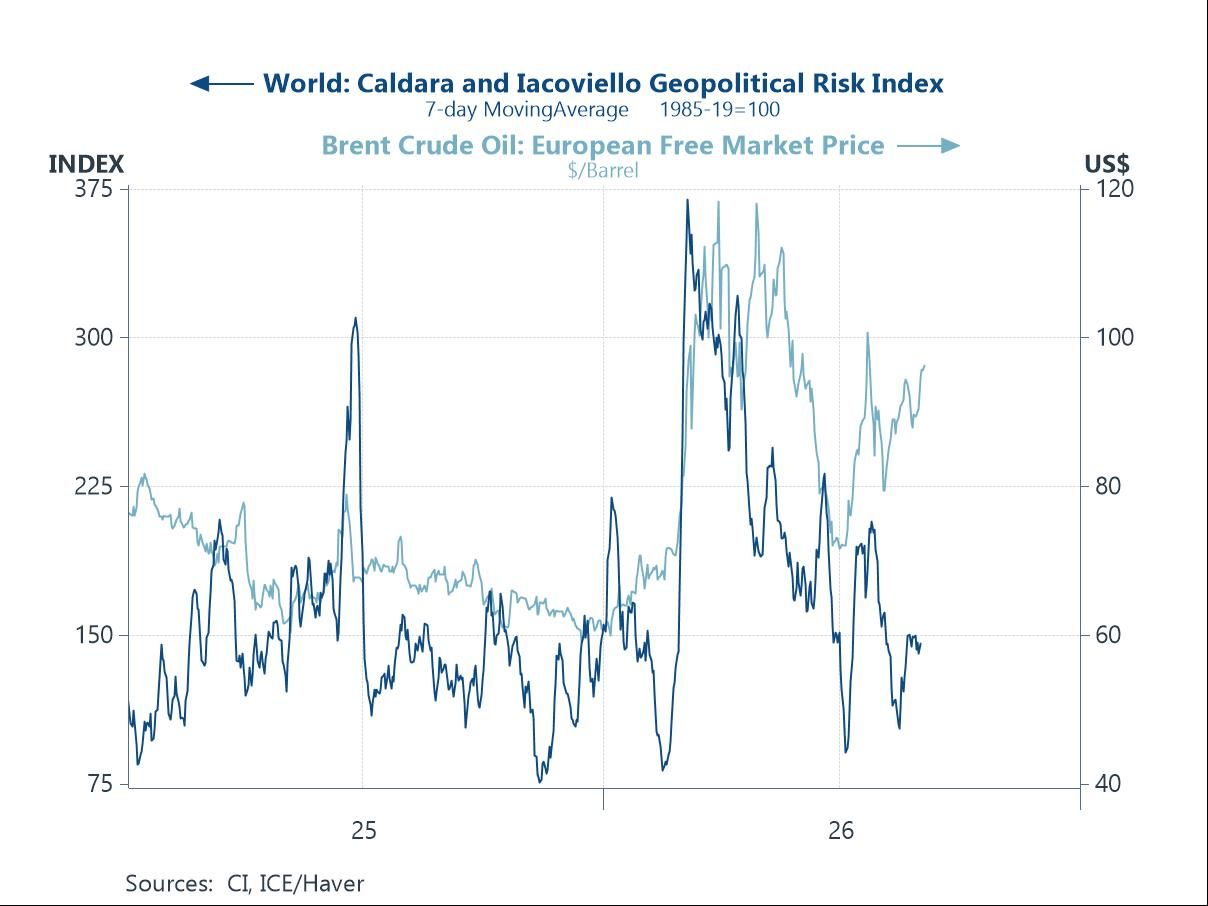
With the Strait of Hormuz closed again, we will be looking at the impact of higher energy prices on inflation in the local economies. The ECB will be meeting this week; it is not expected to change rates. However, it started to raise rates at its previous meeting while it forged ahead not waiting for the U.S. to start the next cycle. Having had a brief hiatus from rising oil prices because of the short closure of the Strait and the relief that it brought in June may be enough to keep the ECB on the sidelines for a meeting. But looking farther ahead, there is still a great deal of geopolitical conflict with Ukraine showing an ability to reach and bomb Russian oil facilities as well as some of its more important commercial sites. The U.S. has gone back to bombing Iran, focusing more on its infrastructure and threatening to some of its power supplies. Iran has shown some unexpected teeth, unleashing missile attacks on fellow Arab countries in the Middle East rather than aiming at Israel; Iran has struck at a U.S. base in Jordan. After thinking that the U.S. had defanged Iran, it continues to launch missiles and now appears to have missiles that are faster and more evasive than those used earlier, raising the question of where Iran is getting help from and perhaps also how that help is getting into the country. It is unclear what the next move will be in the Middle East.

Robert Brusca
AuthorMore in Author Profile »Robert A. Brusca is Chief Economist of Fact and Opinion Economics, a consulting firm he founded in Manhattan. He has been an economist on Wall Street for over 25 years. He has visited central banking and large institutional clients in over 30 countries in his career as an economist. Mr. Brusca was a Divisional Research Chief at the Federal Reserve Bank of NY (Chief of the International Financial markets Division), a Fed Watcher at Irving Trust and Chief Economist at Nikko Securities International. He is widely quoted and appears in various media. Mr. Brusca holds an MA and Ph.D. in economics from Michigan State University and a BA in Economics from the University of Michigan. His research pursues his strong interests in non aligned policy economics as well as international economics. FAO Economics’ research targets investors to assist them in making better investment decisions in stocks, bonds and in a variety of international assets. The company does not manage money and has no conflicts in giving economic advice.
More Economy in Brief
 Asia
Asia