Global| Aug 21 2026
Flash S&P PMIs Show Ongoing Improvement Amid Unsettled Geopolitics
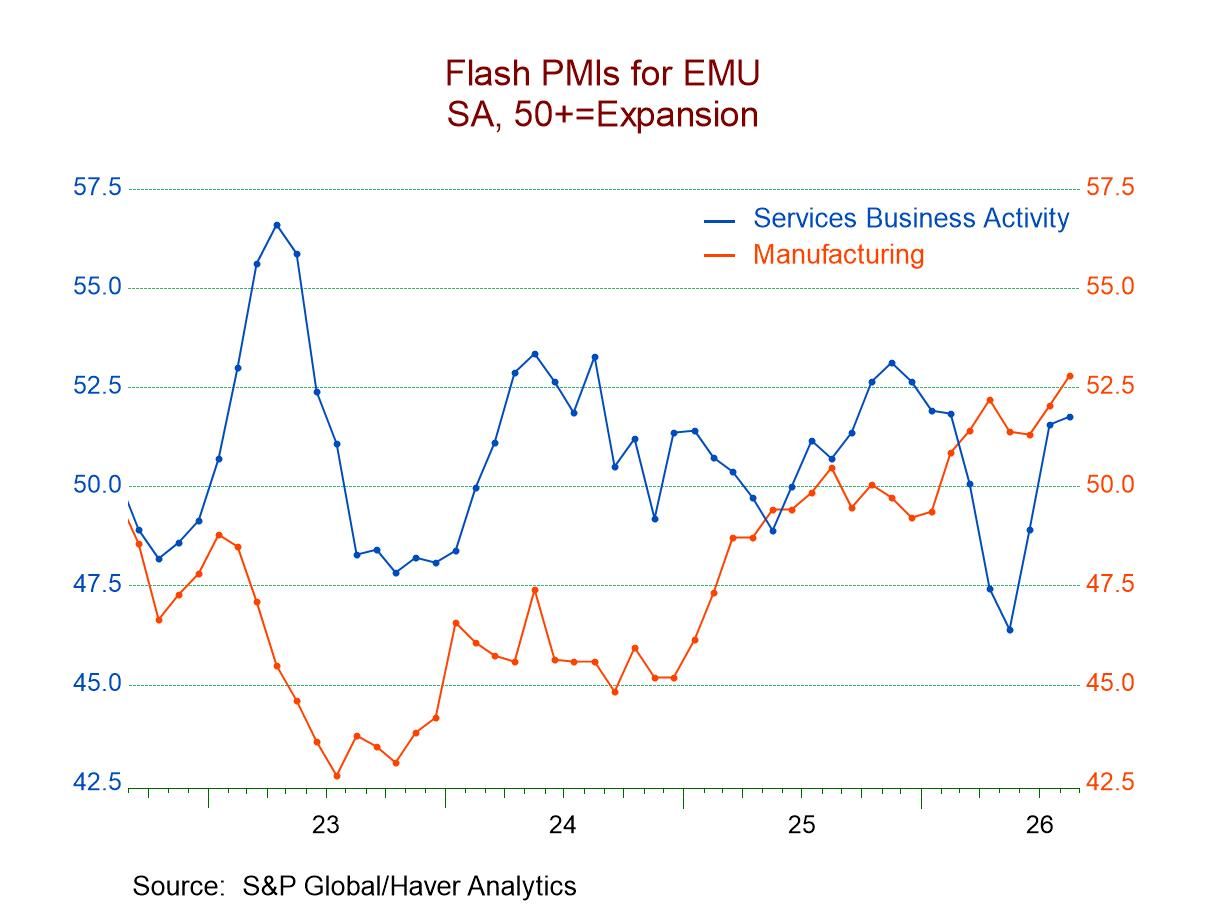
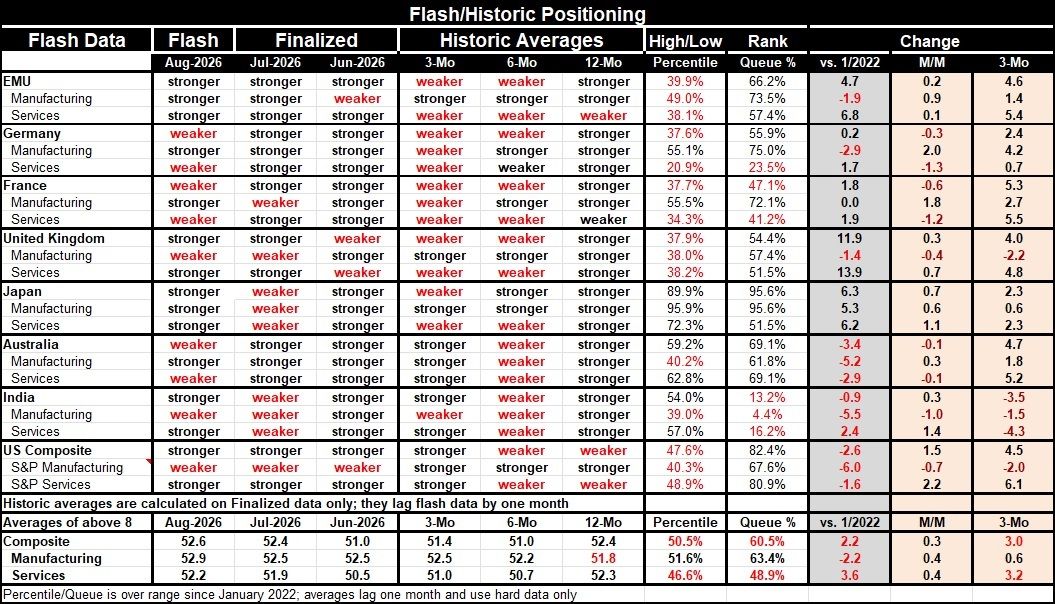
The S&P PMIs show a mixture of strength and weakness in August. However, the readings on average show the composite stronger in August than in July, the manufacturing readings stronger in August than in July, and the services readings slightly stronger in August than in July. That suggests there's broad sectoral improvement underway. However, there's still a great deal of irregularity. The composite indexes rose in five of the eight early reporting countries, with Australia, France, and Germany showing monthly weakening. Despite the weakening in France and Germany, the European Monetary Union showed better conditions on balance. Manufacturing sectors improved in August except for the United States, India, and the United Kingdom. France and Germany also had the only weakening service sectors in August.
Apart from August, the three-month, six-month, and 12-month averages, compiled only on completed data through July, show a bit more weakening. Five countries show composite readings weakening over three months compared to six months, with only the U.S., India, and Australia getting stronger. Over six months, all of the reporters’ composite values are weaker compared with their 12-month values on average, with only Japan getting stronger. For 12 months compared to 12 months ago, all the reporters are stronger and they're stronger on almost all of their readings except for the U.S. The U.S. composite is weaker over 12 months on average, compared to 12 months ago, and its service sector is weaker. The EMU composite is stronger, but the service sector is weaker compared to 12 months ago.
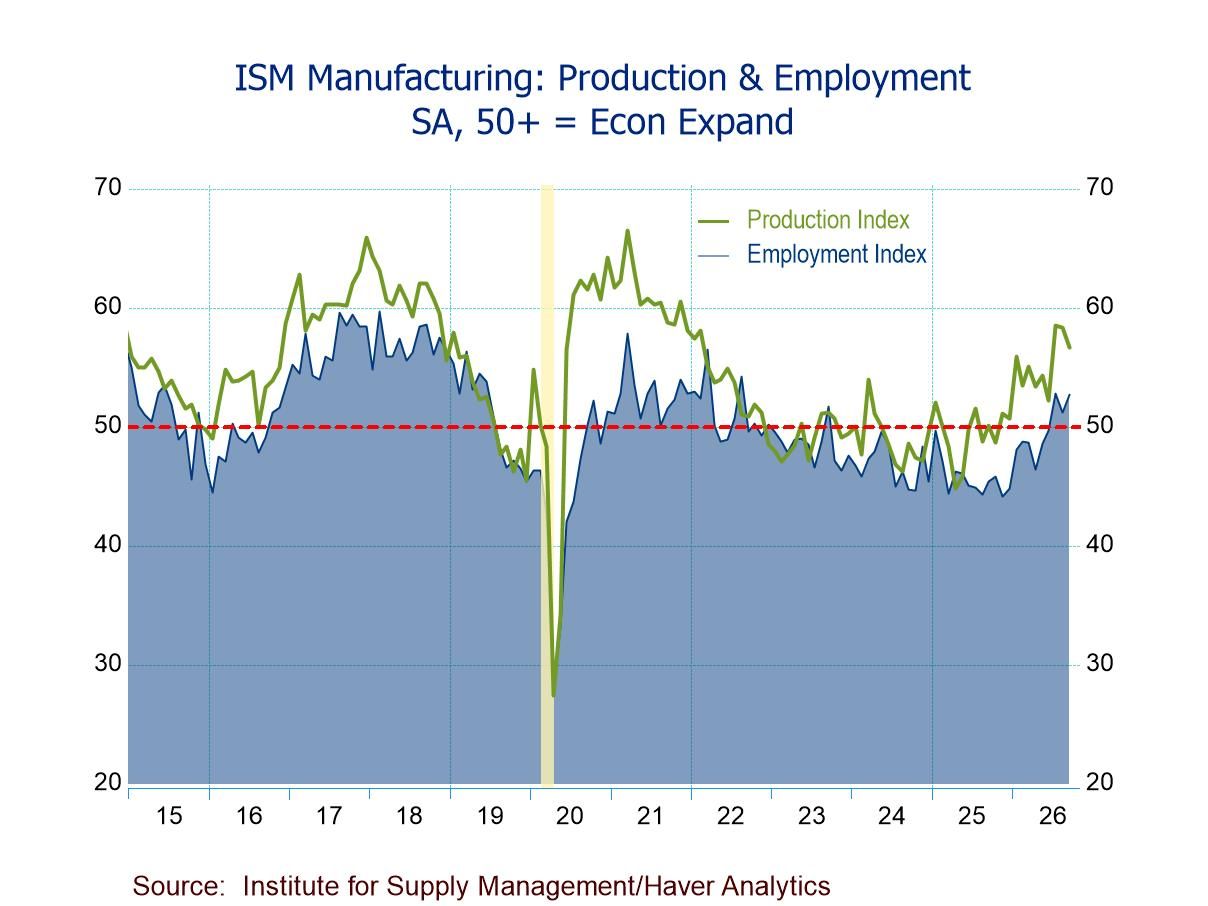
However, in terms of standings, the queue percentile standings for the group are quite good and have been clearly progressing over recent months. The average composite queue standing is in its 60th percentile. For manufacturing, it's in its 63rd percentile, while for services, the average is only in its nearly 49th percentile, just barely below its historic median. Manufacturing PMIs are on a long climb higher. The composite queue readings are dragged down by services, particularly in India but also in Germany and France. The U.K. and Japan have readings above 50 but by the thinnest of margins. The U.S. has a strong service sector by ranking, in its 80th percentile compared to where it's been since 2021. The next strongest ranking is a 69th percentile standing in Australia, and after that, it's a 57th percentile standing in the EMU. The services reading has been in a trendless oscillation since at least mid-2022.
Global conditions are changing in some ways for the worse since the Middle East is looking more intractable. Markets seem to see oil prices as higher for longer as Iran has a death-grip on the Strait of Hormuz. And that is about the only leverage it has, except for its ability to shoot off a rogue missile or drone to try to catch defense systems napping or to attack a ship in the strait. It’s more than enough to prevent normalcy. For now, it is a very uneasy stalemate. It has markets on edge, inflation rates are rising, and bond markets are on their back foot or worse. Fiscal budgets are already stretched globally, and more military spending appears to be on tap. For now, equity markets are still plugged into optimism.

Robert Brusca
AuthorMore in Author Profile »Robert A. Brusca is Chief Economist of Fact and Opinion Economics, a consulting firm he founded in Manhattan. He has been an economist on Wall Street for over 25 years. He has visited central banking and large institutional clients in over 30 countries in his career as an economist. Mr. Brusca was a Divisional Research Chief at the Federal Reserve Bank of NY (Chief of the International Financial markets Division), a Fed Watcher at Irving Trust and Chief Economist at Nikko Securities International. He is widely quoted and appears in various media. Mr. Brusca holds an MA and Ph.D. in economics from Michigan State University and a BA in Economics from the University of Michigan. His research pursues his strong interests in non aligned policy economics as well as international economics. FAO Economics’ research targets investors to assist them in making better investment decisions in stocks, bonds and in a variety of international assets. The company does not manage money and has no conflicts in giving economic advice.
More Economy in Brief