Belgian Consumer on the Edge?
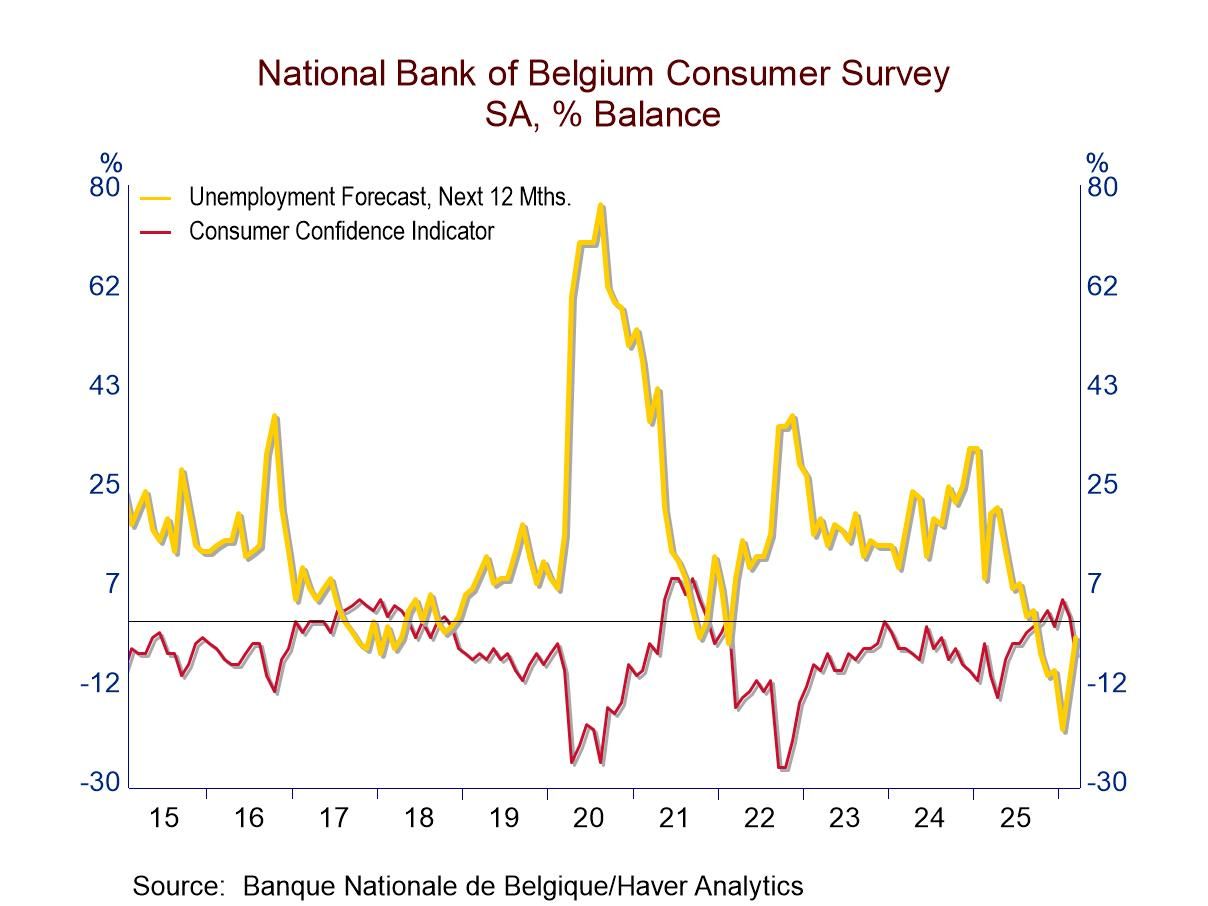
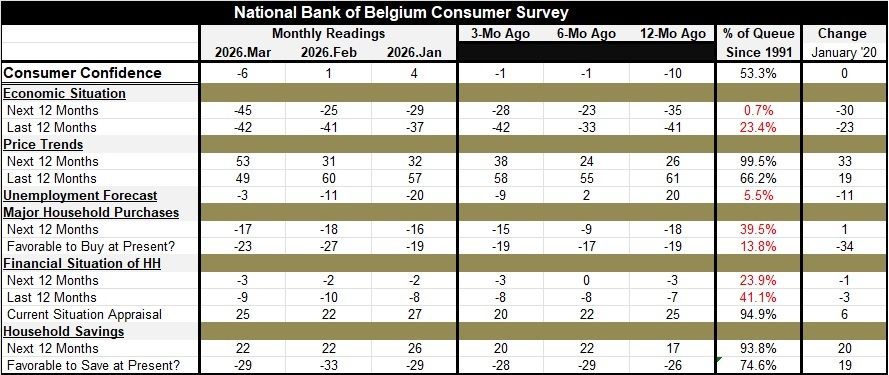
The Belgian consumer may be on the edge of a sudden deterioration based on responses to the National Bank of Belgium Consumer Survey for March. The consumer confidence reading registered at -6 in March compared to +1 in February. And on data back to 1991, this gives the consumer confidence metric a ranking in its 53rd percentile, slightly above the median for this span. For ranked data, the median occurs at the 50th percentile.
However, the response by consumers to the current situation appraisal gives them an extremely high 94.9 percentile ranking which suggests that the Belgian consumer is quite happy; however, the financial situation for households as appraised over the next 12 months has a reading of -3 in March, with a queue percentile standing at a 23.9 percentile mark in the lower quartile of its ranked responses since 1991. It's clearly a very difficult situation to be extremely happy with the current situation but to be concerned about your financial situation over the next 12 months.
Households rate the next 12 months as relatively inhospitable to make major household purchases as well. The reading at -17 in March is just a tick higher than -18 in February and has a rank standing in its 39.5 percentile. Despite the upbeat ranking of the current situation, households do not rank the current situation as a good time to buy as the favorability to purchase goods at present has a ranking in its 13.8 percentile. Clearly, the Belgian consumer is facing cross-currents and a deteriorating trend.
Among those cross-currents, however, is not a great concern about unemployment. The unemployment reading did rise month-to-month to -3 in March from -11 in February and from -20 in January. Concerns about unemployment have been rising; however, they still have a very low 5.5 percentile standing.
One of the concerns percolating in the background is about inflation. Price trends over the last 12 months had eased to some extent, to 66.2 percentile standing. However, over the next 12 months the reading has picked up to 53 from 31 previously, to a 99.5 percentile standing; concerns about inflation have turned around and now are extremely high.
Consumers rate the economic situation at a -45 in March compared to -25 in February looking ahead to the next 12 months. The queue standing for this reading is in its 0.7 percentile, one of the lowest ratings that we have seen since 1991. The assessment for the previous 12 months has a raw diffusion net score of -42, with the standing in its 23rd percentile. Conditions have deteriorated extremely rapidly in terms of the outlook for the economic situation.
The survey by the National Bank of Belgium shows the Belgian consumer is going through a significant transition. Concerns about unemployment are not high, but they are deteriorating. Concerns about inflation, however, have ramped up. And concerns about the economic situation ahead have deteriorated to an extreme level. Consumers view their current financial situation as quite good at the moment, but they expect it to deteriorate over the next 12 months. These assessments set a very difficult table for policy for the period ahead.

Robert Brusca
AuthorMore in Author Profile »Robert A. Brusca is Chief Economist of Fact and Opinion Economics, a consulting firm he founded in Manhattan. He has been an economist on Wall Street for over 25 years. He has visited central banking and large institutional clients in over 30 countries in his career as an economist. Mr. Brusca was a Divisional Research Chief at the Federal Reserve Bank of NY (Chief of the International Financial markets Division), a Fed Watcher at Irving Trust and Chief Economist at Nikko Securities International. He is widely quoted and appears in various media. Mr. Brusca holds an MA and Ph.D. in economics from Michigan State University and a BA in Economics from the University of Michigan. His research pursues his strong interests in non aligned policy economics as well as international economics. FAO Economics’ research targets investors to assist them in making better investment decisions in stocks, bonds and in a variety of international assets. The company does not manage money and has no conflicts in giving economic advice.
More Economy in Brief
 Global