Global| Apr 03 2009
U.S. Jobless Rate Reaches 8.5%; 5.1 Million Payroll Jobs Are Lost Since Cycle Peak
by:Tom Moeller
|in:Economy in Brief
Summary
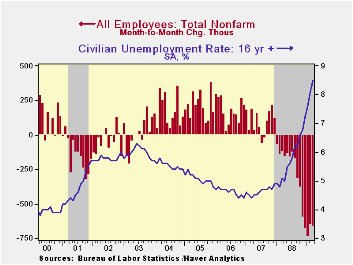
The March employment figures showed that there was little, if any, diminution in the pace of job loss. Nonfarm payrolls fell an expected 663,000 following their unrevised 651,000 worker drop during February. The loss of employment [...]
 The March
employment figures showed that there was little, if any, diminution in
the pace of job loss. Nonfarm payrolls fell an
expected 663,000 following their unrevised 651,000 worker drop during
February. The loss of employment spread across industries. The Bureau
of Labor Statistics indicated, furthermore, that the number of payroll
jobs lost during this recession so far totals 5.1 million, the record
for a 15-month period. Even after accounting for the labor force's
larger size, that's a huge number. In percentage terms, jobs are down
3.7% since the 2007 peak, close to a record.
The March
employment figures showed that there was little, if any, diminution in
the pace of job loss. Nonfarm payrolls fell an
expected 663,000 following their unrevised 651,000 worker drop during
February. The loss of employment spread across industries. The Bureau
of Labor Statistics indicated, furthermore, that the number of payroll
jobs lost during this recession so far totals 5.1 million, the record
for a 15-month period. Even after accounting for the labor force's
larger size, that's a huge number. In percentage terms, jobs are down
3.7% since the 2007 peak, close to a record.
The weakness in payrolls also was associated with a jump in the unemployment rate to an expected 8.5%, the highest level since November of 1983. The unemployment rate reached its recent low of 4.4% in October of 2006. Last months' increase was fueled by an 861,000 drop in household employment (-3.5% y/y) and a 166,000 drop (+0.1% y/y) drop in the labor force.
Long-term unemployment has risen substantially.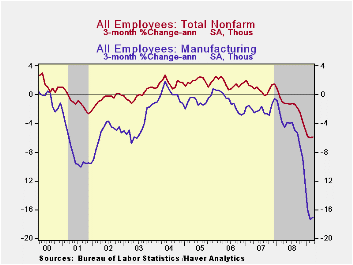 The
average duration of unemployment rose even further in March to 20.1
weeks, up from 16.9 weeks during 2007. The number of those unemployed
for longer than 15 weeks more than doubled during the last year and
they accounted for nearly half of all those who are unemployed.
Long-term unemployment has discouraged workers. The ranks of those who
have dropped out of the labor force has grown by nearly one-quarter
during the last year to 5.8 million.
The
average duration of unemployment rose even further in March to 20.1
weeks, up from 16.9 weeks during 2007. The number of those unemployed
for longer than 15 weeks more than doubled during the last year and
they accounted for nearly half of all those who are unemployed.
Long-term unemployment has discouraged workers. The ranks of those who
have dropped out of the labor force has grown by nearly one-quarter
during the last year to 5.8 million.
The payroll employment figures indicate that the breadth of job loss continues to grow. Only 22.0% of industries were hiring last month, half that of last March and down from the 2006 peak of 24.9%. Over a six-month period, just 15.7% of firms were hiring. The breadth of the downturn includes 126,000 construction industry jobs lost last month, bringing the total to 1.3 million since early 2007. Factory jobs were down another 161,000 in March, adding to the 10-year downtrend during which over 5 million jobs (29.1%) have been shed. The job market has turned so sour that the somewhat immune service sector has suffered. It lost 353,000 jobs last month and 2.8 million (3.0%) since the peak in late 2007. Even government sector hiring has slowed. The 81,000 rise in payrolls last month left them up just 0.4% y/y. Hiring by local governments has been unchanged since last year.
Fewer workers worked fewer hours last
month and the length of the average workweek fell to 33.2 hours, a
record low. 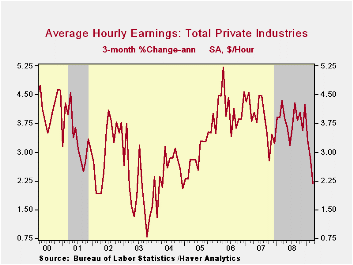 For the first quarter, the combination of lower employment
and fewer hours-worked brought aggregate hours down by 8.7% (AR) from
4Q' 08. That rate of decline was even faster than during 4Q and
suggests negative growth in real GDP in excess of 7% in 1Q '09.· The
weak labor market has taken a toll on average hourly earnings in
private industries. The 0.2% gains in each of the last three months
lowered the annualized rate of growth by half since last year to 2.2%.
In the construction and the goods producing sectors, growth in average
hourly earnings was negative.
For the first quarter, the combination of lower employment
and fewer hours-worked brought aggregate hours down by 8.7% (AR) from
4Q' 08. That rate of decline was even faster than during 4Q and
suggests negative growth in real GDP in excess of 7% in 1Q '09.· The
weak labor market has taken a toll on average hourly earnings in
private industries. The 0.2% gains in each of the last three months
lowered the annualized rate of growth by half since last year to 2.2%.
In the construction and the goods producing sectors, growth in average
hourly earnings was negative.
The figures referenced above are available in Haver's USECON database. Additional detail can be found in the LABOR and in the EMPL databases.
Policies to Bring Us Out of the Financial Crisis and Recession is this morning's speech by Fed Vice Chairman Donald L. Kohn and it is available here.
| Employment: 000s | March | February | January | Y/Y | 2008 | 2007 | 2006 |
|---|---|---|---|---|---|---|---|
| Payroll Employment | -663 | -651 | -741 | -3.5% | -0.4% | 1.1% | 1.8% |
| Previous | -- | -651 | -655 | -- | -0.3% | 1.1% | 1.8% |
| Manufacturing | -161 | -169 | -262 | -9.8% | -3.3% | -2.0% | -0.5% |
| Construction | -126 | -107 | -135 | -12.5% | -5.5% | -0.8% | 4.9% |
| Service Producing | -358 | -366 | -336 | -2.2% | 0.2% | 1.6% | 1.8% |
| Average Weekly Hours | 33.2 | 33.3 | 33.3 | 33.8 (March '08) | 33.6 | 33.8 | 33.9 |
| Average Hourly Earnings | 0.2% | 0.2% | 0.2% | 3.4% | 3.8% | 4.0% | 3.9% |
| Unemployment Rate | 8.5% | 8.1% | 7.6% | 4.8% March '08) | 5.8% | 4.6% | 4.6% |

Tom Moeller
AuthorMore in Author Profile »Prior to joining Haver Analytics in 2000, Mr. Moeller worked as the Economist at Chancellor Capital Management from 1985 to 1999. There, he developed comprehensive economic forecasts and interpreted economic data for equity and fixed income portfolio managers. Also at Chancellor, Mr. Moeller worked as an equity analyst and was responsible for researching and rating companies in the economically sensitive automobile and housing industries for investment in Chancellor’s equity portfolio. Prior to joining Chancellor, Mr. Moeller was an Economist at Citibank from 1979 to 1984. He also analyzed pricing behavior in the metals industry for the Council on Wage and Price Stability in Washington, D.C. In 1999, Mr. Moeller received the award for most accurate forecast from the Forecasters' Club of New York. From 1990 to 1992 he was President of the New York Association for Business Economists. Mr. Moeller earned an M.B.A. in Finance from Fordham University, where he graduated in 1987. He holds a Bachelor of Arts in Economics from George Washington University.
More Economy in Brief
 Global| Aug 21 2026
Flash S&P PMIs Show Ongoing Improvement Amid Unsettled Geopolitics