U.S. Trade Deficit Narrows to Five-Year Low in September
by:Tom Moeller
|in:Economy in Brief
Summary
- Foreign trade deficit shrinks to lowest since June 2020.
- Surge in exports is driven by foods, industrial supplies & nonauto consumer goods.
- Minimal import increase is held down by fewer capital goods, autos & foods.
- Services surplus eases.
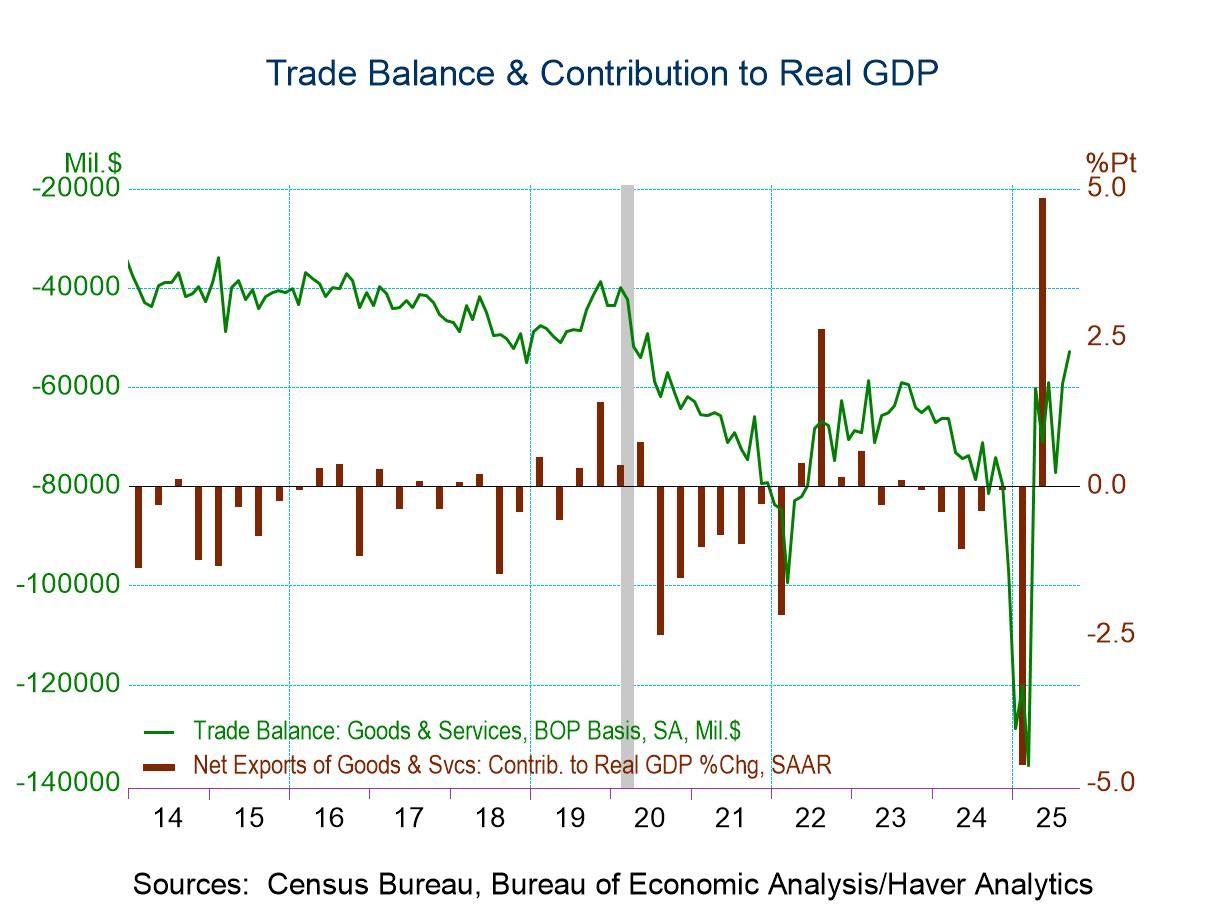
The U.S. trade deficit in goods and services (BOP basis) narrowed to $52.8 billion in September from $59.3 billion in August, revised from $59.6 billion, according to the U.S. Census Bureau. The Action Economics Forecast Survey expected a deficit of $64.6 billion. The goods deficit fell to $79.0 billion in September from $86.1 billion in August, while the services surplus slipped to $26.2 billion from $26.8 billion in August. The real (inflation-adjusted) trade deficit in goods narrowed to $79.0 (2017$) in September from $83.7 billion in August. For all of Q3’25, the real deficit averaged $87.4 billion versus $87.7 billion in Q2, and thus it should be a modest addition to Q3 economic growth after a 4.8 percentage point addition in Q2.
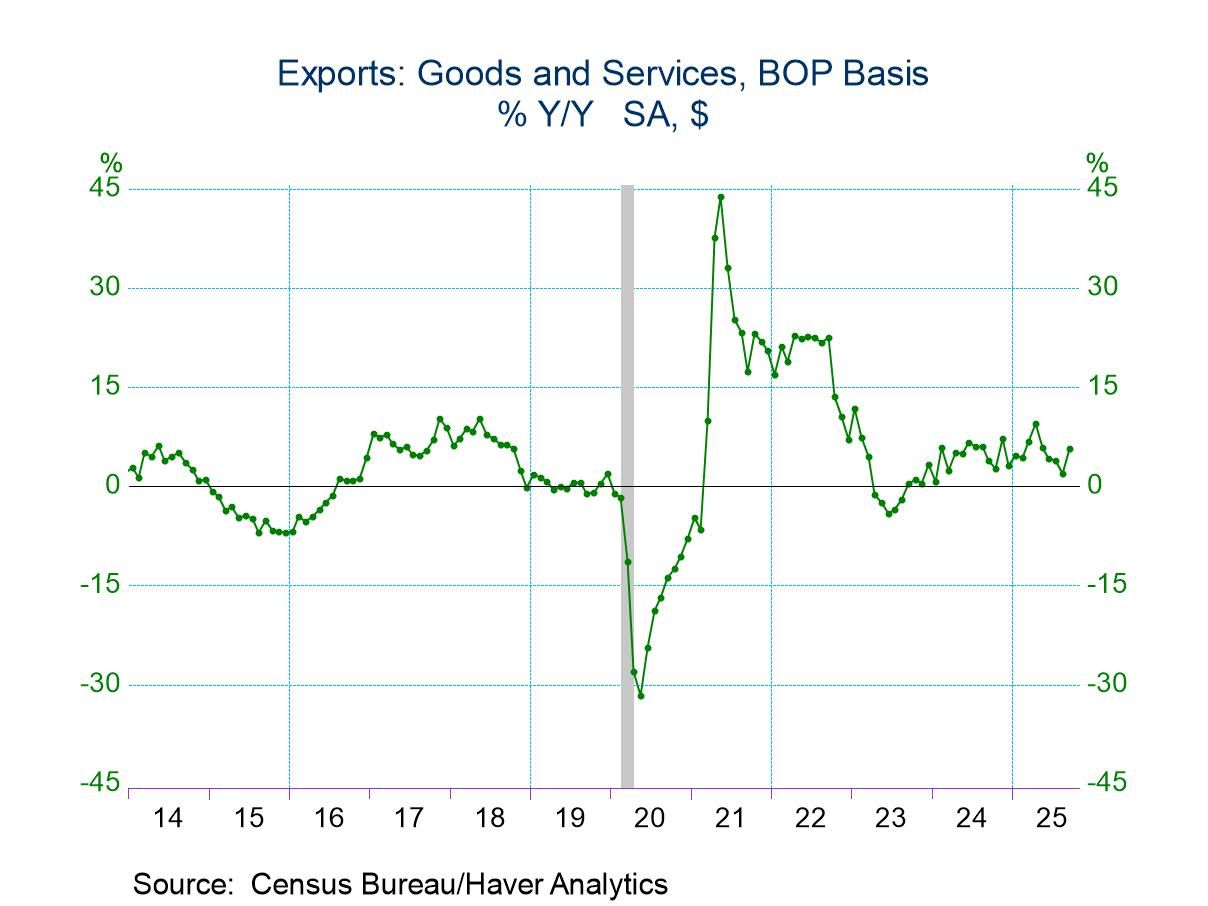
Exports of goods & services rose 3.0% (5.7% y/y) in September following a 0.2% August slip. Goods exports (Census basis) strengthened 4.9% after a 0.8% slip. Nonauto consumer goods exports surged 19.1%. Industrial supplies & materials exports increased 12.1% while foods, feeds & beverage exports rose 3.4%. “Other” goods exports rose 7.6%. To the downside, capital goods exports excluding autos declined 5.3% while auto & parts exports fell 2.2%. Services exports eased 0.4%. Exports of financial services rose 1.4% while exports of maintenance & service repairs rose 0.8%. Exports of government goods and services rose 1.7%.
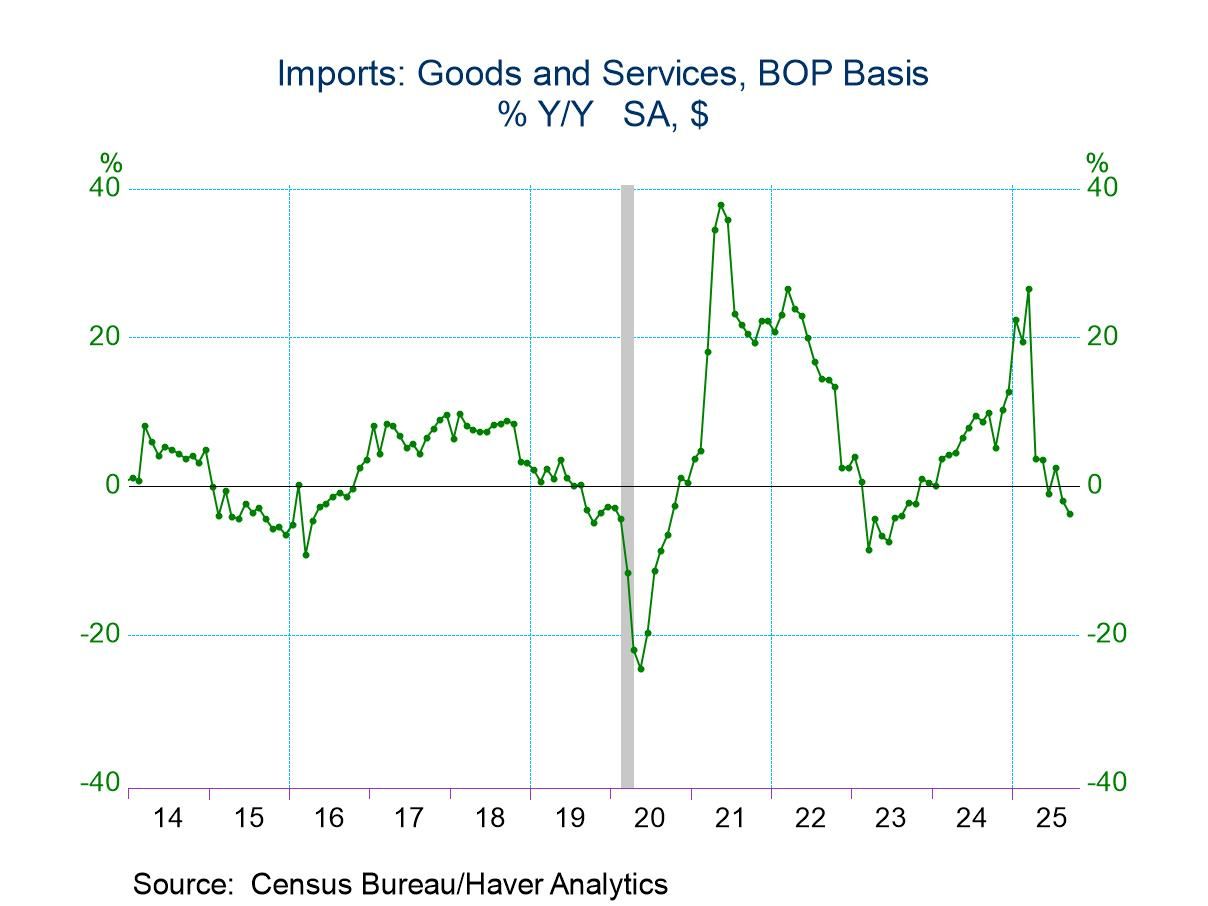
Imports of goods & services in September increased 0.6% (-3.7% y/y) after a 5.2% decline. Goods imports rose 0.7% (-5.9% y/y) in September after a 6.6% August decline. Nonauto consumer goods jumped 18.4% while industrial supplies & materials imports were little-changed. Elsewhere, imports fell. Capital goods excluding auto imports slumped 6.0%, auto imports fell 4.1% and food imports declined 1.6%. Total services imports rose 0.3% in September after a 0.3% decline. Maintenance & repair services increased 3.1%, construction service imports rose 1.1%, transport rose 1.5% but travel weakened 1.2%. Imports of government goods & services held steady.
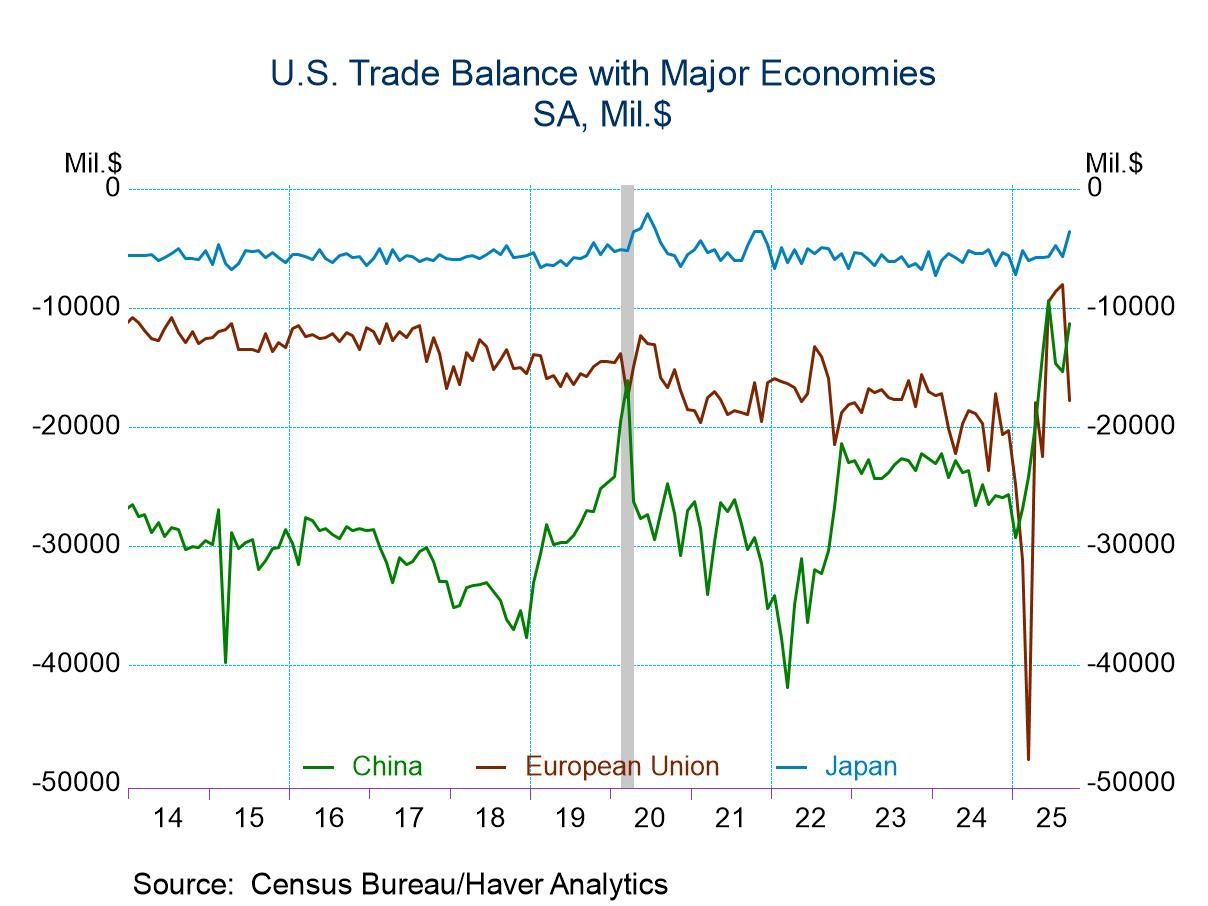
By country, the goods trade deficit with China narrowed to $11.4 billion (SA) in September from $15.4 billion in August. Exports to China rose 1.8% while imports from China weakened 16.1%. The trade deficit with the European Union doubled m/m to $17.8 billion in September. Exports rose 13.2% but imports surged by one-third. The deficit with Japan declined sharply to $3.6 billion in September. Exports increased 7.9% while imports declined 12.7%.
The international trade data can be found in Haver’s USECON database. Detailed figures on international trade are available in the USINT and USTRADE databases. The expectations figures are from the Action Economics Forecast Survey in AS1REPNA.

Tom Moeller
AuthorMore in Author Profile »Prior to joining Haver Analytics in 2000, Mr. Moeller worked as the Economist at Chancellor Capital Management from 1985 to 1999. There, he developed comprehensive economic forecasts and interpreted economic data for equity and fixed income portfolio managers. Also at Chancellor, Mr. Moeller worked as an equity analyst and was responsible for researching and rating companies in the economically sensitive automobile and housing industries for investment in Chancellor’s equity portfolio. Prior to joining Chancellor, Mr. Moeller was an Economist at Citibank from 1979 to 1984. He also analyzed pricing behavior in the metals industry for the Council on Wage and Price Stability in Washington, D.C. In 1999, Mr. Moeller received the award for most accurate forecast from the Forecasters' Club of New York. From 1990 to 1992 he was President of the New York Association for Business Economists. Mr. Moeller earned an M.B.A. in Finance from Fordham University, where he graduated in 1987. He holds a Bachelor of Arts in Economics from George Washington University.
More Economy in Brief
 Global