Consumer Confidence Tumbled in January
Summary
- Both expectations and assessments of the present situation contributed to the decline
- The index moved to a new low for the current cycle.
- A softening labor market played a role.
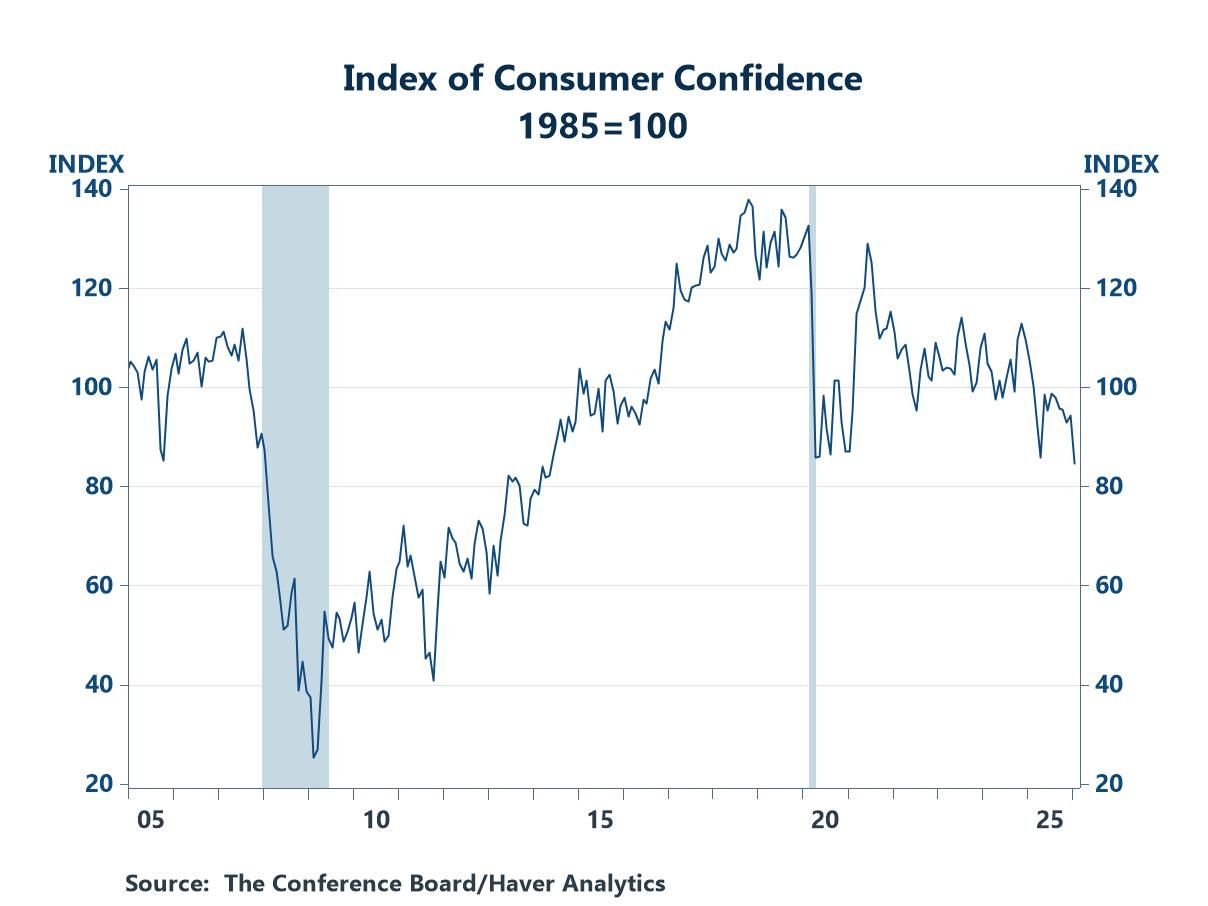
The Conference Board’s index of Consumer Confidence fell 10.3% in January, marking the sharpest decline during the soft patch that began in late 2024. The measure moved to a new low for the current cycle, dipping even below the trough seen during the pandemic. However, confidence was not at a desperate level relative to long-run standards. The index was far lower during the recession associated with the financial crisis, and it also was noticeably lower during the previous four recessions or their aftermaths.
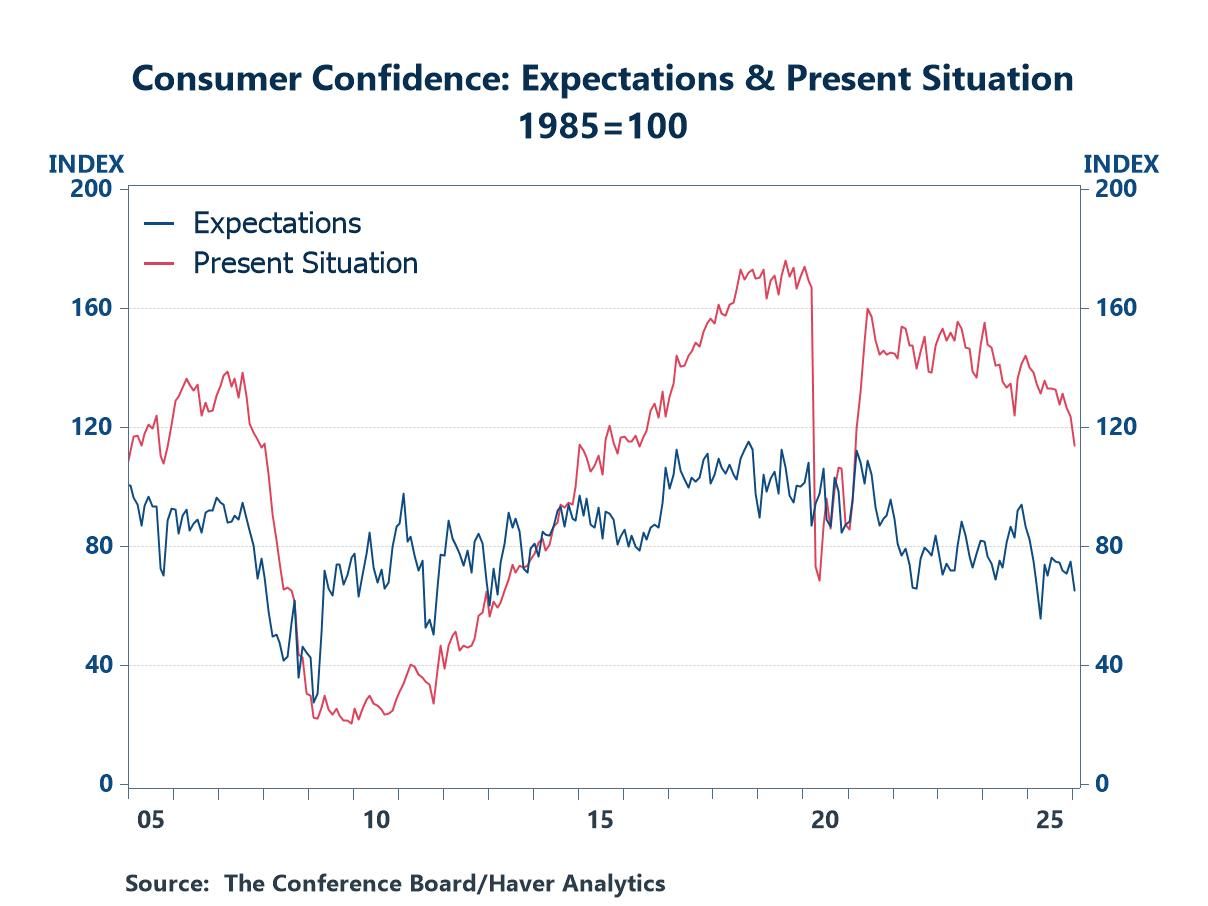
Both the present situation and the expectations components contributed to the decline in January, with expectations posting a sharper change (-12.7% versus -8.0%). Like the headline index, the present situation component moved to a new low for the current cycle. The expectations component saw a softer result in one other recent month -- April 2025, no doubt a response to President Trump’s announcement of hefty tariffs on April 2.
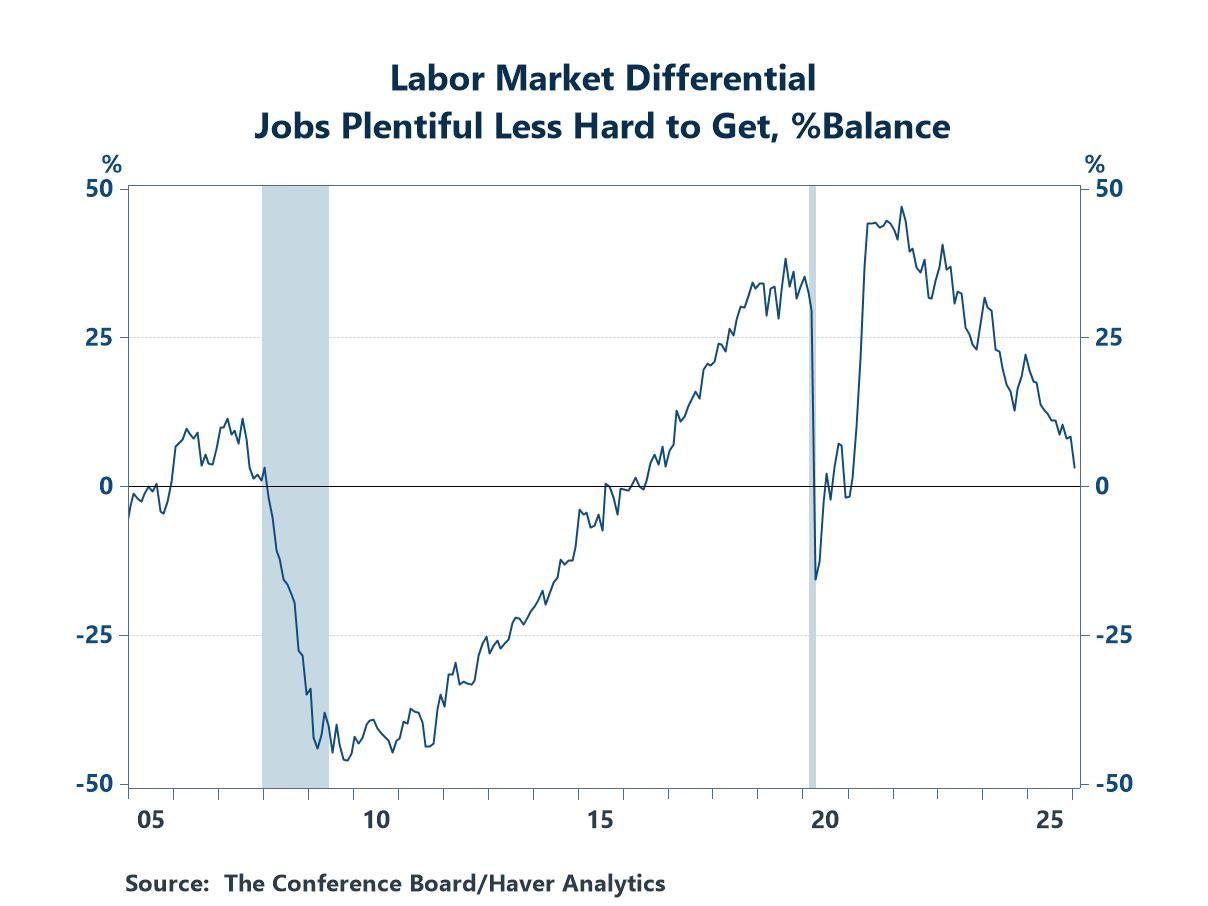
The softening labor market seems to be playing a role in the erosion of confidence in the past year or so. The Conference Board’s survey of consumers asks whether jobs are plentiful or hard to get. The differential in responses (the share saying plentiful less the share saying hard to get) provides clear insight into perceptions of the labor market. After registering a record reading in March 2022 (47.1%), this measure has trended sharply lower, moving to 3.1% in January. While the erosion has been notable, the level of the index is not troubling relative to historical standards. It has been well into negative territory when conditions are weak (-46.1% around the time of the financial crisis and a record low of -58.7% in December 1982).
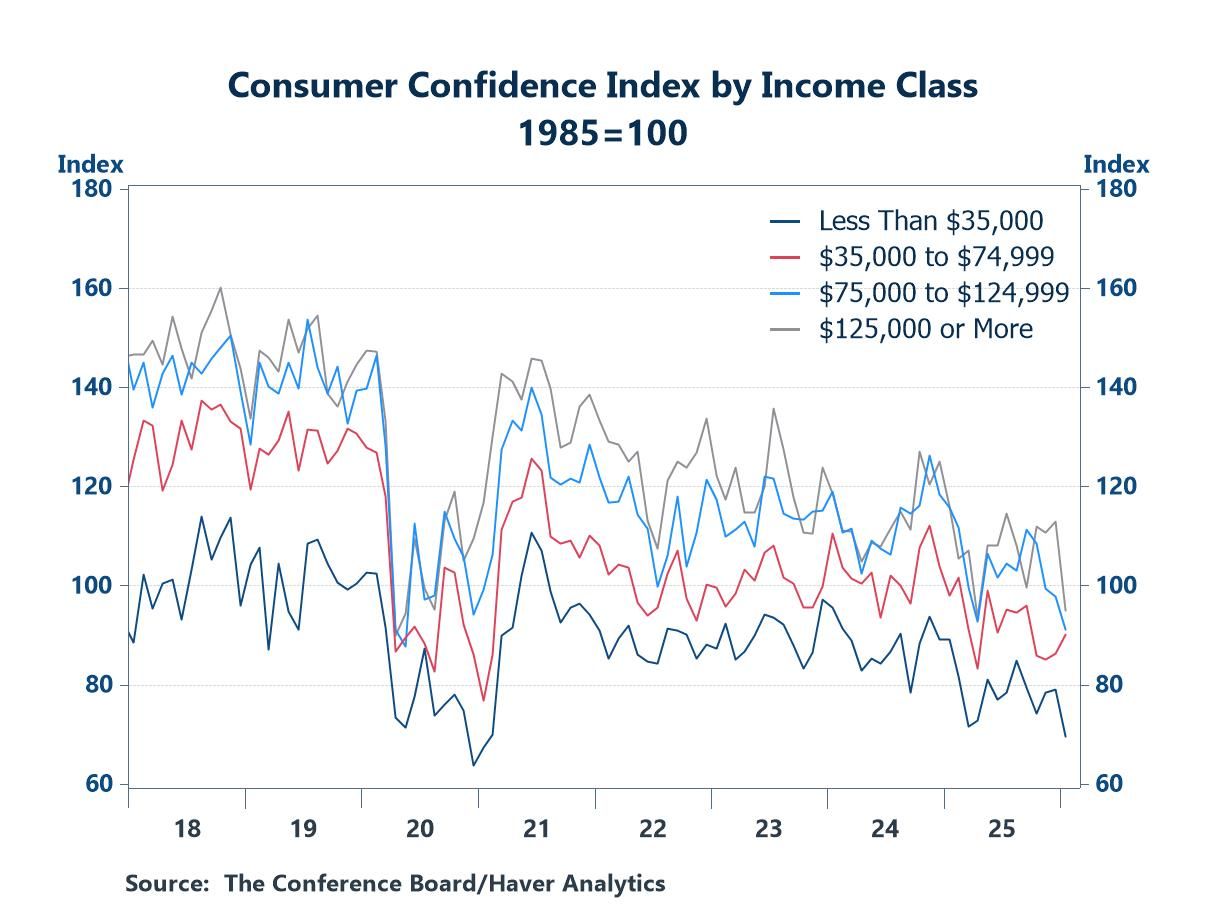
The media has recently characterized the economy as being “K-shaped”: upper-income individuals advancing while lower-income individual are losing ground. One could argue that the confidence survey supports such a view, as the confidence among the two lowest income groups is lower than those for the two upper income groups. However, the differential is not unique to the current cycle. The confidence index among lower-income individuals is nearly always lighter than those for upper income groups, and the current differential is on the lighter side of historical norms.
The Consumer Confidence data are available in Haver’s CBDB database. The total indexes, which are indexed to 1985=100, appear in USECON, and market expectations are in AS1REPNA.

Michael J. Moran
AuthorMore in Author Profile »Before joining Haver Analytics in 2025, Michael J. Moran was the chief economist of Daiwa Capital Markets America Inc. He was responsible for preparing the firm’s economic forecast and interest rate outlook. He traveled frequently to visit the clients of Daiwa Capital Markets and wrote weekly economic commentary. Mr. Moran also was involved in the flux of financial markets, as he spent a portion of each day on Daiwa’s trading floor interpreting economic statistics and Federal Reserve activity for traders and salespeople. Mr. Moran is quoted frequently in the financial press, and he appears regularly on cable news shows. He also has published articles in several journals and periodicals. Before joining Daiwa Capital Markets America, Mr. Moran worked as an economist at the Federal Reserve Board in Washington, D.C. where he analyzed a broad range of issues dealing with the financial sector of the economy and regularly briefed the Board of Governors. He was on the faculty of Pennsylvania State University from 1979 to 1980 and taught on a part-time basis at George Washington University from 1980 to 1987.
Mr. Moran received his Ph.D. in economics from Pennsylvania State University in 1980 and a B.S. in business administration from the University of Bridgeport in 1975. He was a CFA charter holder from 2002 until 2016.
More Economy in Brief
 Global