U.S. JOLTS: Openings Drop to Lowest Level Since Sept. ’20; Hiring Rebounds in December
Summary
- Job openings down 5.6% (-12.9% y/y) to 6.542 mil., third straight m/m decline.
- Hiring up 3.4% (-1.5% y/y) to 5.293 mil., first m/m increase since September.
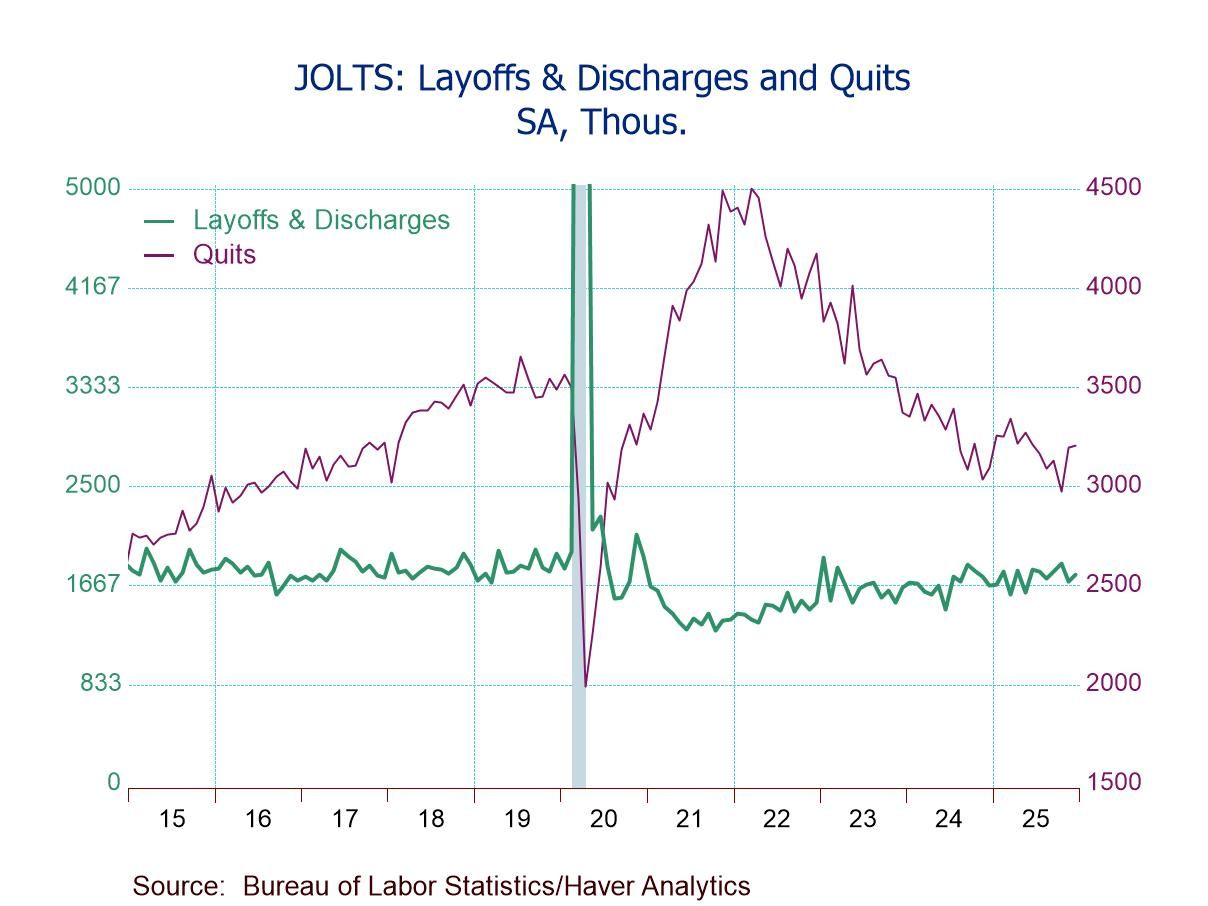
- Separations rise to a three-month high; quits reach a six-month high; layoffs rebound.
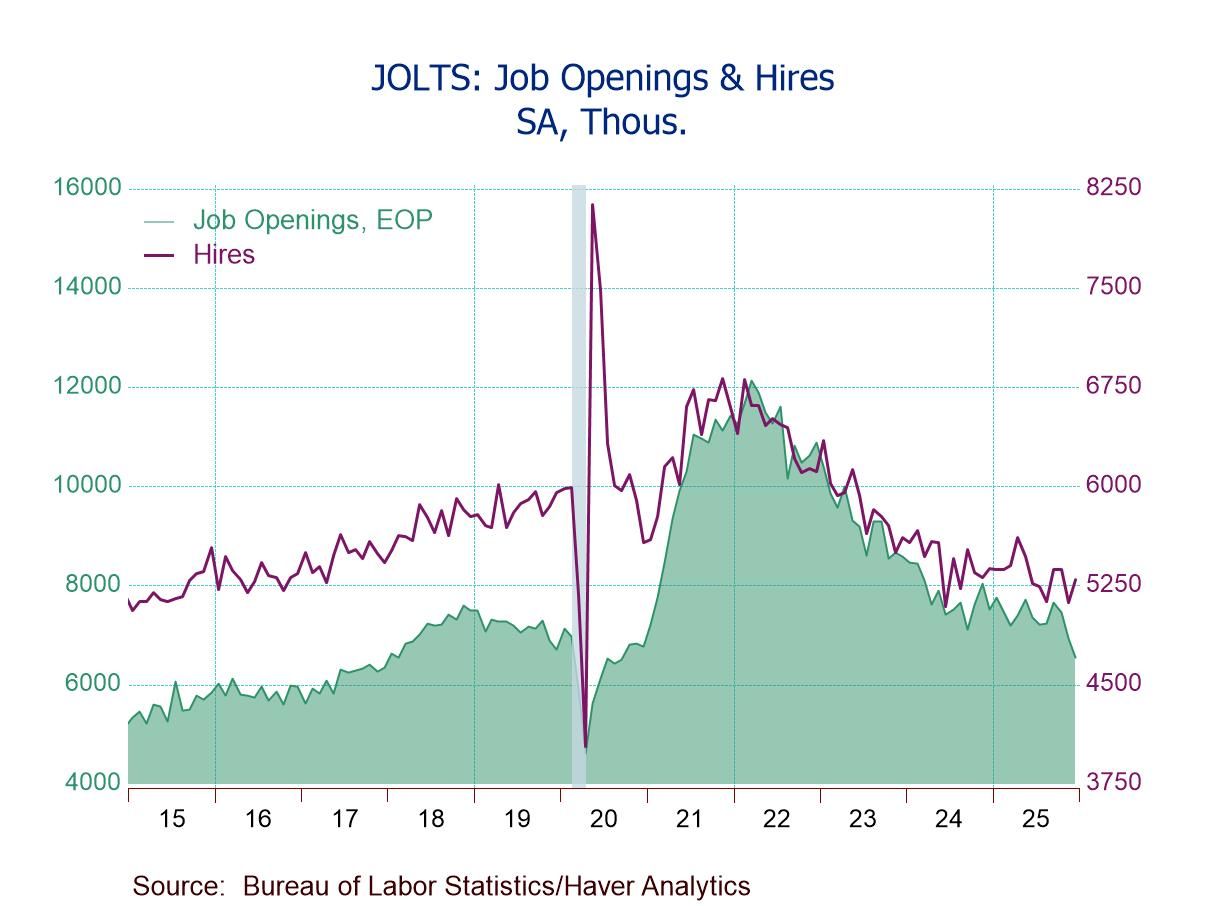
Total job openings fell 5.6% m/m (-12.9% y/y) to 6.542 million in December after a downwardly revised 7.0% decline to 6.928 million in November (previously -4.1% m/m; 7.146 million), according to the Job Openings and Labor Turnover Survey. December marked the third consecutive m/m fall and the lowest level since September 2020. The job openings rate declined to 3.9% in December, the lowest since April 2020, from 4.2% in November, remaining below a record-high 7.4% in March 2022. This rate is calculated as the ratio of job openings to total nonfarm employment plus openings. Significantly, the drop in job openings also lowered the ratio of job openings to unemployed individuals to 0.872 in December—the lowest since March 2021—from 0.890 in November, down from 1.085 in December 2024 and a pre-pandemic 1.211 in February 2020. A reading of 0.872 implies there were about 0.87 open jobs per unemployed person—indicating fewer openings than unemployed workers. December was the fifth time in six months that this ratio remained below 1.0.
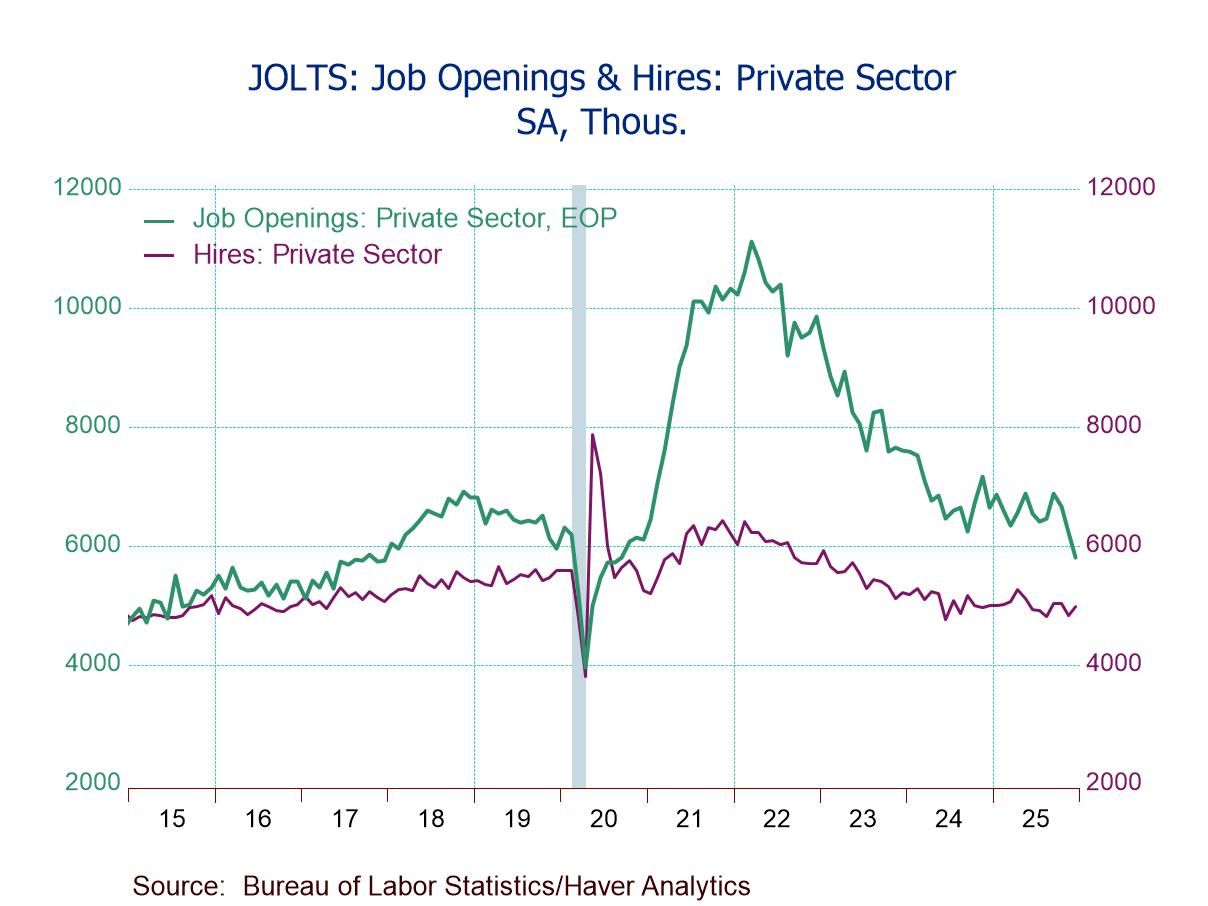
Private sector job openings fell 6.8% (-12.5% y/y) to 5.804 million in December after a 6.6% fall to 6.227 million in November, registering the third successive m/m decline and the lowest level since September 2020. The private sector job openings rate fell to 4.1% in December, the lowest since April 2020, from 4.4% in November. The December m/m decline in private sector openings reflected drops of 27.7% (-36.9% y/y) in financial activities, 20.2% (-25.5% y/y) in professional & business services, 14.4% (-5.1% y/y) in trade, transportation & utilities, and 5.2% (-12.4% y/y) in private educational & health services. To the upside, private sector openings in the following categories rose m/m in December: other services (21.1%; 11.0% y/y), mining & lodging (17.6%; 0.0% y/y), information (13.5%; -4.7% y/y), manufacturing (8.5%; 0.5% y/y), leisure & hospitality (7.5%; -17.2% y/y), and construction (2.8%; 42.4% y/y). Meanwhile, government job openings rose 5.3% (-15.6% y/y) in December, the first m/m rise in three months, after a 10.6% drop in November.
Total hiring rebounded 3.4% (-1.5% y/y) to 5.293 million in December, the first m/m increase since September, following a 4.6% decrease to 5.121 million in November. The hiring rate edged up to 3.3% in December from 3.2% in November, though it remained below pre-pandemic levels. Private sector hiring rose 3.1% (-0.4% y/y) to 4.978 million in December, the third m/m rise in four months, after a 4.0% decline to 4.826 million in November. The private sector hiring rate rose to 3.7% in December from 3.5% in November, the same as in October and September. The December m/m increase in private sector hiring was led by a 32.1% jump (42.3% y/y) in information, followed by gains of 24.0% (-4.6% y/y) in financial activities, 23.5% (0.0% y/y) in mining & lodging, 6.5% (-4.8% y/y) in private educational & health services, 4.2% (-4.9% y/y) in trade, transportation & utilities, 3.6% (6.1% y/y) in construction, 3.4% (7.9% y/y) in leisure & hospitality, and 1.8% (-4.3% y/y) in manufacturing. To the downside, private sector hiring in professional & business services (-5.2%; +0.5% y/y) and other services (-4.3%; -16.5% y/y) declined m/m in December. Meanwhile, government hiring rebounded 6.4% (-16.3% y/y) in December, the first m/m rise since September, following a 13.5% drop in November.
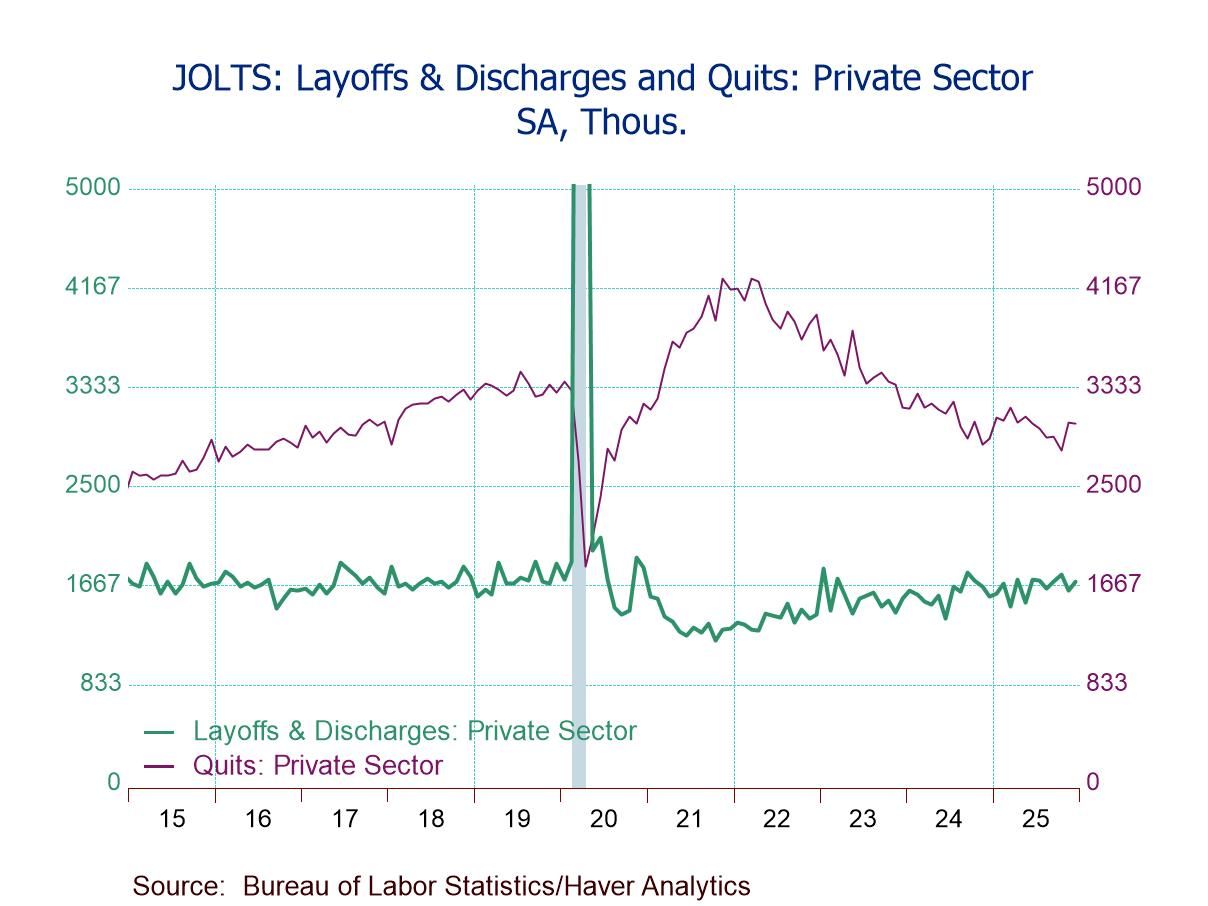
Total separations rose 2.1% (3.3% y/y) to 5.251 million in December after a 1.5% rise to 5.144 million in November, marking the third m/m increase in four months and the highest level since September. The total separations rate edged up to 3.3% after holding at 3.2% in November and October. Private sector separations rose 1.6% (4.2% y/y) to 4.932 million in December, the highest level since June, while government sector separations jumped 10.4% (-9.1% y/y) to 319,000 following two consecutive m/m declines. Total quits (voluntary separations initiated by the employee) increased 0.3% (3.5% y/y) to 3.204 million in December, the third m/m rise in four months and the highest level since June, after a 7.4% rebound in November. The quits rate (a measure of workers’ willingness or ability to leave jobs) held at 2.0% in December and November, slightly below 2.3% in February 2020. Private sector quits eased 0.2% (+4.5% y/y) following an 8.4% November rebound. Layoffs and discharges (involuntary separations initiated by the employer) increased 3.6% (5.6% y/y) to 1.762 million in December, up for the third time in four months, after an 8.1% drop in November. The layoffs & discharges rate remained at 1.1% in December and November, marginally below 1.3% in February 2020. Private sector layoffs grew 4.3% (7.8% y/y) following a 7.3% November decrease.
The Job Openings and Labor Turnover Survey (JOLTS) data are available in Haver’s USECON database.

Winnie Tapasanun
AuthorMore in Author Profile »Winnie Tapasanun has been working for Haver Analytics since 2013. She has 20+ years of working in the financial services industry. As Vice President and Economic Analyst at Globicus International, Inc., a New York-based company specializing in macroeconomics and financial markets, Winnie oversaw the company’s business operations, managed financial and economic data, and wrote daily reports on macroeconomics and financial markets. Prior to working at Globicus, she was Investment Promotion Officer at the New York Office of the Thailand Board of Investment (BOI) where she wrote monthly reports on the U.S. economic outlook, wrote reports on the outlook of key U.S. industries, and assisted investors on doing business and investment in Thailand. Prior to joining the BOI, she was Adjunct Professor teaching International Political Economy/International Relations at the City College of New York. Prior to her teaching experience at the CCNY, Winnie successfully completed internships at the United Nations. Winnie holds an MA Degree from Long Island University, New York. She also did graduate studies at Columbia University in the City of New York and doctoral requirements at the Graduate Center of the City University of New York. Her areas of specialization are international political economy, macroeconomics, financial markets, political economy, international relations, and business development/business strategy. Her regional specialization includes, but not limited to, Southeast Asia and East Asia. Winnie is bilingual in English and Thai with competency in French. She loves to travel (~30 countries) to better understand each country’s unique economy, fascinating culture and people as well as the global economy as a whole.
More Economy in Brief
 Global